I’ve spent the last 4 years building conversion tools at WiserNotify. And if there’s one thing I’ve learned, it’s this: the CTA is where money is made or lost.
You can have the best product, the most persuasive copy, and gorgeous visuals. But if your call to action doesn’t make people click, none of it matters.
The problem? Most CTA designs are either invisible (bland button, wrong color, buried at the bottom) or so aggressive they push people away (“BUY NOW!!!” in flashing red).
I’ve collected 21 CTA design examples from real websites that get it right. For each one, I’m breaking down why it works and what you can steal for your own site.
Why CTA Design Makes or Breaks Your Conversion Rate
Here’s a number that should get your attention: personalized CTAs convert 202% better than generic ones, according to HubSpot research.
Your CTA button is the bridge between browsing and buying. Everything else on the page (headlines, images, copy, testimonials) exists to get someone to that button.
A well-designed CTA does three things at once. It tells visitors exactly what to do next. It makes the action feel easy and low-risk. And it stands out visually, so nobody misses it.
A poorly designed CTA does the opposite. It blends into the page. It uses vague language (“Submit” or “Click Here”). And it creates friction instead of removing it.
The good news? CTA design isn’t complicated. There are clear patterns that work across industries. And once you see them, you can apply them to your own site in an afternoon.
21 Call to Action Design Examples (With Breakdowns)
1. Action-Oriented Text (Listings Lab)

Why it works: The headline “will show you how you can double your revenue” does the heavy lifting before you even reach the button. The CTA itself is secondary. The surrounding copy creates such a strong value proposition that clicking feels like the obvious choice.
The design lesson: Your CTA button doesn’t work on its own. The headline, supporting text, and visual hierarchy around it matter just as much.
A “Download Now” button is boring on its own. But pair it with “Double your revenue without sacrificing your lifestyle” and suddenly the click feels irresistible.
Build urgency
Add floating offers with countdown timer & coupon code.
2. Urgency That Drives Action (Fastrack)

Why it works: Fastrack uses a time-limited offer (win a free watch) to create immediate urgency. The form is dead simple. The “Submit” button text is generic, but it doesn’t matter because the headline carries all the persuasion.
The design lesson: Urgency is one of the most powerful CTA boosters. But it has to feel real. “Limited time” without a deadline is meaningless.
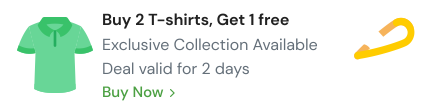
Fastrack gives a specific prize and a clear action, which makes the urgency believable. You can create similar urgency with countdown timers, stock alerts, or live activity notifications through tools like WiserNotify’s urgency widgets.
3. Color Psychology in Action (Joy)

Why it works: Joy sells razors to women, and the entire color scheme speaks to their audience. The CTA button color contrasts sharply with the background, making it impossible to miss. The “Add to Cart” text is simple and direct.
The design lesson: Color contrast is the single biggest factor in CTA visibility. Your button needs to pop against its background.
Test this: squint at your page. Can you still see the CTA? If not, increase the contrast. Studies show CTAs with high contrast against backgrounds can increase conversions by up to 20%.
4. Size for Impact (HubSpot)

Why it works: HubSpot uses an oversized CTA button for its free resource downloads. The button is large enough to dominate the section. You can’t scroll past it without noticing.
The design lesson: Bigger buttons get more clicks (up to a point). The sweet spot is large enough to be noticed instantly, but not so large that it feels aggressive. For desktop, aim for a height of at least 44px. For mobile, Apple recommends a minimum tap target size of 44x44px. HubSpot goes bigger than the minimum, and it works because the surrounding copy justifies the size.
5. Hover Effects That Engage (Slider Revolution)

Why it works: Slider Revolution’s CTA button has a heartbeat-like animation on hover. It pulses, drawing your eye and creating a feeling of life on the page. The interaction feels playful, not aggressive.
The design lesson: Subtle animation creates micro-interactions that increase engagement. A color shift on hover, a slight scale increase, or a gentle pulse all signal “this is clickable.”
But keep it subtle. Aggressive animations (spinning, flashing, bouncing) feel spammy and decrease trust. The best hover effects feel like a gentle invitation, not a shouting salesperson.
6. Bold Contrast (HelloFresh)

Why it works: HelloFresh pairs a bright green CTA button with an offer of “10 Free Meals.” The green pops against the white and image-heavy background. The headline creates value, and the CTA captures it.
The design lesson: The best CTA color isn’t red, green, or orange. It’s whatever color contrasts most with your page background.
HelloFresh uses green because their brand is green, and it pops against white. If your brand is green, a green button on a green page won’t work. Pick the color that stands out most in context.
Also check: Top 10 Call to Action Button Colors Users Love to Click
7. Icons for Clarity (Pinterest)
![]()
Why it works: Pinterest’s sign-up page offers two paths: Facebook or email. The Facebook icon on the button instantly communicates its function before you read the text. Visual recognition is faster than reading.
The design lesson: Icons reduce cognitive load. A shopping cart icon on an “Add to Cart” button, a download arrow on a “Download” button, or a social media logo on a login button all make the action clearer in a split second.
Use icons when the action involves a recognizable symbol. Skip them when the text alone is clear enough.
Build trust & FOMO
Highlight real-time activities like reviews, sales & sign-ups.
8. Scarcity That Converts (Flipkart)

Why it works: Flipkart creates urgency with a specific date range (“1st to 7th April”) and bold visuals. The limited-time offer feels real because it has boundaries.
The design lesson: Scarcity and urgency are different tools. Scarcity says, “Only 3 left.” Urgency says “offer ends tonight.”
Both work, but they work best when specific. “Limited time offer” is weak. “Ends Friday at midnight” is strong. You can add real-time scarcity signals to your website with live purchase notifications and stock alerts.
9. Personalized CTAs (Handy)

Why it works: Handy speaks directly to its target audience with copy that addresses users’ specific situations. The calming color palette builds trust. The CTA feels like a natural next step, not a hard sell.
The design lesson: Personalization dramatically increases conversions. HubSpot found that personalized CTAs perform 202% better than default versions.
Even simple personalization (changing CTA text based on whether someone is a new vs returning visitor) can make a significant difference. Personalized marketing extends to every touchpoint, including your CTAs.
10. Strategic Placement (HubSpot)

Why it works: HubSpot places CTAs between content sections, at the end of posts, and in popups. The CTA appears wherever the reader’s engagement peaks, catching them at the moment they’re most likely to act.
The design lesson: CTA placement matters as much as CTA design. The best positions: above the fold (for clear-intent visitors), after a compelling section (when value is fresh), at the end of content (for committed readers), and as a sticky element on scroll (for ongoing visibility).
Test multiple placements. What works for a blog post won’t necessarily work for a landing page.
11. First-Person Language (Neil Patel)

Why it works: Neil Patel’s CTA uses the phrases “Yes, I want…” and “My website URL”. This puts the visitor in the driver’s seat. They’re not being told what to do. They’re telling the site what they want.
The design lesson: First-person CTAs (“Start my free trial”) outperform second-person CTAs (“Start your free trial”) by up to 90% in some tests.
The shift is tiny but powerful. “Get my report” feels like ownership. “Get your report” feels like an instruction. Try switching just the pronoun on your highest-traffic CTA and measure the difference.
12. Minimal Design (Backlinko)

Why it works: Backlinko’s newsletter CTA is clean, simple, and backed by social proof (subscriber count). No clutter, no distracting visuals, just a clear value proposition and a single action.
The design lesson: Sometimes less is more. If your CTA is surrounded by competing elements (navigation links, sidebars, multiple offers), visitors experience decision fatigue.
Research shows CTAs surrounded by more white space can increase conversions by up to 232%. Strip away everything that doesn’t serve the click.
13. Shadow and Border Emphasis (Buffer)

Why it works: Buffer uses a bordered CTA button that adds depth without being flashy. The border creates a clear boundary between the button and surrounding elements, making it feel clickable.
The design lesson: Borders and subtle shadows communicate “this is a button” to the user’s brain. Flat designs sometimes make buttons look like decorative elements.
A 1-2px border or a soft drop shadow adds just enough depth to signal interactivity. This is especially important on mobile, where users need clear tap targets.
14. Shape Experimentation (Mangools)

Why it works: Mangools uses fully rounded (pill-shaped) CTA buttons. The rounded edges feel friendly and modern. They soften the “click here” energy, making the action feel less transactional.
The design lesson: Button shape communicates personality. Sharp corners feel corporate and decisive. Rounded corners feel friendly and approachable.
Fully rounded (pill) shapes feel modern and casual. Match your button shape to your brand personality.
SaaS tools tend toward rounded. Financial services tend toward sharper edges. There’s no wrong answer, just alignment with your brand.
15. Mobile-First Design (Ixigo)

Why it works: Ixigo’s mobile app CTA is responsive, properly sized for thumb tapping, and uses enough white space around it to prevent accidental taps on nearby elements.
The design lesson: Over 60% of web traffic is mobile. If your CTA isn’t optimized for mobile, you’re losing more than half your potential conversions.
Key mobile CTA rules: minimum 44x44px tap target, enough padding around the button, text large enough to read on small screens, and placement within thumb reach (bottom half of the screen).
For more, check our guide on mobile call-to-action best practices.
16. Value Proposition Alignment (Evernote)

Why it works: Evernote’s CTA is a direct extension of its value proposition. The button text connects to the benefit promised by the headline. There’s no disconnect between what’s offered and what the button says.
The design lesson: Your CTA should finish the sentence your headline starts. If your headline says “Organize your life,” your CTA should say “Get organized free” or “Start organizing,” not “Sign up” or “Learn more.” Aligned CTAs feel like natural next steps. Misaligned CTAs feel like interruptions.
17. Negative Space Mastery (Dropbox)

Why it works: Dropbox uses generous white space around its CTA. The button breathes. There’s nothing competing for attention in the immediate area. Your eye goes straight to the action.
The design lesson: White space is not wasted space. It’s a design tool that directs attention. The more space around your CTA, the more it stands out.
Think of it like a painting in a gallery. A single painting on a large white wall gets all the attention. The same painting crammed between 20 others gets none.
18. Benefit-First Copy (Shopify)

Why it works: Shopify leads with the benefit (what you get) before the action (what you do). The CTA doesn’t ask for anything. It offers something. That mental flip changes how the button feels.
The design lesson: Every CTA is a value exchange. You’re asking for a click, an email, or money. In return, you need to give something worth more than the effort you put in.
Make that exchange obvious. “Start free trial” is good. “Start selling online today” is better because it focuses on the outcome rather than the tool.
19. Secondary CTAs (Trello)

Why it works: Trello offers a primary CTA (“Sign up, it’s free!”) alongside a secondary option (“Watch a video”). The primary is bold and prominent. The secondary is clearly less visually important, but it gives hesitant visitors an alternative path.
The design lesson: Not every visitor is ready to commit to your primary action. A secondary CTA gives fence-sitters a reason to stay engaged.
The key is to make the visual hierarchy crystal clear. Primary CTA = filled button with strong color. Secondary CTA = ghost button (outline only) or text link. Never let the secondary CTA compete visually with the primary.
20. A/B Testing Different Copy (Crazy Egg)

Why it works: Crazy Egg tests different CTA text variations to identify which convert best. Their approach is data-driven, not based on assumptions.
The design lesson: You can guess which CTA works best, or you can test it. A/B testing is the only reliable way to improve CTA performance.
Test one element at a time: button text, color, size, placement. Even small wording changes can shift conversion rates by 10-30%.
“Get started,” “Start my free trial,” and “See it in action” will perform very differently depending on your audience.
21. Careful Animation (Mailchimp)

Why it works: Mailchimp uses subtle animation to draw attention to its CTA without overwhelming the visitor. The animation serves the function (drawing the eye) without becoming the focus (distracting from the message).
The design lesson: Animation in CTAs is a tool, not a trend. Use it to guide attention, provide feedback (button press animation), or create delight.
But keep it fast (under 300ms for transitions), subtle (no full-screen animations), and purposeful (every animation should serve conversion, not decoration).
CTA Design Principles That Actually Work
After analyzing hundreds of CTAs across different industries, here are the principles that consistently drive higher conversions:
Contrast is king. Your CTA color should be the most contrasting element on the page. Not your brand color (unless it contrasts well), but the color that pops the hardest against your background. Test with a squint. If the button disappears, increase contrast.
Specific beats generic. “Start my 14-day free trial” beats “Sign up.” “Get 10 free meals” beats “Learn more.” “See my personalized plan” beats “Get started.” The more specific your CTA text, the clearer the value exchange.
One primary CTA per section. Multiple competing CTAs create decision paralysis. Each section of your page should drive toward one clear action. Secondary CTAs are fine, but they must be visually subordinate.
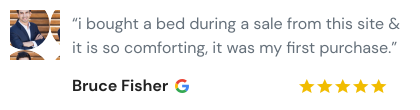
Social proof amplifies CTAs. Adding proof near your CTA (“Join 50,000+ subscribers” or “4.8 stars from 2,000+ reviews”) reduces hesitation at the moment of decision. Tools like WiserNotify add real-time social proof notifications that work alongside your CTAs.
Mobile isn’t an afterthought. Test every CTA on a real phone. Check tap target size, thumb reachability, and loading speed. A desktop-perfect CTA that’s too small to tap on mobile costs you more than half your potential conversions.
Test everything, trust nothing. What works for HubSpot won’t necessarily work for your SaaS tool. What converts for fashion ecommerce might flop for B2B. A/B test button text, color, size, placement, and surrounding copy. Small changes compound over time.
Also check: 9 Best Call to Action Tools to Raise Conversions
Common CTA Design Mistakes (And Fixes)
“Submit” as button text. The most wasted CTA word on the internet. “Submit” tells visitors nothing about what happens next. Replace it with action-specific text: “Get my free guide,” “Create my account,” “Send my message.” Every CTA should answer the question: “What do I get when I click this?”
Too many CTAs competing. When everything on the page is screaming for attention, nothing gets it. I’ve seen landing pages with 5+ different CTAs above the fold. One primary CTA per section. One goal per page.
Button blends into the background. If your button color is similar to your page background or navigation, it’s invisible. The fix is simple: pick the highest-contrast color available. Orange button on a blue background. White button on a dark background. Whatever pops hardest.
No CTA above the fold. If visitors have to scroll to find your first CTA, you’ve already lost the most motivated ones. Place your primary CTA on the first screen, then repeat it at logical points throughout the page.
Ignoring the copy around the CTA. A button doesn’t convert in isolation. The headline, subhead, and body copy directly above the CTA prime the visitor for the click. Weak surrounding copy = weak CTA performance, regardless of button design.
Forgetting mobile users. Buttons too small to tap, text too small to read, CTAs buried below heavy images that load slowly on mobile connections. Test on real devices, not just a browser resize.
How Social Proof Makes Your CTAs More Powerful
Every high-converting CTA I’ve studied has one thing in common: it doesn’t rely solely on the button. The best CTAs are surrounded by trust signals that reduce the risk of clicking.
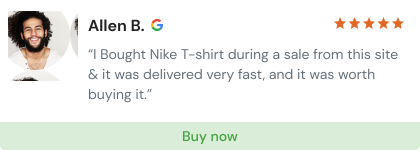
Star ratings near a “Buy Now” button tell shoppers the product is good. Subscriber counts near a “Join” button prove the community is active.
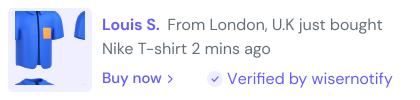
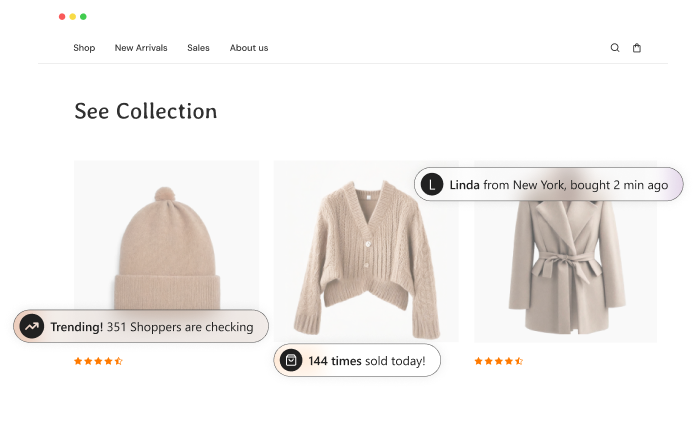
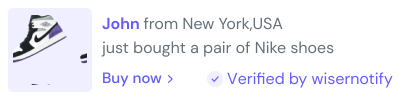
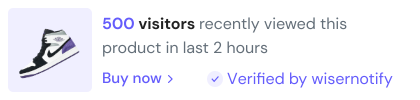
Live purchase notifications near an “Add to Cart” button create urgency that the button text alone can’t.
This is exactly what WiserNotify is built for. Real-time purchase notifications, live visitor counts, review popups, and social proof marketing signals that sit alongside your CTAs and boost their effectiveness without changing a single pixel of your button design.
The combination of a well-designed CTA plus surrounding social proof is what separates pages that convert at 2% from pages that convert at 5%+.
Getting Started
Your CTA design doesn’t need to be perfect on day one. But it does need to be intentional.
Start with the basics: a high-contrast button, specific action text, and one clear CTA per section.
Then layer in the advanced techniques: first-person language, strategic placement, hover effects, and social proof nearby.
Test one change at a time. Measure the results. Keep what works. That’s how you go from a generic “Sign Up” button to a CTA that actually converts.
And if you want to boost your CTA conversions without redesigning anything, adding social proof to your landing pages is the fastest win. WiserNotify sets it up in minutes.