
How to Create a Sense of Urgency in Sales (8 Ways)
Most deals do not die because the buyer said no. They die because the buyer said “let me think about it” and then nothing happened for six weeks.
So reps reach for a deadline. A discount that expires Friday. A price rise that is not coming.
Buyers see it. They have seen it hundreds of times, and the moment they spot a fake deadline, the trust you built in discovery is gone.
Real urgency works differently. You do not add it to a deal. You find what is already there and make it visible.
Below is how that works, the questions that surface it, eight ways to build it honestly, and what to do when a deal has none at all.
What Is a Sense of Urgency in Sales?
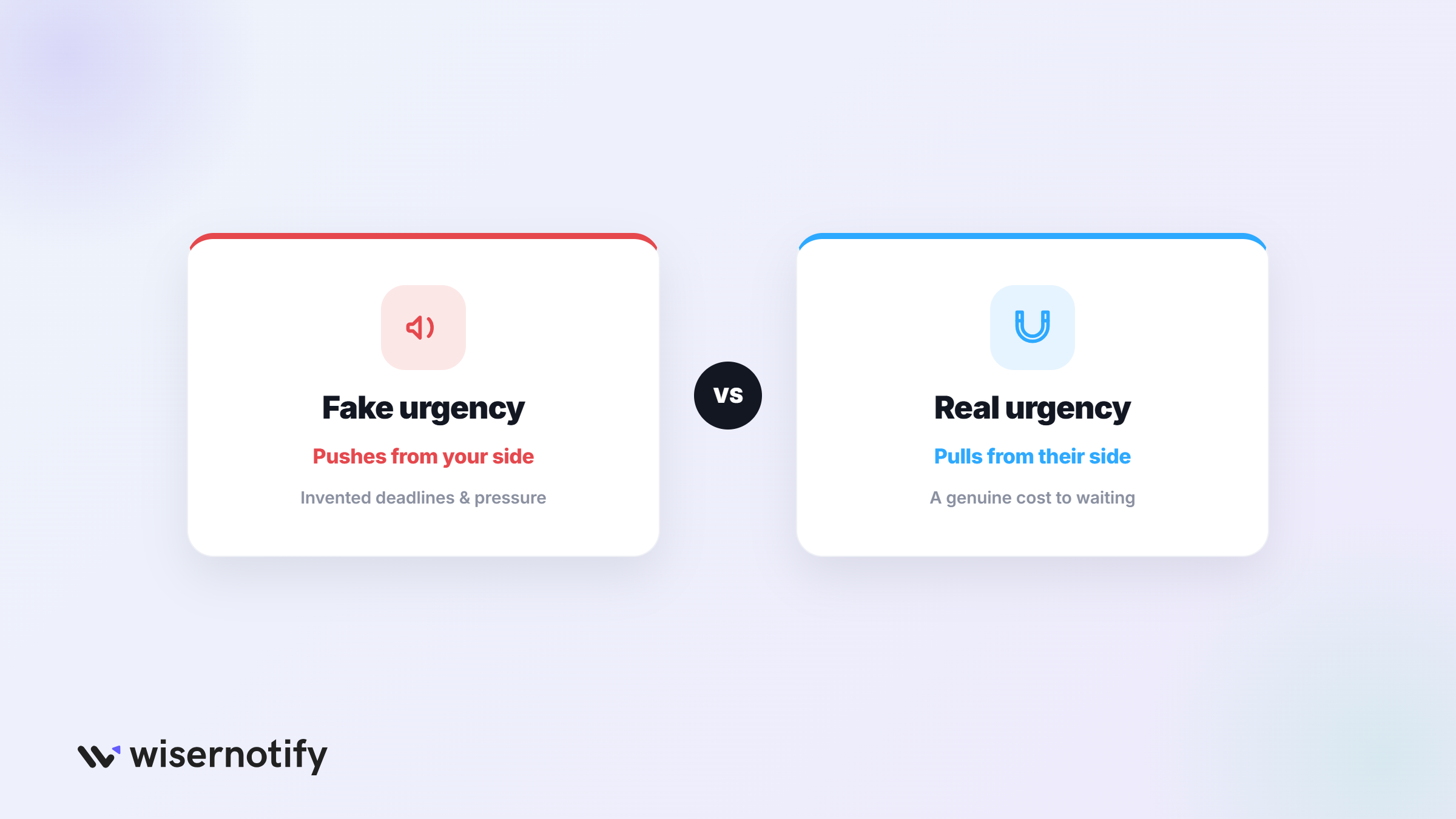
A sense of urgency in sales is the buyer’s own answer to one question: what does waiting cost me?
If the answer is nothing, no deadline you invent will change that. If the answer is real, your job is only to make it clear enough that they can see it too.
Fake urgency pushes from your side of the table. Real urgency pulls from theirs. That is the whole difference.
So urgency is not a stage of your process. It is a fact about their situation, and your job is to find out whether it is there.
Why Fake Urgency Backfires
Fake deadlines fail in three ways, and all three cost more than the deal.
- Buyers recognise the pattern. Anyone who has bought software before has seen the end-of-quarter discount. Using it tells them your price was never firm and your timeline was never real.
- It trains bad behaviour. A buyer who gets 20% off for signing in March will wait for March next year. You have taught them that patience pays.
- It shifts the frame to you. Once urgency is about your quota, the buyer stops asking whether they need the product and starts asking whether you are being straight with them.
The same logic applies online. Shoppers now read permanent “24 hours left” banners as decoration, which is why the honest version of scarcity outperforms the invented one.
Questions That Find Real Urgency
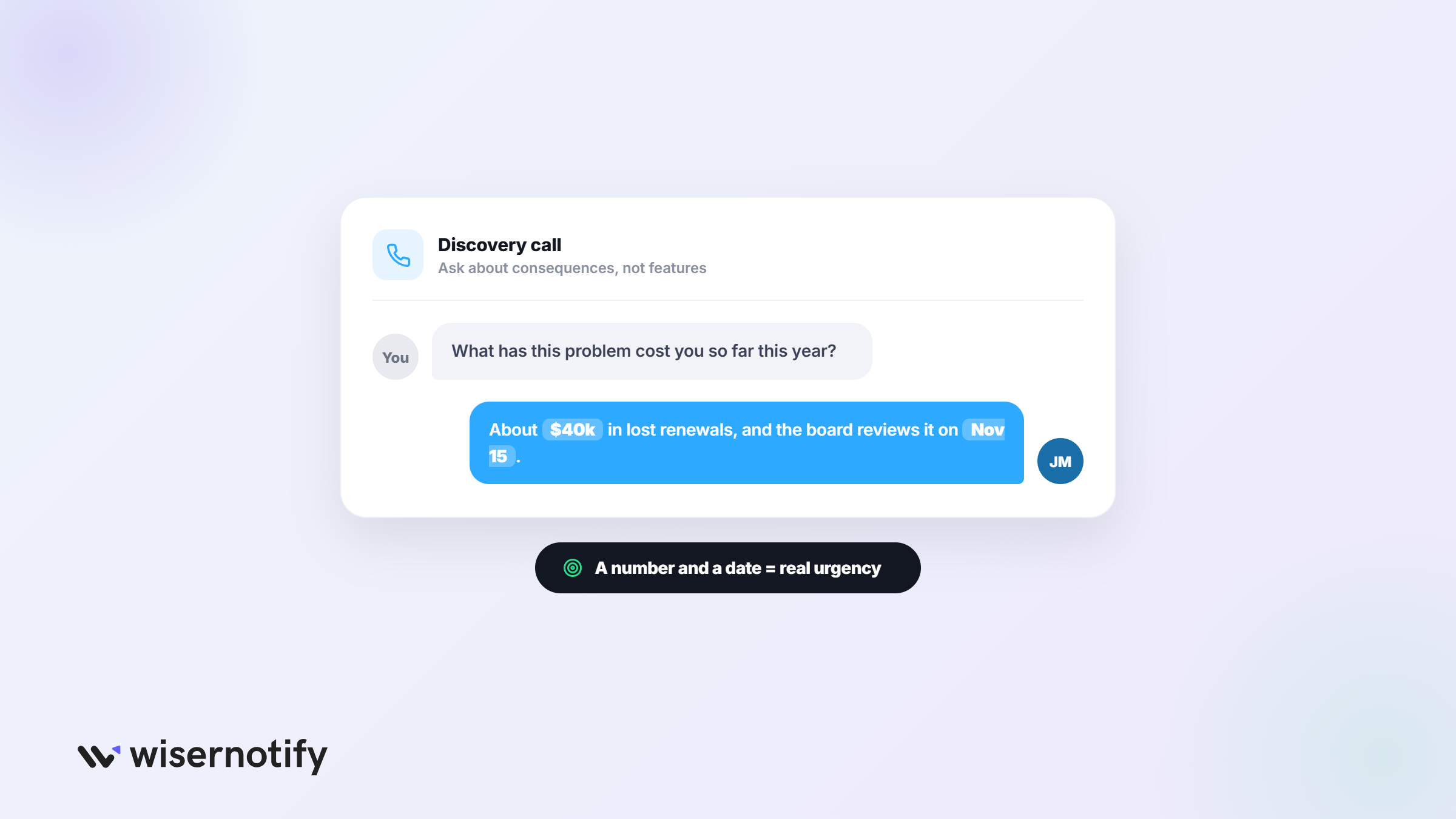
You cannot create urgency in a pitch. You find it in discovery, by asking about consequences instead of features.
These are the questions that do the work.
Ask what doing nothing costs
- What happens if this is still the situation in six months?
- What has this problem cost you so far this year?
- Who feels it most when it goes wrong?
Ask what changed recently
- Why is this on your list now and not last year?
- What made you take the meeting this week?
- Has something shifted internally that put a clock on this?
Ask about their deadlines
- Is there a date this needs to be working by, and what happens on that date?
- What else is competing for this budget?
- Who else has to agree, and when do they next meet?
Listen for the answer that has a number or a date attached to it. That is your urgency, and everything you do after this is just repeating it back to them clearly.
Build trust & FOMO
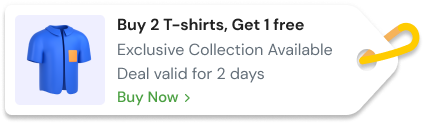
Highlight real-time activities like reviews, sales & sign-ups.

8 Ways to Create Urgency Without Being Pushy
These work because each one is grounded in something true. Use the ones your situation supports and skip the rest.
1. Use honest scarcity

Scarcity works when it is real and specific.
- Twelve seats left in the March cohort
- Three units of that configuration in the warehouse
- Two onboarding slots left this month
The number has to be checkable and it has to move. A counter that says the same thing every week is not scarcity, it is wallpaper.
If you sell a service, your scarcity is capacity. That is finite in a way buyers respect.
2. Use countdown timers for real deadlines

A countdown timer earns its place when it marks a real event.
- Enrolment closing on a stated date
- A price change you have already announced
- A sale with an actual end
It fails when it resets on refresh, which every experienced buyer tests for. If you are putting one on a page, the timer needs to hold the same deadline across visits rather than restarting for each visitor. Cheap scripts get this wrong, and it is one of the things we built WiserNotify to handle.

Used properly, the timer is not applying pressure. It answers a question the buyer already has, which is how long they get to decide. Clarity speeds people up.
Worth browsing countdown timer examples to see which ones read as helpful and which read as desperate.
Build urgency
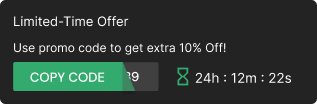
Add floating offers with countdown timer & coupon code.
3. Book the next step before you hang up

Deals stall in the gaps between conversations. The fix costs nothing.
End every call with the next step booked. Not “I will follow up next week” but a calendar invite with a date, a purpose and the people who need to be in it.
A deal with a scheduled next step and a named owner moves. A deal that ends with “let me know” does not.
4. Make the decision easier, not faster
Most stalls are not about price. They are about a buyer who is not sure they can defend the decision internally.
So arm them.
- A one-page comparison against the two alternatives they are weighing
- A rough cost model built with their own numbers
- A short summary they can forward to whoever signs
When a buyer says they need sign-off from their boss, the weak move is asking them to chase it. The better one is asking when that person next reviews budget, then building the one-pager for that meeting.
You are not pushing them to decide faster. You are removing the work that was making them slow.
5. Show them what waiting costs
This is the strongest one here and the one reps skip most.
Waiting is never free. It has a price the buyer has usually never worked out.
- Three more months of manual reconciliation
- Another quarter at the churn rate they told you about
- The hire they cannot make until the process is fixed
Do the arithmetic with them, out loud, using their figures. Not yours.
So when a buyer wants to revisit next quarter, you do not argue. You say that works, then add that on their own numbers another quarter is about 120 hours of manual work, and let them decide what to do with that.
When the cost of waiting is bigger than the cost of buying, urgency stops being something you argue for. It is just what the numbers say.
6. Be honest about your onboarding capacity
Onboarding capacity is a real constraint and buyers know it.
If your implementation team can take four new accounts in April and three are spoken for, saying so is not a tactic. It is scheduling.
The version that works: sign this month and you go live before your busy season. Sign in June and you are implementing during it. That trade-off is concrete and it is theirs to weigh.
7. Reward early movers
A deadline threatens loss. Priority access offers gain, and it lands better with buyers who bristle at pressure. Most FOMO marketing leans on the first of those, which is why it wears out so fast.
Early customers get things later ones do not.
- Hands-on migration support
- A direct line to the product team
- Input on what gets built next
Nothing is taken away from anyone who waits. Something extra goes to whoever moves.
It also survives scrutiny, because you can deliver on it.
Build trust & FOMO
Highlight real-time activities like reviews, sales & sign-ups.
8. Say when the deal will change
Buyers delay because they assume the same deal will be there later. Sometimes that is not true, and saying so plainly is fair.
- A pricing change already scheduled
- A legacy plan being retired
- A feature moving to a higher tier
This is also the honest answer when someone asks for a discount to decide. Not “20% if you sign today” but “I can hold current pricing to the end of the month, so what would need to be true for you to decide by then?”
If it is on your roadmap, you can say it. If you made it up to close this quarter, you cannot.
Where to Use Urgency
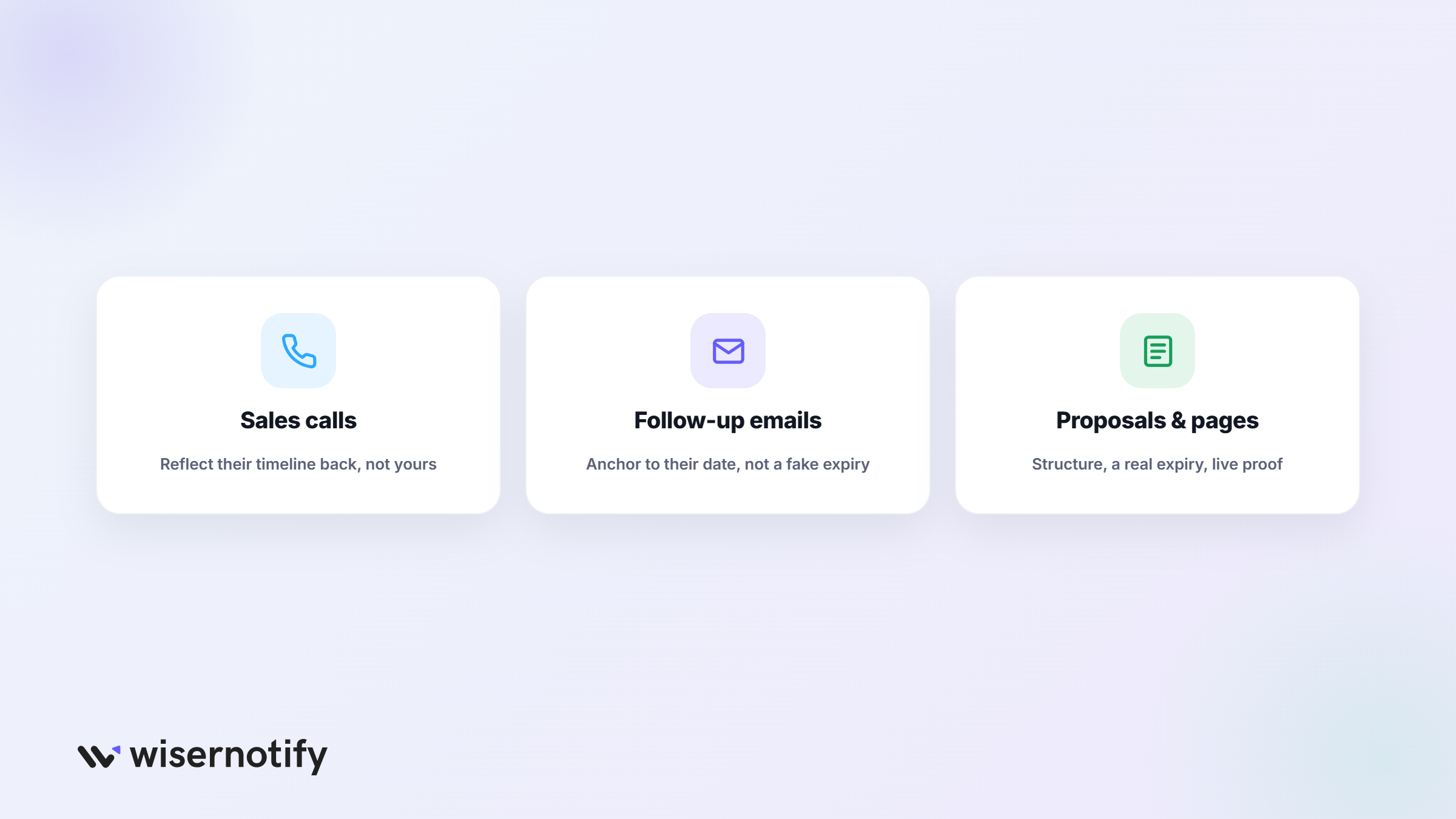
The same principle changes shape depending on where the conversation happens.
Urgency in sales calls
On a call, urgency comes out of listening, not talking.
When a buyer mentions a board meeting, a renewal date, a hiring plan, pull the thread. Ask what happens at that date and what has to be in place before it.
Then reflect the timeline back as theirs, not yours. “So working backwards from October, we would need a decision by mid August” lands very differently from “I need this closed in August.”
Urgency in follow-up emails
Fake urgency shows up worst in follow-up email, because it is easy to write and easy to spot.
Give each email a reason to exist that is not “checking in.” A relevant customer story, a number that answers their objection, the one-pager they need for their boss.
When a buyer has gone quiet after a demo, “just circling back, this offer expires Friday” gets ignored. “You mentioned the audit is in September, so onboarding would need to start by the 15th, is that date still holding?” gets a reply, because it is their date and not yours.
Urgency in proposals and landing pages
A proposal creates urgency through structure. Show what happens in week one, week four, week twelve. A buyer who can see the sequence starts thinking about when to begin instead of whether to.
Put an expiry on the proposal itself and honour it. Scope and pricing you quoted in April should not still be valid in October. Saying so is normal business practice, not a tactic.
On a landing page, the equivalent is showing real activity. A social proof popup showing live sign-ups, recent purchases or current viewers does the same job as a well-chosen customer story on a call.
That is what we build at WiserNotify, so treat this as interested rather than neutral. It reads the events already flowing through your store or CRM and puts them on the page, which keeps the honesty problem from arising in the first place. Nothing is invented because nothing needs to be.
What to Do When There Is No Urgency
Sometimes discovery turns up nothing. No date, no cost of waiting, no internal pressure. The buyer is curious and that is all.
Inventing urgency here is the fastest way to lose the deal and the relationship.
Three better moves.
- Say it out loud. “It sounds like this is not urgent right now, and that is fine. Is it worth continuing or should we pick it up later?” Buyers rarely hear this, and it usually gets a more honest answer than any close.
- Find the trigger instead of forcing one. Ask what would have to happen for this to become a priority. A funding round, a headcount change, a system hitting its limit. Now you know what to watch for.
- Requalify it in your pipeline. A deal with no urgency belongs in month nine of your forecast, not month one. Calling it anything else wastes your quarter.
The reps who consistently hit number are not the ones who create urgency everywhere. They are the ones who spot early where it does not exist and spend their hours where it does.
Urgency in Long Sales Cycles
Everything above gets harder when the deal takes nine months and needs four signatures.
Discounts and deadlines fail completely at this level. A buyer spending six figures is not moved by 10% off, and a procurement team that senses a rushed timeline will slow down on purpose.
What works instead is sequencing.
Break the decision into stages, each with its own date.
- A technical review in March
- A security sign-off in April
- A pilot in May
Each stage carries a deadline that comes from their calendar, not yours.
Then attach urgency to the stage, not the contract. “To hit the September go-live, security needs the questionnaire back by the 20th” is a real constraint that nobody has to be persuaded of.
For long cycles, stop asking when they can sign. Ask what has to be true before it can be signed, and who owns each piece. Answer that and the timeline builds itself.
How to Tell If It Is Working
Most people never check. They assume a tactic works because it feels like it should.
Four signals worth tracking.
- Time from first meeting to decision. Not win rate, which moves for a dozen reasons. Cycle length is the one urgency should move.
- Reply rates after a deadline. If follow-ups carrying a deadline get fewer replies than ones carrying a customer story, the deadline is costing you.
- What buyers write in closed-lost notes. “Timing was not right” turning up all quarter means you are inventing urgency where none existed.
- On a website, clicks not views. Forty thousand impressions on a stock alert and eleven clicks means it is being ignored. Run the page with and without it and compare.
Test one signal at a time. Three changes at once tell you nothing about which one moved the number.
3 Mistakes That Make Urgency Feel Pushy
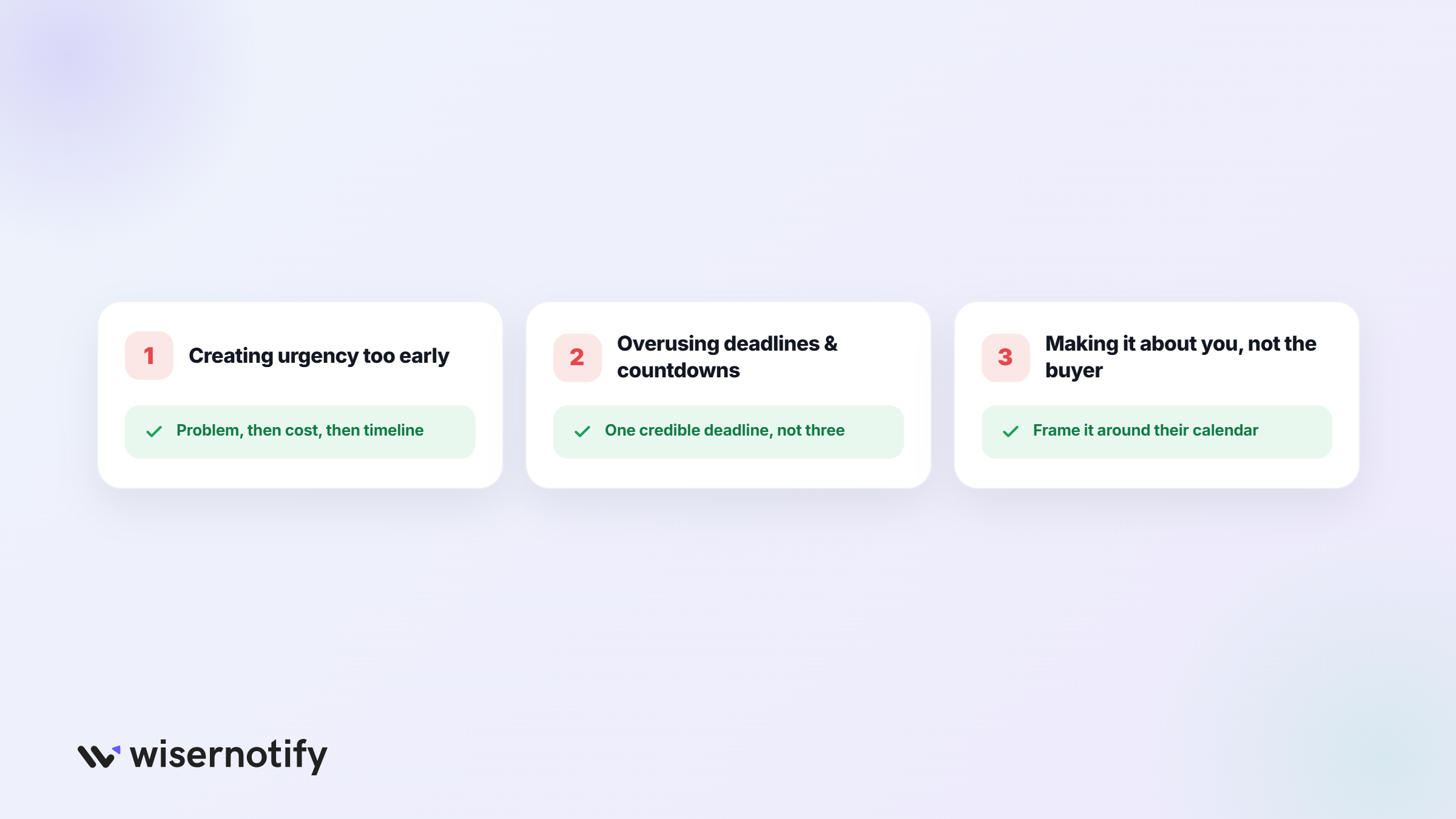
1. Creating urgency too early
Push a timeline before the buyer has agreed there is a problem and it reads as pressure, because that is what it is.
The order matters. Problem, then cost of the problem, then timeline. Skip to the timeline and you are selling to someone who has not decided they need anything.
2. Overusing deadlines and countdowns
One credible deadline moves a deal. Three competing ones cancel each other out and make the whole thing look scripted.
The same goes for a website. A countdown, a low-stock alert and an exit popup on one page do not stack. They just tell the visitor everything on the screen is a tactic.
3. Making it about you, not the buyer
This one hides in wording. “I would love to get this wrapped up before month end” sounds harmless, and the buyer hears your calendar, not theirs.
Run every urgency line through one filter before you send it. If the buyer asked why this matters to them specifically, does the answer survive?
Swap the frame and the same message works. Not “before month end” but “before your team starts planning Q4.”

Boost Conversion Instantly
Add Social Proof & Urgency to your website
Wrap Up
You do not apply urgency to a deal. You uncover it and then describe it clearly.
Start in discovery, not in the close. Ask the consequence questions, listen for the date or the number, and build everything else on top of whatever comes back.
It feels slower in week one. Over a quarter it is faster, because nothing you said has to be walked back.
Also check: 6 Winning Social Proof Tactics To Boost Sales (2026)
Related Guides
Frequently Asked Questions
Does urgency reduce trust if buyers feel pressured?
Only when the constraint is invented. Buyers have seen enough fake deadlines to spot one, and the moment they do, everything else you said gets re-examined. A real limit explained plainly does the opposite. It gives them a reason to move that they can verify.
How do I know which urgency tactic fits my product or service?
Match it to what is genuinely scarce in your business. If you sell a service, that is capacity, so onboarding windows and implementation slots work. If you sell physical products, it is stock. If you sell software, it is usually a pricing change or a feature moving tiers. Discounts are the fallback when none of those apply, and they are the weakest option.
Can urgency work for long sales cycles or high-ticket deals?
Yes, but not through deadlines. A buyer spending six figures will not move for 10% off. Break the decision into stages instead, each with a date that comes from their calendar, and attach the urgency to the stage rather than the signature.
How often should I use urgency without causing fatigue?
Once per deal, tied to something real. Reps who put a deadline in every follow-up train buyers to ignore all of them. The same applies on a website, where a countdown, a stock alert and an exit popup on one page cancel each other out.
How do I measure whether urgency improves conversions?
Track cycle length rather than win rate, since win rate moves for a dozen reasons. Then watch reply rates on messages that carry a deadline against ones that carry a customer story. On a website, compare clicks rather than impressions, and run the page with and without the element.

Krunal Vaghasiya is a marketing tech expert who boosts e-commerce conversion rates with automated social proof and FOMO strategies. He loves to keep posting insightful posts on online marketing software, marketing automations, and improving conversion rates.




 Capterra