
FOMO Marketing: 12 Strategies With Examples (2026)
FOMO marketing uses the fear of missing out to move people from browsing to buying. It pulls three levers, urgency, scarcity, and exclusivity, and uses social proof as the signal that other people are already acting.
More than 20,000 brands run social proof and urgency campaigns through WiserNotify. Some of those campaigns flop. The ones that work share one trait. The urgency is real.
Fake a countdown timer that resets every day and shoppers stop trusting you. Since 2024, regulators in the UK, EU, and US have also started fining it, and the cases are further down this post.
Here are 12 FOMO marketing strategies, grouped by the lever they pull, with brand examples and the line between true and deceptive on each one.
What Is FOMO Marketing?
FOMO marketing is any tactic that makes a shopper feel they will lose something by waiting. A deadline, a low stock count, a members-only price, or a notice that 47 people just bought the same product.
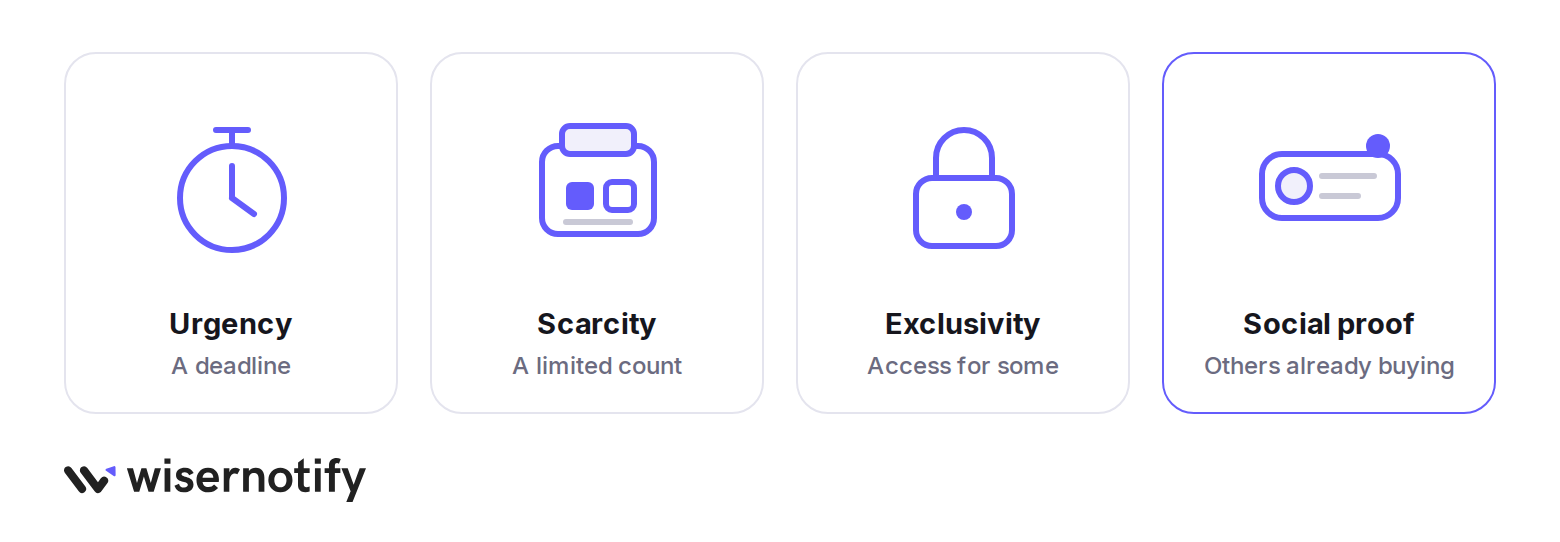
The term covers four kinds of signal. Urgency is a deadline. Scarcity is a limited count. Exclusivity is access some people have and others don’t. Social proof is evidence that other people are already buying.
The numbers behind it are in our FOMO statistics roundup. The short version is that most younger shoppers say FOMO shapes what they buy, and deadlines lift sales when the deadline is true.
Why FOMO Marketing Works
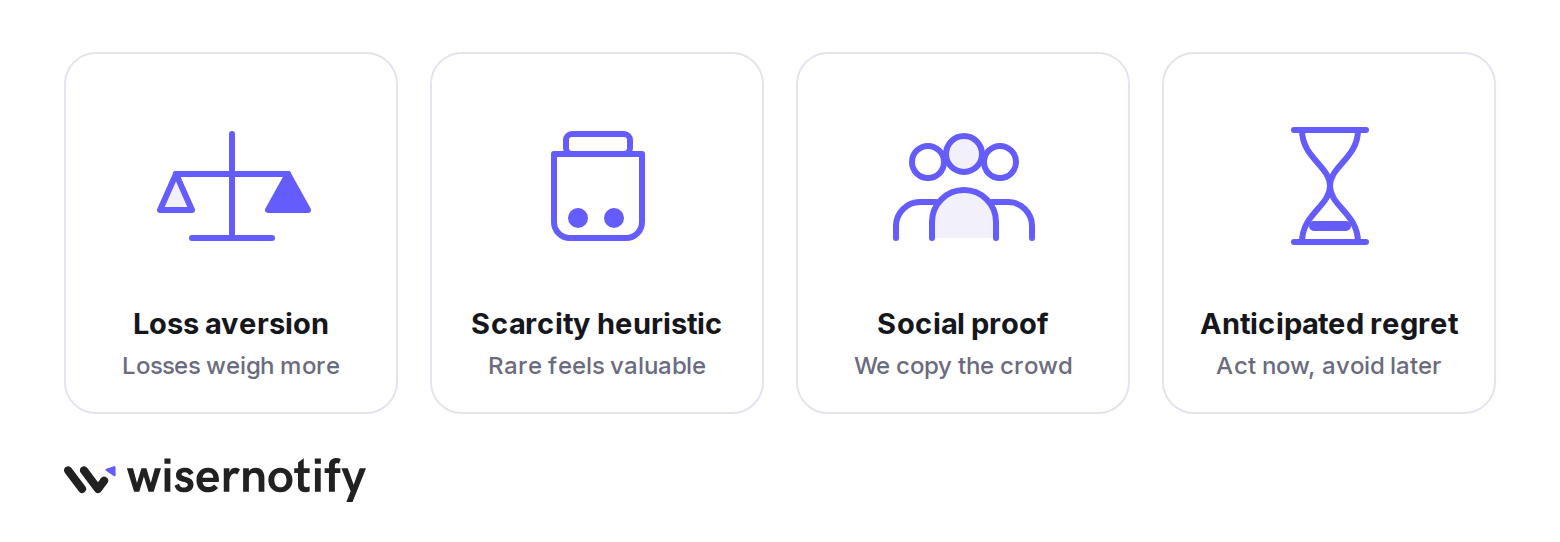
FOMO marketing works because it stacks four findings from consumer psychology, and each one maps to a tactic in this post.
- Loss aversion. Kahneman and Tversky showed that losing something hurts roughly twice as much as gaining it pleases. A deadline turns a possible gain into a possible loss, the same instinct behind most nudge marketing tactics.
- The scarcity heuristic. When something is hard to get, we assume it’s worth more. That’s why a low stock count raises perceived value without changing the product.
- Social proof. When we’re unsure, we copy what other people do. A notice that 47 people bought something today answers “is this any good?” without a word of copy.
- Anticipated regret. People act now to avoid the feeling of having missed out later. The fear in FOMO is regret, not the deadline itself.
The flip side is JOMO, the joy of missing out. Shoppers who feel pushed tune out, and some leave for good. That’s why every strategy below comes with its honest version and its deceptive one.
Urgency: Put a Real Clock on the Offer
1. Limited-Time Offers
This is the most direct FOMO tactic. Put a deadline on the offer and people have to decide now or lose it.
The deadline has to be real. If your “24-hour sale” runs every week, people catch on and stop caring.
Limited-time offers work best when they’re tied to a reason: a product launch, a holiday, an anniversary. Give people a “why” behind the urgency.
Hostinger does this well. It runs time-bound hosting sales tied to seasonal events, with clear end dates.

Pair the offer with an announcement bar at the top of the site. It puts the deadline on every page instead of only the landing page.
2. Flash Sales with Countdown Timers
Flash sales differ from regular sales. They’re shorter, usually 2 to 12 hours, less predictable, and the discount is bigger.
What makes them work is surprise plus urgency. Your audience didn’t plan for this sale. It appeared, and it’s disappearing soon.
A countdown timer widget makes the deadline visible on the page itself, so the shopper doesn’t have to remember when the sale ends.
Boat uses this on product pages by showing a timer next to the discounted price. Customers see exactly how much time they have left.

Keep them rare. A flash sale every week becomes expected. Once a month or less keeps the surprise alive.
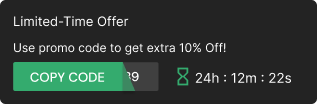
Build urgency
Add floating offers with countdown timer & coupon code.

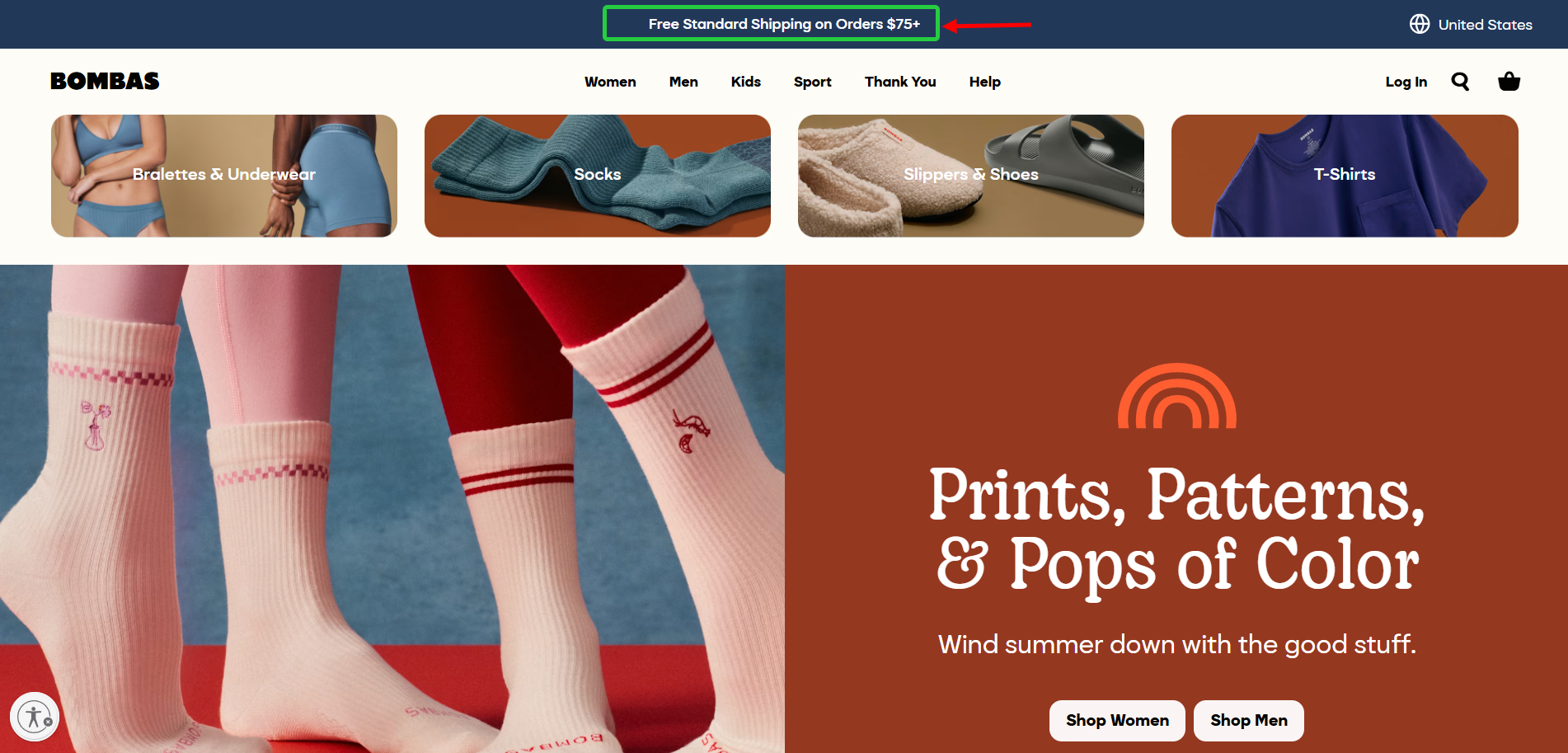
3. Free Shipping Deadlines
Extra costs at checkout are the top reason people abandon a cart once they’ve decided to buy.
That makes shipping the cheapest urgency lever you own. You can attach a deadline to it without touching product margin.
Two versions work. A threshold (“$12 away from free shipping”) grows cart size. A deadline (“order by 2pm for delivery Friday”) beats a discount, because it answers a question the buyer already has.
Amazon runs the best-known version. Its “order within 3 hrs 12 mins” line on product pages turns delivery speed into a deadline on every visit.
Keep the cut-off true. If your 2pm cut-off is 4pm in practice, someone will notice, and the whole page loses credibility with it.
Scarcity: Show What Is Running Out
4. Low-Stock Alerts
“Only 3 left in stock.”
Five words that change how a shopper thinks about a product.
When something is scarce, we see it as more valuable. A 1975 study by Worchel, Lee, and Adewole found that cookies from a nearly empty jar were rated as more desirable than identical cookies from a full jar.
Scarcity shifts the decision from “should I buy this?” to “can I afford to miss this?”
Flipkart uses low-stock alerts to prompt faster decisions. When shoppers see only a few units left, hesitation drops.

This only works when it’s true. A stock badge that reads live inventory is a sales tool. A static “only 3 left” on every product is the kind of claim regulators now act on.
Scarcity doesn’t always need a unit count. LEGO tags sets near the end of production “Retiring soon” and gathers them on one page that opens with “Going, going…nearly gone!”
Fans know a retired set leaves official shelves for good, so the label sells at full price with no markdown.

A “Last chance” collection for retiring colors, scents, or sizes does the same job in a small store.
5. Limited-Edition Product Drops
Limited editions create FOMO through pure scarcity. When something exists in small quantities, people assign it more value.
Jim Beam produces millions of cases of bourbon a year. Pappy Van Winkle releases a few thousand bottles. Guess which one people line up for.
The same principle applies to any business. Limited-run products, seasonal collections, and exclusive bundles all trigger the “I need this before it’s gone” response.
Some trigger words that sharpen it: “limited run,” “while supplies last,” “one-time release,” “never restocked.”
SEIKO does this with limited-edition watch releases that create demand through controlled scarcity.

e.l.f. and Bubble ran a 2026 version of this. Their three hybrid products launched on August 7 in limited quantities, sold under a “limited time drop” banner on e.l.f.’s site.
A collab like this pulls FOMO from two fan bases at once. Each brand’s followers hear about it from the other side too.

If you run one, publish the unit count before launch day. “Only 300 made” gives shoppers a number to race against.
6. Waitlists and Pre-Launch Signups
A waitlist turns “not available” into a reason to act rather than a reason to leave.
The mechanic is simple. You publish the product before it ships, cap the list or the first run, and give the list a true advantage over the public launch.
For smaller stores, the version that works is a back-in-stock waitlist on sold-out products. You capture demand you were losing, and the restock email carries its own urgency, because the buyer knows others got the same email.
BigBadToyStore treats its waitlist as a real queue. Past customers join from the sold-out product page at no cost, and restocked units go out first on, first off.
Nobody pays until their spot comes up, and BigBadToyStore says plainly that joining doesn’t guarantee the item. That candor is why collectors keep signing up.
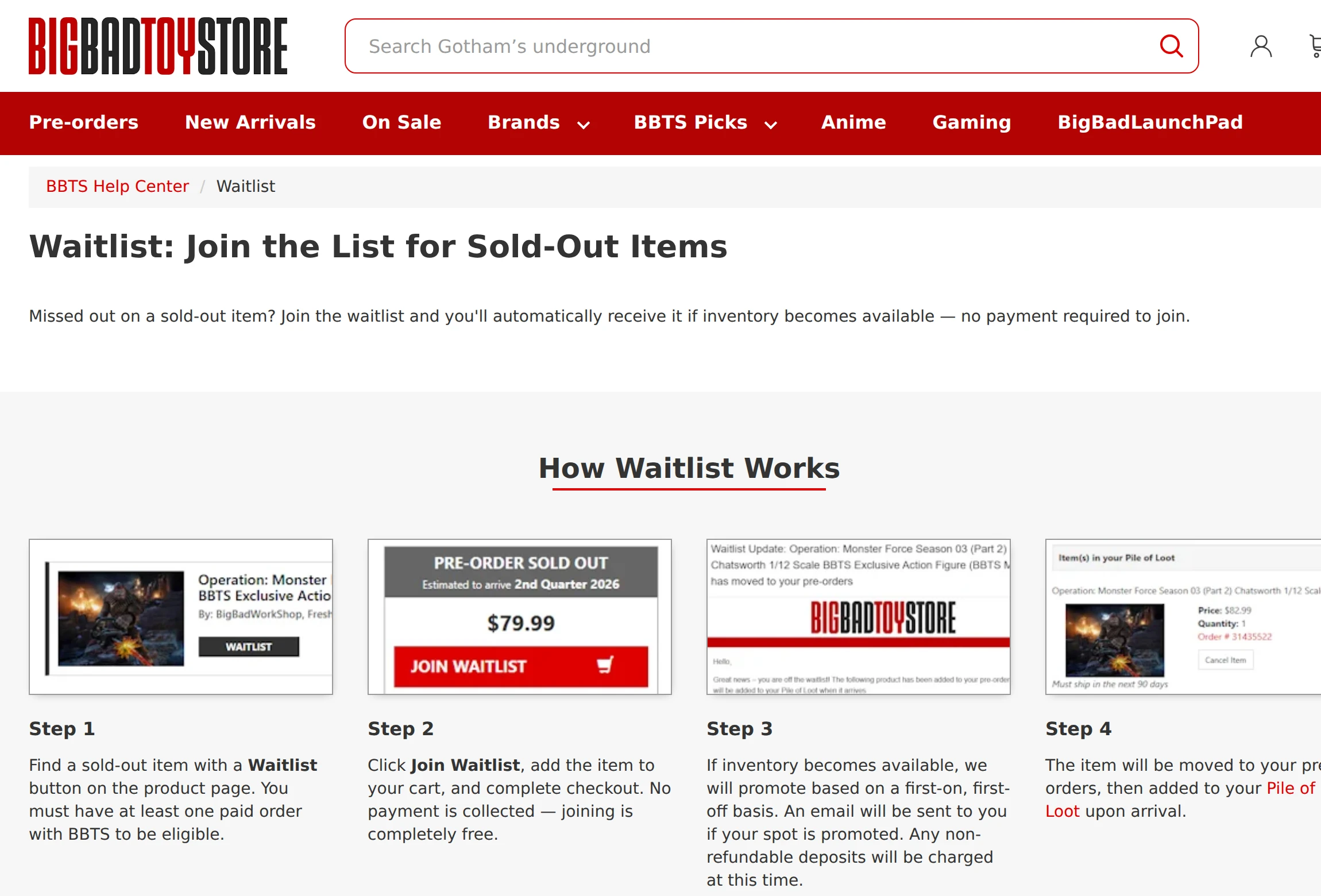
Two rules not to break. Tell people roughly when, and honor the queue order. A waitlist that quietly opens to everyone at once is the fastest way to make your next launch fail.
Exclusivity: Make Access Feel Earned
7. Exclusive Access and VIP-Only Deals
People want what they can’t easily get.
Offering exclusive access to deals, content, or products for a specific group (email subscribers, loyalty members, early adopters) triggers FOMO and a sense of belonging at the same time.
It works especially well for SaaS companies and course creators. “Join 5,000+ marketers who get our strategies first” reads differently from “subscribe to our newsletter.”
Drip does this. Its newsletter signup promises resources and strategies that aren’t published anywhere else on the site.

The catch is delivering the exclusive value. If people sign up and get the same content everyone else sees, they unsubscribe within a month.
Retail runs the same play with products. Nike’s SNKRS app sends Exclusive Access invitations that let selected members buy limited sneakers outside the regular launch.
Nike picks members by how they engage with the app, and says bots and extra accounts won’t improve the odds.
In December 2025 Nike added SNKRS Code, which unlocks a drop only for fans who find a hidden password.

For a small store, email past buyers a private link to a short batch before it goes public.
8. Early Bird Pricing
Early bird discounts reward people for acting fast. Instead of punishing late buyers, you reward early ones, and the framing matters.
It suits events, course launches, and seasonal promotions. “Get 25% off when you book before [date]” gives people a concrete reason to commit now.
Imagica runs early bird offers for holiday bookings, giving customers a reason to plan ahead and save.

Sephora ties the early window to loyalty tier. In the Holiday Savings Event below, Rouge members got 20% off from October 30, VIB joined at 15% on November 3, and Insiders at 10% on November 5.
Sephora’s spring 2026 event kept the same order, with Rouge shopping from April 10 and everyone else from April 14.

The earlier you get in, the bigger the discount. Lower tiers can watch favorites sell out before their window opens.
Early bird offers convert best when you show the price after the deadline. “Save $50, price goes to $199 on March 15” beats “25% off for early birds.”
9. Influencer Partnerships
When someone your audience already trusts promotes a product, it creates instant FOMO. “If they use it, maybe I need it too.”
A limited collaboration between a brand and a creator feels exclusive by default.
Sugar Cosmetics uses influencer campaigns to build product desire and push its audience toward quick decisions.

The best influencer FOMO campaigns pair the endorsement with a limited-time code. “Use my code for 20% off, but it expires Friday.” That’s FOMO plus social proof in one move.
10. Contests and Giveaways
Few things create buzz like a well-run giveaway. The fear of missing a free prize is surprisingly strong.
Set a clear entry deadline, promote it across your channels, and watch engagement spike.
Mageplaza uses a spin-the-wheel popup where visitors enter their email for a chance to win a discount. It’s playful, it’s urgent, and it collects leads.

Make the prize relevant to your product. A free iPhone attracts freebie seekers. A free six-month subscription to your tool attracts potential customers.
Social Proof: Show Others Already Acting
11. Social Proof Notifications
This is where WiserNotify has the most hands-on data, since it’s what the product does.
Social proof and FOMO work together. When visitors see live notices that others are buying, signing up, or viewing a product, two things happen.
Trust goes up. If other people are buying, it must be worth buying.
Urgency kicks in. If everyone else is grabbing this, maybe I should too before it’s gone.
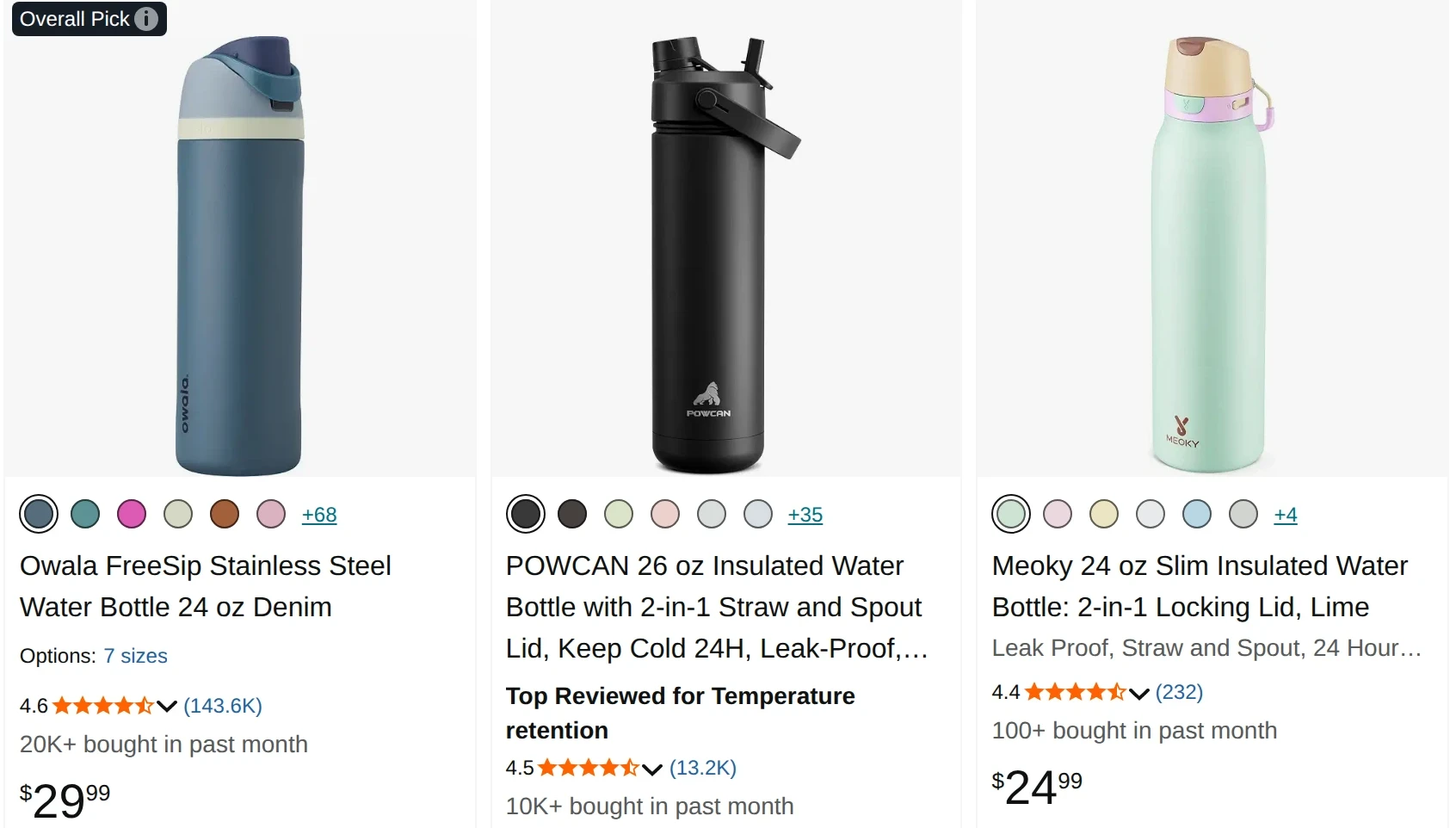
Amazon puts the crowd right in its search results. Badges like “20K+ bought in past month” sit under the star rating, so the busy product looks like the safe pick.
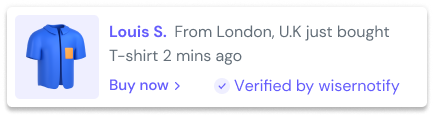
Stores without Amazon’s volume get the same effect from a live notice on the product page.
Here’s how WiserNotify shows it: live notifications of recent purchases, visitor counts, and signups, pulled from your own store data.

No discount needed. The notification only works if the events behind it are real, which is why WiserNotify pulls them from your orders and signups rather than letting you type them in.
Also check: social proof examples
Build trust & FOMO
Highlight real-time activities like reviews, sales & sign-ups.
12. Exit-Intent and Cart Recovery
Around seven in ten carts are abandoned. Exit-intent is the last chance to change that before the session ends.
The mistake most stores make is offering a discount on exit. That trains people to abandon on purpose, and you pay for orders you would have got anyway.
The better version puts a clock on something the shopper already chose. “Your cart is saved for 60 minutes” holds the item without cutting price. “Only 2 left in your size” restates a fact they can verify.
In the recovery email, urgency belongs in the second send, not the first. The first send is a reminder. The second one carries the deadline.
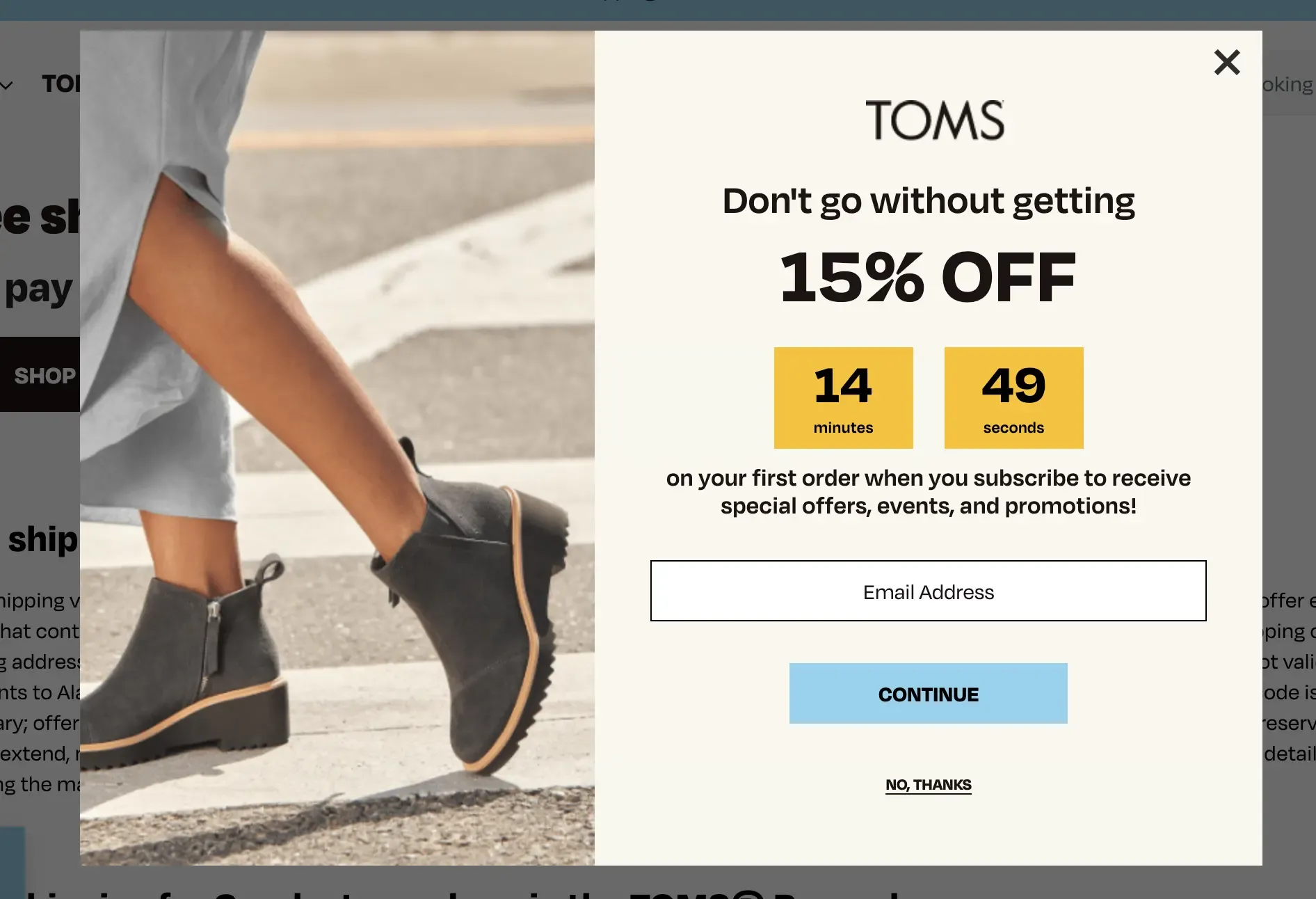
Test the exit popup against a holdout before you keep it. This is the tactic that most often looks like a win in aggregate and turns out to be cannibalizing sales that would have closed anyway.
Real Scarcity vs Fake Scarcity
Every guide says not to fake scarcity. Few say what the honest version looks like in the build. Here is the line, signal by signal.
| Signal | Honest version | Version that gets you in trouble |
|---|---|---|
| Countdown timer | Ends at a fixed time for everyone, and the price changes after | Resets on refresh, or restarts with the same offer |
| Low-stock badge | Reads live inventory, hides above a set threshold | Static number, or a random range |
| “X people viewing” | Live concurrent sessions on that page | Made-up number on a loop |
| Sale price | Reference price is the lowest you charged in the previous 30 days | Inflated “was” price nobody paid |
| “Selling fast” | Triggered by actual sales velocity | Applied sitewide by default |
| Waitlist position | Actual queue, honored in order | Cosmetic number |
Where FOMO Becomes Illegal
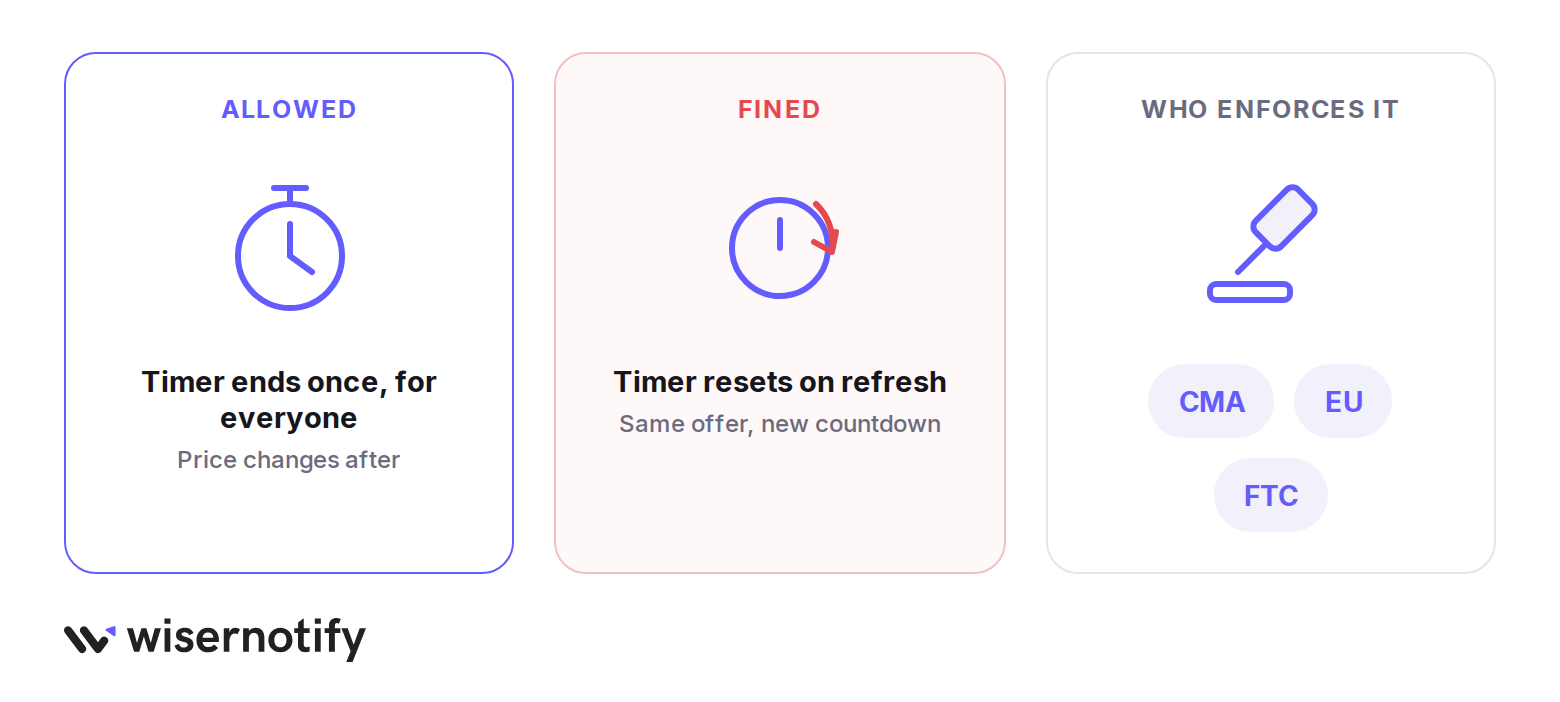
Fake urgency stopped being a trust problem and became a legal one. Three regulators have moved on it since 2024.
- UK: the Wowcher case. The Competition and Markets Authority investigated Wowcher’s countdown timers and “Running out!” claims, found most products stayed at the same price after the timer ended, and secured undertakings plus over £4 million in refunds in 2024.
- UK: Emma Sleep. The CMA found Emma’s countdown timers and “high demand” banners risked misleading shoppers, took the company to court in 2024 when it wouldn’t commit to changes, and ended with a consent order against the urgency messaging.
- UK: fines from April 2025. Under the Digital Markets, Competition and Consumers Act, the CMA can now fine a business directly, up to 10% of global turnover. Aggressive sales practices and fake reviews are on its priority list.
- EU: the 30-day rule. Any announced price reduction has to show the lowest price charged in the 30 days before it. A countdown on a “was $199” price nobody paid breaks it.
- US: fake social proof. The FTC’s rule on consumer reviews and testimonials took effect in October 2024. It bans fake reviews, fake testimonials, and bought indicators of social influence, with civil penalties per violation.
The CMA runs these cases under its online choice architecture program, its term for dark patterns. The test is simple. Every urgency signal on your site should be something a regulator could check against your order data and find true.
Where FOMO Marketing Doesn’t Work
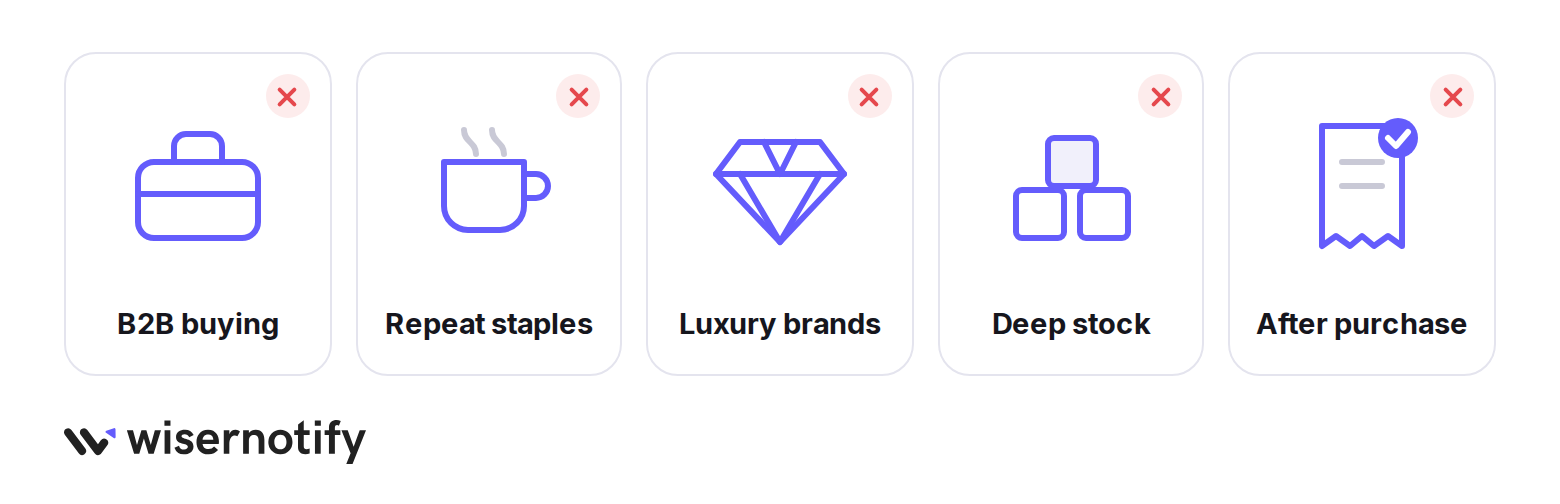
FOMO is a tool for decisions that can be made in a session. It backfires where the decision can’t.
- B2B and high-consideration purchases. A buying committee on a six-week cycle reads a 48-hour countdown as a sales trick. Use early-access and waitlist tactics here, not timers.
- Repeat buyers of staples. Someone who buys the same coffee every month knows the price comes back. Urgency on a reorder trains them to wait for the next sale.
- Luxury and high-trust brands. Scarcity fits. Countdown timers and “selling fast” badges don’t, because they signal discounting the brand is built to avoid.
- Deep stock. A low-stock badge on a product with 800 units is a lie waiting to be caught, and the kind regulators now check.
- After the purchase. Urgency in post-purchase emails breeds regret and returns. Once someone has bought, switch to reassurance.
How to Use FOMO Across Different Channels
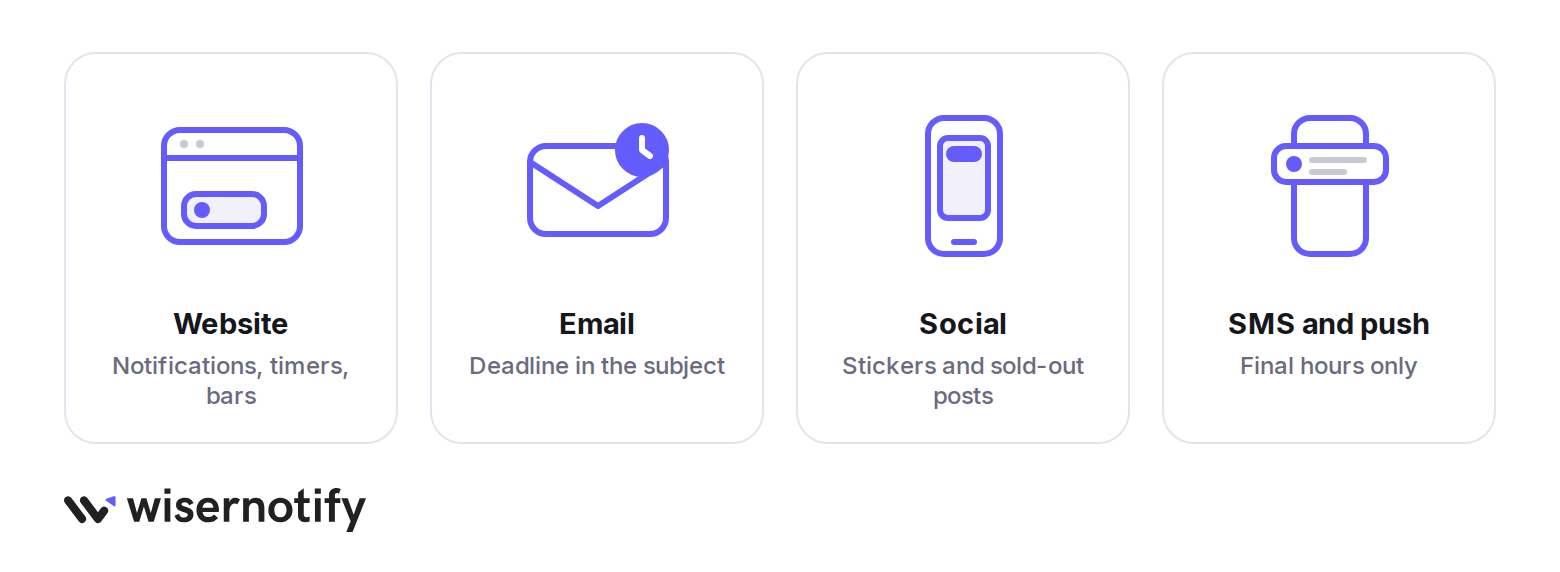
FOMO isn’t only a website tactic. Here’s how it applies across your main channels.
Website FOMO
Your site gives you the most control. Use social proof notifications, countdown timers, low-stock alerts, announcement bars, and exit-intent popups.
Layer two or three signals on high-intent pages such as pricing, product pages, and checkout. Don’t put every tactic on the homepage at once. Too many urgency triggers feel desperate.
Email FOMO
Subject lines do the heavy lifting. Use specific numbers (“only 7 left”), deadlines (“ends at midnight”), and personalization (“saved for you until 6 pm”).
Inside the email, bold the deadline, repeat the scarcity element once, and keep the design clean so the button stands out.
Social Media FOMO
Stories with countdown stickers. Posts showing sold-out notices. Behind-the-scenes clips of limited inventory. User-generated content showing customers with your product.
Social FOMO works best when it feels organic. A quick photo of a nearly empty warehouse shelf creates more urgency than a designed graphic that says “HURRY!”
SMS and Push FOMO
SMS and push are the only channels where the deadline arrives whether or not the person opens an app, so they suit the final hours of an offer rather than the announcement.
Keep them to one send per campaign, put the deadline in the first six words, and link straight to the cart rather than the homepage. Anything more frequent and the unsubscribes cost more than the campaign returns.
19 FOMO Marketing Phrases to Use
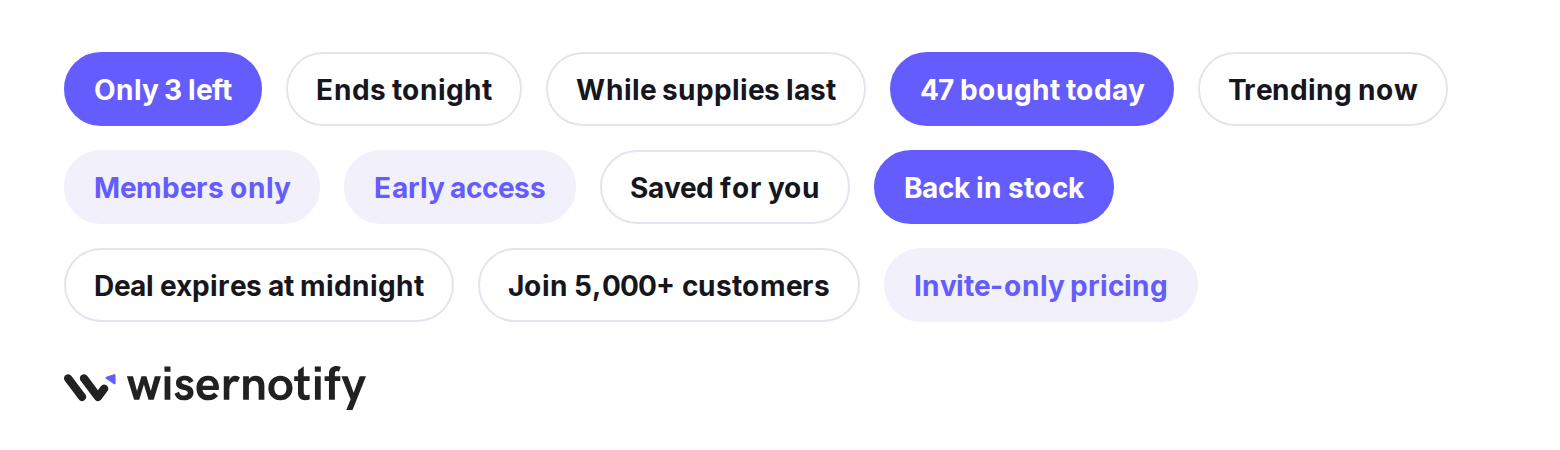
The right words trigger action. Here are phrases that perform across campaigns, grouped by the type of FOMO they create.
Urgency and Scarcity
- “Limited time only!”
- “Offer ends in [countdown timer].”
- “Only X left in stock.”
- “While supplies last.”
- “Selling out fast!”
- “Deal expires tonight.”
Social Proof
- “[Number] people bought this in the last 24 hours.”
- “Just added to cart by [name] in [location]”
- “Trending right now.”
- “Join [number] happy customers.”
- “Most popular choice this month.”
Exclusivity
- “Members-only discount”
- “Early access sale”
- “VIP offer: get it before it goes public.”
- “Back in stock (grab it before it’s gone again).”
- “Invite-only pricing”
Personal Touch
- “We saved one just for you.”
- “Your cart is about to expire.”
- “This deal won’t come back.”
Context matters with all of these. Pick phrases that match your brand voice and are true when they’re shown.
The FOMO Tool in Our Stack
WiserNotify
WiserNotify shows live notifications on your site: recent purchases, live visitor counts, signups, and review activity, pulled from your store and your tools.
The same dashboard runs countdown timers, low-stock alerts, and announcement bars, so the urgency and social proof signals in this post come from one place.
It connects to 250+ platforms, including Shopify, WooCommerce, WordPress, and the main CRMs, and is used by 20,000+ brands. Plans start at $59 a year, with a 7-day free trial.
Not a fit if: you want a popup builder, a review collection tool, or a listings manager. For a neutral look at the category, see our comparison of FOMO tools.
How to Measure Your FOMO Campaign Results
Four metrics tell you whether a FOMO element is working.
- Conversion rate. The big one. Track the share of visitors who complete the action, before and after adding a FOMO element.
- Click-through rate. Tells you whether the FOMO message is compelling enough to get clicks. Test FOMO-driven CTAs against standard ones.
- Bounce rate. Reveals when tactics are too aggressive. If bounce rate spikes after adding urgency, dial it back.
- Revenue per session. The bottom line. Compare it with the FOMO element on and off, not before and after, so seasonality doesn’t fool you.
Track through Google Analytics, your ecommerce platform’s reports, or your FOMO tool’s dashboard.
6 FOMO Mistakes That Kill Conversions
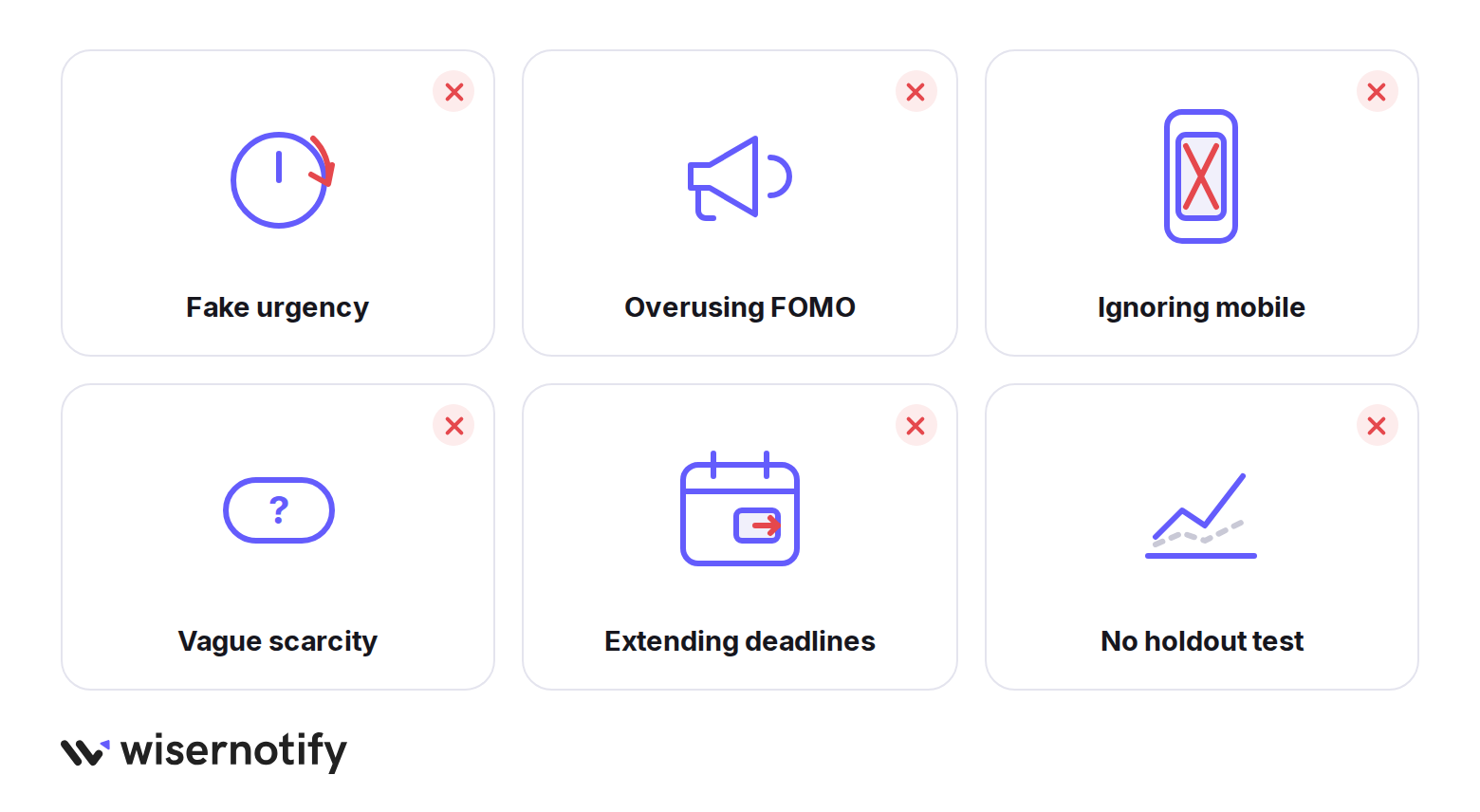
- Fake urgency. A countdown timer that resets on refresh. Customers notice, and they never trust your deadlines again.
- Overusing FOMO. If every page screams “HURRY! LIMITED! ACT NOW!” visitors feel overwhelmed, not motivated. Use it on your highest-intent pages.
- Ignoring mobile. Popups, bars, and timers have to work on a phone. A popup that covers the screen and can’t be closed loses the customer.
- Vague scarcity. “Limited availability” means nothing. “Only 4 left at this price” means everything. Specifics build trust.
- No follow-through. Promising a deal ends Friday, then extending it to Sunday, damages credibility for good. Set a deadline and honor it.
- Measuring without a holdout. Turn on five urgency elements in one week and watch conversions rise, and you’ve learned nothing about which one worked. Ship them one at a time, against a control.

Boost Conversion Instantly
Add Social Proof & Urgency to your website
Wrap Up
FOMO marketing works when the thing people fear missing is real.
The brands that get the best long-term results aren’t the ones using every trick. They use two or three of these strategies well, with deadlines that hold and stock counts that are true.
Pick one or two from this list. Test them on your highest-traffic pages against a holdout. Measure, then expand.
Frequently Asked Questions
What is FOMO marketing?
FOMO marketing uses the fear of missing out, through deadlines, low stock, exclusive access, and signs that other people are buying, to move shoppers from browsing to buying.
Why does FOMO marketing work?
It works because of loss aversion. People feel the pain of missing out more strongly than the pleasure of gaining something, so a deadline or a low stock count pushes them to act.
Is FOMO marketing ethical?
Yes, when the deadline, stock count, or demand claim is true. Fake timers and made-up scarcity are dark patterns, and regulators in the UK and EU now treat them as breaches of consumer law.
What are examples of FOMO marketing?
Limited-time offers, low-stock alerts, early bird pricing, waitlists, and social proof notifications showing recent purchases are the most common.
Does FOMO marketing work for B2B?
Rarely in the countdown-timer form, because buying committees on long cycles read it as a sales trick. Early access, waitlists, and capped cohorts work better for B2B.
How do you measure FOMO marketing?
Compare conversion rate and revenue per session with the FOMO element on and off, against a holdout group, and watch bounce rate for signs the tactic is too aggressive.

Krunal Vaghasiya is a marketing tech expert who boosts e-commerce conversion rates with automated social proof and FOMO strategies. He loves to keep posting insightful posts on online marketing software, marketing automations, and improving conversion rates.




 Capterra