



According to BrightLocal, 97% of consumers check reviews before choosing a business.
For most local businesses, your Google reviews are the first impression customers see, often before they visit your website or walk through your door.
I’ve spent time testing Google review management tools to find which ones actually help you collect more reviews, respond faster, and display social proof where it matters.
Some tools are overpriced for what they offer. Others lack critical features such as automated review requests or website display widgets.
This guide compares 8 Google review management tools based on hands-on evaluation.
Whether you’re looking for Google review software for a single location or a Google review tracker that handles 50+ locations, I’ll break down what each tool does best and where it falls short.
Quick Comparison: Google Review Management Software
| Tool | Best For | Starting Price | Standout Feature |
|---|---|---|---|
| WiserReview | Affordable all-in-one | Free / $9/month | Multi-channel collection + display |
| Birdeye | Multi-location businesses | $299/month | Unified inbox across 150+ sites |
| ReviewTrackers | Enterprise analytics | $49/month | Advanced sentiment analysis |
| SOCi | Franchise brands (20+ locations) | Custom pricing | Reviews + social + listings in one |
| Broadly | Service businesses | $249/month | SMS review requests after jobs |
| ReviewInc | Data-driven teams | Custom pricing | API access + custom workflows |
| ReviewOnMyWebsite | Display-only (budget) | $9/month | Simple embeddable widgets |
| BrightLocal | Local SEO + reviews | $39/month | Reviews tied to local rankings |
What to Look for in a Google Review Management Tool

Before diving into the tools, here are the criteria I used to evaluate each one.
These are the factors that actually separate useful review management software from tools that just look good in demos.
Google Business Profile integration. The tool needs to connect directly to your Google Business Profile, automatically pull reviews, and let you respond without switching between dashboards. If you have to log in to Google separately to reply, the tool adds steps instead of saving them.
Review collection and automation. The best Google review management software automates the ask. It sends review requests through email, SMS, or direct links after a purchase or service. Automated follow-ups for non-responders are what separate good tools from great ones. Businesses that actively request reviews get 2 to 4x as many reviews as those that don’t.
Response management. Templates, AI-assisted replies, and a centralized inbox for managing responses across locations save real time. Google also factors response rate and speed into local search rankings, so fast replies aren’t just good practice. They directly affect your visibility.
Reporting and sentiment analysis. Basic dashboards show star ratings and review counts. Better tools offer sentiment analysis (what customers feel and why), keyword trending (what topics come up repeatedly), and competitor benchmarking. This turns feedback reviews into business intelligence.
Website display and social proof. Can you embed your Google reviews on your site? Widgets, carousels, and review sections that display real customer feedback near buy buttons and contact forms directly increase conversion rates.
Pricing relative to value. Tools range from free to $500+ per month. A solopreneur displaying reviews on a landing page has different needs than a franchise managing 50 locations. Overpaying for enterprise features you won’t use is just as bad as choosing a tool that can’t grow with you.
Also check: We Tested 5 Review Management Software So You Don’t Have To
8 Best Google Review Management Tools (2026)
1. WiserReview
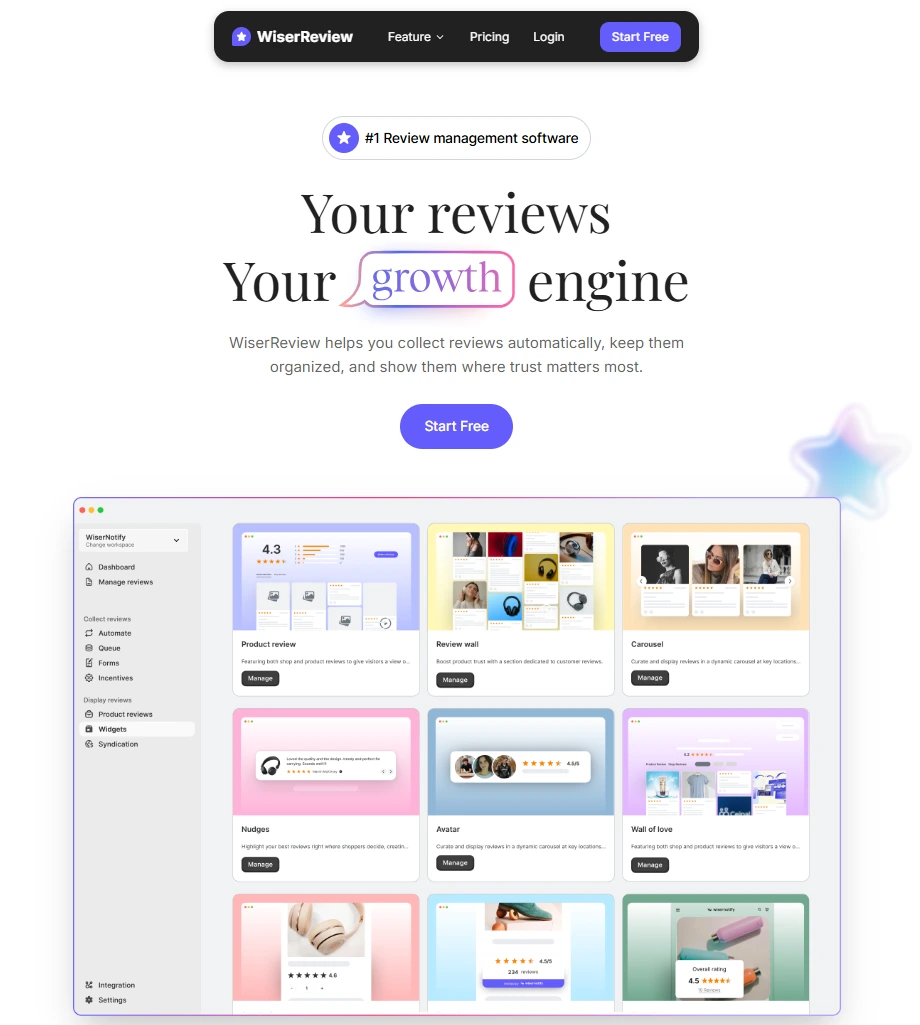
WiserReview is the most affordable all-in-one Google review management tool on this list. It handles collection, response management, and display on a single platform.
Automated review requests are sent via email, SMS, WhatsApp, QR codes, and direct links.
What stood out in testing: The multi-channel collection. Most tools offer email + SMS. WiserReview adds WhatsApp, QR codes (great for in-store), and direct link generation. The AI-powered review tagging automatically groups reviews by topic and sentiment, so you can spot patterns without manually reading every review. Display widgets include carousels, grids, popups, and review walls with rich snippet markup for SEO.
Best for: Local businesses, ecommerce stores on Shopify or WooCommerce, and any business that wants complete Google review management without enterprise pricing.
Pricing: Free plan available. Paid plans start at $9/month.
Limitation: Smaller user base than established players like Birdeye or BrightLocal. Less suited for 50+ location enterprise operations. But as an affordable Google review tool with strong display options, it punches above its weight.
2. Birdeye
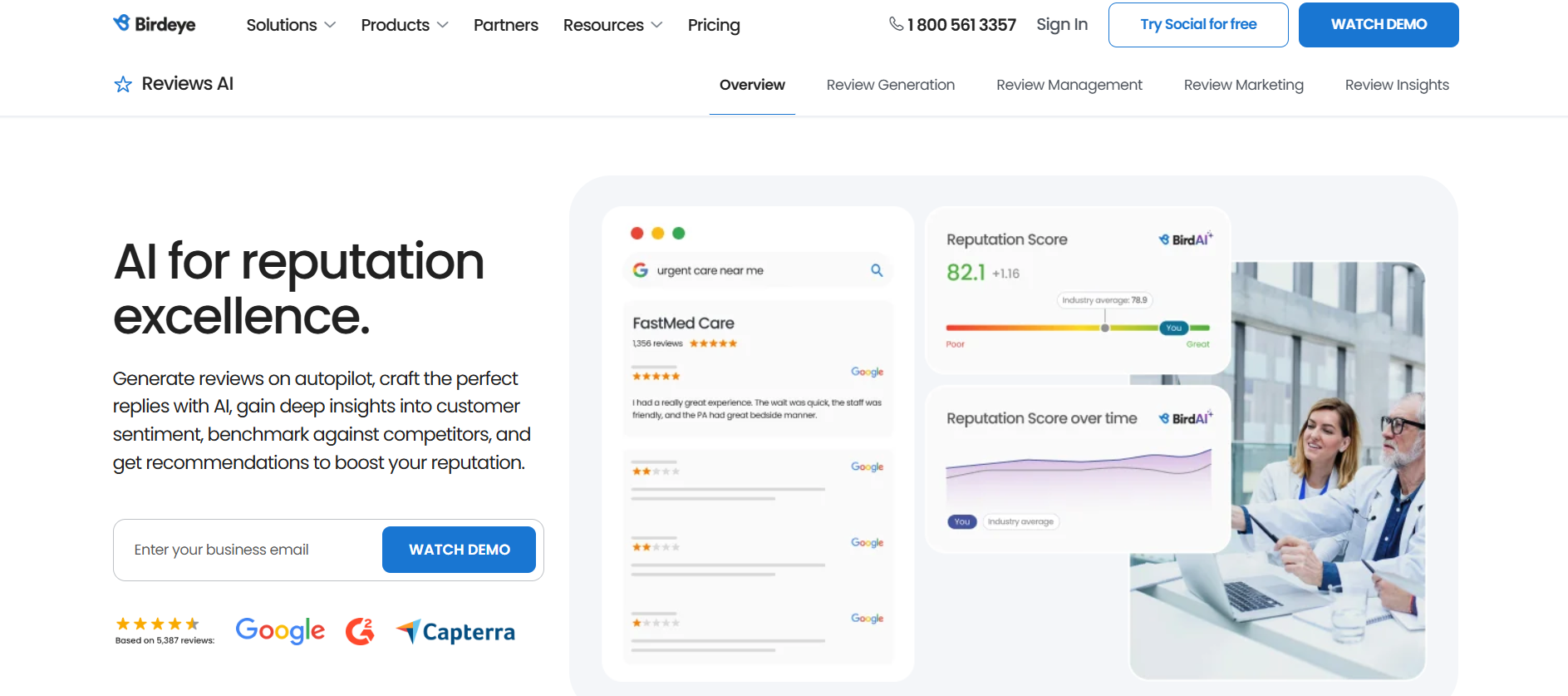
Birdeye is the enterprise-grade option for businesses managing Google reviews across multiple locations at scale.
Its unified inbox consolidates reviews, social comments, and customer messages from 150+ platforms into one view.
What stood out in testing: The AI-powered reply suggestions genuinely speed up response time. Sentiment analysis breaks down reviews by location and time period, so you can spot operational issues before they become reputation problems. The automated review request campaigns (SMS + email) are highly configurable.
Best for: Multi-location businesses, healthcare providers, automotive dealerships, and any company managing high review volumes across multiple Google Business Profiles.
Pricing: Standard plan at $299/month. Professional at $399/month. Premium with custom pricing.
Limitation: Expensive for small businesses. The feature depth means a steeper learning curve. Overkill if you only manage 1 to 3 locations.
3. ReviewTrackers
ReviewTrackers goes deeper on analytics than any other tool on this list. Its standout is advanced sentiment analysis that identifies recurring themes across reviews.
Instead of just showing you a 4.2-star average, it tells you that 73% of negative mentions relate to “wait times” and 85% of positive mentions reference “staff friendliness.”
What stood out in testing: The keyword insights feature extracts the most mentioned terms across all your reviews and groups them by sentiment. The dashboard provides four clickable metrics (average rating, total reviews, response rate, response time) that drill into monthly breakdowns. Competitor review tracking lets you benchmark against specific local competitors.
Best for: Multi-location businesses and enterprise teams that want to turn customer feedback into strategic decisions, not just manage reply queues.
Pricing: Single location at $49/month. Essential plan with custom pricing for multiple locations.
Limitation: No website displays widgets. The focus is analytics and monitoring, not review collection or display.
4. SOCi
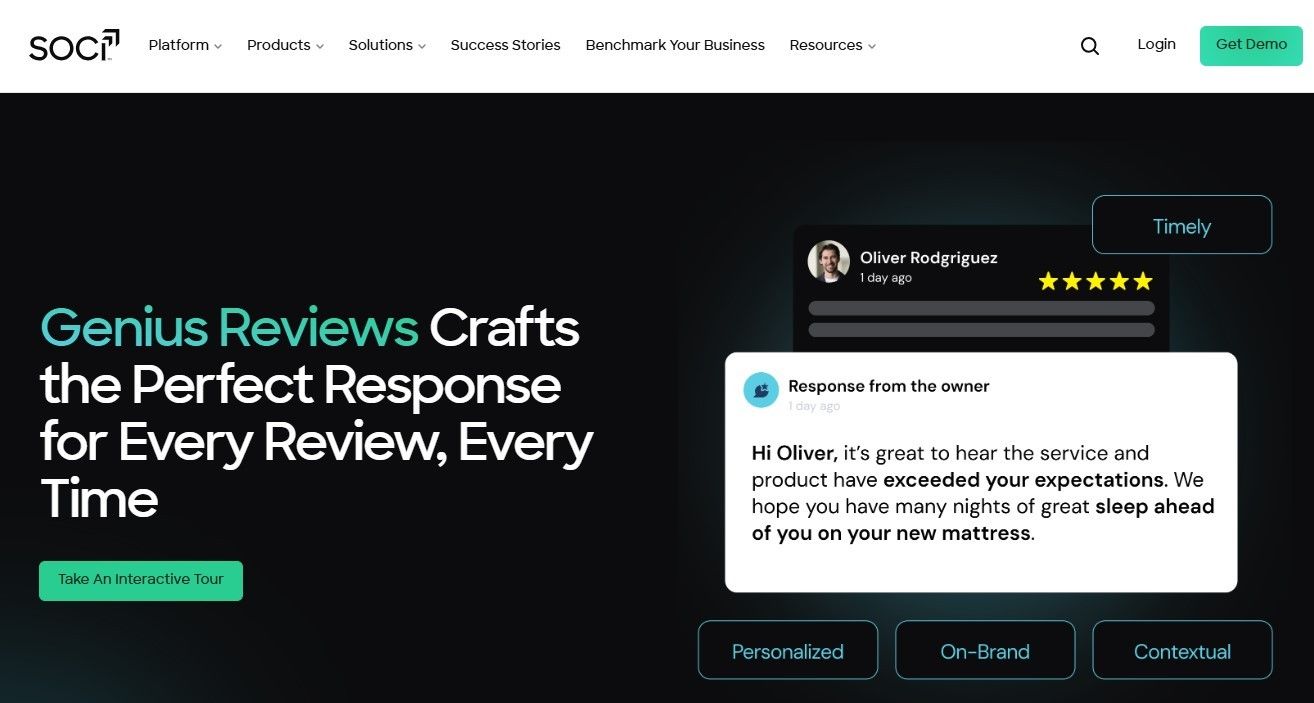
SOCi is the platform for franchise brands and multi-location operations that need reviews, social media, listings, and local ads managed from one dashboard.
If you’re managing 20+ Google Business Profiles, SOCi is built to centralize everything.
What stood out in testing: The unified approach is the real value. Instead of using separate tools for reviews, social posting, and listing management, SOCi handles all three. Review workflows with custom templates to keep responses consistent across locations. SOCi also offers tools to identify and report fake reviews, which is critical for high-visibility businesses.
Best for: Franchise operations with 20+ locations, enterprise marketing teams, and multi-location brands that need consistency across all customer touchpoints.
Pricing: Custom pricing based on the number of locations and features.
Limitation: Overkill for small businesses or single-location operations. Custom pricing means you won’t know costs until you talk to sales.
5. Broadly
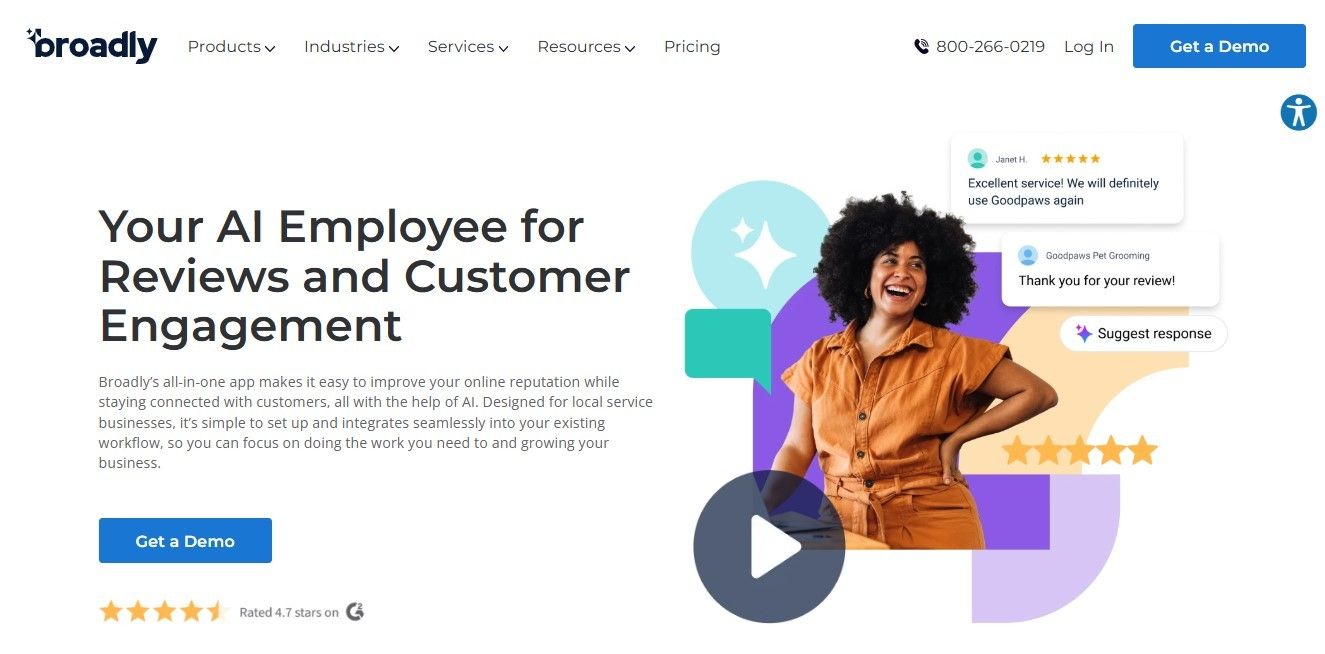
Broadly is purpose-built for service businesses. Dentists, plumbers, HVAC companies, home service pros.
Its SMS-first approach sends review requests right after a job is completed or payment is processed, capturing feedback while the experience is fresh.
What stood out in testing: The payment-triggered review requests are genuinely clever. A customer pays for a plumbing repair, and 30 minutes later, they get a text asking for a Google review. The timing is perfect. The unified inbox handles chats, texts, and emails in one place, which works well for teams in the field who manage customer communication from their phones.
Best for: Local service businesses where customers interact in person and respond better to text messages than email.
Pricing: Standard at $249/month with a $350 setup fee. Annual plan at $2,249/year (25% savings).
Limitation: Not for ecommerce or digital-first brands. Reporting is basic compared to ReviewTrackers or BrightLocal. The $249/month starting price is steep for small operations.
6. ReviewInc
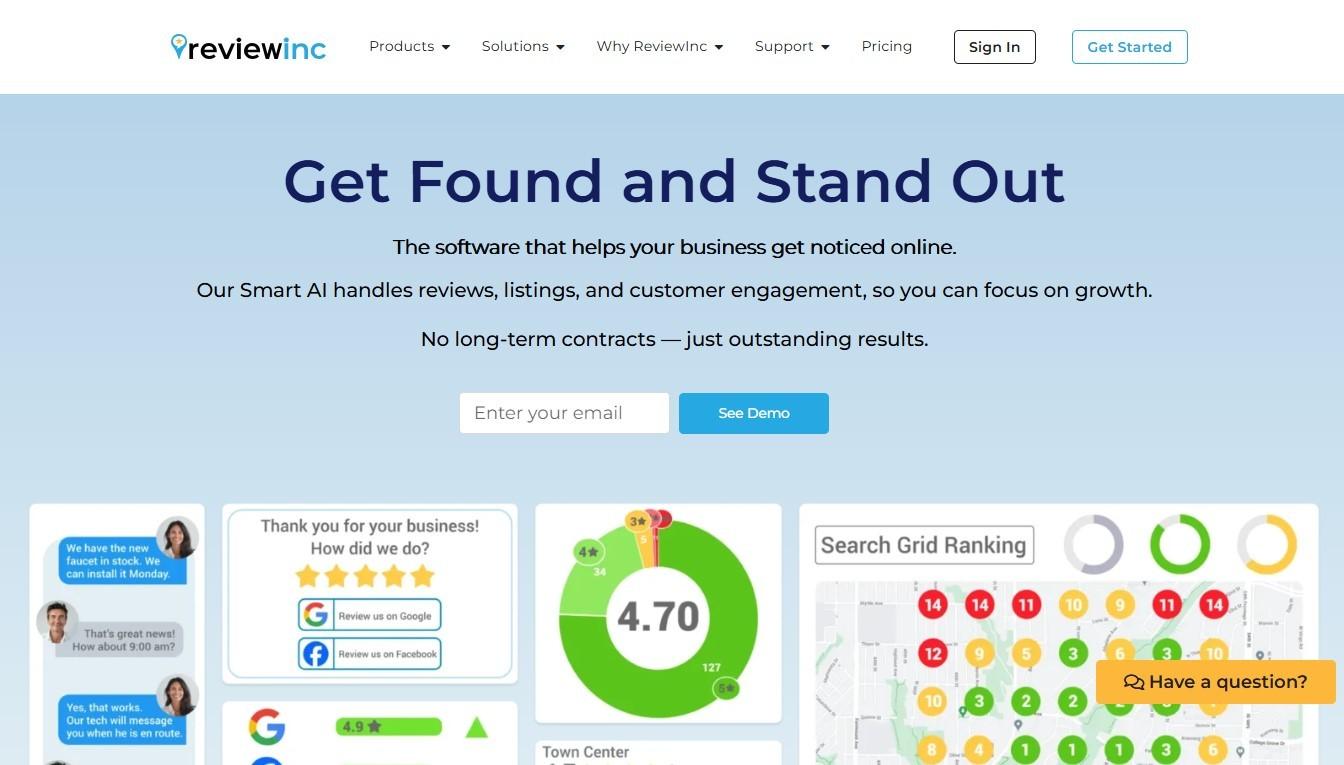
ReviewInc is the tool for technical teams that want granular control. It offers API access for custom integrations, detailed filtering, and workflow automation that other tools don’t match.
If you want to pipe review data into your CRM or build custom reporting dashboards, ReviewInc provides the infrastructure.
What stood out in testing: The API access is the differentiator. You can pull review data into your own systems, trigger custom workflows, and build integrations that match your specific tech stack. Response time tracking and sentiment analysis are built in.
Best for: Data-driven teams and mid-to-large businesses that want to integrate Google review data into their existing business intelligence tools.
Pricing: Custom pricing. ReviewInc claims its packages are up to 40% less than some competitors.
Limitation: UI feels dated compared to newer tools. Setup can be complex. Not the right fit for non-technical teams.
7. ReviewOnMyWebsite

ReviewOnMyWebsite does one thing and does it well: embeds Google reviews on your website. It’s the simplest, most affordable option on this list.
No review collection, no response management, no analytics. Just clean, customizable display widgets.
What stood out in testing: Setup takes minutes. Choose a widget style (carousel, grid, slider), filter which reviews to show, copy the embed code, and paste it on your site.
For businesses that only need to display existing Google reviews as social proof, this is the fastest path.
Best for: Solopreneurs and small businesses that already have Google reviews and want to show them on their website without paying for features they won’t use.
Pricing: Basic plan at $9/month.
Limitation: No review collection, no response tools, no monitoring, no analytics. Display only.
8. BrightLocal
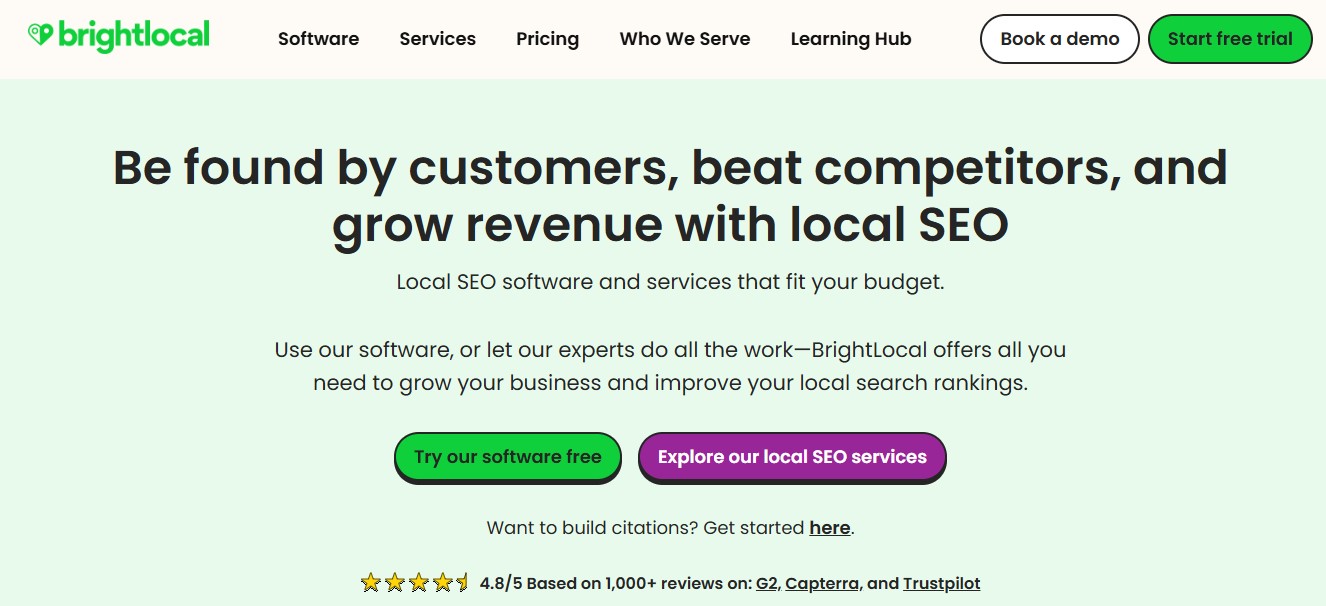
BrightLocal is the strongest choice if you want Google review management tied directly to your local SEO performance.
Unlike tools that treat reviews in isolation, BrightLocal connects your review data to citation building, rank tracking, and local search audits on a single platform.
What stood out in testing: The real-time review alerts are fast, and the competitor benchmarking is genuinely useful. You can see exactly how your review volume, average rating, and response rate compare to local competitors. The review display widgets are basic but functional for embedding reviews on your site.
Best for: Local businesses and agencies that need review management as part of a broader local SEO strategy. If Google Maps visibility matters to your business, BrightLocal is built for that.
Pricing: Track plan at $39/month. Manage plan at $49/month. Grow plan at $59/month.
Limitation: Review request automation is more basic than dedicated tools like Birdeye or Broadly. Not ideal for purely digital brands with no physical location.
How to Choose the Right Google Review Management Tool
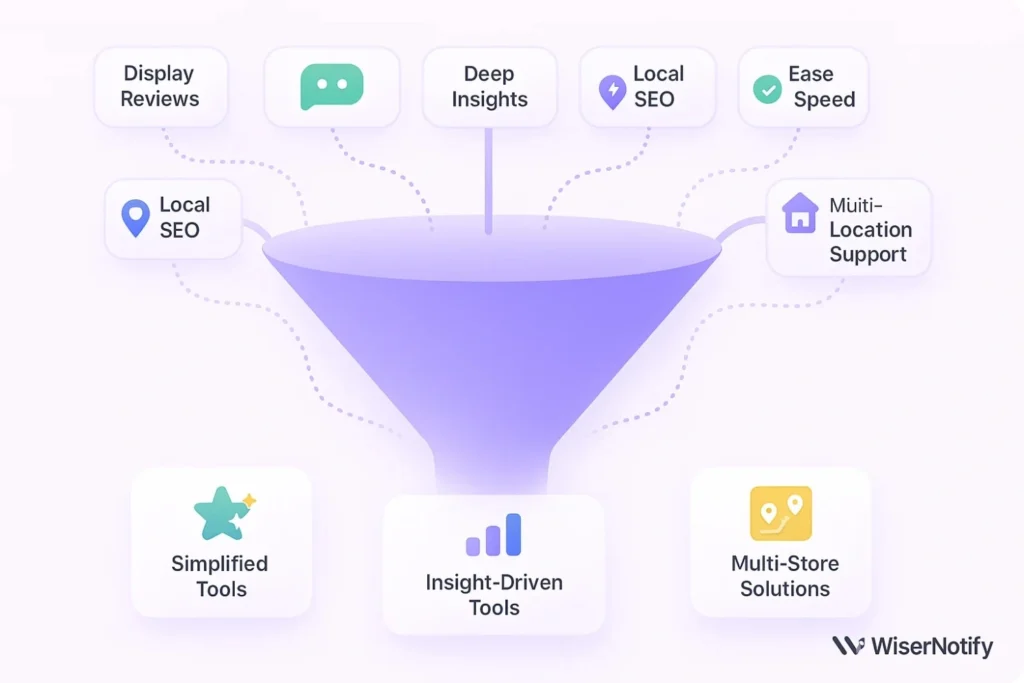
The right tool depends on what problem you’re solving. Here’s a decision matrix based on your primary goal:
Display Google reviews on your website: ReviewOnMyWebsite ($9/month) or WiserReview (free) are the fastest and cheapest options.
Collect more Google reviews: WiserReview, Birdeye, and Broadly all automate review requests. Broadly’s SMS-after-payment trigger works best for service businesses. WiserReview’s WhatsApp + QR code channels work well for retail and restaurants.
Respond to reviews at scale: Birdeye, ReviewTrackers, BrightLocal, and SOCi offer centralized response management. Birdeye’s AI suggestions are the most advanced.
Get deep analytics and insights: ReviewTrackers has the strongest sentiment analysis. BrightLocal provides the best review analytics tied to local SEO data.
Manage 20+ locations: Birdeye, SOCi, or ReviewTrackers. SOCi is best if you also need social media and listing management bundled together.
Win at local SEO: BrightLocal, because it’s the only tool that connects review management to citation building, rank tracking, and local search audits.
Stay under $50/month: WiserReview ($9/month), ReviewOnMyWebsite ($9/month), BrightLocal ($39/month), or ReviewTrackers ($49/month for a single location).
How to Manage Google Reviews Effectively

Having the right tool is only half the equation. Here’s how to use it:
Ask for reviews proactively. Send requests within 24 to 48 hours of a purchase or service. Use a direct Google review link that takes customers straight to the review form. Every extra click between the ask and the review form loses you responses.
Respond to every review. Thank positive reviewers with specific details (“glad you loved the same-day delivery”). For negative reviews, acknowledge the issue, apologize if warranted, and offer to resolve it offline. Never argue publicly. Response speed and consistency directly influence your online reputation and local rankings.
Monitor in real-time. Set up alerts for new reviews. Fast responses to negative reviews prevent small issues from becoming public reputation crises. A one-star review left unanswered for a week does more damage than the review itself.
Analyze feedback for patterns. Use sentiment analysis to identify recurring themes. If 30% of your 3-star reviews mention “long wait times,” that’s not a review problem. That’s an operations problem you can fix.
Display reviews where they convert. Embed your best Google reviews on your website. Place star ratings and social proof near buy buttons, contact forms, and pricing pages. Reviews displayed at the point of decision have the highest impact on conversions.
Flag fake or spam reviews. Report guideline violations through your Google Business Profile. Document the violation clearly. Google’s automated spam detection catches some fake reviews, but manual reporting speeds up removal.
Also check: 17 Best Customer Review Platforms for Every Business Type (2026)
Wrapping Up
The best Google review management tool matches your business size, budget, and primary goal.
Small local businesses can start with WiserReview or ReviewOnMyWebsite for under $10/month.
Service businesses that need SMS-triggered review requests should look at Broadly.
Multi-location brands need the scale of Birdeye, SOCi, or ReviewTrackers. And if local SEO is the priority, BrightLocal is the only tool that integrates reviews into a complete local search strategy.
Whatever tool you choose, the fundamentals don’t change: ask for reviews consistently, respond quickly, analyze the patterns, and display your best reviews where potential customers can see them.
Google reviews aren’t just reputation management. They’re a direct ranking factor for local search visibility. The businesses that manage them well get found first.


