
25 Yelp Statistics for 2026 (Filter & Advertising Data)
Yelp has a review problem most business owners never fully understand. A real share of genuine reviews never make it onto a business’s public rating at all.
They get filtered out by an algorithm Yelp keeps mostly secret, and nobody outside the company can say for certain why one review survives and another does not. Advertising, review timing, and reviewer activity all seem to play a part. Yelp isn’t alone in this, and our fake review and moderation data across platforms shows how every major site handles it.
This page walks through how that filter actually works, what Yelp advertising really costs, and how much a single star rating can move a business’s revenue.

Boost Conversion Instantly
Add Social Proof & Urgency to your website
Key Yelp Statistics
Ten numbers that sum up Yelp right now. Figures are current as of August 2026, based on the latest published data from each source.
| Metric | Latest Figure |
|---|---|
| Yelp’s total revenue in 2025 | $1.46 billion |
| Cumulative reviews hosted on Yelp | 330 million |
| Reviews filtered into “Not Recommended” | About 24% |
| Genuine reviews contractors report losing to the filter | 30% to 50% |
| Paying advertising locations on Yelp | About 496,000 |
| Typical Yelp advertising cost per click | $2 to $10 |
| Revenue swing from a single star rating change | 5% to 9% |
| AI-generated reviews removed by Yelp in 2025 | About 500,000 |
| Fake or suspicious accounts removed in 2025 | About 1.3 million |
| Yelp’s share of local service searches, 2020 vs 2026 | ~45% down to ~15-20% |
How Does Yelp’s Review Filter Work?
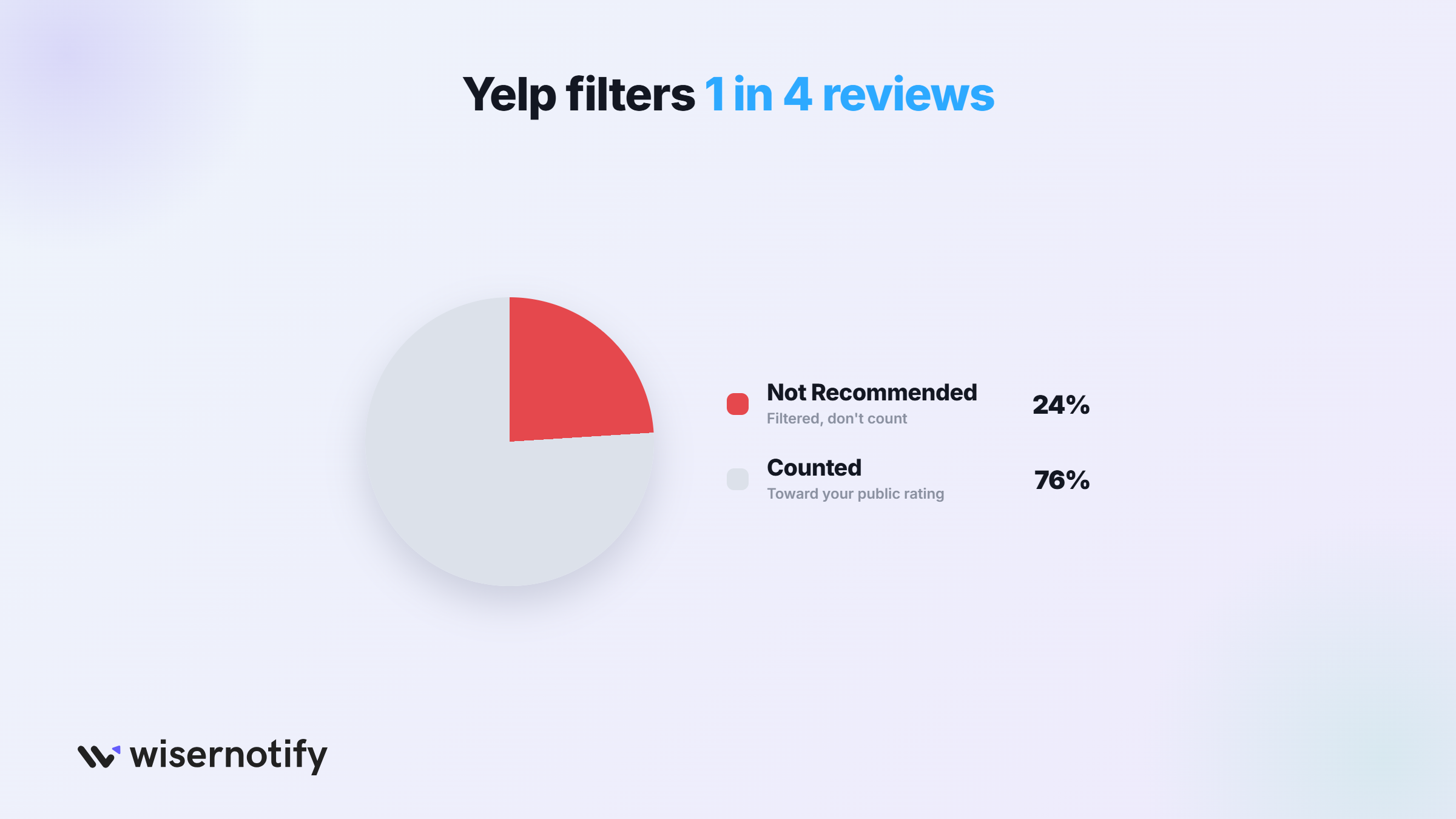
Yelp filters about a quarter of all submitted reviews into a “Not Recommended” section that does not count toward the public star rating, and the exact formula is not public.
1. About 24% of all reviews submitted to Yelp get filtered into the “Not Recommended” section.
2. Contractors and local service businesses commonly report 30% to 50% of their genuine reviews landing in the filter.
Filtered reviews are not deleted, they just do not count toward your public rating unless a visitor clicks through to the “Not Recommended” tab, which most never do, the same trust gap covered in our fake review statistics.
Boost Conversion Instantly
Add Social Proof & Urgency to your website
What Does Yelp Advertising Cost?
Yelp runs on a cost-per-click auction model, similar in structure to Google Ads but with its own pricing dynamics.
3. Yelp’s typical cost per click ranges from $2 to $10, depending on industry and local competition.
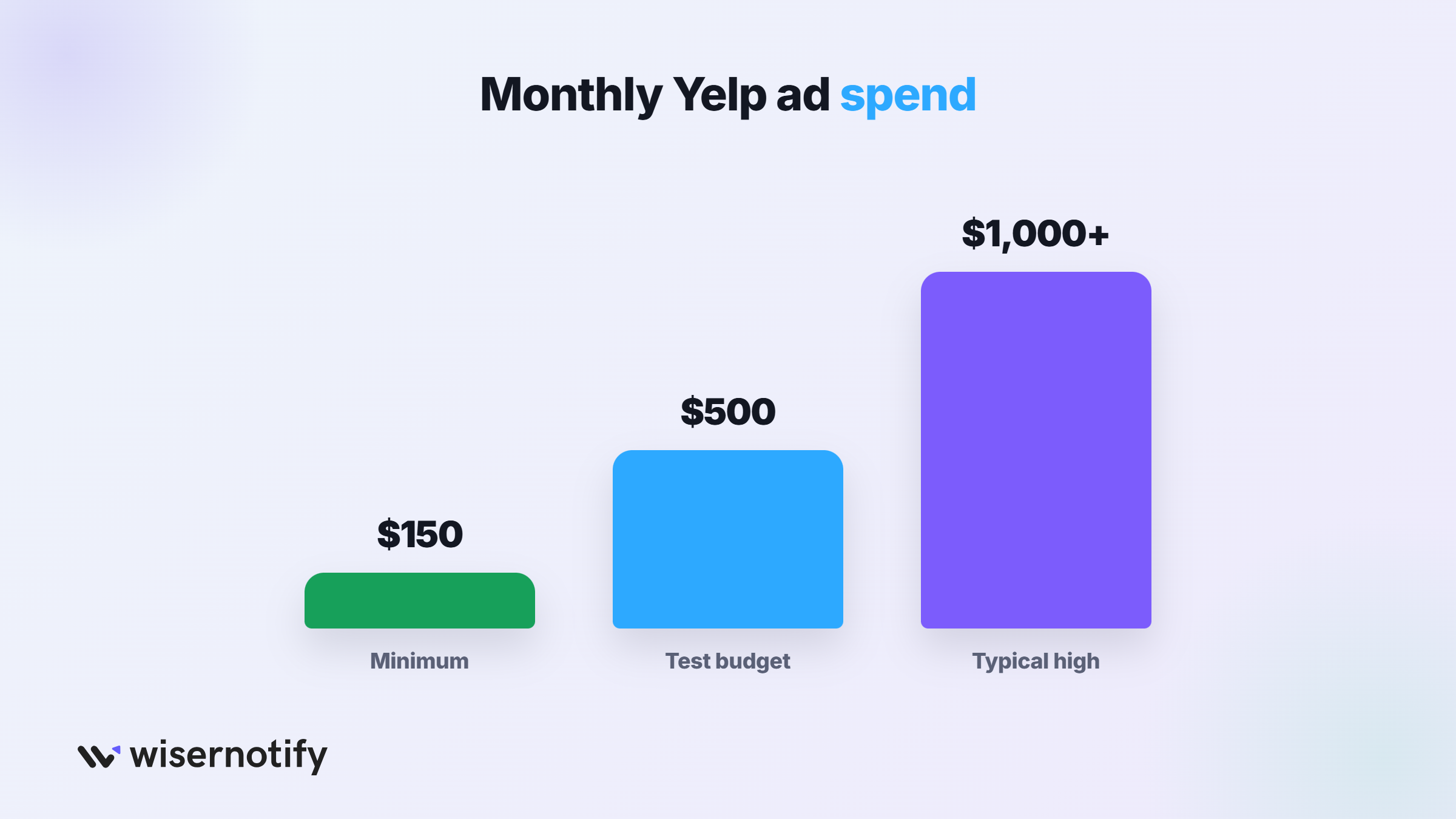
4. Total monthly Yelp advertising spend commonly falls between $150 and $1,000 or more, depending on category and market.
5. Small businesses starting out on Yelp Ads typically budget $500 to $1,000 for their first 30 days of testing.
6. About 496,000 business locations pay for Yelp advertising.
7. Roughly 68% of Yelp’s advertising revenue comes from service-based businesses, with about 32% from restaurants and retail.
Yelp Ads reward businesses that track cost per lead and cost per acquisition closely, not just clicks. A cheap click that never converts is not cheap at all.
Boost Conversion Instantly
Add Social Proof & Urgency to your website
How Is Yelp Fighting Fake and AI-Generated Reviews?
Enforcement has scaled up sharply as AI-written reviews have become easier to produce.
8. Yelp removed an estimated 500,000 suspected AI-generated reviews in 2025.
9. Yelp removed around 1.3 million fake or suspicious accounts in 2025 to protect review quality.
The same filtering system that frustrates legitimate businesses is also the reason Yelp’s review base has not been overrun by obviously fake content, the same pattern covered in our customer experience statistics.
How Many People Use Yelp?
Usage is still large in absolute terms, even as Yelp’s share of local search has shrunk.
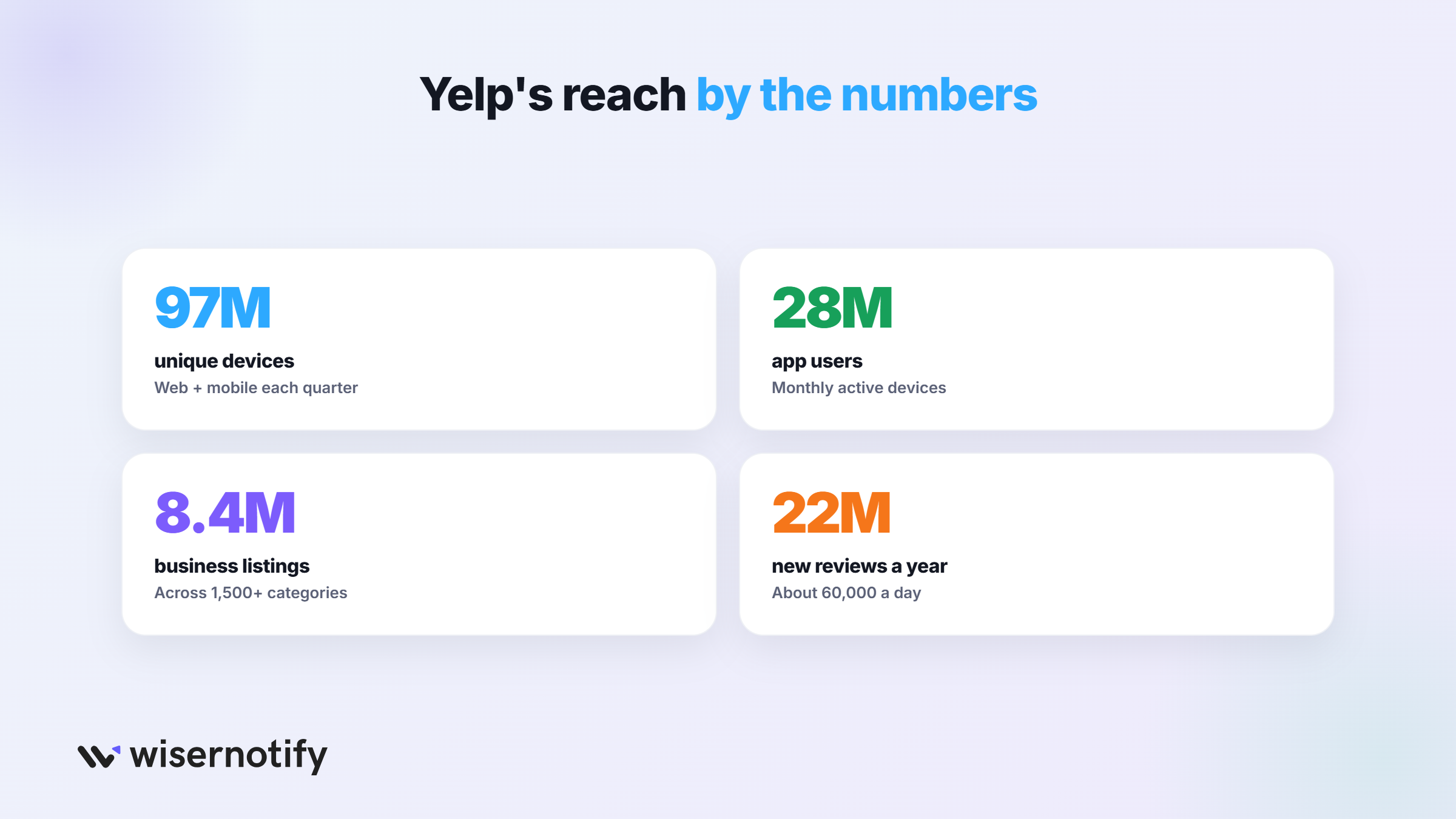
10. The Yelp app averages about 28 million monthly active devices.
11. Yelp records around 97 million unique devices across web and mobile each quarter.
12. About 70% to 75% of Yelp searches happen on mobile devices.
13. Yelp hosts 8.4 million active business listings across more than 1,500 categories.
14. Users add roughly 22 million new reviews a year, close to 60,000 reviews a day.
15. Yelp’s share of local service searches has fallen from around 45% in 2020 to an estimated 15% to 20% by 2026, as Google Business Profile and AI search tools absorb more of that traffic.
Yelp remains a real source of leads, but it is a shrinking share of a growing pie, the same shift covered in our Google review statistics.
Boost Conversion Instantly
Add Social Proof & Urgency to your website
How Much Does a Yelp Rating Move Revenue?
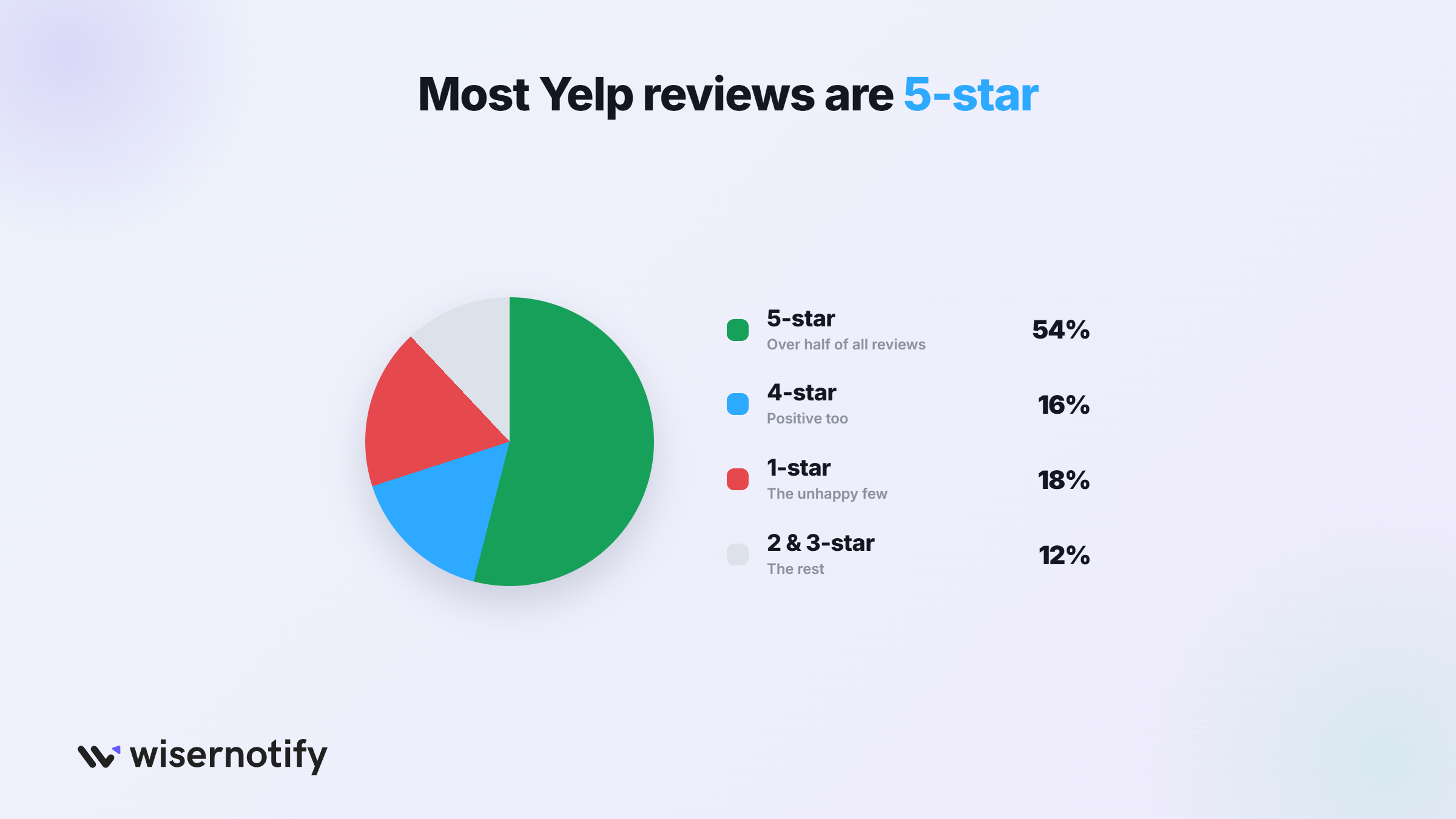
Star rating remains one of the most consistently measured drivers of local business revenue.
16. A one-star increase in Yelp rating is linked to a 5% to 9% increase in business revenue.
17. About 53% to 54% of all Yelp reviews are 5-star, and another 16% are 4-star, meaning the large majority of reviews on the platform are positive.
18. Around 18% of Yelp reviews are 1-star, with 3-star and 2-star reviews making up the remaining smaller share.
19. Home and local service businesses generate about 20% of all Yelp reviews, the largest single category.
20. Restaurants account for around 17% of Yelp reviews, followed by shopping at 15% and beauty and fitness at 11%.
21. 93% of consumers say reviews influence their purchasing decisions.
22. About 77% of consumers say they avoid businesses after reading negative reviews.
23. Nearly 50% of consumers avoid a business with fewer than 20 total reviews, regardless of its average rating.
24. 74% of consumers say they specifically trust reviews written within the last 3 months more than older ones.
25. Yelp generated $1.46 billion in total revenue in 2025, with $146 million in net income.
Rating and review count both matter, but count comes first.
A business needs enough visible reviews before its star average even gets trusted, the same threshold covered in our guide to adding reviews.
How to Use These Numbers
Encourage reviewers to use the Yelp app and leave detailed, specific reviews after an actual visit, since these are the reviews least likely to be filtered.
Track cost per lead and cost per acquisition if you advertise, not just clicks, since Yelp’s CPC auction can look cheap and still lose money.
Do not rely on Yelp alone. Build reputation and review visibility across the platforms your customers search first.
Boost Conversion Instantly
Add Social Proof & Urgency to your website
Conclusion
Yelp still sends real customers to real businesses. It is just a harder platform to win on than the usage numbers alone suggest.
A meaningful share of genuine reviews never count toward a business’s public rating, and nobody outside Yelp can say for certain why. Advertisers see better results, but Yelp says that is not the reason.
Focus on what you can control. Ask for detailed, app-based reviews, watch ad spend against real leads, and treat Yelp as one channel among several, not the whole plan.
Sources
iCatch Marketing | ReputationX | LockedDown SEO | OptimizeUp | Contractor Bear | Digital Silk
Frequently Asked Questions
What are Yelp statistics?
Yelp statistics show data about Yelp users, reviews, business listings, advertising, and revenue. These numbers help explain how the platform is used and how it impacts local businesses.
How do people use Yelp?
People use Yelp to find businesses, read customer reviews, and compare ratings before visiting restaurants, services, or local stores.
Why are Yelp reviews important for businesses?
Yelp reviews help customers understand the quality and reputation of a business. Positive reviews and higher ratings usually attract more customers.
Can businesses respond to Yelp reviews?
Yes. Businesses can reply to both positive and negative reviews on their Yelp business page to communicate with customers and improve trust.
What types of businesses are listed on Yelp?
Yelp lists many types of businesses, including restaurants, home services, shopping stores, beauty services, and other local businesses.

Krunal Vaghasiya is a marketing tech expert who boosts e-commerce conversion rates with automated social proof and FOMO strategies. He loves to keep posting insightful posts on online marketing software, marketing automations, and improving conversion rates.




 Capterra