
50 Online Review Statistics 2026: Trends, Fake Reviews & AI
People check reviews before they trust a business. It only takes a few seconds.
Those habits are changing fast. Shoppers now check more sites, expect quicker replies, and often find a business through an AI tool instead of a search bar.
Here is what the 2026 data shows about reviews, from platform growth to fake review crackdowns to where AI fits in.
Key Online Review Statistics
| Metric | Figure |
| Consumers who wrote a review in the past 12 months | 69% |
| Consumers who expect a response to their review | 89% |
| Policy-violating reviews Google removed in one year | 240 million |
| Consumers who leave local reviews on Google | 45% |
| Conversion lift from displaying reviews on higher-priced products | 380% |
| Average business review response rate | 56% |
| Maximum FTC fine per fake review violation | $53,088 |
| Yelp’s cumulative reviews as of 2026 | 330 million |
| Consumers aged 18-34 who have written a review | 80% |
| Global cost of fake reviews to consumers in 2025 | $770.7 billion |

All your reviews in one place
Collect reviews, manage every response, and display them where they matter most.
How Many People Write Online Reviews?
Online reviews are now part of everyday consumer behavior. Most internet users have either written or read reviews before making purchasing decisions.
Annual Review Writing Behavior
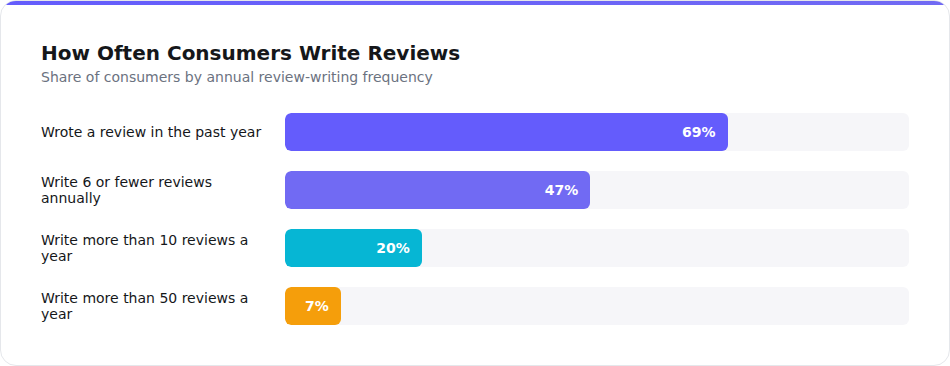
1. 69% of consumers wrote an online review in the past 12 months.
2. The average consumer writes 4 to 6 reviews per year.
3. 47% of consumers write six or fewer reviews annually.
4. 20% write more than 10 reviews per year.
5. 7% write more than 50 reviews annually.
A small group of highly active reviewers can strongly influence a business’s average star rating and online reputation.
The Power of Asking for Reviews
6. 78% of consumers were asked to write a review in the past year.
7. 65% of those asked wrote one.
Review generation is often about process, not persuasion.
Businesses that manage review requests through email, SMS, or point-of-sale prompts gain more reviews than those that wait for customers to act on their own.
Also Read: 37 Ultimate List of Video Testimonial Statistics for 2026
Online Review Growth by Major Platforms
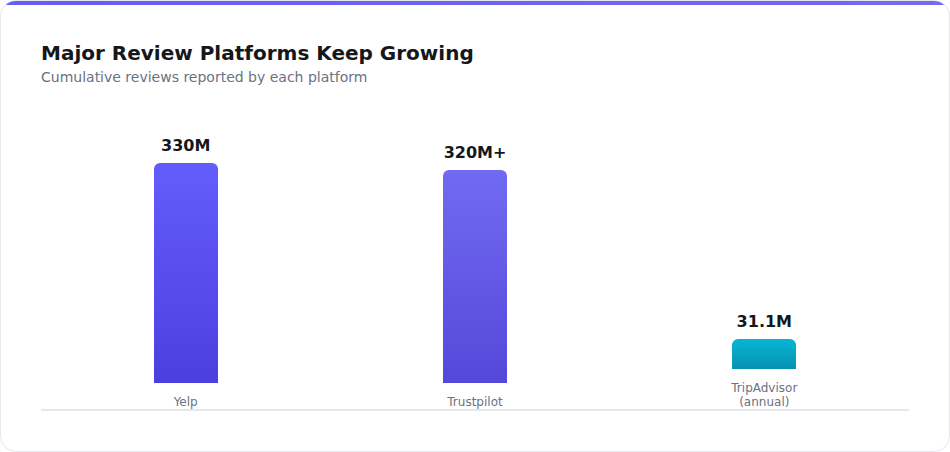
Review platforms keep growing as more consumers read reviews before making purchasing decisions. Here is how the major platforms are expanding.
Yelp Statistics
8. Yelp grew from 121 million cumulative reviews to 330 million.
9. Yelp added 21 million new reviews in one year.
More reviews increase visibility and strengthen a business’s online reputation, especially for local businesses.
Trustpilot Statistics
10. Trustpilot grew from 167 million cumulative reviews to over 320 million.
11. More than 61 million reviews were written on Trustpilot in one year.
As more consumers turn to online reviews, maintaining a positive presence on platforms like Trustpilot can boost sales and influence purchasing decisions.
Tripadvisor Statistics
12. TripAdvisor recorded 31.1 million review submissions in one year.
In high-commitment purchases like travel, the number and quality of reviews strongly influence booking decisions.
All your reviews in one place
Collect reviews, manage every response, and display them where they matter most.
Where Consumers Leave Reviews (Platform Share)
Consumers rarely rely on just one review platform. Before buying, most check ratings and feedback across several sites, from local business reviews to online product reviews.
Local Business Platforms
For local businesses, Google reviews dominate. Because Google is tied directly to search and maps, it plays the biggest role in how customers discover and evaluate a business.
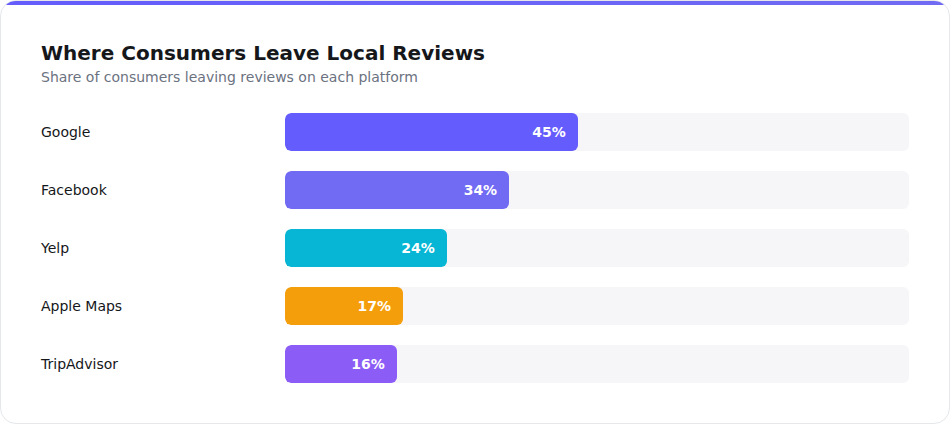
13. 45% of consumers leave local business reviews on Google.
14. 34% leave reviews on Facebook.
15. 24% leave Yelp reviews.
16. 17% leave reviews on Apple Maps.
17. 16% leave reviews on TripAdvisor.
18. 83% of consumers use Google to find local business reviews.
Because consumers check reviews directly in search results, Google-based reviews strongly impact online reputation and local rankings.
Ecommerce and Product Reviews
In online shopping, product reviews are often the final deciding factor before a purchase.
19. 94% of shoppers read Amazon reviews.
20. 91% read reviews on retailer websites.
21. 70% use search engines during brand research.
Online retailers depend heavily on customer reviews to drive sales. The number of reviews and the overall rating often influence buyers more than the product description alone.
B2B Software Review Platforms
In B2B markets, reviews influence high-value software and service purchases too. Decision-makers use review platforms to compare vendors and reduce risk.
22. G2 hosts over 3 million software reviews.
23. Capterra has over 2.5 million verified reviews.
24. Gartner Peer Insights reports 820,000+ verified ratings and reviews.
25. TrustRadius reports 500,000+ reviews and ratings.
For B2B businesses, online reviews influence pipeline growth, vendor trust, and long-term contracts, much like personal recommendations do for consumers.
Online Review Ratings and Sentiment Trends
When consumers read reviews, they usually check the average rating, the number of reviews, and the overall tone of the feedback.
Are Reviews Mostly Positive?
26. 65.8% of Tripadvisor reviews are 5-star ratings.
27. 7.2% are 1-star ratings.
28. The average star rating is 4.30 out of 5.
29. 60% of consumers are more likely to share a positive experience than a negative one.
30. The optimal rating range for conversions is 4.0 to 4.7 stars, since anything above that often triggers skepticism about authenticity.
While positive reviews dominate, negative reviews still shape online reputation. Most consumers read both to get a full picture before buying.
Fake Review Statistics and Moderation Data
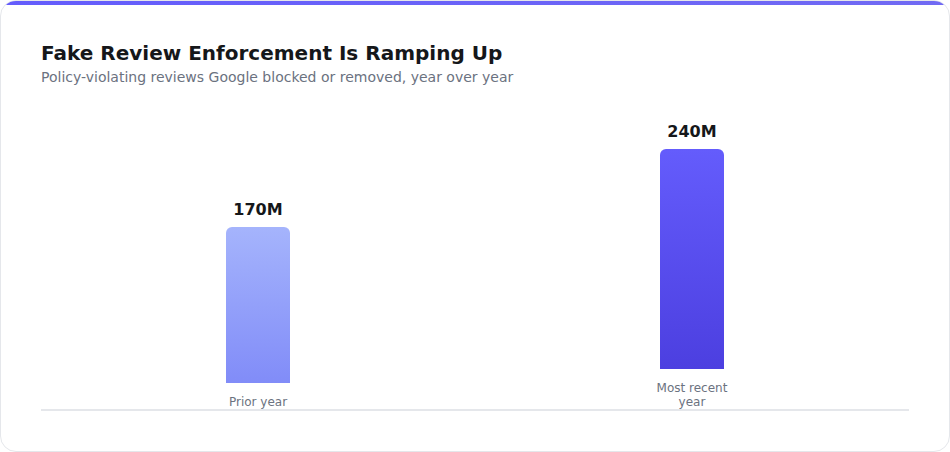
Fake reviews remain a major concern across every platform. As trust in reviews grows more valuable, both platforms and regulators are increasing enforcement.
Google Enforcement Data
31. Google blocked or removed 240 million policy-violating reviews in one year, up from 170 million the year before.
Strong moderation helps maintain trust in Google-based reviews and search results.
Platform-Reported Fake Review Rates
32. 4.4% of Tripadvisor submissions were identified as fake.
33. 72% of fake Tripadvisor reviews were caught before posting.
34. 7.4% of Trustpilot submitted reviews were removed as fake.
Regulatory Enforcement Is Rising
35. The FTC can now fine businesses up to $53,088 per fake or deceptive review under its 2024 Consumer Review Rule.
36. The FTC sent its first formal warning letters over fake reviews to 10 companies in December 2025, followed by its first enforcement actions in 2026.
37. Fake reviews are estimated to have cost consumers $770.7 billion globally in 2025.
Because consumers read reviews before making a purchase, strong moderation and enforcement matter.
Reviews only influence buying decisions when people believe they are genuine.
Fake reviews are one part of a wider fraud problem for online stores, alongside chargebacks, refund abuse and bot traffic, covered in these payment fraud and chargeback statistics.
Review Response Statistics and Benchmarks
Online reputation is no longer just about collecting reviews. It is about responding to them.
Consumer Expectations
38. 89% of consumers expect a response to their review.
39. 51% expect a response within one day.
Fast responses are becoming part of the standard customer experience.
Replying quickly to both positive and negative reviews increases trust and purchase likelihood.
Business Performance Benchmarks
40. The average business response rate is around 56%.
41. The average response time is about 4 days.
That gap between what consumers expect and what businesses deliver can hurt online reputation more than the reviews themselves.
All your reviews in one place
Collect reviews, manage every response, and display them where they matter most.
Demographics and Device Trends
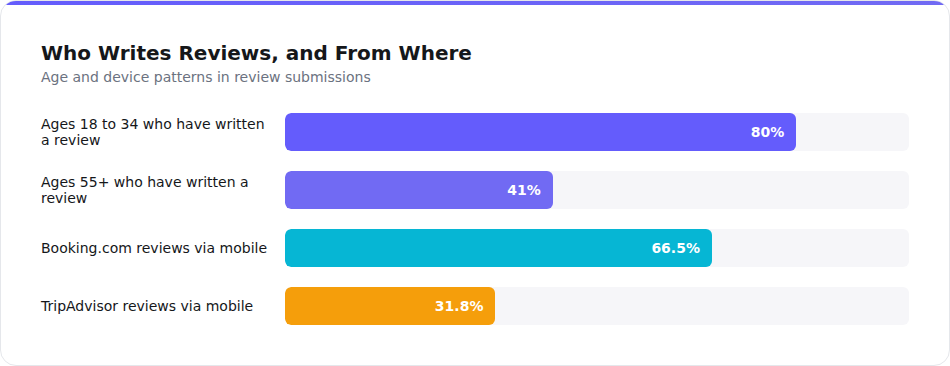
Review behavior is not the same across every consumer. Age group and device both shape how people read and write reviews.
Age-Based Review Behavior
42. 80% of consumers aged 18 to 34 have written online reviews.
43. 41% of consumers over 55 have written reviews.
Younger consumers are more likely to read reviews, leave feedback, and use review sites during brand research and purchase decisions.
Mobile vs Desktop Review Submissions
44. 66.5% of reviews on Booking.com were submitted via mobile.
45. 31.8% of reviews on Tripadvisor were submitted via mobile.
Mobile behavior varies by platform, but the trend shows reviews are increasingly tied to on-the-go consumer behavior.
Also Read: 50+ Testimonial Statistics Every Marketer Must Know in 2026
AI and Answer Engine Discovery Statistics
Consumers no longer only find businesses through a Google search box.
AI tools are becoming a real discovery channel, and reviews are the data feeding them.
46. AI tools jumped from 6% to 45% of local business discovery in a single year.
47. 62% of consumers say they are worried AI could be impersonating people to leave fake product reviews.
48. 88% of consumers oppose AI-generated reviews on review platforms.
Answer engines like ChatGPT, Perplexity, and Google AI Overviews pull from the same review data that ranks a business in search.
A business with thin or outdated reviews is less likely to get cited when someone asks an AI which business to choose.
The businesses positioned to benefit are the ones with a steady stream of genuine, recent, detailed reviews.
That kind of content is exactly what both search engines and AI models treat as trustworthy.
Do Online Reviews Impact SEO and Sales?
Online reviews do more than build reputation. They directly affect search visibility and purchasing decisions.
Reviews and Local Rankings
Google has stated that more reviews and positive ratings can help a business rank higher in local search results.
Businesses with more reviews and a strong average rating tend to rank higher in local search. This creates a simple growth cycle for local businesses: more reviews lead to better visibility.
Better visibility brings more prospective customers, which in turn brings more new clients.
Reviews and Conversion Rates
49. Displaying reviews increased conversion rates by 190% for lower-priced products.
50. Displaying reviews increased conversion rates by 380% for higher-priced products.
Purchasing decisions are strongly influenced by customer reviews, and the effect grows stronger as the price of the product goes up.
Key Takeaways for Businesses
Online reviews directly impact reputation, search visibility, and purchasing decisions, whether consumers are checking Google, Yelp, or Amazon.
- Consumers read reviews before buying. Reviews influence purchases as much as personal recommendations.
- More reviews improve visibility. A higher review count and strong average rating help local businesses rank better.
- Positive reviews boost sales. They increase purchase likelihood, especially in online shopping.
- Fast responses matter. Replying quickly improves customer experience and builds trust.
- Authenticity is no longer optional. With FTC fines now reaching $53,088 per violation, fake or incentivized reviews carry real financial risk.
- AI is a new discovery channel. Genuine, recent reviews are what answer engines cite when recommending a business.
Businesses that actively manage reviews attract more new clients and build a stronger online reputation.
All your reviews in one place
Collect reviews, manage every response, and display them where they matter most.
Conclusion
Reviews still decide who gets picked. Winning in 2026 does not mean zero bad reviews, it means showing up and staying honest.
Fake reviews now carry real financial risk, and AI tools read reviews as closely as customers do.
Keep the reviews coming, keep them recent, and keep every reply honest. That is what builds trust that lasts.
Sources
BrightLocal | Google | FTC | Yelp | TripAdvisor | Northwestern University Spiegel Research Center | Trustpilot | Review42 | PissedConsumer | Capital One Shopping
Frequently Asked Questions
Do consumers read online reviews before making a purchase?
Yes. Most consumers read online reviews before making purchasing decisions, especially for local businesses and online shopping.
How many reviews does the average consumer write?
The average consumer writes about 4–6 online reviews per year.
Do Google reviews affect local rankings?
Yes. Google states that more reviews and positive ratings can improve local search visibility.
How common are fake reviews?
Fake or compensated reviews exist, but major review platforms remove millions of policy-violating reviews each year.
Do online reviews increase sales?
Yes. Customer reviews increase purchase likelihood and can significantly boost conversion rates.

Krunal Vaghasiya is a marketing tech expert who boosts e-commerce conversion rates with automated social proof and FOMO strategies. He loves to keep posting insightful posts on online marketing software, marketing automations, and improving conversion rates.




 Capterra