
Why Product Reviews Matter (and How to Get More)
 Krunal Vaghasiya|Jun 17, 2024
I’ve spent the last five years building tools that put reviews and social proof in front of shoppers. WiserNotify alone runs on more than 10,000 sites now.
So when I tell you product reviews matter, it’s not a hunch. I’ve watched the numbers on real stores, and the pattern never changes.
The stores that win aren’t the ones with the slickest product pages. They’re the ones with reviews stacked up under every product.
A page with 200 reviews and a 4.6 rating basically sells itself. A page with zero? Most shoppers won’t gamble on it.
Here’s what I want to walk you through: what a product review is, why it carries this much weight, what it does for your store, and how to get more without begging. Let’s get into it.
What is a product review?
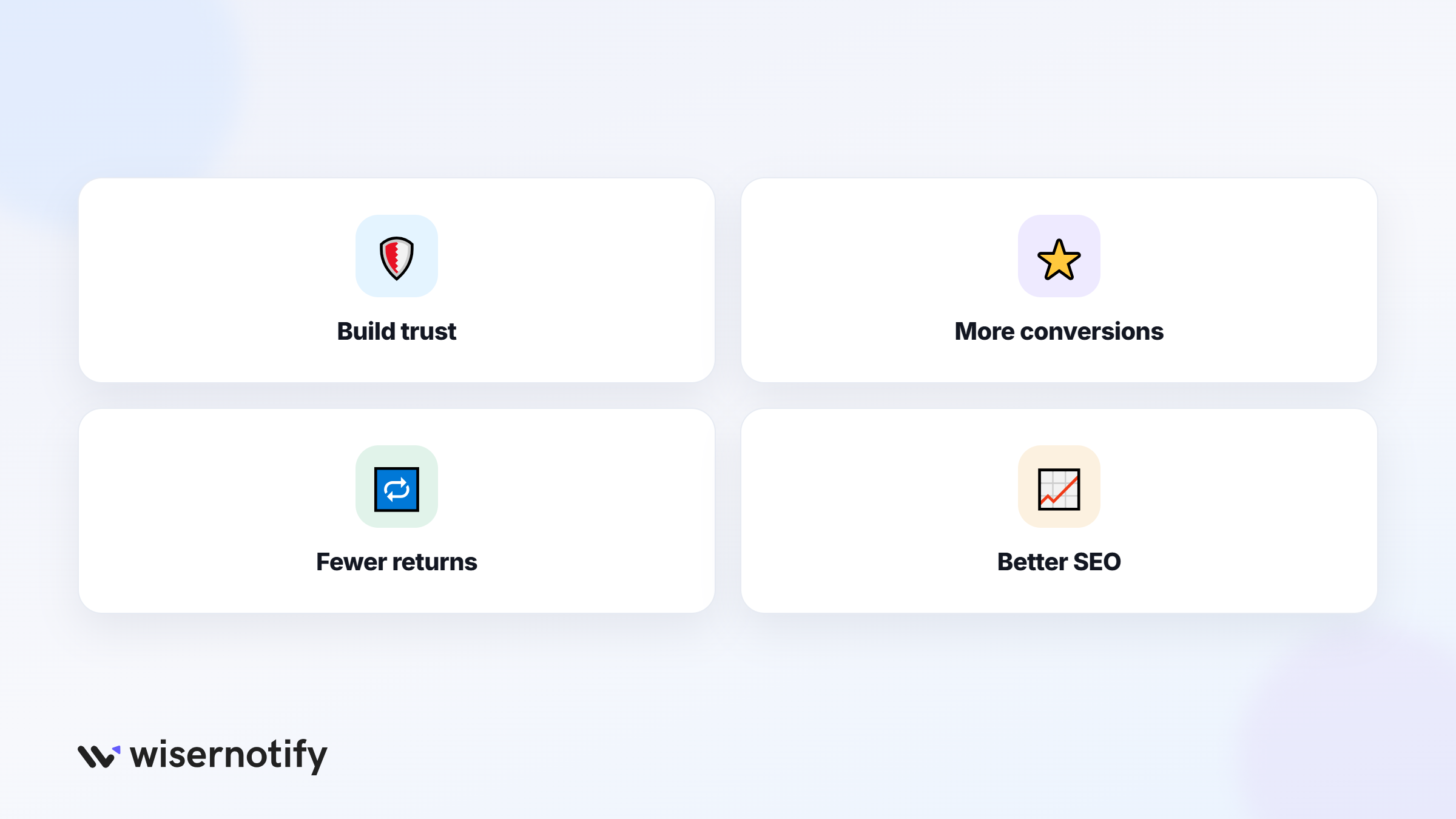
A product review is feedback from someone who bought and used your product. It can be a quick star rating, a written note, or a photo or video of the thing in real life.
Reviews sit on your product page, but they also travel. They feed Google’s star ratings, and they now shape what tools like ChatGPT and Perplexity say when a shopper asks for a recommendation.
The short version: a review is one customer telling the next one whether your product is worth it, and product reviews drive more sales than almost anything else on the page.
Types of product reviews
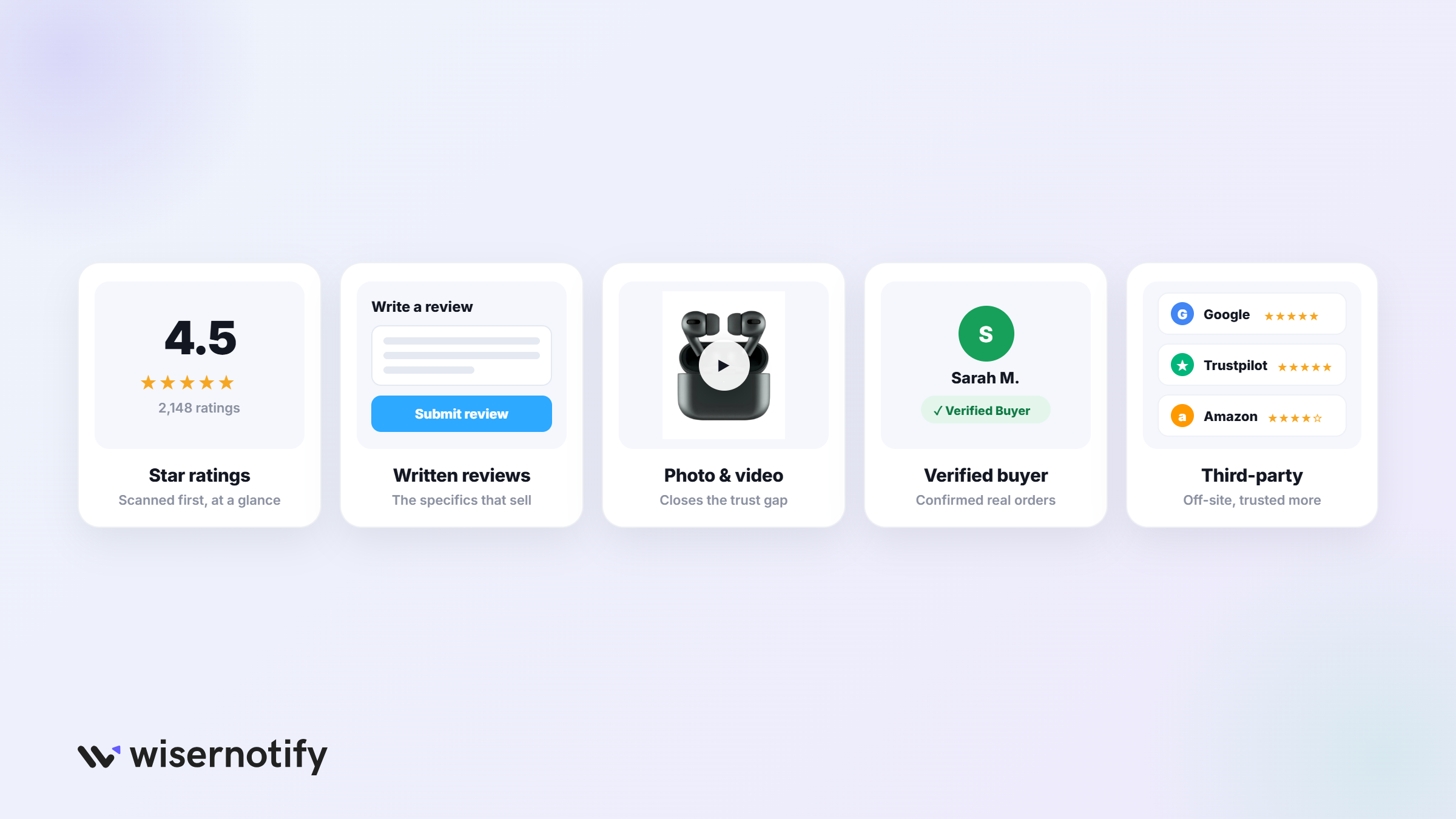
Not all reviews look the same, and each type pulls a slightly different weight with shoppers. Here are the main ones you’ll deal with.
1. Star ratings
The quick 1-to-5 snapshot most shoppers scan first. Fast to leave, easy to compare, but thin on detail on their own.
- Great for at-a-glance judgment on listing and category pages.
- Best paired with written feedback, since a number alone answers nothing specific.
2. Written reviews
The workhorse. A few sentences from a real buyer that answer the questions your product page skips.
- They carry the specifics: fit, durability, whether it matched the photos.
- The more detailed and recent, the harder they sell.
3. Photo and video reviews
Visual proof from a buyer, showing the product in real life instead of a studio shot. This is the type that closes the trust gap fastest.
- Shoppers see the true color, size, and quality before they buy.
- A form of user-generated content you can also reuse in ads and email.
4. Verified-buyer reviews
Reviews tagged to a real, confirmed order. The badge tells shoppers this came from someone who paid for the product.
- They read as more trustworthy than anonymous feedback.
- Worth flagging clearly, since verified reviews lift conversion on their own.
5. Third-party reviews
Feedback that lives off your site, on Google, Trustpilot, Amazon, or niche platforms like G2 and Capterra. You don’t control them, which is exactly why shoppers trust them.
- They shape your reputation before a shopper ever reaches your page.
- Worth monitoring and replying to, even though they’re not on your domain.

All your reviews in one place
Collect reviews, manage every response, and display them where they matter most.
The importance of product reviews, by the numbers
I’m not a fan of throwing stats around for the sake of it. But these ones make the case, so here they are:
- 96% of consumers check reviews before a first-time purchase (Clutch)
- 93% say online reviews shape their buying decisions (DemandSage)
- Products with 5+ reviews are 270% more likely to sell than those with none (Spiegel Research)
- Showing reviews lifts sales by around 18% on average (FastSimon)
- 74% of shoppers want reviews from the last three months (BrightLocal)
- Only 20.5% trust a business showing 100% positive reviews (Forbes)
That last one always surprises people. A perfect score doesn’t build trust, it kills it. More on that later.
Also check: our full roundup of online review statistics if you want the deeper data.
Why product reviews matter so much
Reviews pull double duty. Some of the value lands with your shopper, some lands with your business, and the best reviews do both at once. Here are the eight reasons I keep coming back to.
1. They help shoppers decide with confidence
This is the one most guides skip, and it’s the biggest. Reviews are for the buyer first. Online, nobody can touch or try your product, so they borrow the experience of people who already did.
That’s what closes the gap between interest and purchase. A shopper reads a few reviews, pictures exactly what they’re getting, and buys without second-guessing.
- They answer the specifics your page skips: does it run small, does the battery hold up, is it worth the price.
- They remove the “what if it’s not what I expected” fear that kills online sales.
- A confident buyer checks out faster, is happier on delivery, and returns the product far less often.
2. They build trust before you say a word
A new visitor has no reason to trust you yet. You’re a logo they’ve never heard of, making a claim about your own product. Of course they’re skeptical.
Reviews fix that instantly, because they come from people with nothing to sell. That’s the foundation of trust in your online store, built before you say a word.
- Shoppers trust other buyers far more than they trust your marketing copy.
- A wall of real feedback settles the quiet doubts your own words can’t.
- Verified-buyer badges push that trust higher, since they prove the review came from a real order.
3. They push hesitant shoppers over the line
On the fence is where most sales quietly die. Someone likes your product but isn’t quite sure, so they leave to “think about it” and never come back.
A good review answers the exact thing holding them back, and that’s often all it takes. Even the jump from zero reviews to one can lift purchase rate by around 65%.
- One specific detail, like how a size runs, flips a maybe into a yes.
- A realistic mix of ratings reassures more than a suspicious wall of perfect fives.
- Fresh reviews carry the most weight, since 74% of shoppers want feedback from the last three months.
4. They grow your sales, especially with new customers
Trust and confidence add up to orders, and the effect is measurable. Products with five or more reviews are 270% more likely to sell than those with none.
The impact is strongest exactly where you need it. First-time buyers carry the most doubt, and the pricier the product, the harder they lean on other buyers before committing.
- Displaying reviews lifts conversion by 190% on lower-priced items and up to 380% on higher-priced ones (Spiegel Research).
- New visitors convert at a fraction of the rate without social proof from past buyers.
- The biggest jump comes in the first handful of reviews, so getting off zero is the urgent job.
5. They spread word of mouth that never stops
A friend’s recommendation reaches one person. A written review reaches every shopper who lands on that page, for years, without you lifting a finger after it’s posted.
And people trust it like a personal tip. In a BrightLocal survey, 79% of consumers said they trust online reviews as much as a recommendation from a friend or family member.
- One strong review works around the clock, long after the customer wrote it.
- You can pull the best quotes into ads, emails, and landing pages for even more reach.
- It’s word of mouth at a scale you could never hit by hand.
Also check: the data behind this in our word of mouth marketing statistics.
6. They cut down your returns
Nobody talks about this one, but it’s real money. The average ecommerce return rate now sits around 19 to 20%, and every return eats shipping, restocking, and margin.
Honest reviews set the right expectations before the box is even opened, so buyers know what’s coming and order the right thing the first time.
- Notes on fit, size, and quality stop the wrong-guess purchases that come straight back.
- Fewer surprises means fewer returns, which protects both your margin and your reputation.
- Apparel, where sizing drives most returns, benefits the most from detailed buyer feedback.
7. They lift your search and AI visibility
Every review drops fresh, customer-worded text onto your page, and search engines love that. It happens on its own, without you writing a thing.
Reviews also feed the systems that decide what shoppers see. That reach now stretches well past traditional search results.
- They power the star ratings, including Google reviews, that show up next to your listings and ads, lifting click-through.
- Fresh review content signals an active, relevant page to Google.
- They increasingly shape what AI assistants like ChatGPT and Perplexity say when a buyer asks for a recommendation.
8. They tell you what to fix
Complaints sting, I get it. But they point straight at the problem, and that’s worth more than it feels like in the moment.
Reviews are the cheapest, most honest feedback loop you’ll ever run. Customers tell you exactly what’s wrong, in their own words, for free.
- When three different buyers flag the same issue, that’s sharper data than any survey.
- Recurring complaints point to a fix in the product, the description, or the shipping.
- Fix the cause, and the next batch of reviews improves on its own.
What it costs you to skip reviews
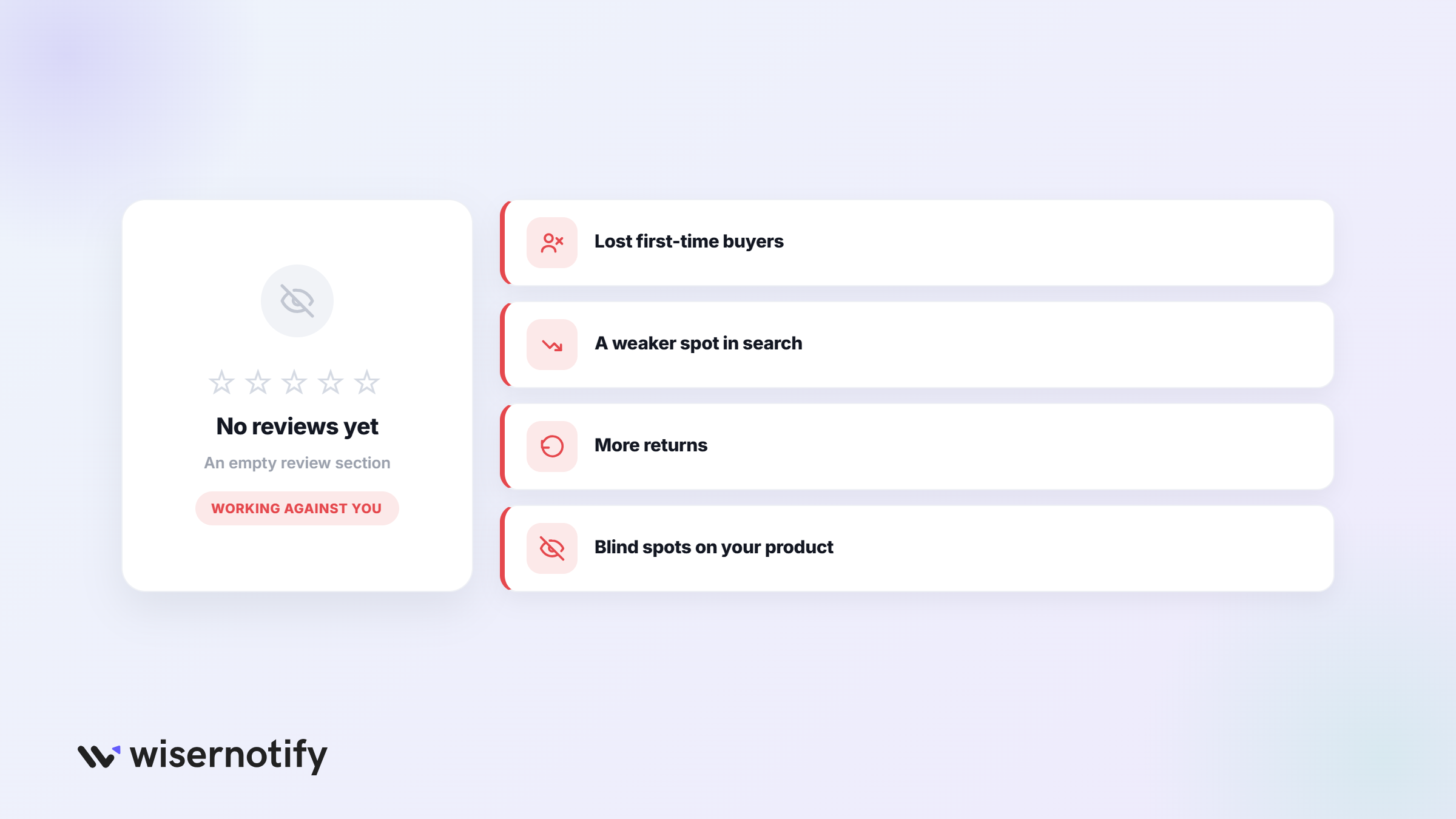
The importance of reviews shows up clearest when they’re missing. An empty review section doesn’t sit there neutral. It works against you.
Here’s what that quietly costs:
- Lost first-time buyers. New visitors have nothing to reassure them, so most bounce to a competitor whose page shows real feedback.
- A weaker spot in search. No reviews means no fresh content and no star ratings, so your listing looks thinner than the ones around it.
- More returns. Without buyer notes on fit or quality, shoppers guess, and wrong guesses come back to you as returns.
- Blind spots on your own product. You miss the steady feedback that would’ve told you what to fix, so problems stick around longer than they should.
None of this shows up as a line on a report, which is exactly why it gets ignored. Meanwhile the store two clicks away with a wall of reviews isn’t leaking any of it.
How to get more product reviews
A steady flow of reviews rarely just happens. You need a light system that runs on its own. Here’s what works:
- Automate the ask. Fire a request a few days after delivery, while the product’s still fresh in their mind.
- Kill the friction. A one-click form with an optional photo prompt beats a long survey every single time.
- Ask for specifics. A prompt like “how did the fit run?” pulls the detailed, recent, photo-backed reviews that sell, not a bare “great product.”
- Reply to the ones that matter. Thank the happy ones, handle the unhappy ones in public where everyone can see you show up.
- Act on the repeats. When the same complaint keeps coming, fix the cause, and the reviews improve on their own after that.
If you want the word-for-word approach, our guides on how to ask for reviews and what a good product review looks like go deeper.
Where to put reviews for the most impact
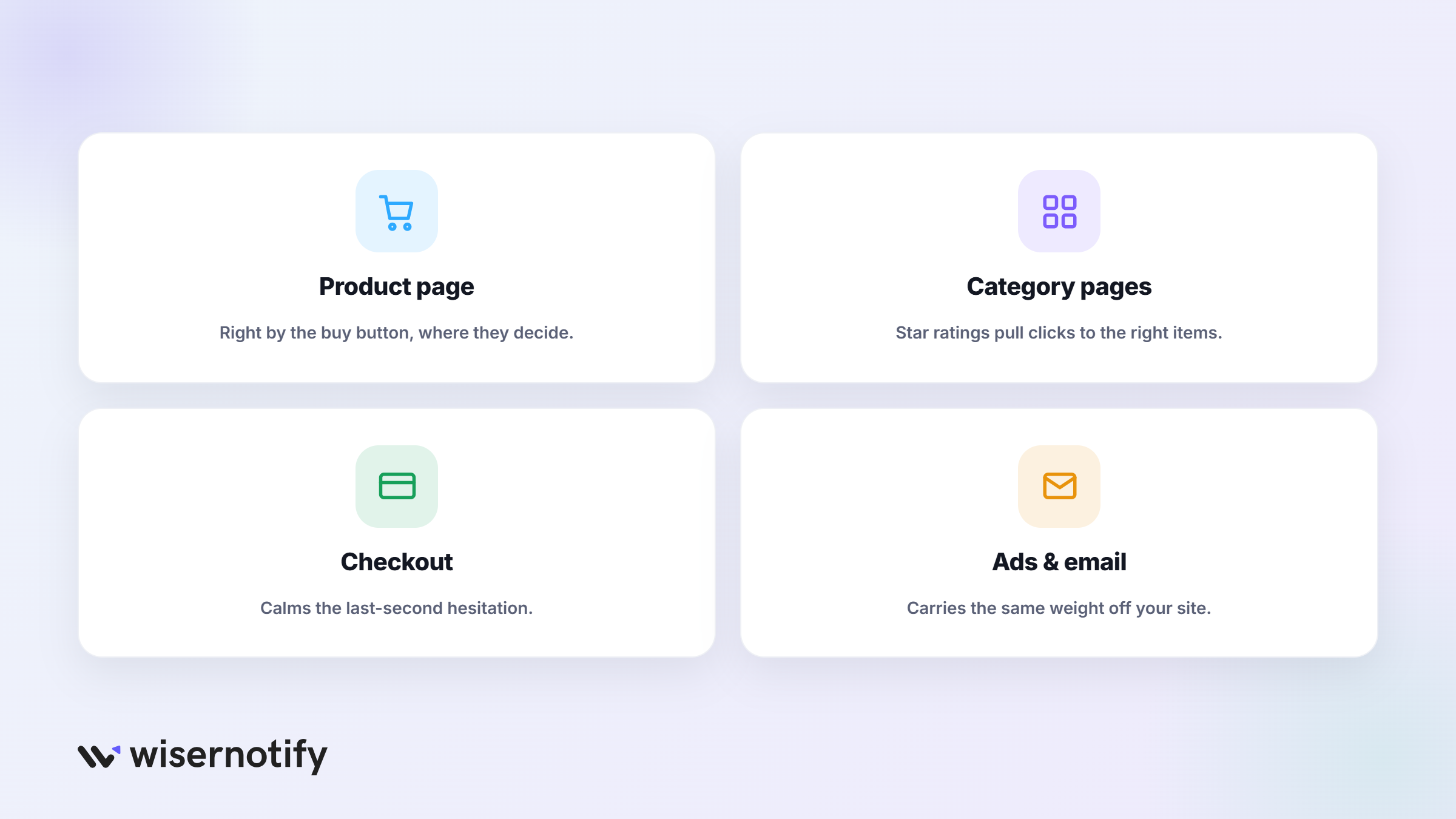
Collecting reviews is only half of it. Where you show them decides how much they move the needle.
- Product page, right by the buy button: proof works best at the exact second someone’s deciding, not buried on a separate tab.
- Collection and category pages: star ratings next to each item pull more clicks toward the products worth buying.
- Checkout: a little reassurance here calms that last-second hesitation before payment.
- Ads and email: a strong quote or rating carries the same weight outside your site, like these social proof examples, as it does on it.
One rule holds everywhere you show them: keep them honest. Roughly 1 in 3 online reviews may be fake, and shoppers can smell a page of flawless fives.
A realistic mix plus clear verified-buyer badges beats a perfect score every time. Our fake review statistics have the full picture.
Collect and display product reviews with WiserReview
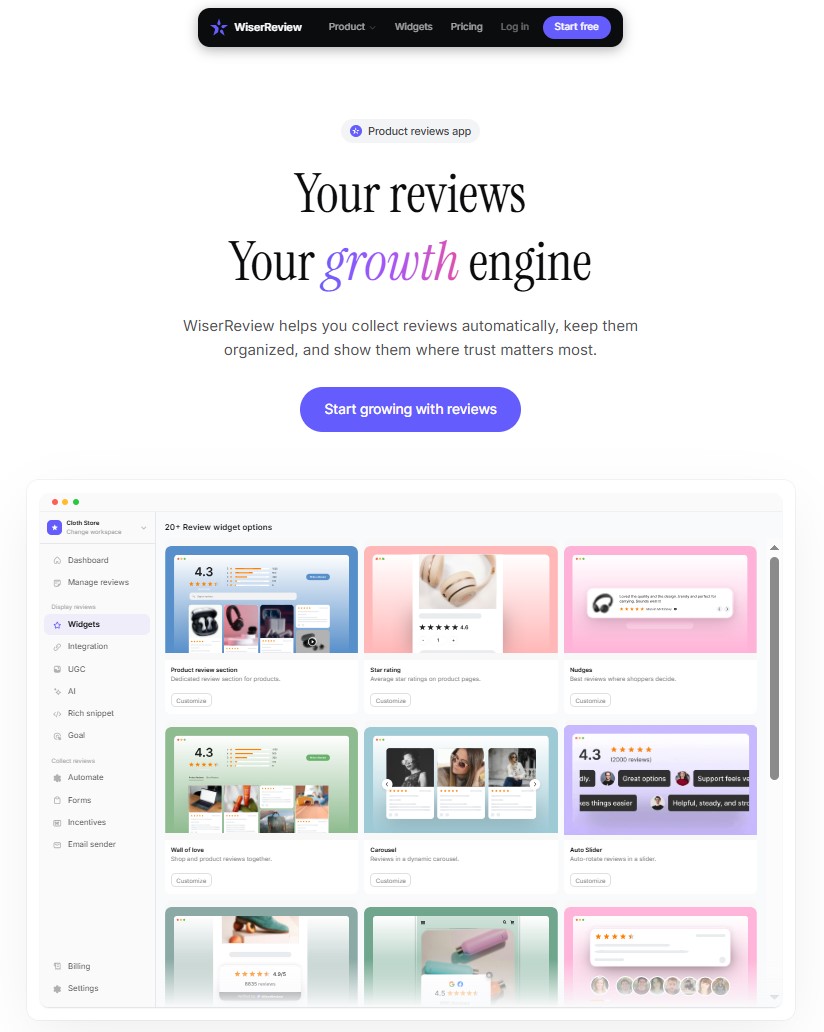
Knowing why reviews matter is one thing. Getting them collected and shown on the page is another job entirely, and that is what WiserReview handles.
The parts that do most of the work:
- Automated requests by email, SMS, or WhatsApp, sent after delivery so nobody has to chase customers.
- Photo and video reviews on every plan, including the free one, so shoppers see the product in real life.
- Verified-buyer labels that mark which reviews came from real orders.
- Display widgets that place reviews on the product page, where the decision happens.
- Support for Shopify, WooCommerce, BigCommerce, Wix, Squarespace, and custom builds.
The free plan covers the basics, which makes it easy to see whether the setup fits your store.
All your reviews in one place
Collect reviews, manage every response, and display them where they matter most.
The bottom line
Reviews are the cheapest, longest-lasting way I know to build trust, lift sales, sharpen your search presence, and learn what to fix. All from one source.
The stores that pull ahead treat them as core infrastructure, not a nice-to-have.
Collect them steadily. Show them where people decide. Keep them honest. Reply to the ones that count.
Do that, and your customers end up doing your best selling for you.
Krunal Vaghasiya is a marketing tech expert who boosts e-commerce conversion rates with automated social proof and FOMO strategies. He loves to keep posting insightful posts on online marketing software, marketing automations, and improving conversion rates.




 Capterra