
FOMO Notifications: 5 Types, Examples & Best Practices (2026)

You’re browsing a product page. A small notification slides in from the corner: “James from London just purchased this.”
Two minutes later, another one: “Only 3 left in stock.” By the time you see the countdown timer showing 14 minutes until the sale ends, you’re reaching for your card.
That’s FOMO notifications working exactly as they’re designed to. FOMO, Fear Of Missing Out, is a reliable psychological trigger in conversion optimization.
When implemented correctly, FOMO notifications turn passive browsing into urgent action by showing visitors what they’re about to miss.
This guide covers what FOMO notifications are, the psychology that makes them work, the five types that drive the most conversions, and how to use them without annoying the people you’re trying to convert.
What Are FOMO Notifications?

FOMO notifications are small, non-intrusive alerts that appear on a website to show real-time activity or create a sense of urgency around a product or offer.
They work by tapping into a fundamental human behavior. We value things more when others want them, and we act faster when we think we might miss out.
Unlike traditional popups that interrupt the browsing experience with a full-screen offer, FOMO notifications appear as compact overlays.
Typically in a corner of the screen, they show relevant information and disappear after a few seconds.
They add context to the browsing experience rather than disrupting it.
•Social proof notifications: “Sarah from New York just purchased this”
•Scarcity alerts: “Only 4 left in stock”
•Live visitor counts: “18 people viewing this right now”
•Countdown timers: “Sale ends in 12:47”
•Recent signups: “47 people joined this week”
Each type creates a different flavor of urgency, but they all work on the same underlying principle.
They show visitors that other people are acting, and that waiting carries a cost.
Also check: FOMO marketing: complete guide with strategies and examples
Build trust & FOMO
Highlight real-time activities like reviews, sales & sign-ups.


Psychology Behind FOMO Notifications
FOMO notifications work because of several overlapping psychological principles that influence human decision-making.
Social proof: When we see that others have made a decision, bought a product, or signed up for a service, it reduces our own uncertainty about that decision.
If someone else from a similar location already bought this, it signals that the decision is safe and worthwhile.
Robert Cialdini’s research on influence identified social proof as a powerful driver of human behavior, precisely because we look to others when we’re unsure what to do.
Scarcity bias: We assign more value to things that are limited or running out. A product that 200 people can buy feels less precious than one where only 3 remain.
This isn’t irrational. Scarcity genuinely does signal value in many real-world contexts.
But it also operates on a psychological level that creates urgency even when the visitor wasn’t planning to act immediately.
Loss aversion: Research in behavioral economics consistently shows that people are roughly twice as motivated by the prospect of losing something as they are by gaining something equivalent.
A notification that says “Only 2 left, don’t miss out” activates loss aversion more effectively than “Get this product” would.
The framing shifts from gaining a product to avoiding the loss of an opportunity.
Studies show FOMO tactics can boost conversions by over 20% when implemented correctly. Here’s how WiserNotify uses social proof notifications showing real subscriber activity on its own site:

The notification is compact, real, and relevant. It doesn’t interrupt anything.
It adds a piece of information that makes the visitor’s decision easier. That’s FOMO notifications done right.
What Good FOMO Notifications Look Like and What to Avoid
Not all FOMO notifications are equal. The line between effective urgency and annoying spam comes down to execution. Here’s the difference:

The popup above overtakes the entire screen. It blocks the content the visitor came to see.
It demands attention before they’ve had time to engage, and feels more like an ambush than a helpful signal. This kind of disruptive implementation damages trust rather than building it.
Effective FOMO notifications share a different set of characteristics:
•Use real data: Fake numbers or fabricated purchase activity destroys trust the moment a visitor notices the inconsistency. Show real recent activity from actual customers.
•Time them correctly: Don’t fire a FOMO notification the second someone lands. Give visitors 15-30 seconds to engage with the page before showing notifications. Interrupting immediately signals desperation.
•Keep design clean and copy simple: A notification that looks trustworthy is one that looks like it belongs on the page. Overly designed or heavily promotional copy reads as an ad, not information.
•Limit frequency: Two or three notifications per session is the threshold. More than that, and visitors start dismissing them reflexively without reading.
•Make them easy to dismiss: A visible close button signals respect for the visitor. Notifications that can’t be dismissed feel coercive and create friction. The same line separates ethical nudge marketing from dark patterns.
•Personalize where possible: Showing a buyer’s city adds authenticity and makes the social proof feel more relevant to the visitor reading it.
Also check: How to create urgency in sales without being pushy
5 Types of FOMO Notifications with Real Examples
Here are the five most effective FOMO notification types, how each one works psychologically, and real examples of each in action.
1. Limited-Time Offer Notifications

Time-based scarcity has been a marketing staple for decades, and it still works better than most urgency tactics.
When a discount or offer has a hard deadline, visitors can’t simply bookmark the page and come back later, the window to act is closing.
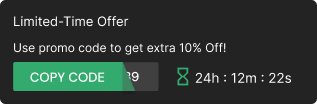
The example above from SwissWatchExpo, “Get $100 OFF + Free Shipping If Ordered within 14:57,” works because it combines a financial incentive with a visible countdown.
The timer isn’t just decorative. It makes the cost of waiting tangible. Every second that passes is a second closer to losing $100.
•Works best for: flash sales, seasonal promotions, limited coupon windows, cart recovery
•Key requirement: the deadline must be real. Fake countdowns that reset on page reload erode trust immediately when visitors notice
•Best placement: near pricing, on product pages, at checkout, on landing pages for time-limited campaigns
Build urgency
Add floating offers with countdown timer & coupon code.
2. Social Proof Purchase Notifications

Showing recent purchase activity from real customers is the most common and most versatile FOMO notification type.
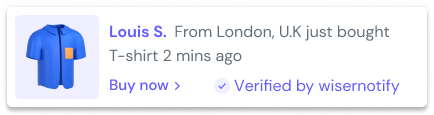
The Studio331 example, “Roettan M from Quinter, KS Just Purchased a Large Magnetic Animal Tin,” gives the notification specificity that makes it credible.
It’s not “someone bought something.” It’s a named person from a named place buying a named product.
That specificity is what separates social proof that builds trust from social proof that reads as fake.
The location detail is particularly effective, it signals to the visitor that people near them, or people like them, are making this purchase. Similarity is a powerful driver of social influence.
•Works best for: ecommerce product pages, subscription services, courses, and digital product sales
•Key requirement: pull from real order data, never fabricate. Visitors are increasingly savvy about fake social proof
•Best placement: product pages, cart page, checkout, anywhere a visitor is evaluating whether to commit
Build trust & FOMO
Highlight real-time activities like reviews, sales & sign-ups.
3. Low Stock Alerts

Inventory scarcity is a clean urgency signal in ecommerce because it’s usually true.
When only 10 items remain, the notification isn’t manufactured pressure, it’s useful information.
The Creative Dukan example, “Only 10 items left,” is effective precisely because of its simplicity. No embellishment, no exclamation points. Just a fact that changes the calculation for the visitor.
Low stock notifications work well because they shift the internal conversation from “do I want this?” to “can I still get this?”
That reframe activates loss aversion and moves the visitor toward the decision faster than any promotional copy could.
•Works best for: physical products with real inventory limits, limited edition releases, event tickets
•Key requirement: connect to real inventory data. Showing “Only 3 left” when stock isn’t limited is deceptive
•Best placement: product pages, especially on the add-to-cart section
Build trust & FOMO
Highlight real-time activities like reviews, sales & sign-ups.
4. Live Visitor Count Notifications
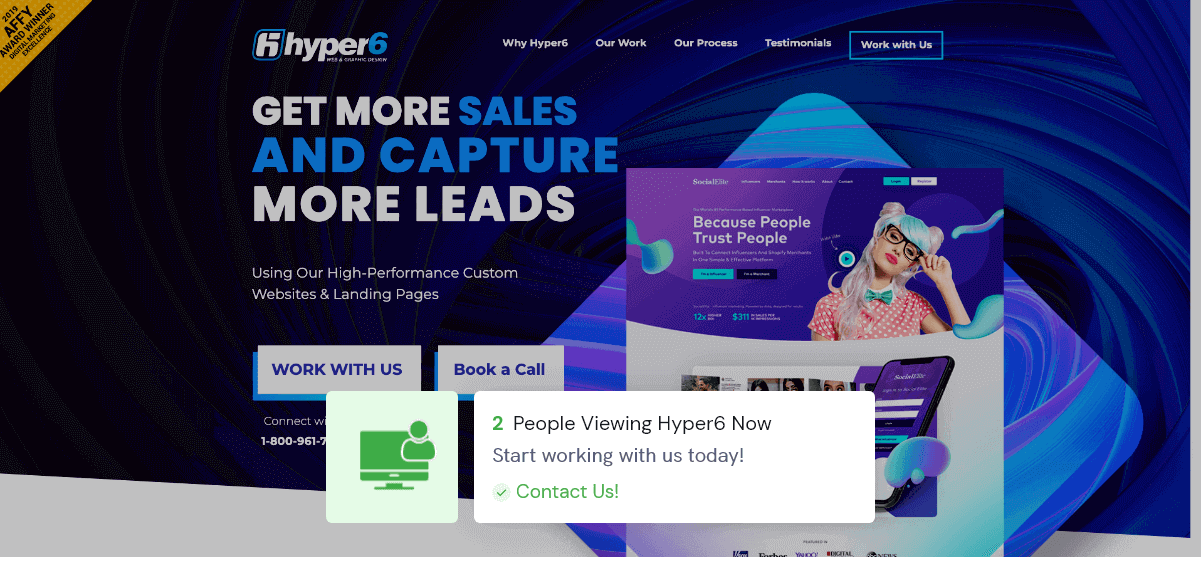
Showing how many people are viewing a page or product right now creates a different kind of urgency, competitive scarcity.
If 23 people are looking at the same product and only 5 are left, the math does the selling for you.
Even without the inventory component, live visitor counts signal that a product or offer is popular and in demand, which activates social proof and urgency simultaneously.
•Works best for: high-demand products, popular services, event registrations, limited-availability offerings
•Key requirement: show real-time session data. Don’t display a static number that never changes
•Best placement: product pages, booking pages, event registration pages
Build trust & FOMO
Highlight real-time activities like reviews, sales & sign-ups.

5. Recent Signup Notifications
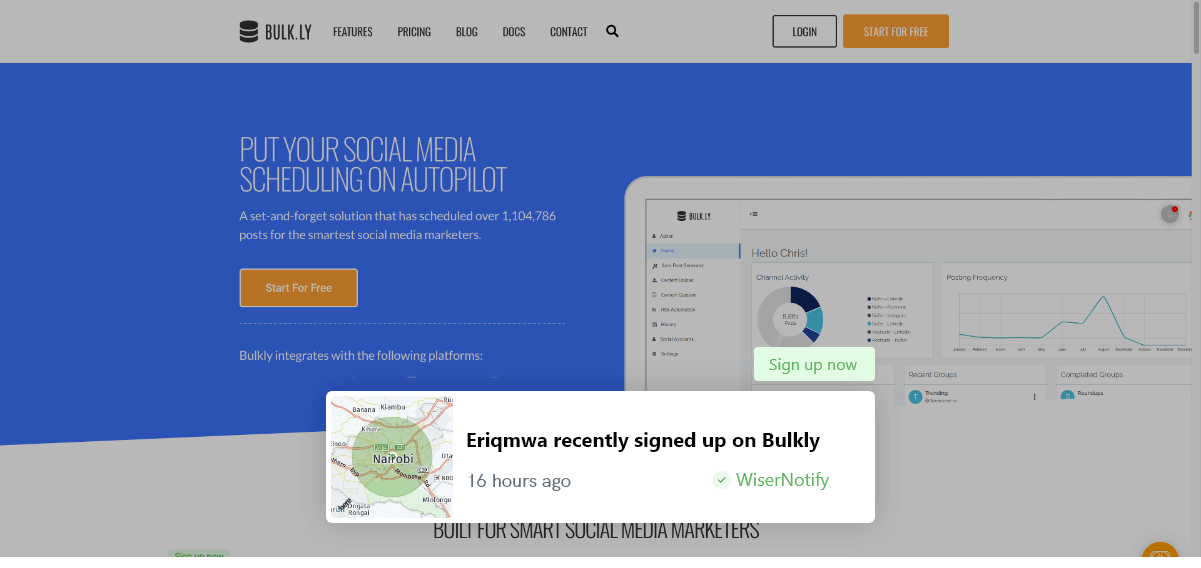
For SaaS products, online courses, newsletters, and services, showing recent signups serves the same role as purchase notifications in ecommerce.
“312 people joined this month” or “Alex from Chicago just signed up” tells a prospective customer that real people are actively choosing this product right now.
It answers the question “is this worth signing up for?” through demonstration rather than persuasion.
•Works best for: SaaS products, online courses, email lists, membership communities, free trial offers
•Key requirement: pull from real signup data connected to your email tool or CRM
•Best placement: landing pages, pricing pages, signup forms
Also check: Exit intent popup examples that convert
Build trust & FOMO
Highlight real-time activities like reviews, sales & sign-ups.

Advanced FOMO Tactics That Go Beyond Basic Notifications
Once you have the core notification types running, these more advanced approaches add additional layers of urgency and personalization.
Countdown Timers

A standalone countdown timer embedded in the page, not just a notification, creates persistent, visible urgency throughout the visitor’s session.
Unlike a notification that appears and disappears, a countdown timer in a sticky bar or product section stays in view as the visitor reads, evaluates, and considers. The ticking clock is a constant reminder that the decision window is closing.
WiserNotify’s countdown timer widget connects to real promotion schedules, so the timer reflects an actual deadline rather than a reset-on-refresh trick.
Visitors who’ve been burned by fake countdowns recognize authenticity immediately.
•Works best for: sales pages, product pages, and cart pages during an active, time-limited promotion
•Key requirement: the timer needs to connect to a real deadline, not reset on every page refresh
•Best placement: a sticky bar at the top or bottom of the page, or embedded right next to the price
Floating Bar Campaigns

A floating bar, a narrow announcement strip that sticks to the top or bottom of the browser as visitors scroll, keeps a FOMO message visible throughout the entire page session.
“Flash sale ends at midnight” or “Free shipping on orders placed today only” in a floating bar means the urgency message is present whether the visitor is reading product specs, checking reviews, or looking at pricing.
•Works best for: sitewide promotions, free shipping thresholds, flash sales
•Key requirement: keep the message short enough to read in a glance while scrolling
•Best placement: fixed to the top or bottom of the browser, visible across every page
Location-Based Personalization

Showing local demand data takes social proof a level deeper.
“15 customers in your city purchased this week” is more persuasive than “15 customers purchased this week” because the geographic proximity makes the social proof feel more directly relevant.
WiserNotify pulls location data automatically from visitor sessions and recent orders, so personalization runs without manual configuration.
•Works best for: businesses with a wide but locally distributed customer base
•Key requirement: real location data pulled from actual visitor sessions and orders, not guesswork
•Best placement: layered into existing purchase or signup notifications, not run as a standalone feature
Reserved Cart Timers

A cart-specific countdown, “Your cart is reserved for 10 minutes”, creates a different pressure than a general sale timer. The item itself is what’s at risk, not just a discount.
This works especially well for products where availability is genuinely tight, like limited drops or event seating, where a real hold on inventory is happening behind the scenes.
•Works best for: limited drops, event or flight seating, high-demand products with real reservation systems
•Key requirement: the cart hold must be real. A fake reservation timer loses trust fast
•Best placement: cart page and checkout, visible from the moment an item is added
Back-in-Stock Alerts

Notifying visitors the moment a sold-out item becomes available again turns a missed opportunity into a second chance, and creates urgency of its own since the item just sold out once already.
A visitor who opts in to a back-in-stock alert has already shown intent to buy, which makes this a high-converting FOMO signal.
•Works best for: limited-run products, seasonal items, anything that sells out and restocks on a cycle
•Key requirement: a real opt-in and a real restock, sent the moment inventory updates, not on a delay
•Best placement: a “Notify me” prompt directly on the sold-out product page
How WiserNotify Powers FOMO Notifications
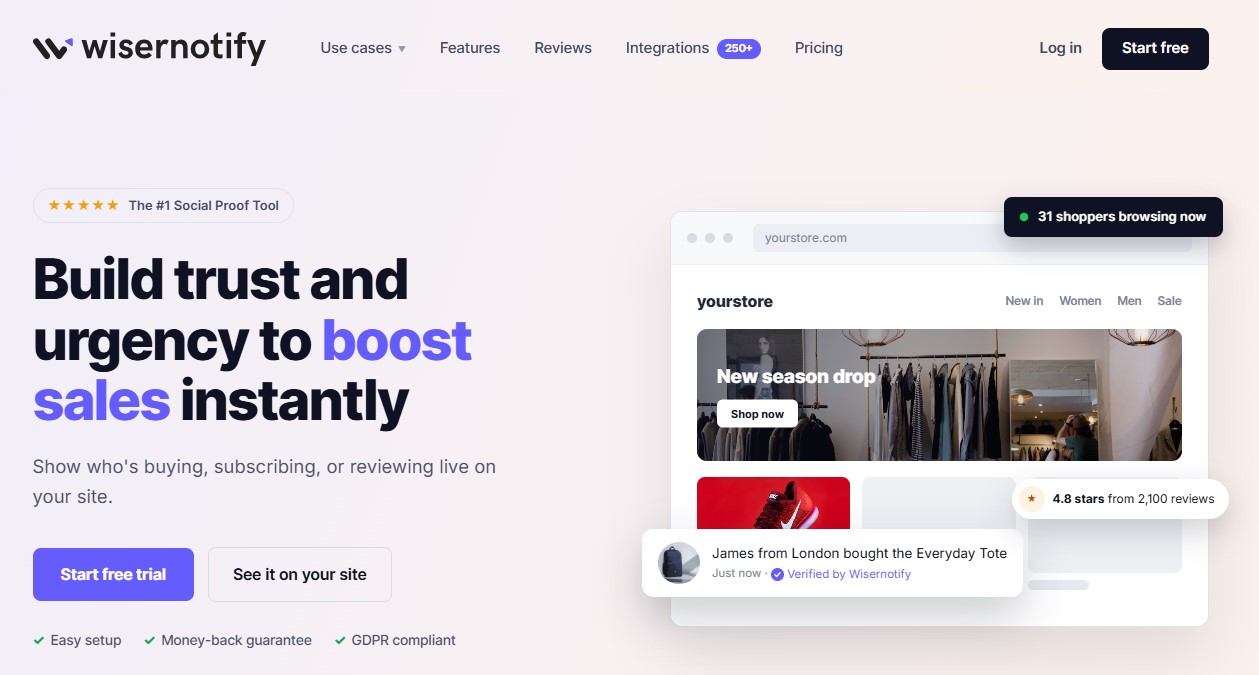
WiserNotify connects to your existing data sources, ecommerce platform, email tool, CRM, payment processor, and uses that live data to power FOMO notifications automatically.
There’s no manual data entry, no fake numbers, no static templates. Every notification pulls from what’s happening on your site and updates continuously.
•Real purchase data: connects to Shopify, WooCommerce, Stripe, and 250+ other platforms to show actual recent orders
•Live visitor counts: shows real-time session data for the current page or product
•Inventory integration: pulls real stock levels to power low stock alerts that are always accurate
•Countdown timers: connect to real promotion schedules so deadlines are genuine
•Targeting controls: set which pages each notification shows on, timing delays, frequency caps, and display duration
•No code required: add one script to your site and manage all notifications from the WiserNotify dashboard
The targeting controls are what separate a good FOMO notification strategy from spam.
You can show purchase notifications only on product pages, limit to 2 notifications per session, delay the first notification by 20 seconds, and suppress notifications for visitors who’ve already purchased, all without touching code.
Also check: Best FOMO tools and apps for ecommerce in 2026

Boost Conversion Instantly
Add Social Proof & Urgency to your website
How to Measure FOMO Notification Performance

Once notifications are live, a few numbers tell you whether they’re helping or just adding noise.
- Conversion rate lift: compare conversion rate on pages with notifications on versus off. This is the number that matters most.
- Notification click-through rate: how often visitors interact with or click a notification, a sign the content feels relevant rather than ignored.
- Dismiss rate: how often visitors close a notification immediately. A high dismiss rate usually means frequency or timing is off.
- Bounce rate on notification pages: if bounce rate rises after adding notifications, they may be interrupting rather than helping.
- Session-level frequency: how many notifications the average visitor sees per session, to confirm your frequency cap is working as intended.
Test one variable at a time, timing, frequency, or notification type, so you know exactly what moved the number.
Final Word
FOMO notifications are one of the few conversion tools that work by giving visitors genuinely useful information rather than by applying pressure.
A real purchase notification tells a visitor that other people have solved the same problem with this product.
A real stock alert tells them that waiting has a cost. A real countdown tells them that the window to act is closing.
When built on real data and targeted correctly, FOMO notifications don’t feel like manipulation. They feel like context.
And context, the right information at the right moment, is what moves hesitant visitors from considering to buying.
Also check: How to add social proof notifications to your website
Frequently Asked Questions
What are FOMO notifications?
They’re small, non-intrusive alerts, usually appearing in a corner of the screen, that show real-time activity like recent purchases, low stock, or live visitor counts to create urgency and build trust.
Do FOMO notifications work?
Yes, when they’re built on real data and shown with reasonable timing and frequency. Fake numbers or overly aggressive timing are what turn FOMO notifications from helpful into annoying.
Which FOMO notification type converts best?
Social proof purchase notifications tend to have the broadest impact since they work across almost any product or service, but low stock alerts convert especially well when the scarcity is genuinely true.
How soon should a FOMO notification appear after page load?
Give visitors 15-30 seconds to engage with the page first, and cap it at 2-3 notifications per session. Showing one immediately on page load tends to feel desperate rather than helpful.
Can fake FOMO notifications hurt a website?
Yes, and it’s one of the fastest ways to lose trust. Once a visitor notices a fake countdown or a purchase number that doesn’t add up, they stop believing every notification on the site, not just that one.

Krunal Vaghasiya is a marketing tech expert who boosts e-commerce conversion rates with automated social proof and FOMO strategies. He loves to keep posting insightful posts on online marketing software, marketing automations, and improving conversion rates.




 Capterra