
40 Customer Feedback Statistics for 2026 (Closing the Loop)
Most companies collect feedback and never do anything visible with it. That gap is why fewer people bother answering surveys anymore.
Plenty of customers leave quietly instead of complaining first. They are not angry enough to write in, they just stop coming back. Businesses that close the loop and show people what changed keep more of those customers and get better responses next time they ask.
This page walks through why so much feedback goes to waste, what actually gets a survey answered, and how fast a business needs to respond to make any of it count.

Boost Conversion Instantly
Add Social Proof & Urgency to your website
Key Customer Feedback Statistics
Ten numbers that sum up customer feedback right now. Figures are current as of August 2026, based on the latest published data from each source.
| Metric | Latest Figure |
|---|---|
| Customers more likely to answer a future survey after seeing action taken | 21% more likely |
| NPS lift from responding within 48 hours | 6 points |
| B2B retention increase from closing the loop under 48 hours | 12% |
| Churn reduction from consistently closing the loop | At least 2.3% |
| Churned customers who never filed a support ticket first | 68% |
| Completion rate for quarterly email NPS surveys | Under 4% |
| Response rate lift from switching to short in-app surveys | Up to 30%+ |
| Customers who pay more for a business known for good experience | 61% |
| Customers more likely to buy again after a positive support interaction | 81% |
| Faster feedback processing with automated tools vs manual review | Up to 3 times |
Why Does Most Feedback Never Get Used?
Businesses collect more feedback than ever, and most of it sits in a dashboard nobody acts on.
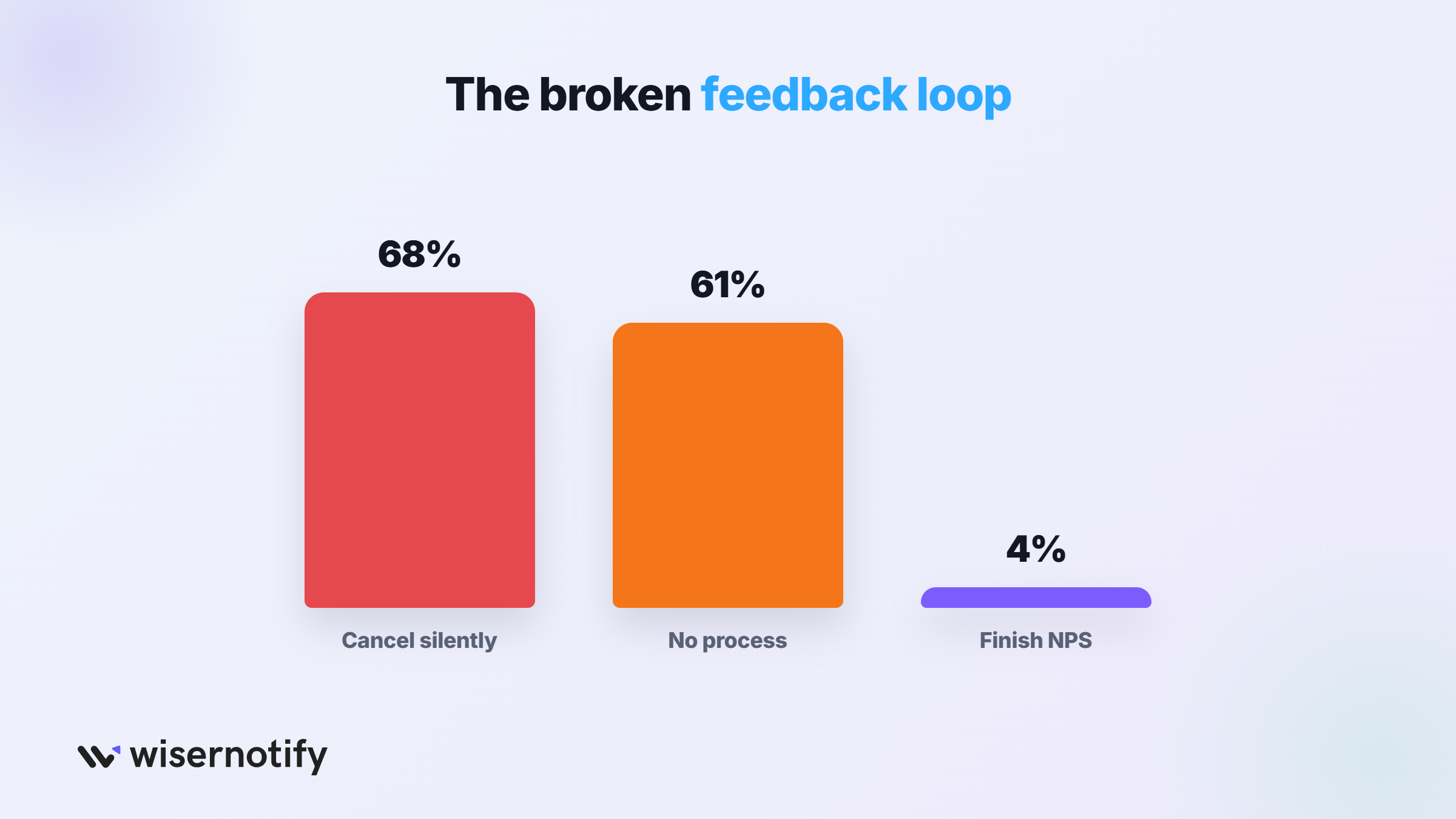
1. 68% of customers who cancel a subscription never file a single support ticket first, they simply leave.
2. Only about 4% of customers complete a typical quarterly NPS email survey.
3. An estimated 61% of companies have no formal process for closing the loop on feedback they collect.
4. Telephone survey response rates fell from 36% in 1997 to roughly 6% by 2018, a trend that has continued into digital surveys.
5. Companies that analyze feedback and act on it grow about 1.5 times faster than competitors who only collect it.
6. 72% of business leaders say customer feedback helps improve products, yet a much smaller share have a documented system for turning it into changes.
The problem was never a shortage of feedback.
It is that most of it never makes it back to the customer as visible proof something changed, the same gap covered in our reputation management guide.
Boost Conversion Instantly
Add Social Proof & Urgency to your website
What Makes a Survey Get Answered?
Format and timing decide response rates more than the questions themselves.
7. Short, single-question in-app surveys can lift response rates from single digits to 30% or more compared to long email forms.
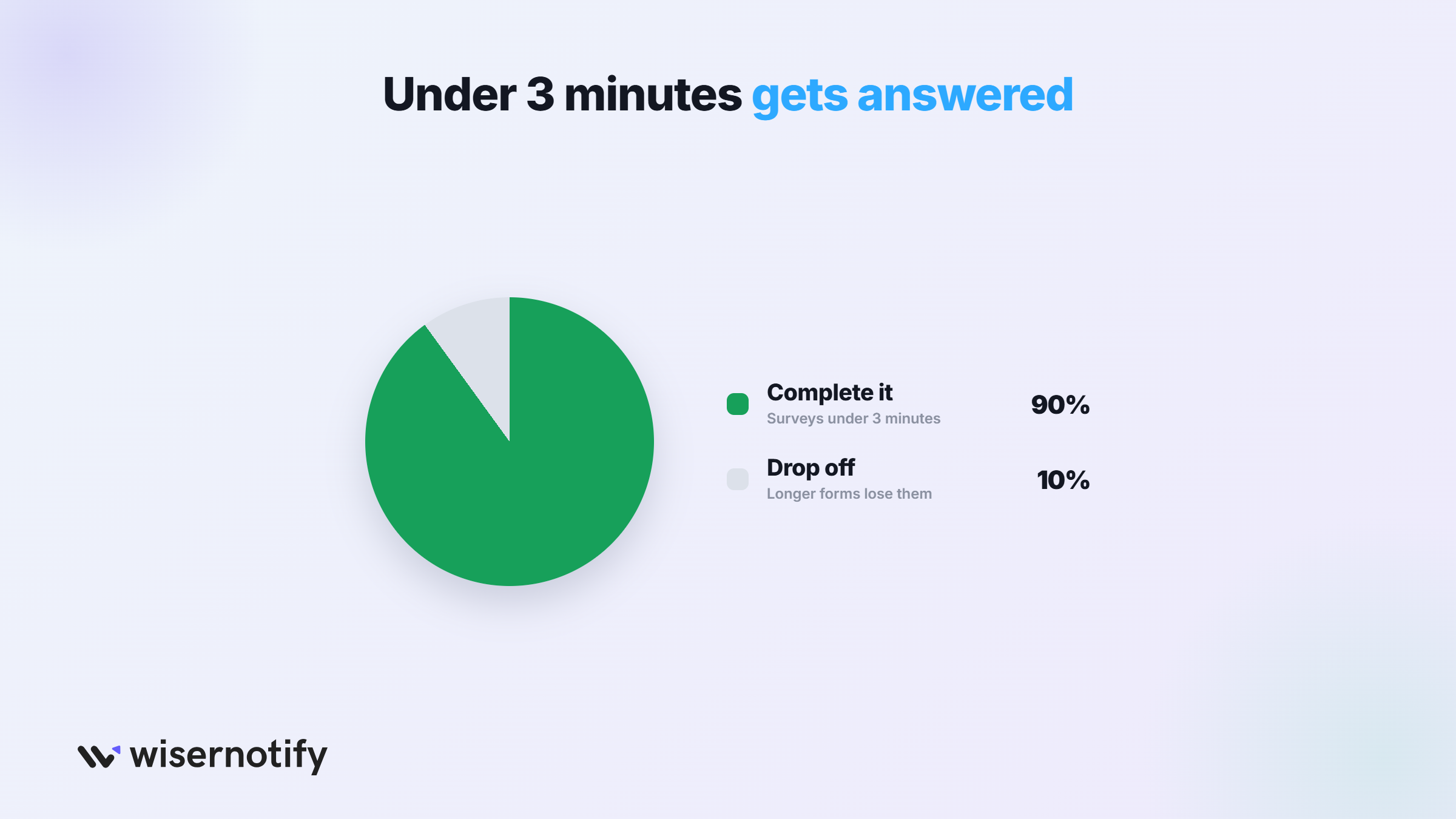
8. 85% to 95% of customers complete surveys that take less than three minutes.
9. 40% of customers complete email surveys specifically when they are short and simple.
10. 60% of companies still collect feedback primarily through surveys, despite falling completion rates on longer formats.
11. Surveys triggered right after a purchase or a support interaction get meaningfully higher completion than ones sent on a fixed schedule unrelated to the customer’s activity.
12. Asking a single contextual question inside the product, instead of a multi-question form, is one of the most consistent ways to raise response rates.
The lesson across every source is the same.
A short question asked at the right moment beats a long survey sent on a schedule, almost every time, a pattern that shows up in consumer decision making too.
Does Closing the Loop Work?
Yes, and the numbers are some of the clearest in customer experience.
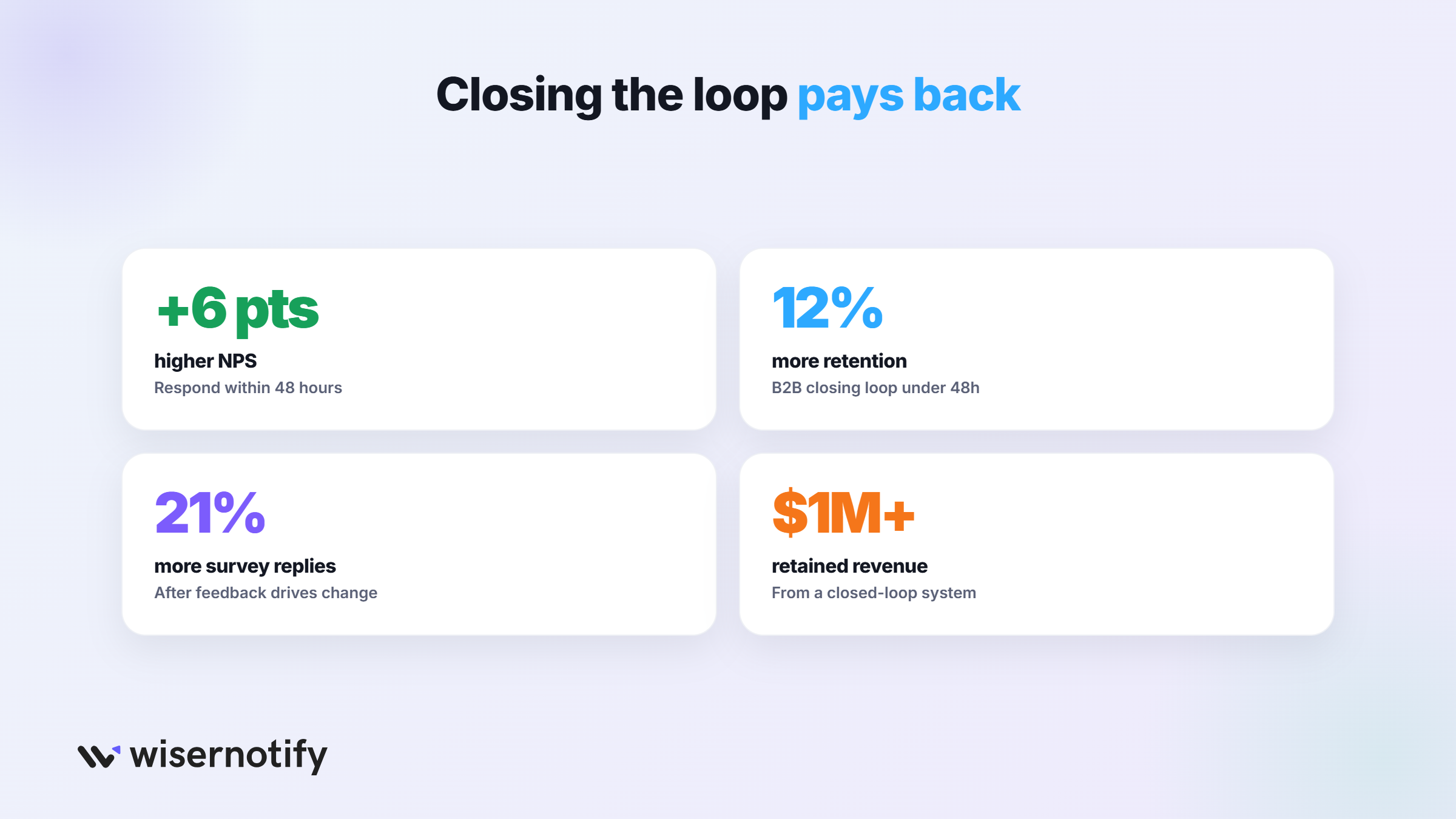
13. Customers are 21% more likely to answer a future survey once they have seen their previous feedback lead to a real change.
14. Companies that respond to feedback within 48 hours see about a 6-point lift in Net Promoter Score.
15. B2B companies that close the loop in under 48 hours report a 12% increase in retention.
16. Businesses that fail to close the loop see churn rise by about 2.1%, while those that do see churn fall by at least 2.3%.
17. One case study found that proactive follow-up on feedback reduced refund requests by 12%.
18. A company that moved from quarterly email surveys to a fast, closed-loop system reported over $1 million in retained annual revenue.
Closing the loop is not a courtesy step, it is the mechanism that makes the whole feedback system worth running, the same principle behind word of mouth statistics.
Boost Conversion Instantly
Add Social Proof & Urgency to your website
How Fast Should You Respond to Feedback?
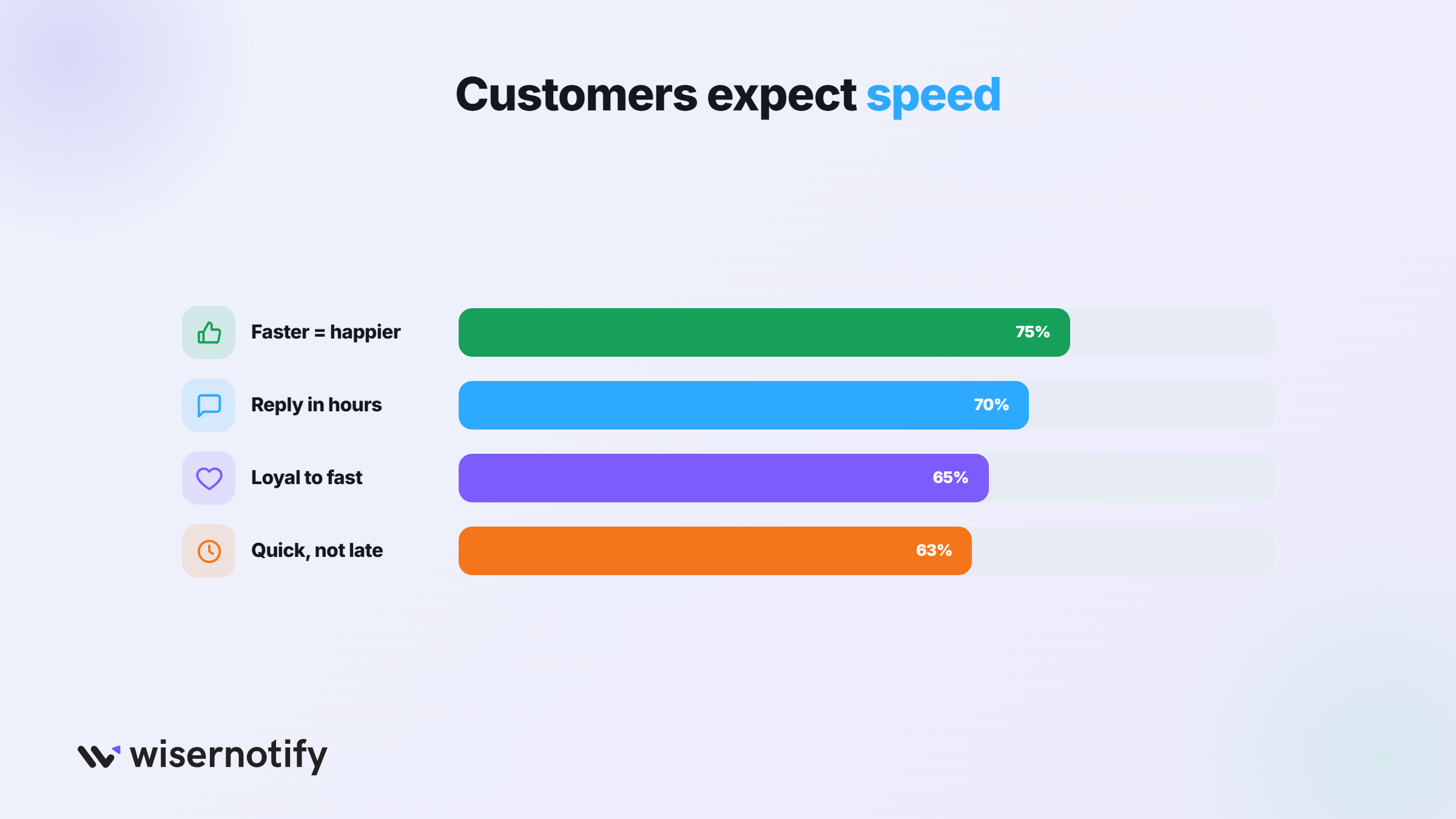
Speed compounds with every other number on this page.
19. 48 hours shows up repeatedly across independent studies as the response window that produces measurable retention and NPS gains.
20. 65% of customers stay loyal to brands that respond to their feedback quickly, even when the response is not the outcome they wanted.
21. 63% of customers expect a business to respond to feedback quickly, not just eventually.
22. 75% of customers say fast support responses directly improve their satisfaction with a business.
23. Customers report noticeably higher satisfaction when an issue is resolved during the first support interaction, rather than requiring a follow-up.
24. 70% of customers expect a response to a social media message within a few hours, not days.
A response that arrives fast changes how customers feel about a business even when the underlying problem takes longer to fully fix, the same trust signal covered in our testimonial statistics.
Where Does Customer Feedback Come From?
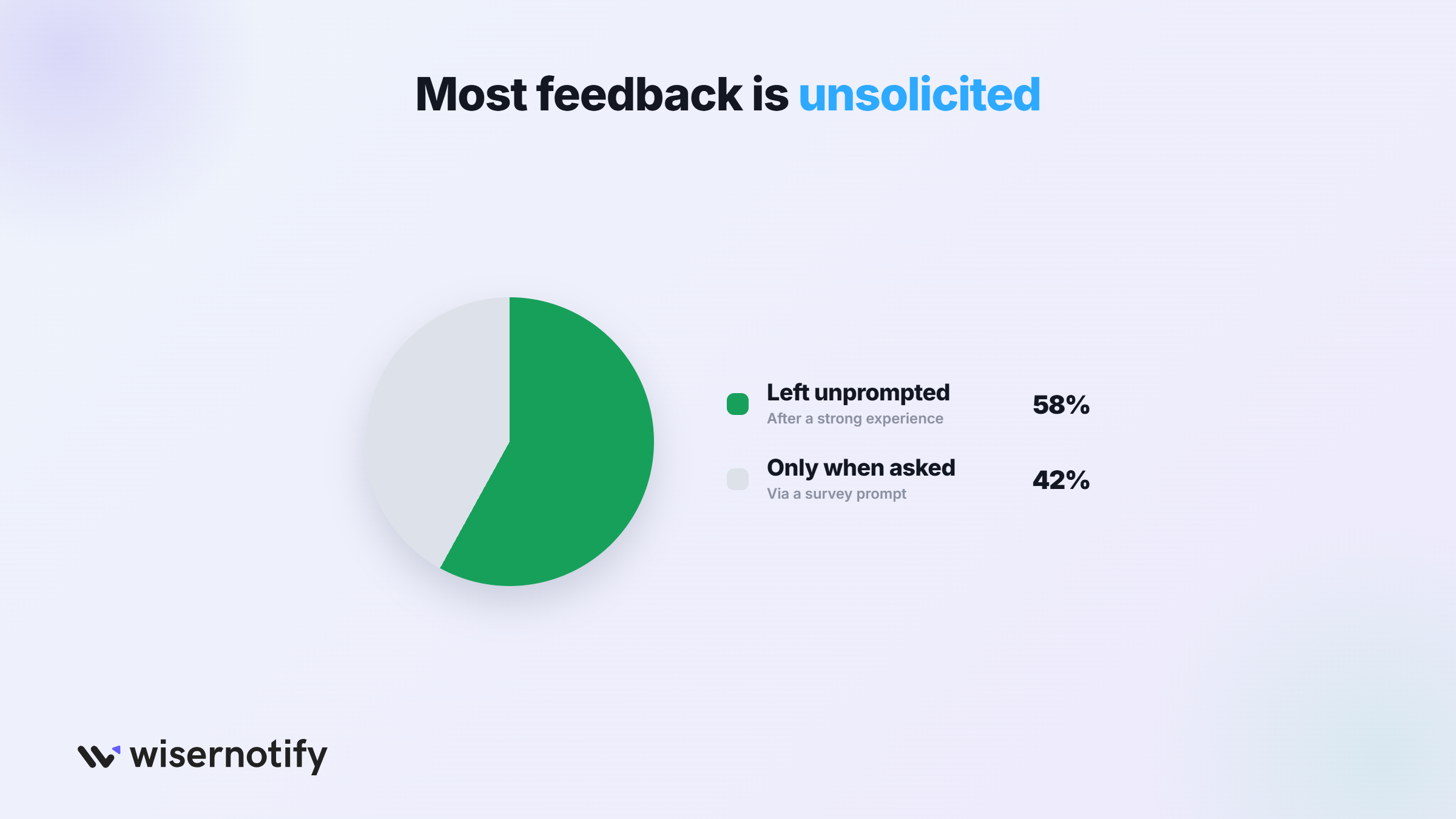
Surveys are only one source, and increasingly not the biggest one.
25. 90% of customers read online reviews before making a purchase decision, making reviews one of the largest sources of unsolicited feedback a business receives.
26. 58% of customers leave feedback voluntarily after either a strongly positive or strongly negative experience, without being asked.
27. 84% of customers trust online reviews as much as a personal recommendation, which makes review content a direct read on customer sentiment.
28. 54% of customers now prefer reaching out over social media for support, generating feedback in a channel many businesses do not systematically track.
29. 60% of customers prefer self-service options before contacting a support agent at all, which means a large share of frustration never becomes a ticket or a survey response.
30. Around 60% of businesses now use AI tools to pull structured feedback out of reviews, tickets, and social mentions instead of relying on surveys alone.
Treat every channel as a feedback channel, not just the ones with a form attached.
The customer who leaves a review or posts on social media is giving you the same signal as someone who filled out a survey, the same signal covered in our social proof statistics.
Boost Conversion Instantly
Add Social Proof & Urgency to your website
How to Use These Numbers
Shorten the ask. A single question at the right moment beats a long form sent on a schedule, and it will get you a real response rate instead of a token one.
Close the loop every time, and do it inside 48 hours where you can.
Tell customers what changed because of what they said, since that single habit is what makes people willing to give feedback again. Track customer experience signals across reviews and social channels too, not just formal surveys.
Boost Conversion Instantly
Add Social Proof & Urgency to your website
Wrap Up
Feedback only pays off once it closes a loop. Collecting it and moving on is why so many customers leave quietly instead of speaking up.
The businesses doing well here are not running longer surveys. They are asking shorter questions at better moments, replying fast, and showing people what actually changed.
Fix that loop first. A short question that gets answered and acted on will always beat a long one that gets ignored.
Sources
Thematic | CustomerGauge | SurveyFlip | Hello Customer | Formbricks
Frequently Asked Questions
What is customer feedback?
Customer feedback is the opinions customers share about their experience with a product or service. Businesses use it to improve customer service and satisfaction.
How do businesses collect customer feedback?
Businesses collect feedback through surveys, online reviews, social media, and customer support interactions.
Why are customer feedback statistics important?
Customer feedback statistics help businesses understand customer expectations and improve customer experience.
What metrics measure customer feedback?
Common metrics include Customer Satisfaction Score (CSAT), Net Promoter Score (NPS), Customer Effort Score (CES), and customer retention rate.
How can businesses improve customer experience using feedback?
Businesses can improve experience by analyzing feedback, responding to complaints, and improving products and services.

Krunal Vaghasiya is a marketing tech expert who boosts e-commerce conversion rates with automated social proof and FOMO strategies. He loves to keep posting insightful posts on online marketing software, marketing automations, and improving conversion rates.




 Capterra