
Importance of Product Reviews: 8 Ways They Grow Sales (2026)
Product reviews matter because they do the selling your product page can’t. They answer a buyer’s last questions, lift conversion, cut returns, and feed the star ratings and AI answers shoppers see before they reach your store.
Most guides stop at “reviews build trust.” That part is true. But it won’t tell you how many reviews you need, which kinds to show, or where each one belongs on the page.
This guide covers all of that, plus the review rules that now carry legal weight and a simple system for collecting more.
Key takeaways
- The first five reviews on a product do most of the work. After that, recency and detail count for more than volume.
- An average rating between 4.0 and 4.7 tends to sell better than a perfect 5.0.
- Detailed reviews lower returns, because buyers pick the right size, color, and model the first time.
- Reviews now shape the Google stars and AI assistant answers shoppers read before they click, not only your product page.
What is a product review?
A product review is a star rating, comment, photo, or video from someone who bought and used your product, published so the next shopper can judge it.
People use “product reviews” and “customer reviews” as if they were the same thing. Close, but not quite. A customer review can rate your shipping, your support team, or the whole store. A product review rates one item.
Both count. This guide sticks to product reviews, the ones that sit on a product page and decide one purchase at a time.
Types of product reviews and where they go
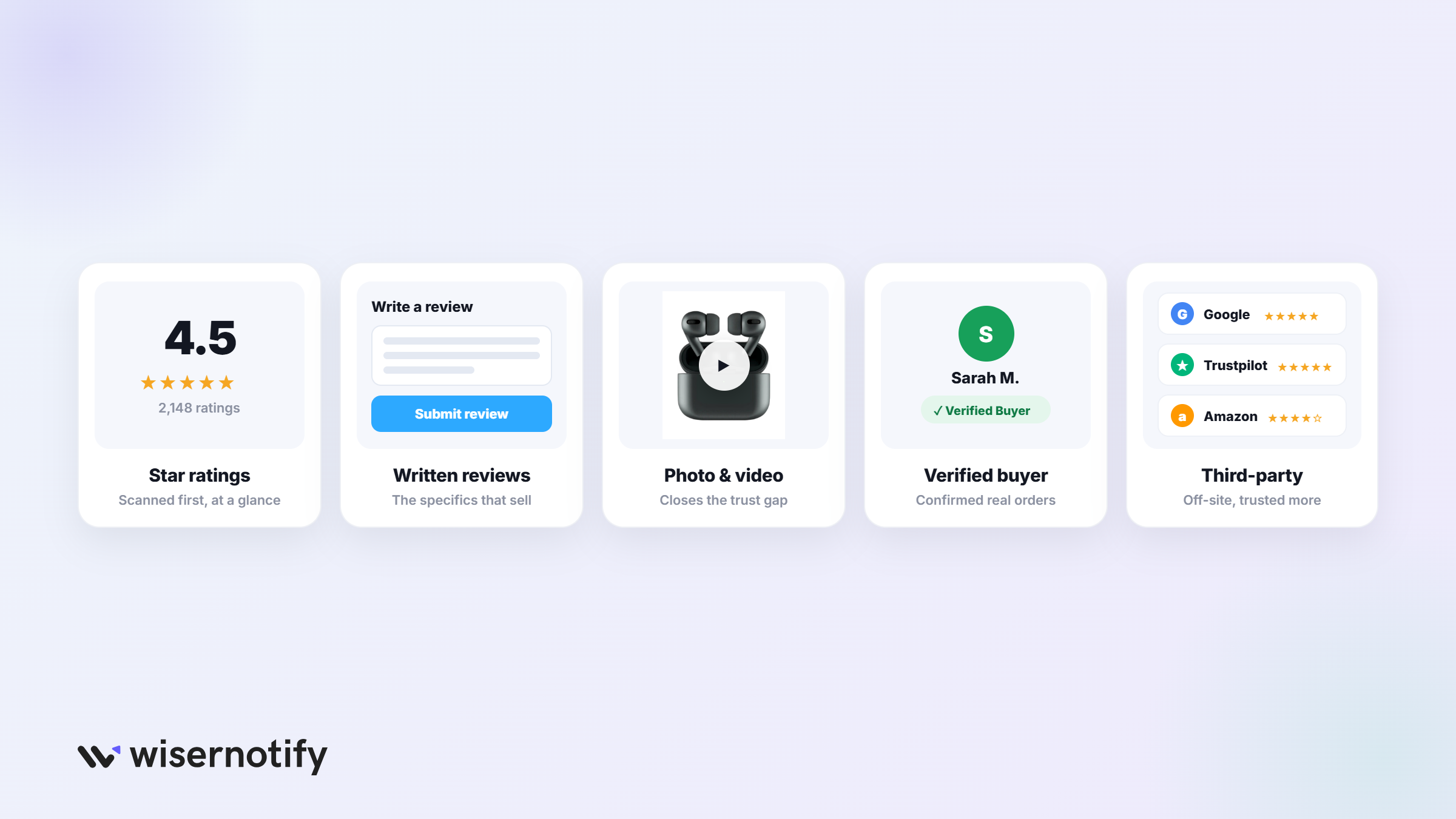
Each type of review answers a different question for the shopper, so each one earns a different spot on your site.
| Review type | What it tells the shopper | Where it works best |
|---|---|---|
| Star ratings | A quick read on overall quality | Collection pages, next to the product title, Google results |
| Written reviews | Fit, durability, value, and whether it matched the photos | Product page, directly below the buy box |
| Photo and video reviews | True color, size, and scale in a normal home | Product page gallery, ads, and email |
| Verified-buyer reviews | Proof that the reviewer paid for the product | Product page, with the badge visible on each review |
| Third-party reviews | How the store is rated off your own site | Homepage, checkout trust row, Google listing |
If you can only push one type this quarter, make it photo reviews. They close the “will it look like this?” gap faster than any paragraph of text, and they double as UGC examples for your ads.
Written reviews come next. Label them clearly, too, since a verified review badge settles the “is this fake?” doubt before it forms.

All your reviews in one place
Collect reviews, manage every response, and display them where they matter most.
Why are product reviews important?
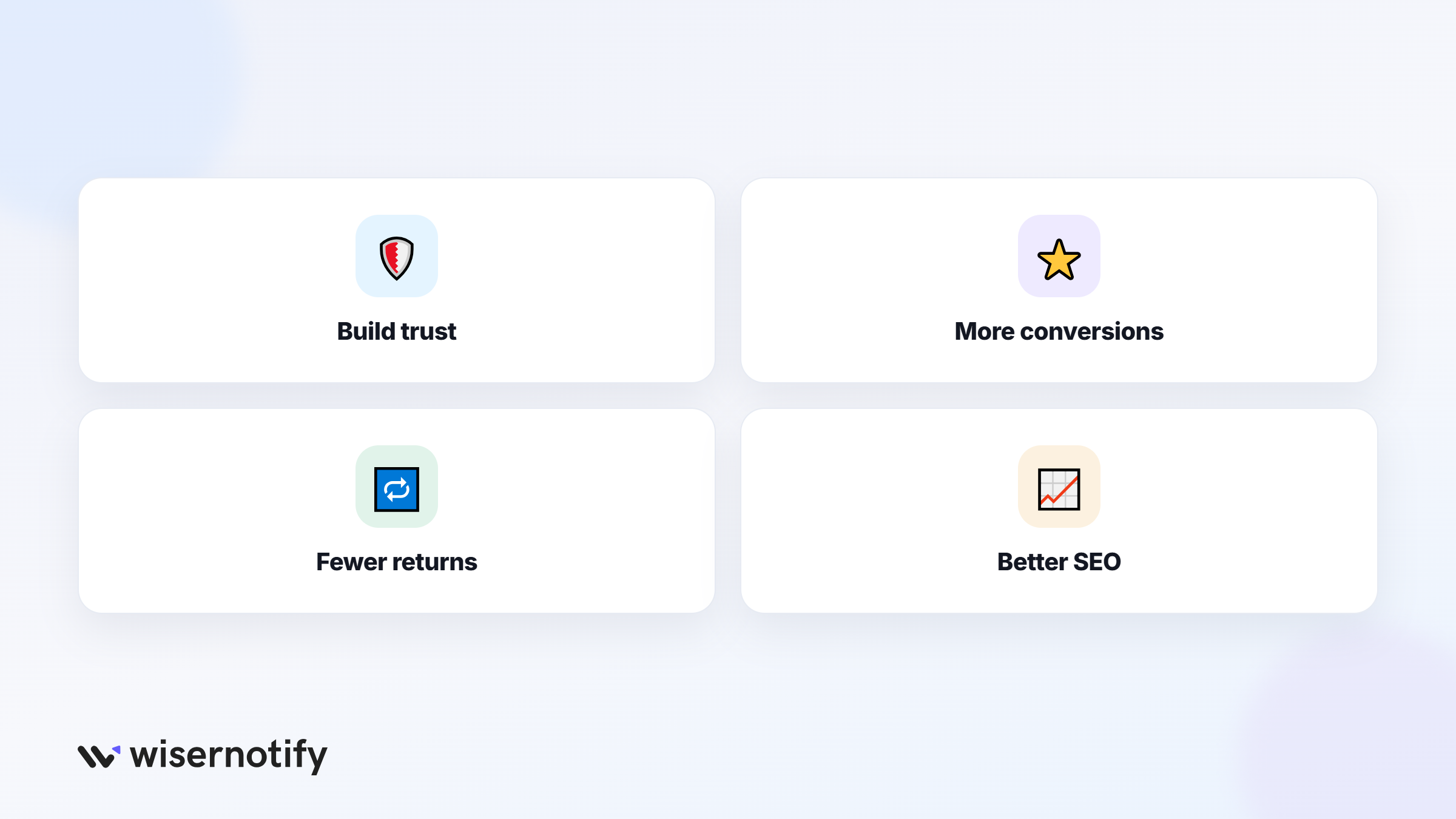
Product reviews are important because they stand in for the in-store test a shopper can’t do online. They build trust, answer specific questions, lift conversion, cut returns, and hand you free product feedback.
Some of that value lands with the shopper and some lands with you. The best reviews do both. Here are the eight reasons I keep coming back to after years of building review and social proof tools.
1. Shoppers buy with confidence
Nobody can touch your product through a screen. So shoppers borrow the experience of people who already did.
A few honest reviews let them picture what arrives at the door.
Does it run small? Does the battery last a full day? Is the fabric thinner than it looks? Once those answers are on the page, the purchase stops feeling like a gamble.
Reviews are for the buyer first. Stores that forget this write review requests for themselves and get “Great product!” back.
2. Trust shows up before you speak
A first-time visitor has no reason to believe you. You’re a logo they’ve never seen, praising your own product.
Reviews fix that because they come from people with nothing to sell. That third-party voice is the base layer of ecommerce trust, and it’s something your own copy can’t fake.
Nearly half of US consumers say they trust online reviews as much as a recommendation from someone they know.
3. On-the-fence shoppers decide
Most lost sales don’t end in a “no.” They end in “let me think about it,” followed by a closed tab.
A single review that answers the exact doubt holding someone back can flip that. Think of a runner who wants to know if a shoe works for wide feet, and finds three reviewers saying yes.
- Specific details (sizing, setup time, noise level) settle the questions your product copy skipped.
- A mix of ratings reads as honest, which makes the praise easier to believe.
- Recent reviews carry more weight, since shoppers assume older ones may not reflect today’s product.
4. Conversion climbs fastest early
Here is the number worth knowing. A product with five reviews is about 270% more likely to be bought than the same product with none.
The effect is bigger on expensive items. Displaying reviews lifted conversion by 190% on lower-priced products and by 380% on higher-priced ones in the same research.
That makes sense. The more a purchase costs, the harder people lean on other buyers before they commit.
5. Word of mouth that never stops
A friend’s recommendation reaches one person, once. A written review reaches every shopper who lands on that page for as long as it stays up.
You can stretch that reach. Pull your strongest quotes into ads, welcome emails, and landing pages, and one customer’s words keep working in places they never saw. That reuse is the payoff of product review marketing, and it costs nothing beyond the reviews you already have.
6. Returns go down
About 19% of online sales were expected to come back as returns in 2025. Every one of them costs you shipping, handling, and margin.
Honest reviews set expectations before the box ships. When a reviewer writes “order a size up” or “the blue is darker in person,” the next buyer orders the right thing.
Apparel and footwear gain the most here, since fit drives so many of their returns.
7. Google stars and AI answers
Reviews don’t stay on your product page anymore. They power the star ratings under your Google listings and Shopping ads, which pull the eye in a crowded results page.
They also feed AI assistants. In 2026, 45% of US consumers used tools like ChatGPT for business recommendations, up from 6% a year earlier, and most shoppers now read AI-written review summaries on sites like Amazon and Google.
When an AI tool describes your product, it’s often paraphrasing your reviews. Thin or stale reviews mean a thin or stale answer.
8. You learn what to fix
Complaints sting. They’re also the cheapest product research you’ll ever get.
When three buyers mention the same loose zipper, that’s clearer than any survey. Fix the zipper, update the product description, and the next wave of reviews improves on its own.
How many reviews does a product need?
Aim for at least five reviews on every product you want to sell. Purchase likelihood climbs steeply up to five, then the gains from each extra review shrink fast.
Nearly all of the lift happens inside the first ten reviews. So the urgent job on a new product is getting off zero, not chasing a hundred.
After that, switch your focus from volume to freshness. About three in four consumers care most about reviews written in the last three months, which means a steady trickle beats a one-time burst.
Local and service businesses face a higher bar. Close to half of consumers won’t consider a local business with fewer than 20 reviews. Our online review statistics roundup has the wider data.
Why a perfect 5.0 rating can hurt sales
Sales usually peak when a product’s average rating sits between 4.0 and 4.7. A flawless 5.0 looks too good to be true, so shoppers start to doubt it.
This is the part most store owners resist. But a few three-star reviews that say “runs a bit small” make every five-star review around them more believable.
What you do next matters more than the rating itself. Most shoppers expect a reply to reviews, and a calm, specific answer to a complaint often wins more trust than the complaint lost.
- Reply to negative reviews in public, briefly, with the fix you offered.
- Never hide or delay bad reviews. It damages trust, and in the US it can break the law (more on that below).
- Watch for patterns rather than single complaints. One angry review is noise. Five on the same issue is a product problem.
What it costs you to skip reviews
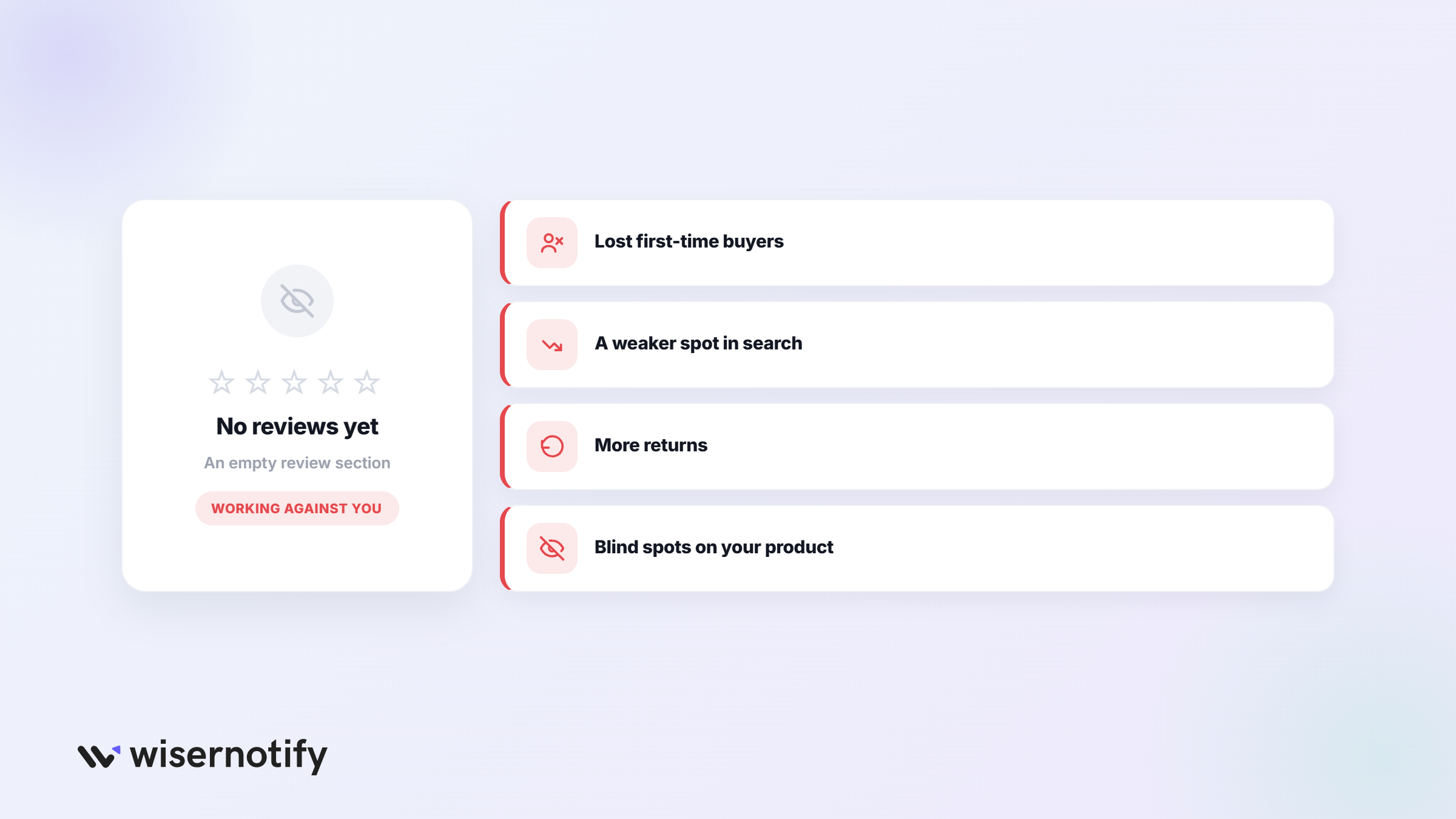
An empty review section isn’t neutral. It tells every visitor that nobody has bought this yet, or that the people who did had nothing good to say.
Here’s what that quietly costs you:
- First-time buyers. With nothing to reassure them, new visitors leave for a competitor whose page shows proof.
- Clicks from search. No reviews means no star ratings in Google, so your listing looks plain next to the ones around it.
- Margin lost to returns. Without notes on fit or quality, shoppers guess, and wrong guesses come back to you.
- Early warnings. You miss the feedback that would have flagged a defect before it spread.
None of this shows up as a line on your dashboard. That’s exactly why it gets ignored while the store next door keeps collecting.
How to get more product reviews
A steady flow of reviews rarely happens by accident. It takes a light system that runs without you. Here’s the one I’d set up first:
- Ask after delivery, not after checkout. Send the request a few days after the product arrives, once the buyer has used it.
- Keep the form short. A star rating, one text box, and an optional photo upload. No login, no long survey.
- Prompt for specifics. “How did the fit run?” gets you a useful review. “Leave us a review!” gets you two words.
- Send one reminder. Plenty of people mean to write a review and forget. A single follow-up catches them.
- Reward the effort, not the rating. A small thank-you for a photo review is fine, as long as every reviewer gets it whatever stars they give.
Most consumers who are asked for a review go on to leave one, so the ask itself is the biggest lever. For word-for-word request templates, see our guide on how to ask for reviews.
Review rules to follow in 2026
In the US, the FTC’s rule on consumer reviews and testimonials took effect on October 21, 2024. It turned long-standing best practice into law, with civil penalties for knowing violations.
The rule bans:
- Fake reviews, including AI-written ones and reviews from people who never used the product.
- Incentives tied to a positive (or negative) review, whether the condition is stated or implied.
- Undisclosed reviews from employees, their families, or other insiders.
- Hiding negative reviews or pressuring customers to take them down.
Platforms add their own rules on top. Google, for example, doesn’t allow incentives for reviews at all, even neutral ones. Check the policy of each site you collect on.
Where to put reviews for the most impact
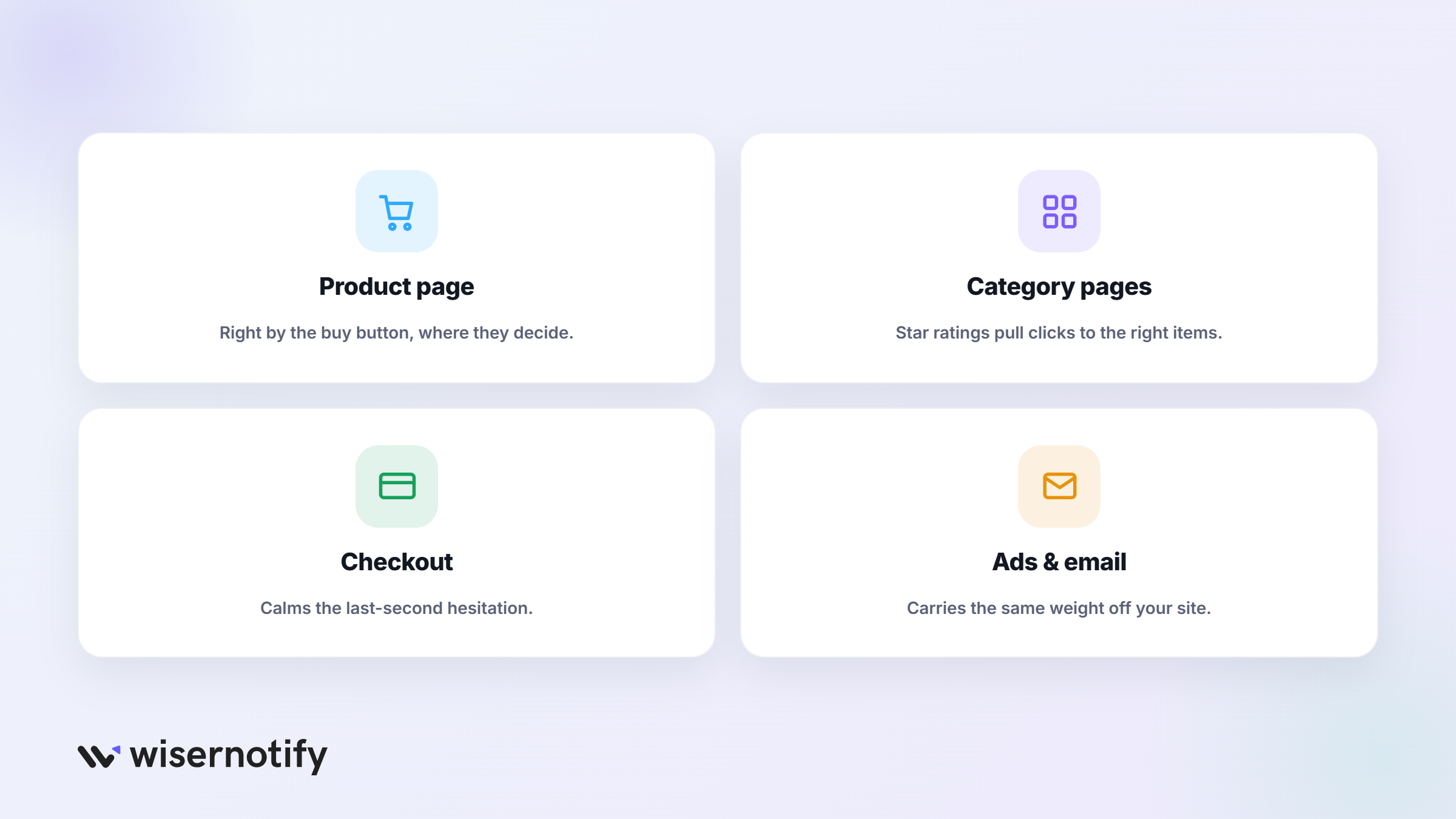
Collecting reviews is half the job. Placement decides how much they move sales.
- Product page, near the buy button. Proof works best at the moment of decision, not tucked into a tab at the bottom.
- Collection and category pages. Star ratings on each product card steer clicks toward the items that sell.
- Homepage. A short strip of top reviews reassures first-time visitors before they browse.
- A dedicated reviews page. One page that gathers your best reviews by product gives skeptical visitors a single place to check you out.
- Cart and checkout. One short quote next to the order total calms last-second doubt.
- Ads and email. A strong photo review often outperforms a studio shot in paid social and post-purchase emails.
For layouts and widget ideas, see how to show reviews on website pages without cluttering them.
Collect and display product reviews with WiserReview
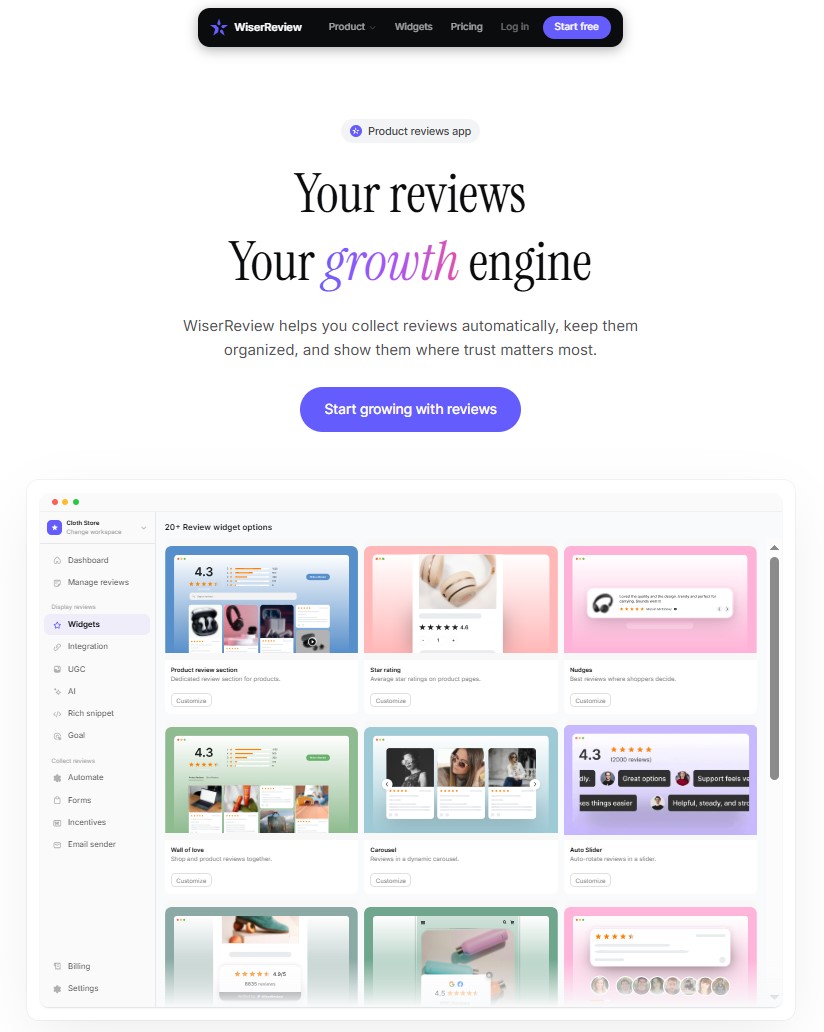
Knowing why reviews matter is one thing. Collecting them every week and getting them on the right pages is another. That’s the job we built WiserReview for (disclosure: it’s our product).
The parts that do most of the work:
- Automated requests by email, SMS, WhatsApp, or QR code, sent after delivery with a reminder.
- Photo and video reviews collected in the same short form.
- Display widgets for the product page, star counts, carousels, and a Wall of Love page.
- SEO rich snippets and Google Shopping reviews, so your stars show up in search.
- AI moderation and reply suggestions to keep up with responses.
It works with Shopify, WooCommerce, BigCommerce, Wix, Squarespace, and custom builds. Plans start at $6.75/month billed yearly on Starter, metered by review requests (100 a month), with a 7-day free trial.
One honest limit: Starter caps video reviews at 20, so video-heavy brands will want a higher plan. If you’d like to compare options first, our roundup of the best product review software lays them side by side.
All your reviews in one place
Collect reviews, manage every response, and display them where they matter most.
Wrap Up
Reviews are the one piece of your product page you can’t write yourself, and that’s exactly why shoppers believe them.
Get every product off zero. Keep new reviews coming in. Put them where people decide, answer the bad ones in public, and play it straight on the rules.
Do that, and your customers end up doing a big share of your selling for you.
Frequently Asked Questions
Why are product reviews important?
They answer the questions a shopper can’t settle online, like fit, quality, and value. That builds trust, lifts conversion, and lowers returns.
How many reviews does a product need?
Aim for at least five on every product, since most of the lift in purchase likelihood happens in those first few. After that, keep new ones coming so they stay recent.
Do negative reviews hurt sales?
A few negative reviews usually help, because a perfect score looks suspicious. A calm public reply to each complaint matters more than the rating itself.
What is the difference between product reviews and customer reviews?
A product review rates one item. A customer review can cover the whole experience, including shipping, support, and the store.
Can I offer a reward for leaving a review?
In the US you can, as long as the reward doesn’t depend on a positive rating and every reviewer gets it. Some platforms, like Google, ban review incentives entirely.
Where should I display product reviews?
Put them on the product page near the buy button first. Then add star ratings to collection pages and a few top reviews to your homepage and checkout.

Krunal Vaghasiya is a marketing tech expert who boosts e-commerce conversion rates with automated social proof and FOMO strategies. He loves to keep posting insightful posts on online marketing software, marketing automations, and improving conversion rates.




 Capterra