
40 Google Review Statistics for 2026 (Requests & Responses)
Getting Google reviews is not the hard part anymore. Getting customers to leave them, and then doing something with them once they land, is where most businesses fall short.
78% of customers were asked to leave a review by a local business in 2026, and 83% of those who were asked actually did.
The businesses winning local search are not the ones with the most reviews, they are the ones with a system for asking, responding, and staying fresh.
This page has 40 up-to-date Google review statistics. You will see how asking actually works, what response rates do to rankings and revenue, the recency trap most businesses fall into, and how fake reviews are handled.

Boost Conversion Instantly
Add Social Proof & Urgency to your website
Key Google Review Statistics
| Metric | Latest Figure |
|---|---|
| Customers asked to leave a review by a local business | 78% |
| Of those asked, share who actually left one | 83% |
| Reviews generated per 100 structured requests | About 30 |
| Consumers who trust only reviews from the last month | 73% |
| Businesses that never respond to a review | 95% |
| Conversion lift from responding to 80%+ of reviews | Up to 16.4% |
| Consumers who expect owners to respond to reviews | 89% |
| Rating threshold most consumers now require (4+ stars) | 68% |
| Consumers who won’t consider a business under 20 reviews | 47% |
| Reviews confident to be fake, per shoppers surveyed | About 50% |
Does Asking for Reviews Actually Work?
Yes, and the gap is bigger than most businesses expect. 78% of customers were asked in 2026, and 83% of those asked left a review.
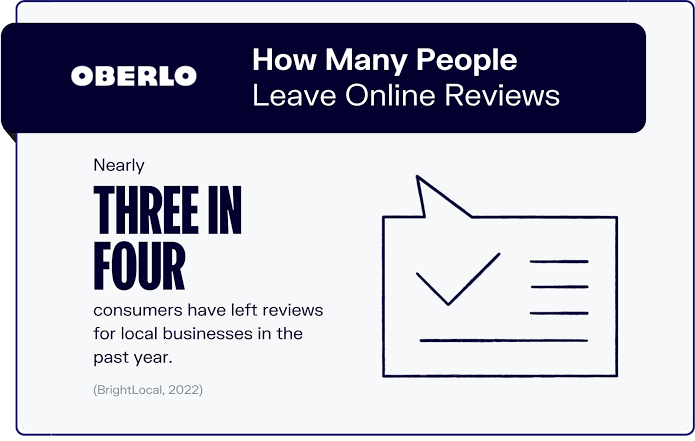
1. 78% of customers were asked to leave a review by a local business in 2026.
2. Of those asked, 83% actually left a review.
3. Structured outreach programs generate about 30 reviews per 100 requests sent.
4. Nearly 3 in 4 customers leave a review for a business they have engaged with, when given an easy way to do it.
5. 68% of customers say having a Google Business Profile increases their likelihood of visiting a business in person.
6. Google is the platform most reviews are written on, ahead of every other review site.
7. 57.5% of all reviews posted online are on Google specifically.
The gap between businesses with strong review profiles and weak ones usually comes down to one thing: who has a system for asking, and who is hoping customers remember on their own.
Boost Conversion Instantly
Add Social Proof & Urgency to your website
Does Responding to Reviews Actually Change Anything?
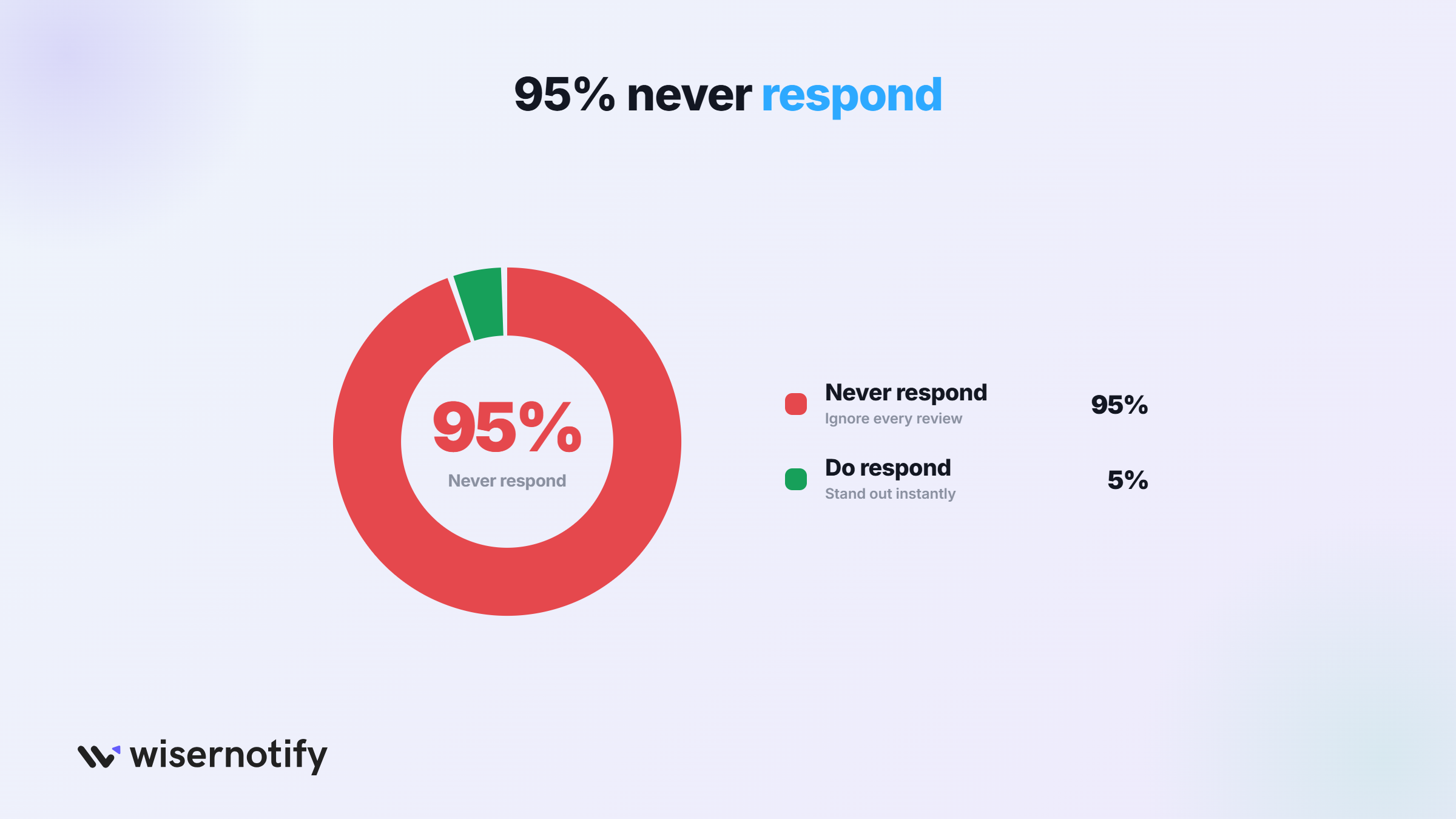
95% of businesses never respond to a review, which means the businesses that do stand out immediately, both to customers and to Google’s ranking signals.
8. 95% of businesses never respond to a single review.
9. Responding to 80% or more of your reviews can lift conversion rates by up to 16.4%.
10. 89% of consumers expect a business owner to respond to reviews.
11. 19% of consumers now expect a same-day response, more than triple the share who said so a year earlier.
12. 44.6% of customers say they will still engage with a business after seeing it respond to a negative review.
13. Google reads consistent response activity as a signal that a business is active and engaged, which feeds directly into local ranking.
14. Personalized responses that reference specific details from the review outperform generic templates, both for trust and for Google’s ranking signals.
A response is not just customer service, it is free, indexed content on your profile every time you post one.
Most of your competitors are skipping it entirely, which makes it one of the cheapest ways to stand out. See our Google review response examples for how to word one well.
Why Old Reviews Hurt You More Than No Reviews
73% of consumers only trust reviews written in the last month. A business with hundreds of old reviews and no recent activity looks weaker than one with far fewer, fresher reviews.
15. 73% of consumers say they only trust reviews written within the last month.
16. A business with 500 reviews collected over five years, with none in the last eight months, sends a weaker trust signal than a competitor with 50 reviews arriving weekly.
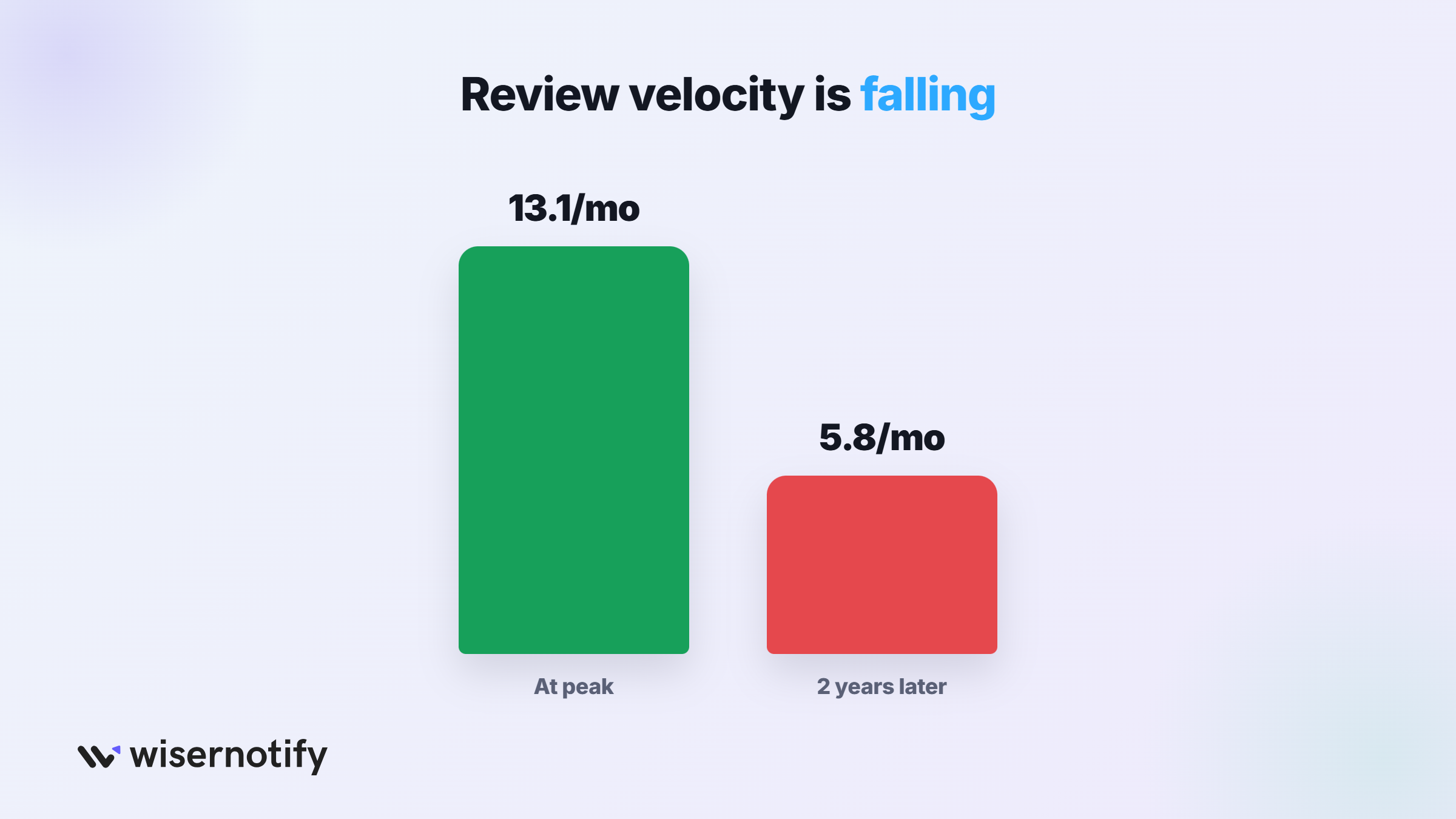
17. Multi-location brands averaged 13.1 new reviews per month per location at their peak.
18. That average fell to 5.8 new reviews per month per location within a couple of years, as review requests slowed down.
19. Google’s algorithm weighs review velocity, how frequently new reviews arrive, alongside star rating and volume.
20. Review diversity, meaning different customers describing different services in their own words, also strengthens a profile’s ranking signal.
Volume without velocity is a trap. Collecting reviews once and stopping is worse than most businesses realize, because Google and customers both discount what looks stale.
Boost Conversion Instantly
Add Social Proof & Urgency to your website
What Rating Do Customers Actually Require?
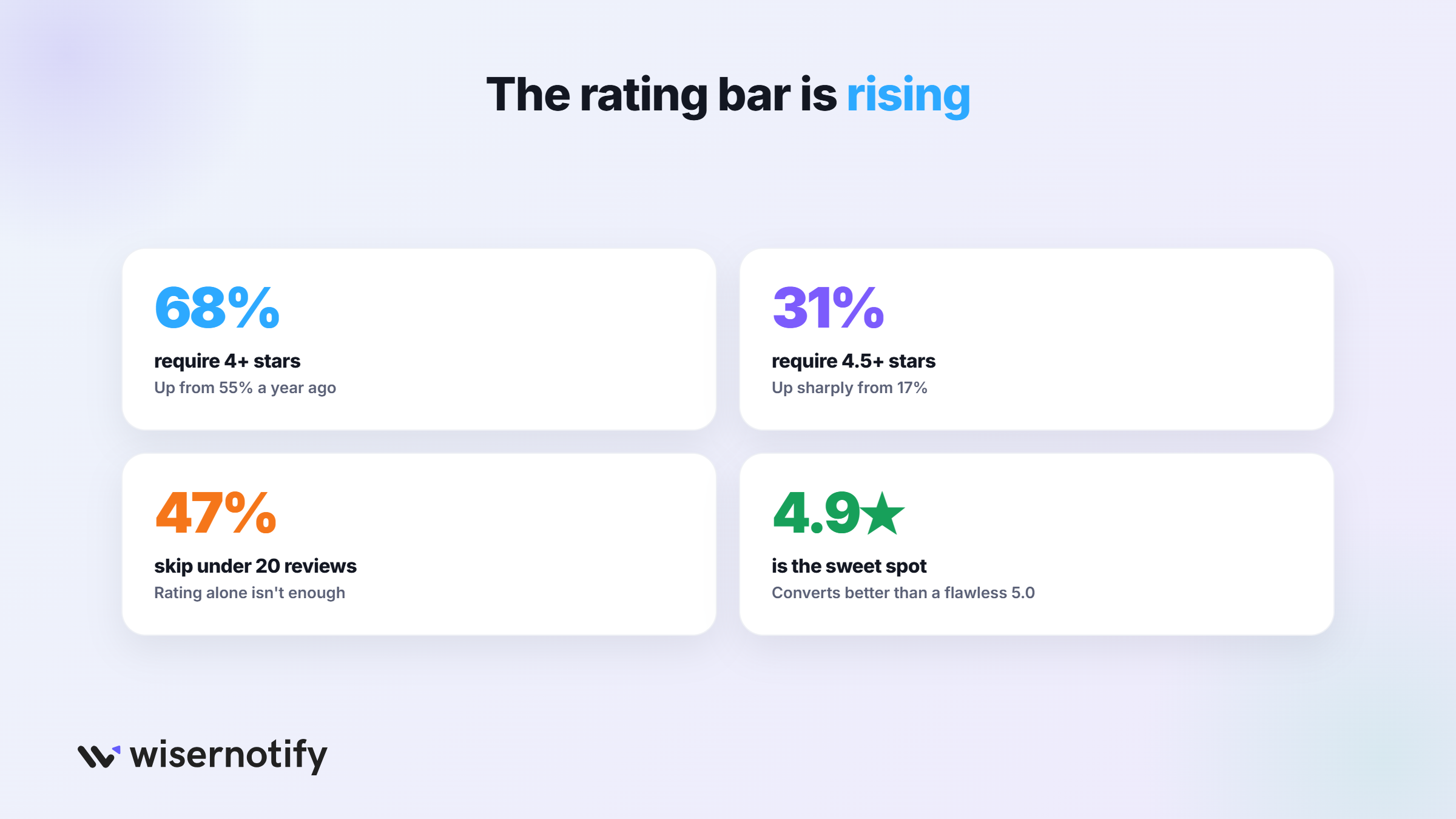
The bar has moved up fast. 68% of consumers now require at least 4 stars, and 31% won’t consider anything under 4.5.
21. 68% of consumers require a rating of at least 4 stars before considering a business, up from 55% the year before.
22. 31% of consumers now only consider businesses rated 4.5 stars or higher, up sharply from 17%.
23. 47% of consumers will not consider a business with fewer than 20 reviews.
24. Businesses ranking in the top 3 local results tend to have 40 or more reviews in competitive markets.
25. A perfect 5.0 rating is not the conversion sweet spot; around 4.9 stars, with a realistic mix of ratings, converts better than a flawless score.
26. Around 56% of Google reviews are five-star, meaning positive sentiment dominates the average profile by default.
An overly perfect score reads as suspicious. A realistic spread, mostly high with a few honest lower ratings, builds more trust than a flawless one does.
How Much Do Reviews Actually Affect Local Ranking?
Reviews are one of the few local SEO factors a business can directly influence, and Google evaluates far more than the star average.
27. Google reviews carry an estimated 20% weight in local search visibility.
28. Google’s algorithm checks review keywords, meaning specific services or locations mentioned inside review text can reinforce relevance for those search terms.
29. Response rate and response speed both feed into how Google scores a business’s engagement.
30. A rating of 4.8 stars or higher is common among businesses that consistently rank in the top local results, a bar our customer experience statistics break down further.
31. Unlike location or website authority, a business’s review profile is one of the few ranking factors it can improve quickly through consistent effort.
You cannot move your address or rebuild your domain overnight, but you can start asking for reviews and responding to them this week. Few other ranking levers move that fast.
Boost Conversion Instantly
Add Social Proof & Urgency to your website
How Big Is the Fake Review Problem on Google?
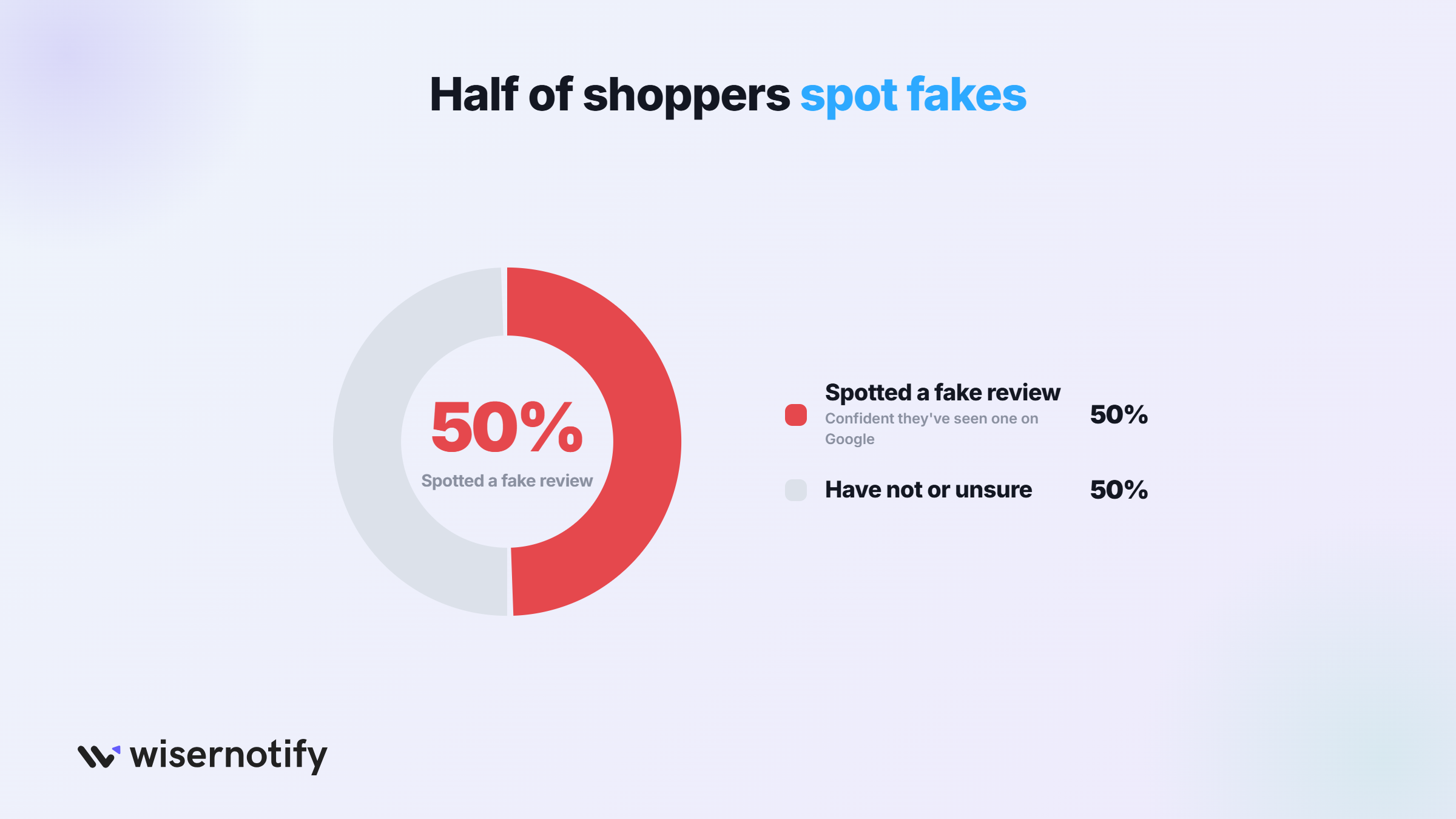
About half of shoppers believe they have spotted a fake review, which makes authentic, detailed feedback worth more than ever.
32. About 50% of customers say they are confident they have seen a fake review on Google.
Detailed, specific review text is harder to fake convincingly and tends to carry more weight with both readers and Google’s systems.
Businesses caught buying or manipulating reviews risk having their entire profile’s trust discounted, not just the fake reviews removed.
A steady, honest flow of real reviews is the most reliable way to outrun suspicion, since sudden unnatural spikes in reviews are what typically draw scrutiny.
Buying reviews is a shortcut that tends to backfire. The safer, and ultimately faster, path is what actually works here: ask consistently, respond consistently, and let real reviews accumulate.
Our fake review statistics cover how widespread the problem is across every platform, not just Google.
How to Use These Numbers
Build a request habit, not a one-time push. Ask right after a positive interaction, keep the process to one click, and you’ll land close to that 83% response rate the data shows is possible.
A review management tool makes that process repeatable instead of manual.
Respond to everything, especially the negative ones, since 95% of your competitors skip this entirely.
Add reviews to your own website with a tool like this one so the proof works everywhere, not just on your Google profile, alongside reviews on your own website.
Boost Conversion Instantly
Add Social Proof & Urgency to your website
Conclusion
Getting Google reviews was never really the hard part. Getting a steady flow, and responding to what comes in, is what actually separates businesses that rank and convert from ones that don’t.
Asking works far better than most businesses assume, and responding costs nothing but time. Both are still skipped by the majority of businesses, which is exactly why doing them consistently is such an easy edge to hold.
Build the habit once, keep it running, and your review profile becomes one of the fastest-moving advantages you have in local search.
Sources
BizIQ | Digital Applied | SearchX | ReviewScout AI | Nadernejad Media
Frequently Asked Questions
How effective are Google reviews?
Google reviews are important for small and local businesses as they relay customer experience to potential customers. As such, good reviews affect customer perception and help develop trust and social proof.
Can Google detect fake reviews?
As many customers check Google reviews before engaging with a brand, there are bound to be fake reviews and endorsements to dupe customers. However, Google has automated systems that flag and delete any suspicious reviews submitted by customers while maintaining the integrity of online reviews and testimonials.
What makes a good Google review?
Users read online reviews which are crisp and right on the mark. Even a negative review will have good feedback if it is written in a productive way, which makes it easier to understand and gets the point across effectively.
Do Google reviews increase sales?
More Google reviews increase the clicks on your website, which improves your search engine presence. Therefore, more customers will be attracted to your business, and the purchase likelihood will increase as well. Thus, the conversion rates for your website increase considerably.

Krunal Vaghasiya is a marketing tech expert who boosts e-commerce conversion rates with automated social proof and FOMO strategies. He loves to keep posting insightful posts on online marketing software, marketing automations, and improving conversion rates.




 Capterra