
20 Positive Review Examples That Buyers Trust (2026)
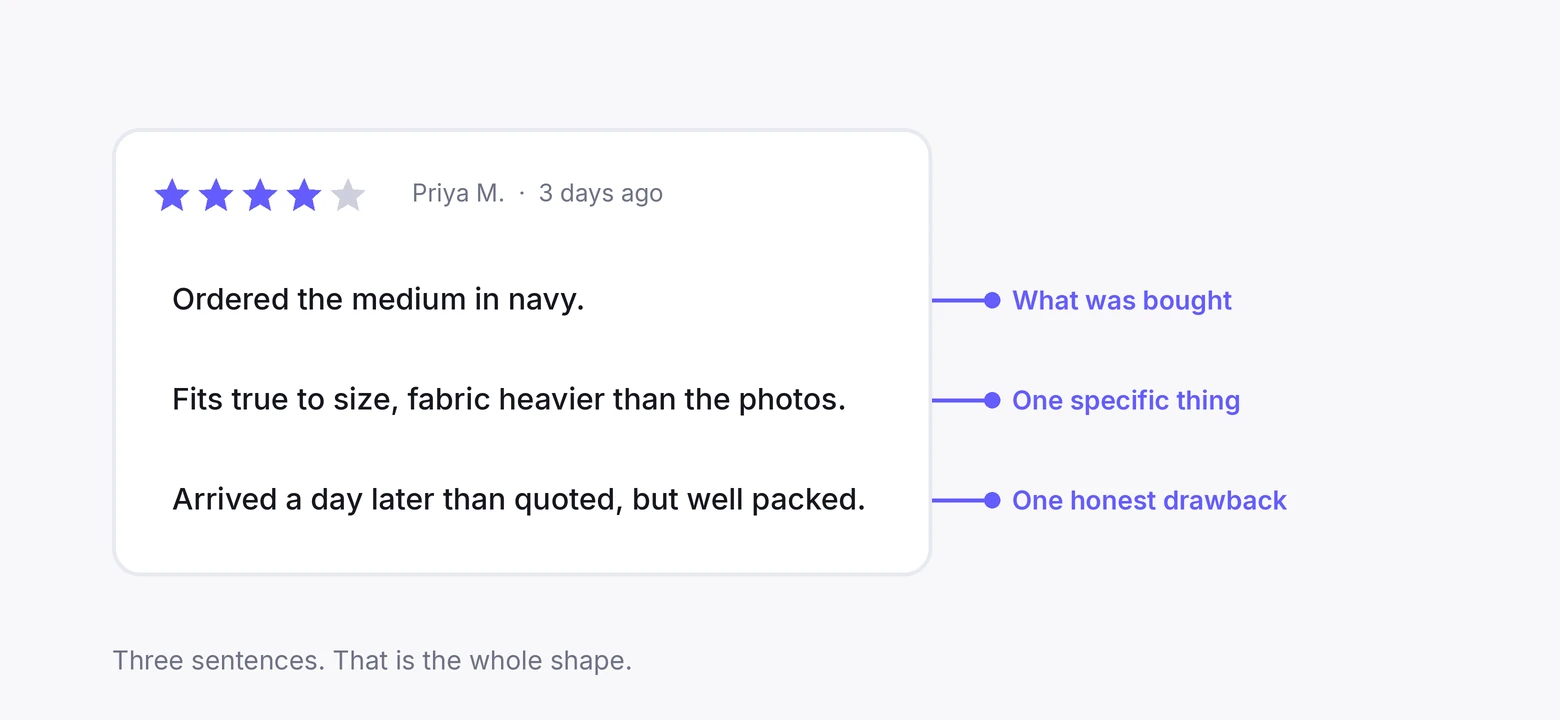
A useful review tells the next buyer something they could not learn from the product page. It names what was bought, says one specific thing that happened, and admits one thing that was not perfect.
Length has almost nothing to do with it.
This page shows twenty examples. Twelve are real reviews from ecommerce stores, software products, coaches, and local services, screenshotted with dates and helpful-vote counts, each with a note on what it gets right or misses.
Eight are short ones written to send with a review request.
No invented quotes attributed to a first name and an initial. Every numbered review from 1 to 12 exists on a public platform today.
It is written for the business owner who wants better reviews, not the customer writing one. The last section shows how to put these in front of your customers when you ask.
Key takeaways
- The trait readers trust most is consistency. A review backed by others saying the same thing ranks first, ahead of star rating.
- “Long and detailed” ranks last among the things that make a review believable. Specific beats long.
- One honest drawback makes every positive line in the same review more credible.
- Recency matters more than volume. Most readers ignore anything older than three months.
- Show one good example in your review request. Customers copy the shape of what they are shown.
- Reply to the good reviews too. Owner replies rank fifth among trust traits, and most businesses only answer complaints.
What a Useful Review Looks Like
Every review below was left by a real customer on a public platform. What separates the ones that move a buyer from the ones that scroll past is a short list of traits.
BrightLocal’s 2026 consumer survey put a number on each.
The table ranks what consumers say makes a review believable, and what each trait does for the person reading it.
| Trait | Consumers who trust it | What it does to the next buyer |
|---|---|---|
| Backed by other reviews saying the same thing | 56% | Turns one opinion into a pattern they can rely on |
| Describes a positive experience | 46% | Tells them what going right looks like |
| Posted in the last month | 44% | Proves the business is still like this now |
| High star rating | 42% | Sets the expectation before they read a word |
| Owner has replied | 37% | Shows someone is listening if things go wrong |
| Photo or video attached | 36% | Proves the reviewer had the product in hand |
| Reviewer is named | 35% | Makes it a person, not a rating |
| Long and detailed | 26% | Less than you would think. Specific detail wins, length does not |
Two things in that table change how most businesses ask for reviews.
Consistency ranks first, which means the tenth review saying “fits true to size” is worth more than the first.
Length ranks last, which means the customer who writes three specific sentences has done more for you than the one who writes three paragraphs of praise.
The traits that never made the list are the ones template guides push hardest. “Highly recommended.” “Exceeded my expectations.” “Five stars.” None of them tells the next buyer anything.
12 Real Reviews and What Each Gets Right
The reviews below are screenshots from Amazon, G2, Google Play, Google, Myntra, and business websites, grouped by the kind of business they were left for. The note under each says which trait it demonstrates, or which one it is missing.
Ecommerce
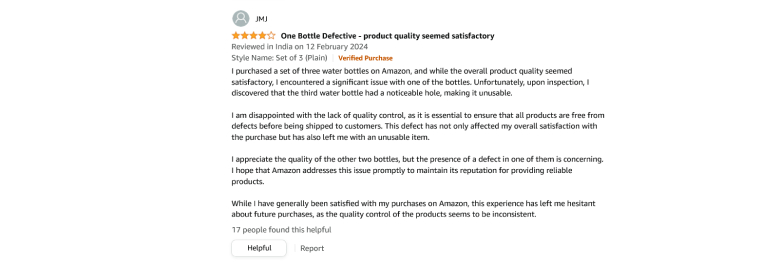
1. The four-star bottle set. This one is not a positive review. It is a four-star review that says two bottles were fine and the third had a hole, and it was found helpful by 17 people.
That is the honest-drawback trait at full strength. A reader now knows the product is good and the quality control is not perfect, which is more than any five-star rave would have told them.
It sat on this page for two years labelled as a positive example. It is a better example of a useful one.
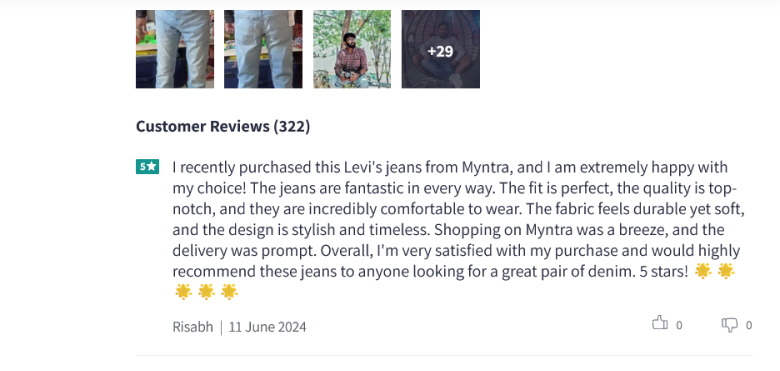
2. The jeans that fit. Fit, fabric, durability, and delivery speed, in that order, from a named buyer with a date. Those are the four things a clothing shopper cannot check from a photo.
What weakens it is the padding. “Fantastic in every way” and “stylish and timeless” add nothing a reader can use. Cut those and it is a stronger review at half the length.
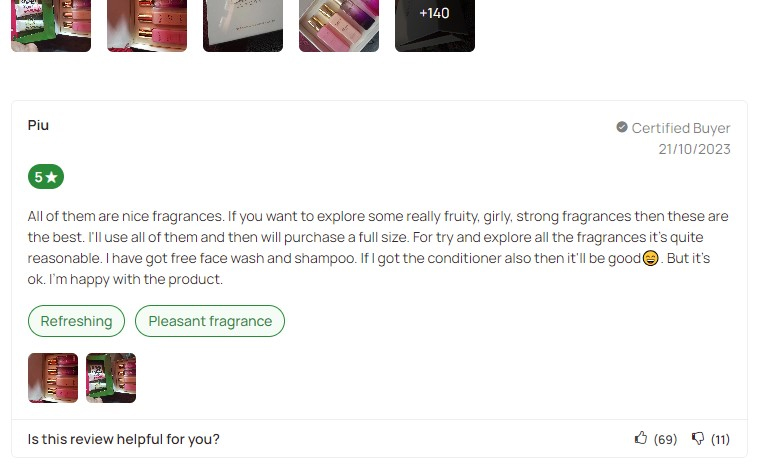
3. The fragrance sampler. A certified-buyer badge, a date, two product photos, and a plan: “I’ll use all of them and then purchase a full size.” Sixty-nine people found it helpful.
The line “if I got the conditioner also then it’ll be good” is the honest drawback again, small and specific. That is why it outperforms the five-star reviews around it.
SaaS and apps
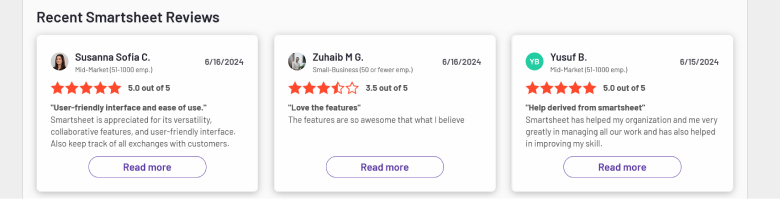
4. The reviewer with a company size. G2 tags each reviewer with their segment. “Mid-Market, 51 to 1,000 employees” tells a buyer at a 200-person company that this opinion applies to them.
That is the named-reviewer trait, doing extra work.
5. The 3.5-star review between two 5-stars. Zuhaib’s rating sits in the middle of the row. A page of nothing but five stars reads as curated. One mid rating in the set makes the two around it believable.
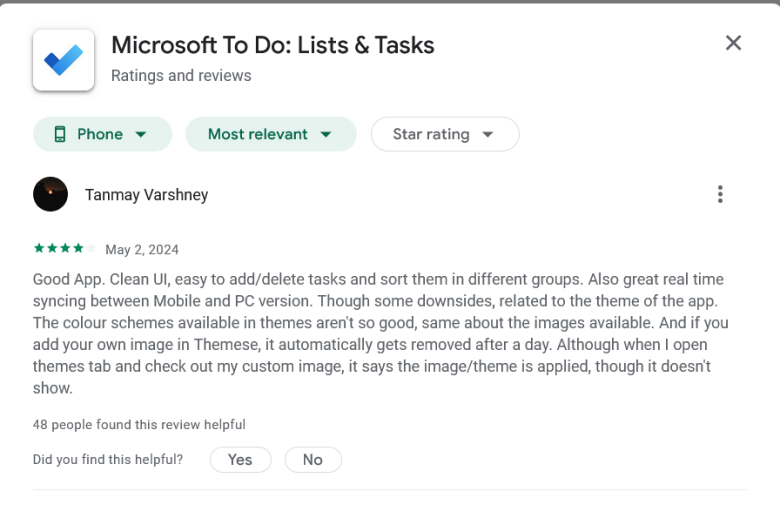
6. The app review with a downside section. Four stars. Clean UI, real-time sync between phone and PC, and then a specific complaint about custom theme images disappearing after a day. Forty-eight people marked it helpful.
Note what the reviewer did not do. No “amazing app,” no “highly recommend.” Every sentence describes something that happens when you use it.
Coaching

7. The one with a path. Samar’s review names what he came for, a two-day refresher, and what he ended up doing, the full ten-day program and a credential. A prospective client can place themselves on that path.
8. The one with an outcome. Amal’s names the change: direction in her career. It is short, and it works because the outcome is the kind a reader wants for themselves.
9. The thank-you note. Stephen’s is warm and says nothing. “Enjoyable and life-changing” could describe any coach on earth. This is what most coaching testimonials look like, and it is the one to stop collecting.
The gap between 7 and 9 is the gap between asking “would you write a few words” and asking “what did you come in for, and what changed.”
Local services
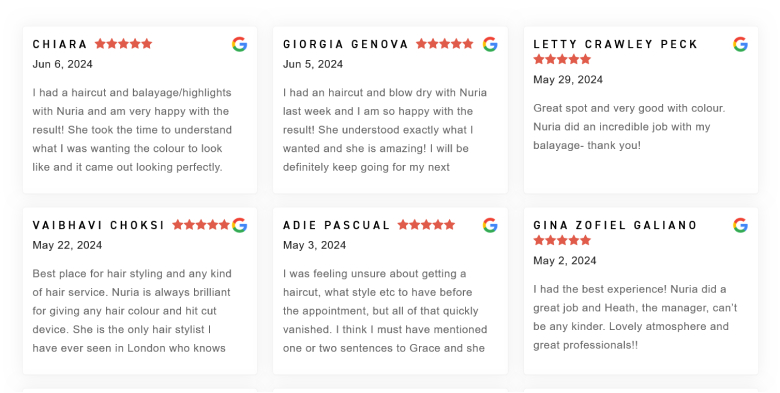
10. Six reviews, one name. Every review on this salon page names Nuria and names the service, balayage, blow dry, cut. Read together they are the consistency trait in action.
A new client does not need to trust any one of them, because they all say the same thing. The same pattern runs through the best testimonial examples in any service business.
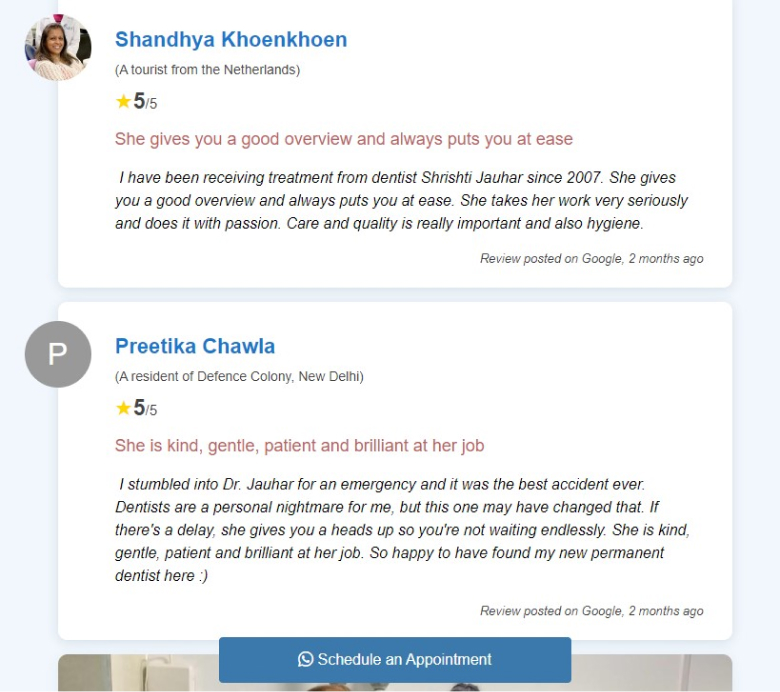
11. The fear, then the fix. “Dentists are a personal nightmare for me” is the opening line, and the rest of the review describes how that was handled. It is written for the exact person who is afraid to book.
The second review adds the line “since 2007,” which is the recency trait’s older cousin, longevity.
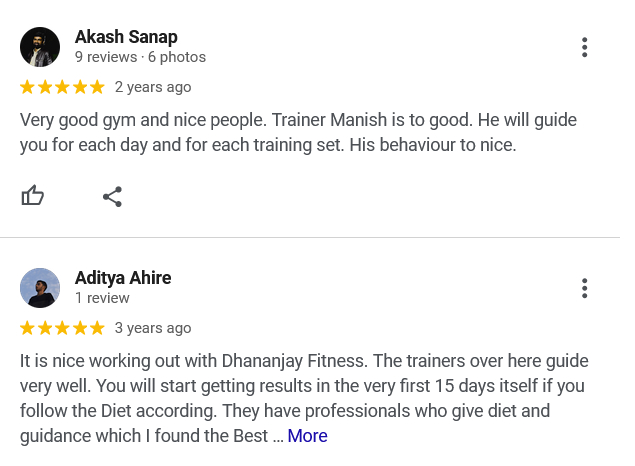
12. The result, and the date problem. “Results in the first 15 days if you follow the diet” is a concrete outcome with a condition attached, which is what makes it credible.
The review above it, “very good gym and nice people,” is the template version and says nothing.
Both are two to three years old. To 74% of readers that makes them invisible, whatever they say. The most useful review on your profile is the one from last week.
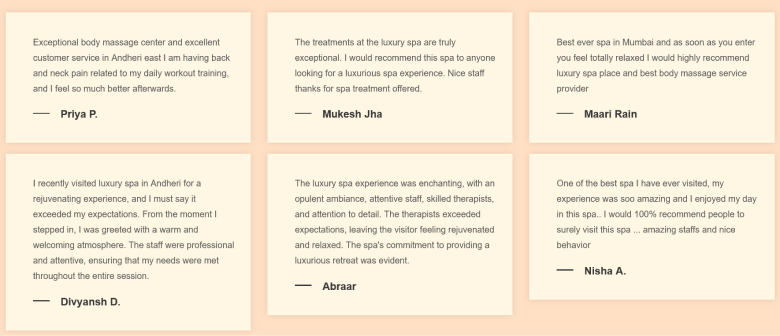
What filler looks like. These six spa testimonials are not numbered because they are the counter-example. “Exceptional,” “truly exceptional,” “exceeded my expectations,” and no detail a reader could check.
A page of these reads as written by the business. It is the failure mode most of our social proof examples post is built to avoid.
Build urgency
Add floating offers with countdown timer & coupon code.

8 Short Examples to Send With Your Request
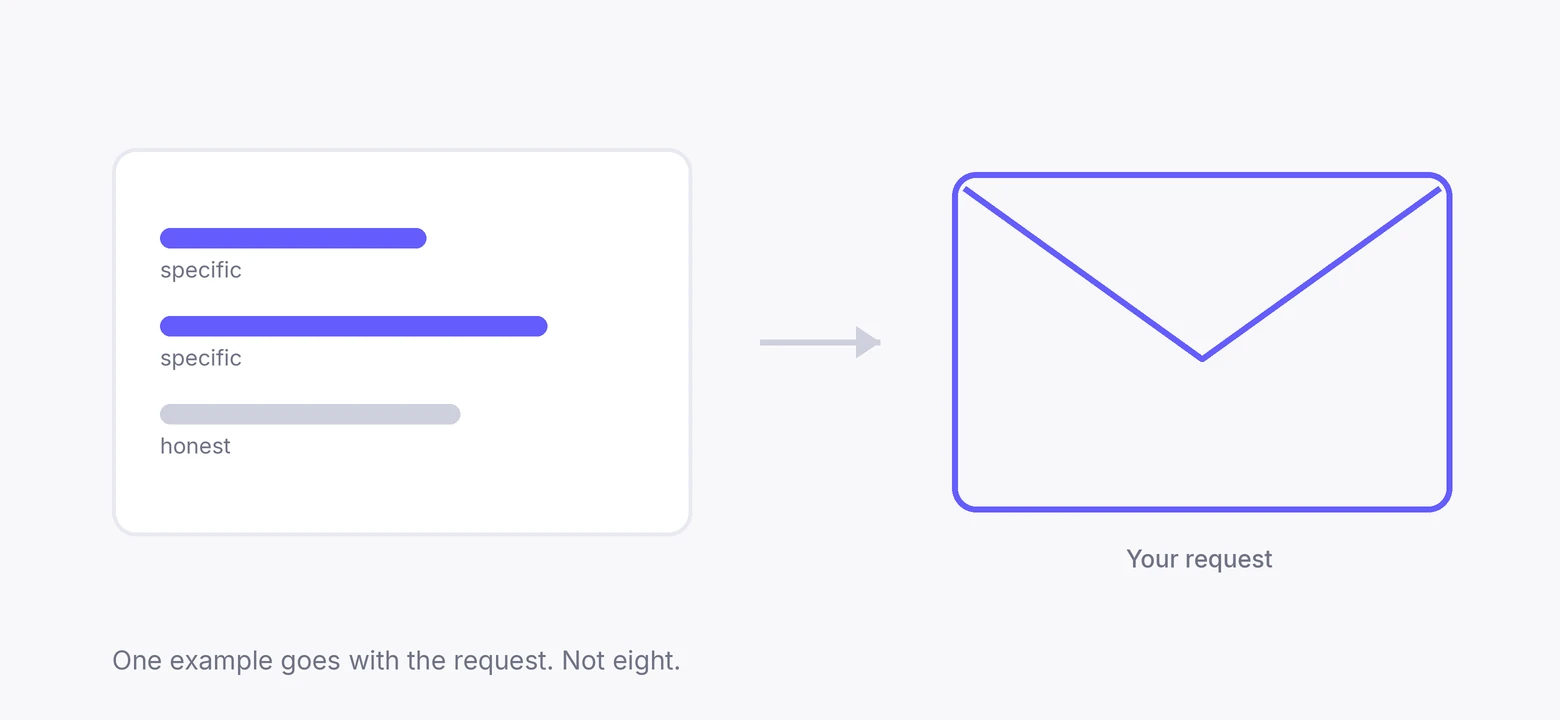
These are written to be shown to a customer at the moment you ask, so they see the shape of a useful review before they write one.
Each is three sentences, names a specific, and admits one small thing. Two per segment.
Ecommerce
13. Ordered the medium in navy. Fits true to size on a 5’10” frame and the fabric is heavier than it looks in the photos. Arrived a day later than quoted, but well packed.
14. Third order from this store. The candles burn evenly and the scent lasts the whole evening. The lids sit loose in the box, so check them on arrival, but nothing has ever broken.
SaaS and apps
15. Moved our five-person team over in an afternoon and the CSV import handled 2,000 contacts with no cleanup. The mobile app lags on older phones. Support replied inside an hour both times I asked.
16. Daily use for four months tracking invoices. The recurring invoice feature saves me about an hour a week. Reports only export to PDF, not Excel, and that is my one complaint.
Coaching
17. Came in wanting to leave my job with no plan. After six sessions I had a launch date, a first client, and a price I could say out loud. The homework between sessions is real work.
18. Booked the eight-week program to get my cohort filled. It sold out two weeks early. The Tuesday call time was hard for my time zone, but the recordings covered it.
Local services
19. Priya did my balayage and spent twenty minutes on photos first to work out what would suit my hair. Three weeks on it has not brassed. Street parking is tight on Saturdays, so book a weekday.
20. First visit after moving here. The hygienist explained each step as she went, which I have never had before. The wait ran fifteen minutes past my slot, but the appointment itself was unhurried.
Send one of these, or one of your own real reviews shaped like this, with the request. Do not send all eight.
A customer shown one example writes a review. A customer shown a list picks one and edits a word.
How to Show These in a Review Request
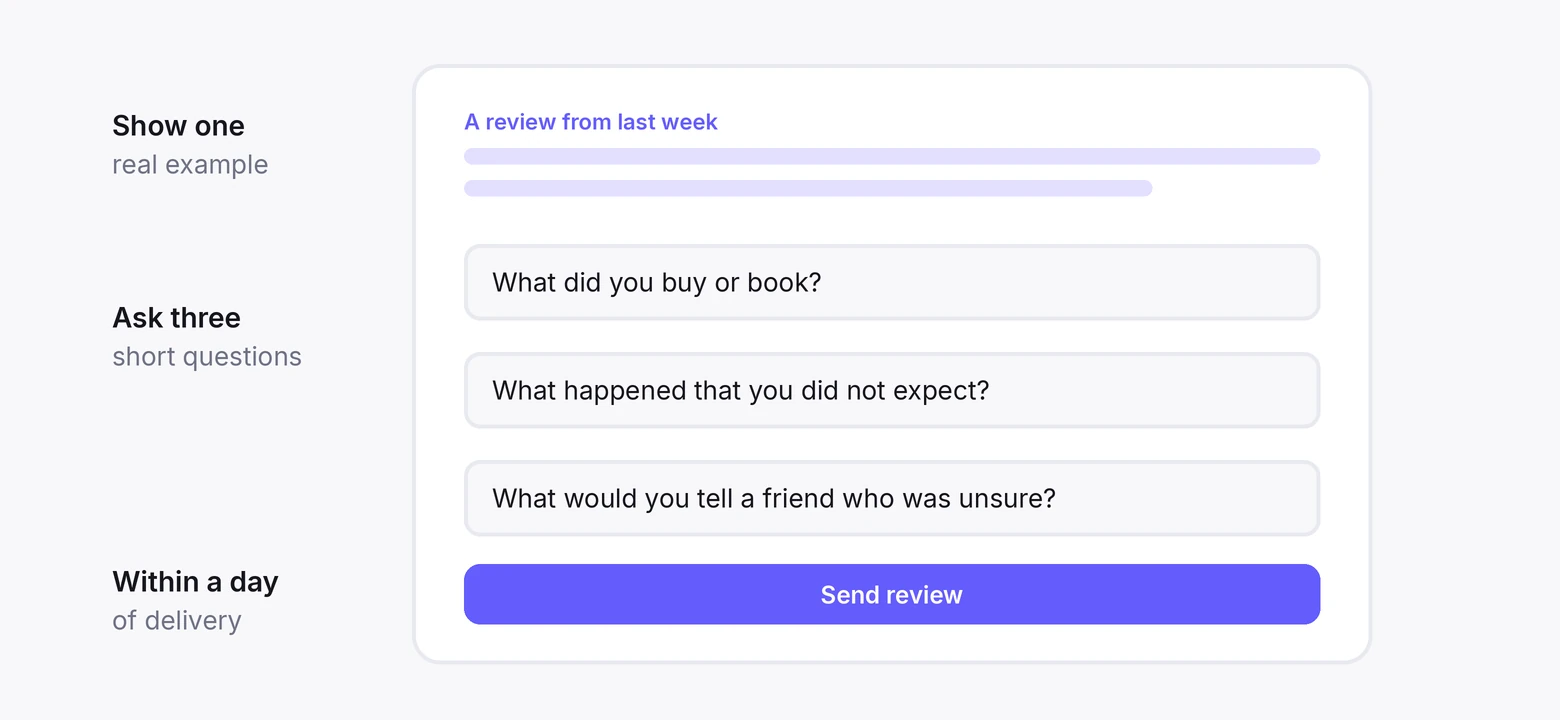
Customers write the review they think you want. Most think you want “great service, five stars.” The fix is to show them a better one at the moment you ask.
Put one real review in the request. Not a template. A real one from a previous customer, three sentences long, that names a specific and admits a small drawback.
Customers copy the shape of what they are shown.
Ask three questions instead of one. What did you buy or book. What is one thing that happened that you did not expect. What would you tell a friend who was unsure.
Three short answers make a better review than one open box.
Ask within a day of delivery or the appointment. The recency trait starts with when you ask. A request two weeks later gets a vaguer review, if it gets one at all.
Never ask for five stars. Ask for an honest review. The four-star review with a drawback in it is worth more than the five-star with none, and it keeps you inside every platform’s rules.
WiserReview’s request forms carry a sample review and custom prompts, so the customer sees the example and answers the questions on the same screen.
The reviews it collects then show on your site through WiserNotify as notifications, review counts, and widgets. That is the consistency trait working for you across the whole page.
For the request itself, our guide to customer review platforms covers where each kind of business should be collecting, and visual reviews covers getting photos attached.
How to Reply to a Positive Review
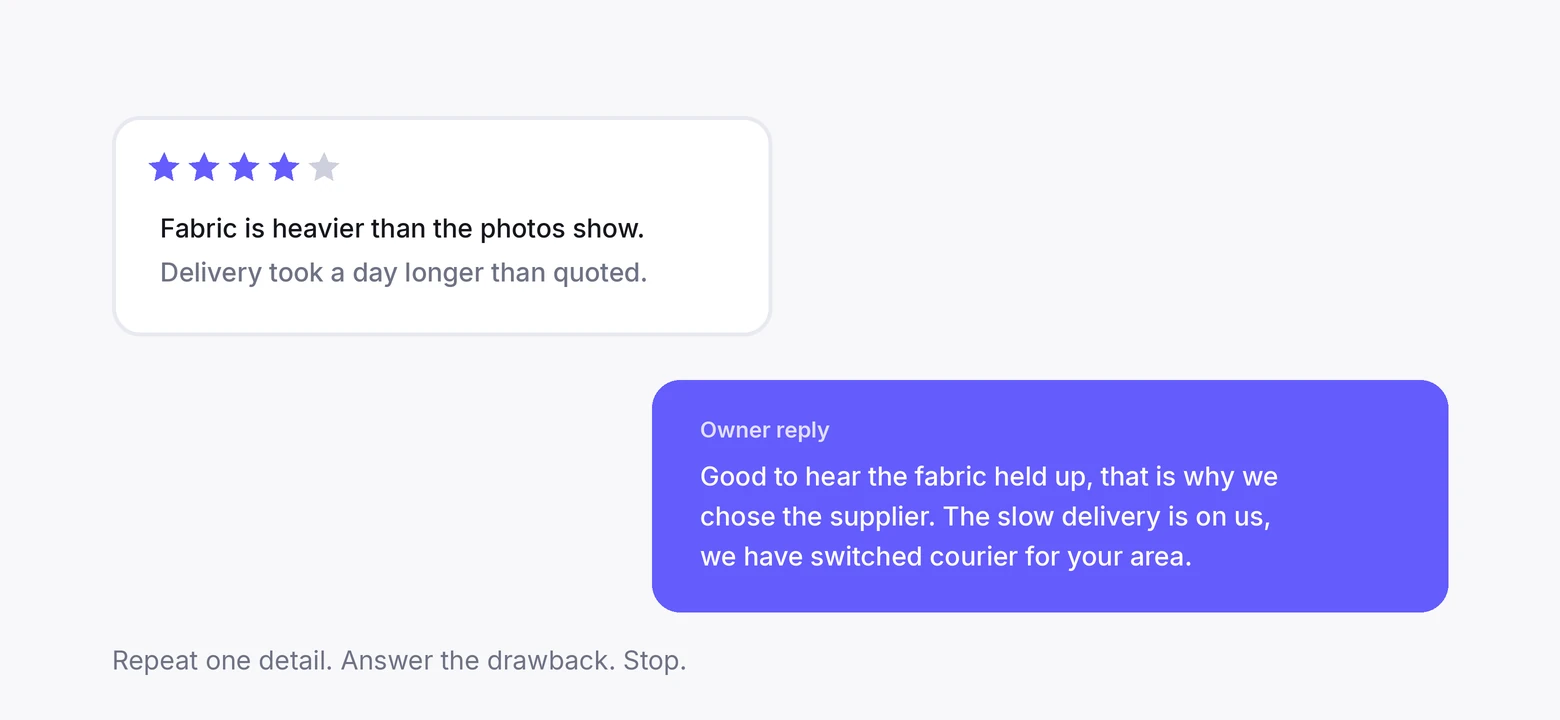
Owner replies are the fifth-ranked trust trait, at 37%, and most businesses reply only to complaints. A short reply to a good review is read by every future buyer who scrolls past it.
Three rules. Name the specific thing they praised, so the reply could not be pasted under any other review. Keep it under three sentences.
Never put an offer or a discount code in the reply. It reads as paying for the review after the fact.
Ecommerce. Thanks, Maya. Good to hear the navy held its colour after washing, that fabric is why we chose the supplier. The slow delivery is on us, we have switched courier for your area since.
SaaS. Thank you, Daniel. The CSV import is the feature we spent longest on, so a clean 2,000-contact run is what we hoped for. Excel export ships next quarter, and I will message you when it does.
Local service. Thanks for this, Anna. Priya will be pleased the balayage has held three weeks on. Saturday parking is a fair point, we have started holding two spaces at the back for clients, ask at the desk next time.
Each reply repeats one detail from the review, answers the one drawback, and stops. That is the whole technique.
Related post: Negative Review Examples and How to Respond
What a Complete Review Contains
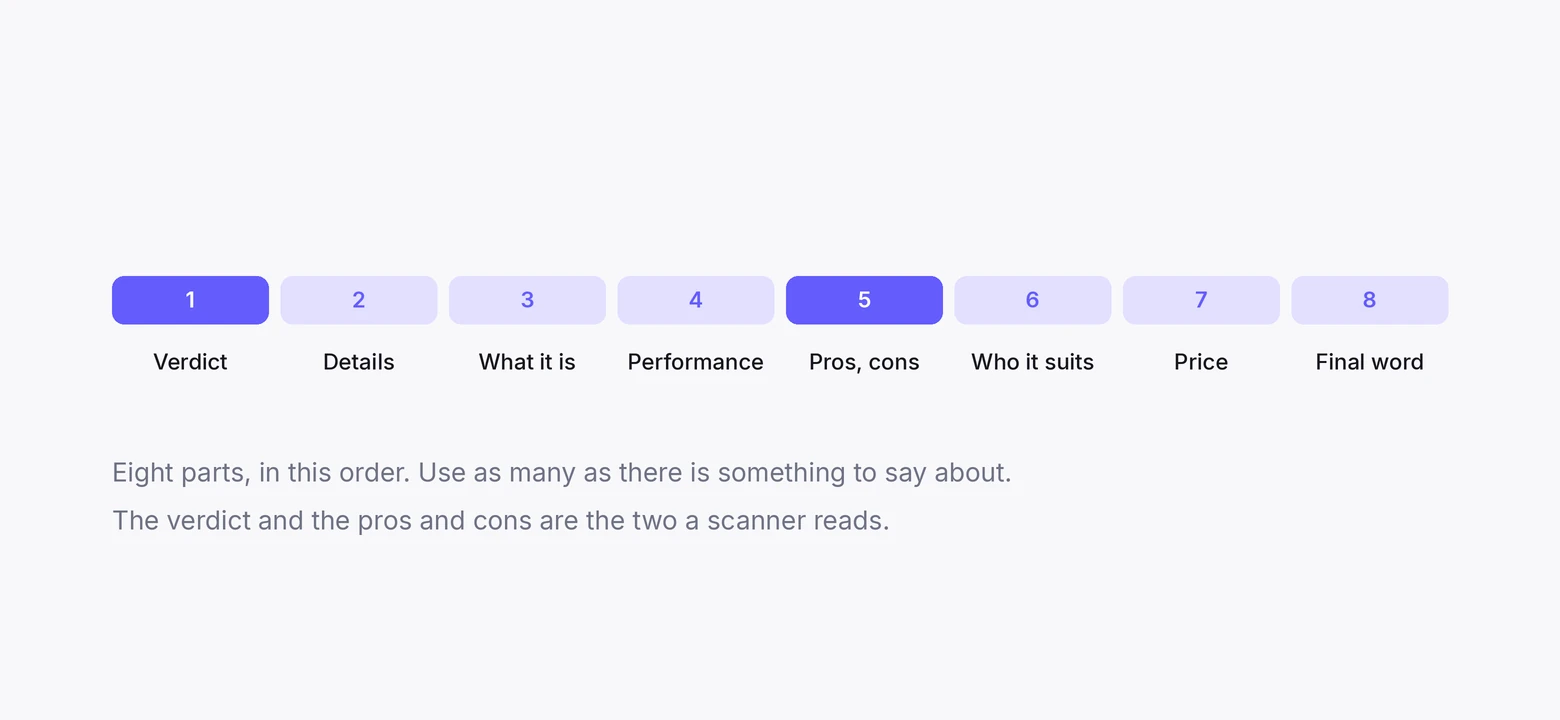
Short reviews are fine. When a customer has more to say, or you ask for a detailed one, this eight-part order covers everything the next buyer wants to know.
It is worth linking from your request as “if you want to write more.”
- Verdict. Two or three sentences with the overall opinion. Do not make readers scroll to find out whether you recommend it.
- Quick details. Product or service name, what you paid, your rating, and who it is best for. Scanners stop here.
- What it is. One or two lines on what the product does and the problem you bought it to solve.
- How it performed. Feature by feature, with specifics. “I got 28 hours per charge” beats “great battery life.”
- Pros and cons. A short balanced list. One honest drawback makes every positive line more believable.
- Who it suits, who should skip it. “Good for beginners” is vague. “Good for a solo founder who needs a simple CRM” is useful.
- Price and value. Worth the money or not, next to the alternatives considered.
- Final recommendation. Would you buy it again, in one line, with a photo if there is one.
This order works for a 100-word Google review and a 2,000-word blog review alike. Use as many parts as there is something to say about.
Review Template to Share
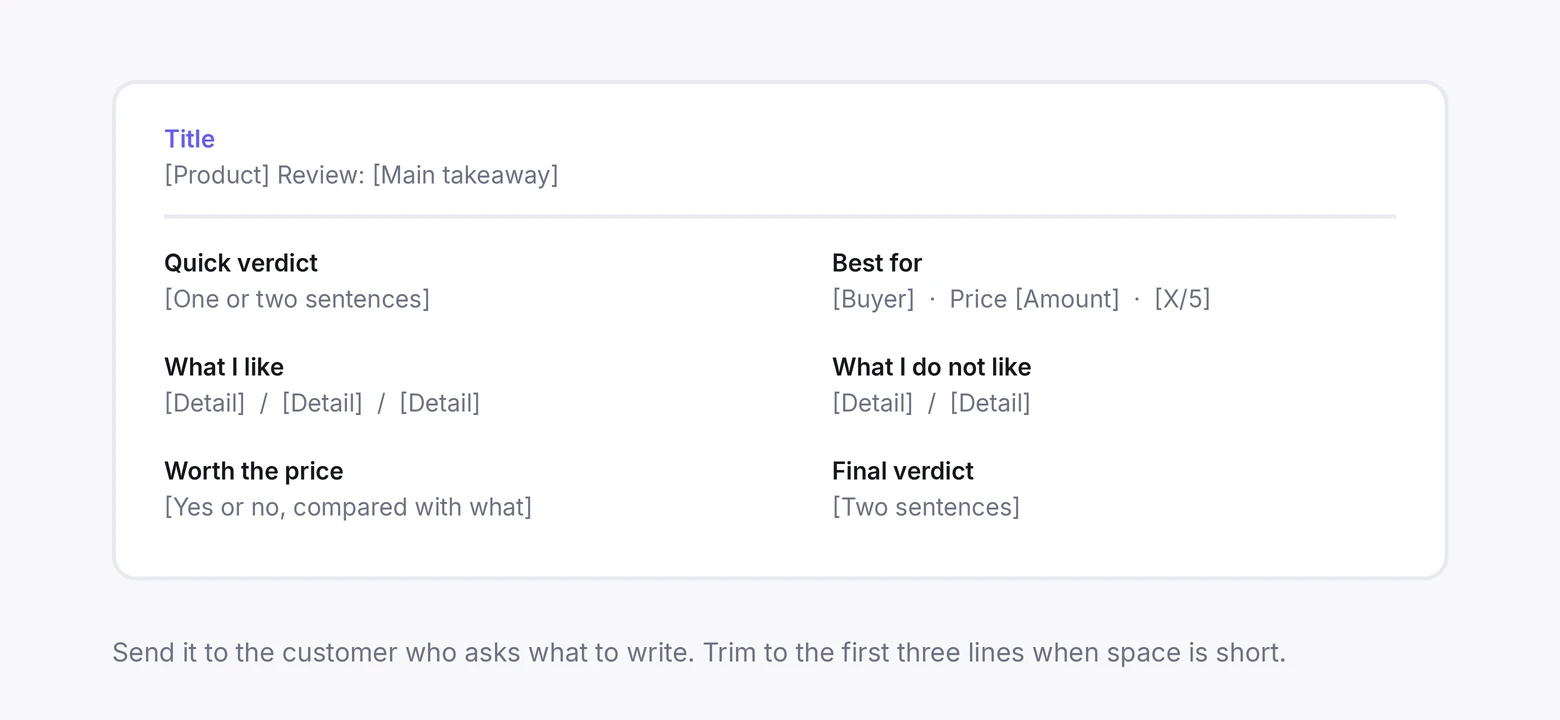
This is the one template worth keeping. Send it to a customer who asks “what should I write,” or link it from your request.
Title: [Product Name] Review: [Main Takeaway]
Quick verdict: [One or two sentences with your overall opinion]
Best for: [Specific buyer or use case] | Price paid: [Amount] | Rating: [X/5]
What I like: [Pro 1 with a detail] / [Pro 2 with a detail] / [Pro 3 with a detail]
What I do not like: [Con 1 with a detail] / [Con 2 with a detail]
What it does: [Two or three sentences on the product and who it is for]
How it performed: [Each main feature and your hands-on experience with it]
Is it worth the price: [Yes or no, and compared with what]
Who should buy this: [Ideal buyer] | Who should skip this: [Who it is wrong for]
Final verdict: [Two or three sentences with your recommendation]
It works for Amazon, Google, app stores, and a product page on your own site. Trim it to the first three lines when the platform limits length.
Build trust & FOMO
Highlight real-time activities like reviews, sales & sign-ups.
Wrap Up
A useful review is specific, recent, honest about one thing, and consistent with the reviews around it. It does not need to be long and it does not need to be five stars.
You get more of them by showing customers one good example when you ask, by asking three questions instead of leaving an empty box, and by replying to the good ones as carefully as the bad.
Then put the reviews where the next buyer will see them, on the page they are deciding on, at the moment they are deciding.
Frequently Asked Questions
What is a good example of a positive review?
One that names what was bought, describes one specific thing that happened, and admits one small drawback. Length matters less than most people think; three specific sentences beat three paragraphs of praise.
Should I include an example review in my review request?
Yes, one. Customers copy the shape of what they are shown, so a single three-sentence example with a specific detail in it produces better reviews than an empty box or a list of templates.
Is a four-star review with a drawback worth more than a five-star review without one?
Often, yes. A review that admits one small flaw makes every positive line in it more believable, and readers rank consistency across reviews above star rating when deciding what to trust.
How many reviews does a business need before they start working?
Around 20 is the first threshold, since 47% of consumers will not use a business with fewer. After that, recency matters more than volume, because most readers ignore reviews older than three months.
How should I reply to a positive review?
Repeat one specific detail from the review, answer any drawback they mentioned, and stop within three sentences. Never put a discount or offer in the reply.
How can a business collect more useful reviews?
Ask within a day of delivery or the appointment, ask three short questions instead of one open box, and show one real example with the request. WiserReview’s request forms carry the sample and the prompts on the same screen.

Krunal Vaghasiya is a marketing tech expert who boosts e-commerce conversion rates with automated social proof and FOMO strategies. He loves to keep posting insightful posts on online marketing software, marketing automations, and improving conversion rates.




 Capterra