
How to Get More Reviews for Your Fashion Brand (12 Ways)

Fashion has a problem no other category has to this degree. The customer cannot try it on before buying, roughly a third of what ships comes back, and most of that is fit.
Product reviews are the only thing on your product page that can answer it, because your model is one size and your customer is not. This covers how to get more of them, and how to make them say something useful about fit.
What Fashion Reviews Do That Product Photos Cannot
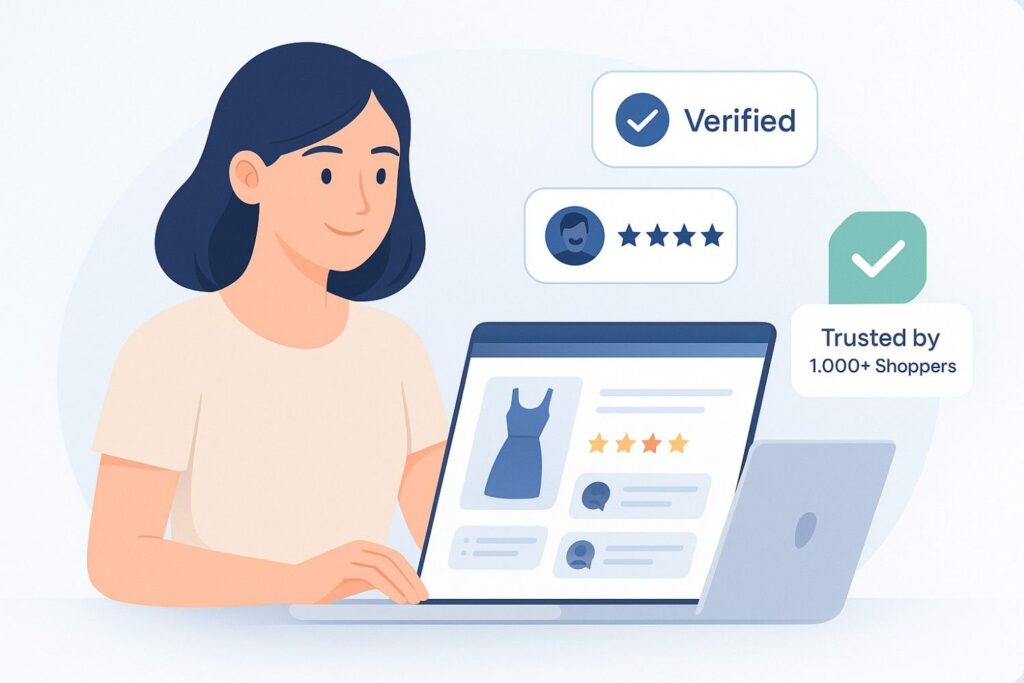
Beyond the sizing question, three things reviews do here that they do nowhere else:
- Fabric and colour do not photograph honestly. Screens differ and lighting flatters. A customer saying the navy reads closer to black saves you an argument later.
- Your own sizing is not consistent. A 12 in one style rarely fits like a 12 in another, and only the people who own both will tell you.
- Reviews date faster than the clothes do. A rating built on last season says very little about the drop you launched in March.
Build trust & FOMO
Highlight real-time activities like reviews, sales & sign-ups.


How to Get More Reviews for Your Fashion Brand
Twelve that work for clothing specifically, roughly in order of how much difference they make.
Before you start, know what you are aiming at. Most stores that ask properly get a review from somewhere between one and five percent of orders, and a good photo rate is one in five of those. If you are well under that, the problem is the asking, not the customers.
1. Wait until they have worn it, not received it
Most brands send the request when the parcel arrives. At that point the customer has opened a bag and nothing else.
Give it seven to ten days for clothing. Long enough to have worn it, washed it once, and formed an actual opinion. That is also long enough for the return window to have shaped their view, which makes the review more honest.
2. Ask for height and size taken, not just a rating
This is the single most useful thing you can add to a fashion review form. Two extra fields, optional, and they turn every review into fit guidance for the next shopper.
Ask for:
- Height and usual size, so the next person can find someone like them.
- How it fitted, on a runs small to runs large scale.
- What they normally buy in that category, which is more useful than a number.
Then let shoppers filter on those fields. A five star review from someone your height answers a question. The same review from a stranger is decoration.
3. Push for photos above everything else
A written review says the jumper fits. A photo of it on a real person shows what “fits” means, which is the whole reason someone hesitates.
Put the upload field inside the review form rather than in a follow-up email, and ask for something specific. “Show us how it fits” gets a worn shot. “Add a photo” gets a flat lay of the packaging.
There is more on this in our guide to collecting photo reviews.
4. Reply to every review, especially the fit complaints
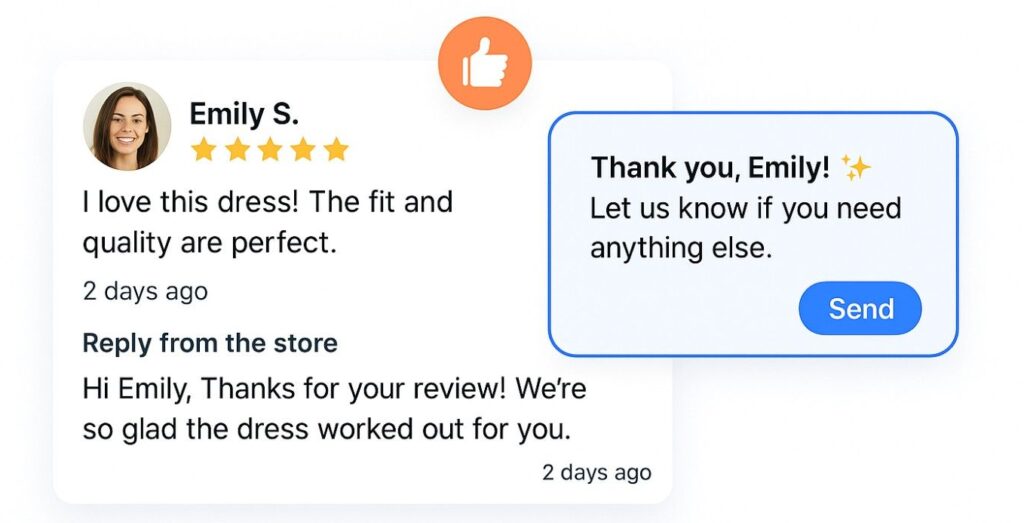
A one star review saying the dress ran two sizes small is not an attack. It is free information, and every shopper reading it is deciding whether you are the sort of brand that responds.
Reply with the actual measurement, offer the exchange, and move on. Do not argue about sizing charts in public.
Our guide to handling bad reviews for products has the wording for the harder ones.
Build trust & FOMO
Highlight real-time activities like reviews, sales & sign-ups.

5. Send the request by the channel they bought on
Fashion skews mobile heavily. If someone bought on a phone at eleven at night, an email to a desktop inbox is the wrong follow-up.
SMS and WhatsApp get opened. Keep it to one line and one link, and only send to numbers you have consent for.
There are wordings you can copy in our guide to review text messages.
6. Put a QR code on the swing tag
The tag is in their hands the moment they unwrap it, which is the highest-attention second in the whole order.
A small printed code on the tag or the care label costs almost nothing per unit. Our guide to the Google review QR code covers generating one.
7. Offer loyalty points, never a payment per star
Points for leaving any review work, and they fit naturally into a fashion loyalty scheme people already use.
What breaks the rules is rewarding the rating. Google prohibits incentivised reviews outright and tightened enforcement in early 2026, and every major platform has similar terms. Reward the act, never the score.
Two other things sit on the wrong side of the line, and both carry FTC penalties in the US:
- Buying or writing fake reviews, including asking staff or family to post as customers.
- Suppressing the bad ones. Hiding negative reviews while publishing positive ones is treated as deceptive, and a page of nothing but five stars reads as staged anyway.
If a competitor is doing it, report it rather than matching it.
8. Ask for video on the pieces worth it
Video shows drape and movement, which a still photo cannot. It matters most on dresses, outerwear and anything with a flowing cut.
Do not ask for it on socks. Reserve it for the twenty percent of the range where movement is the selling point, and expect a lower response rate in exchange for far better content. Our guide to product review videos goes into the how.
9. Trigger it from your store, not a spreadsheet
Set the request to fire on delivered status with a delay. Anything manual gets done for a fortnight and then quietly stops.
The other thing automation buys you is exclusion rules, so nobody who returned the item gets asked to review it.
Build trust & FOMO
Highlight real-time activities like reviews, sales & sign-ups.
10. Look after the customers who buy again

Fashion is repeat-purchase. Someone on their fourth order is far likelier to review than a first-timer, and their review carries more weight because they can compare pieces.
Ask them specifically, and reference what they bought before.
11. Show the reviews on the product page, filtered
Reviews sitting in a dashboard do nothing. On the product page, next to the size selector, they are answering the question at the moment it is being asked.
Filters matter more here than in any other category. Let shoppers narrow by size, height or body type and the same set of reviews becomes several times more useful.
If you also want a reviews page on your website collecting everything in one place, we covered the setup separately.
12. Push them into Google Shopping
The stars under a Shopping listing come from Google’s Product Ratings programme, not from your site, and most clothing brands running Shopping ads never switch it on.
What Google asks for:
- 50 reviews across your whole catalogue before any ratings show at all.
- Three reviews on an individual product before that product gets its own star rating.
- GTINs on your feed, since that is how reviews get matched to products. Without them the match often fails.
- A review feed uploaded monthly, either by you through Merchant Center or by a supported aggregator on your behalf.
One catch worth knowing before you plan around it: product reviews that talk about delivery, service or pricing get rejected, because Google wants them about the item. Another argument for prompting people to write about fit and fabric.
Using Review Feedback to Improve the Product
The reviews you collect are the cheapest product research you will ever get, and most brands never read them in aggregate.
- Sort fit complaints by garment, not by date. Forty reviews saying the shoulders are tight on one style is a pattern issue your factory can fix.
- Watch the wash comments. Shrinkage and pilling show up in reviews weeks before they show up in returns.
- Track colour complaints per screen. If several people say the navy reads black, your product photography is the problem, not the dye.
- Feed it into the next sample round. A design team working from review data makes better decisions than one working from gut feel.
This is also the argument for asking about fit specifically. General praise tells you nothing you can act on.
None of it works if your reviews are a flat list you cannot sort. WiserReview collects reviews by email, SMS and QR code on order status, keeps custom fields like height and size taken, handles moderation and replies in one place, and displays the results on your product page with those fields as filters. That is what makes the patterns above something you filter for rather than something you read four hundred reviews to find.
Putting That Proof Where People Are Deciding
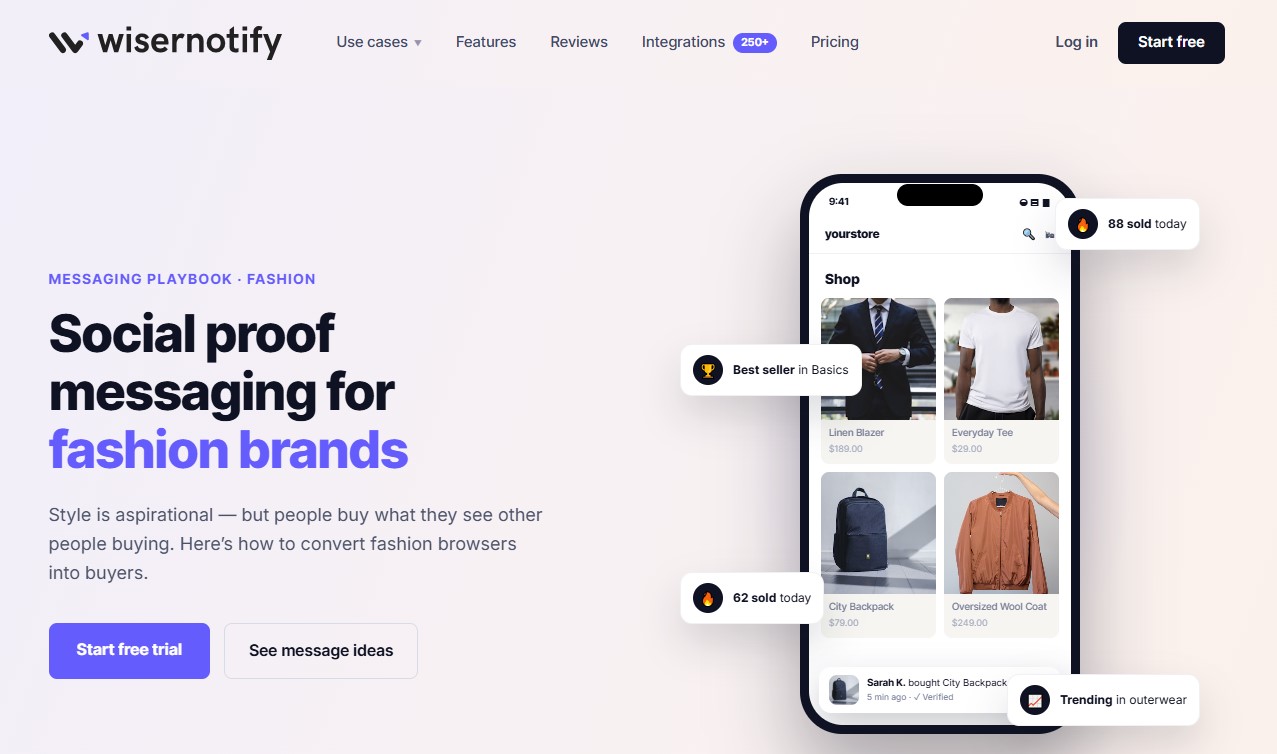
Everything above gets you reviews. A review block still sits below the fold, and on a phone most shoppers never scroll that far.
WiserNotify pulls live activity from your store and shows it as small messages while someone is still looking at the item.
- Recent adds and purchases. Naming the size where you have it, so it doubles as fit proof.
- Review notifications. Your Google and Facebook ratings, with a customer photo where you have permission.
- Sold counters and trending badges. For collection pages, one tag per tile.
- Live visitor counts. Useful when a size is running down.
- Countdown timers. Real drops and end-of-season dates only.
- Trust signals at checkout. Free returns and the fit guarantee, where fit anxiety peaks.
Run them as floating popups over the page, or as inline embeds next to the size selector. Numbers come from your own store data, messaging attaches to the product rather than the variant, and it is first-name-only for GDPR.
The fashion messaging playbook shows each one on a real store layout.

Boost Conversion Instantly
Add Social Proof & Urgency to your website
Wrap Up
Wait until they have worn it, ask for height and size alongside the rating, and push hard for photos. Those three fix most of what is wrong with fashion reviews.
Then put them on the product page next to the size selector, with filters, and reply to the fit complaints in public.
Also check: 27 social proof examples that seal the deal
Related Guides
Frequently Asked Questions
When should I ask a customer to review clothing?
Seven to ten days after delivery. Long enough for the customer to have worn it and washed it once, so the review says something about fit and fabric rather than packaging.
How do I get reviews that mention fit?
Ask for height and usual size as optional fields on the review form, plus a runs-small-to-runs-large scale. Then let shoppers filter reviews by those fields.
Can I offer a discount for a review?
No. Google prohibits incentivised reviews, and paying only for good ratings breaks FTC rules. Loyalty points for leaving any review are fine.
How many reviews do I need for stars in Google Shopping?
You need 50 reviews across your whole catalogue before any stars show, and three on an individual product before that item gets its own rating.
What should I do about a bad review on sizing?
Reply publicly with the actual measurement and offer an exchange. Deleting or hiding negative reviews is treated as deceptive and makes the rest look staged.

Krunal Vaghasiya is a marketing tech expert who boosts e-commerce conversion rates with automated social proof and FOMO strategies. He loves to keep posting insightful posts on online marketing software, marketing automations, and improving conversion rates.




 Capterra