
64 Black Friday Statistics for 2026 (New Data)
Black Friday 2025 broke online sales records in the US and around the world.
More people shopped the holiday weekend than ever before, and a growing share of them found their deals through AI assistants.
These 64 Black Friday statistics cover the 2025 results, how shoppers behaved, and what they point to for Black Friday 2026.
Key takeaways
- US shoppers spent a record $11.8 billion online on Black Friday 2025, up 9.1%, and more of it happened on phones than on desktops.
- AI became a real sales channel, with AI-referred traffic to retail sites up 805% on Black Friday and those visitors converting better than average.
- Shoppers bought earlier and more selectively, paying higher prices for slightly fewer items.
- Black Friday 2026 falls on November 27, so the early-deal window opens in the first weeks of November.
Grab the deal: Top Black Friday SaaS Deals for 2026
Key Black Friday Statistics (Quick Overview)
Ten numbers that tell the story of Black Friday right now.
| Metric | Latest Figure |
|---|---|
| US online sales, Black Friday 2025 | $11.8 billion, up 9.1% |
| Global online sales, Black Friday 2025 | $79 billion, up 6% |
| Thanksgiving weekend shoppers | Record 202.9 million |
| Cyber Week 2025 online total | $44.2 billion, up 7.7% |
| Peak spending rate | $12.5 million per minute |
| Mobile share of online holiday sales | 52.2%, first year above desktop |
| AI traffic to retail sites on Black Friday | Up 805% year over year |
| BNPL spending on Black Friday 2025 | $747.5 million, 80.7% on mobile |
| Deepest discount category | Electronics at 30.9% off peak |
| Black Friday 2026 date | November 27, 2026 |
Black Friday 2025 results
The 2025 event settled the debate about whether Black Friday still matters. It does, and it keeps growing.
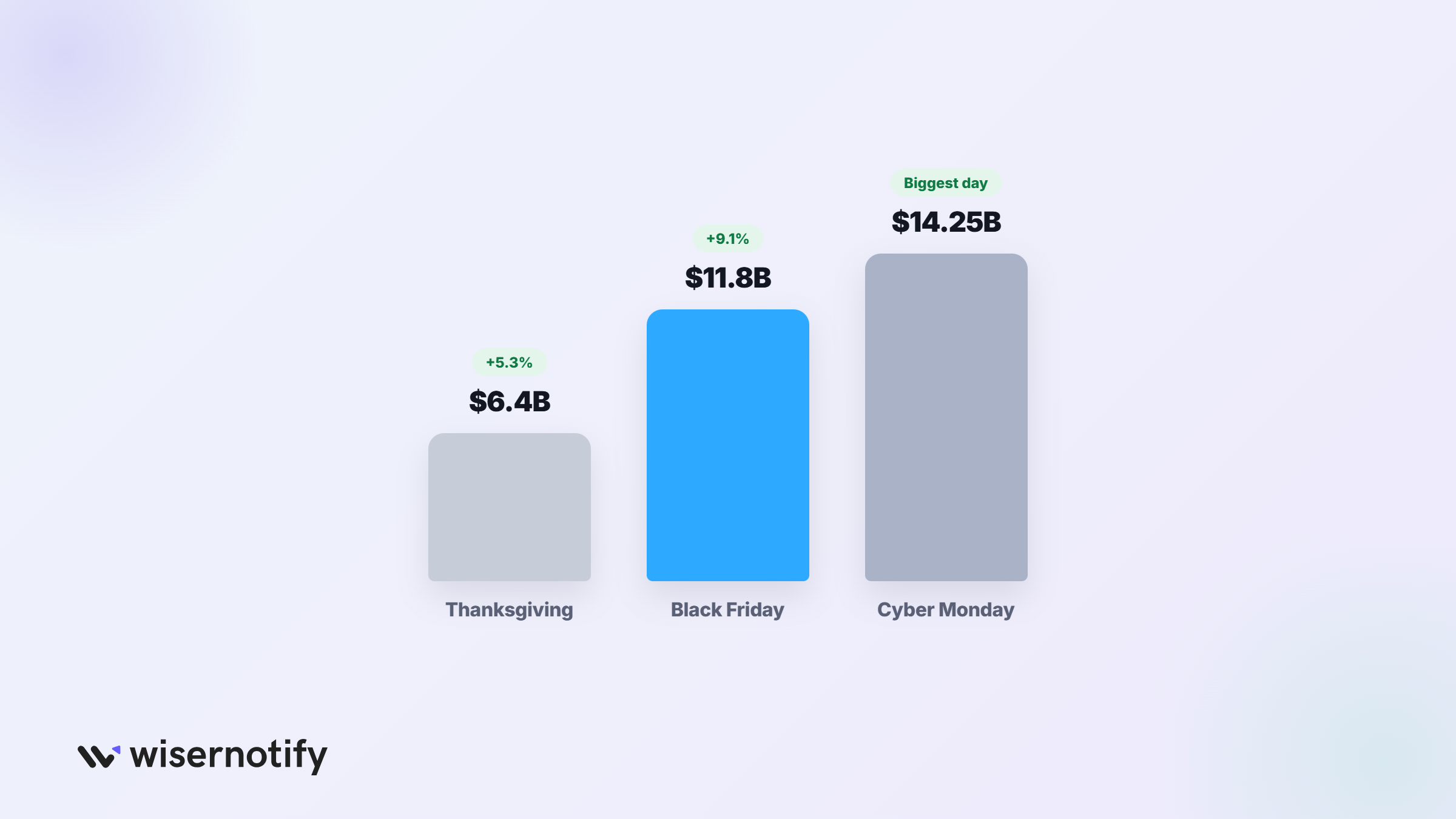
1. US shoppers spent a record $11.8 billion online on Black Friday 2025, up 9.1% from the year before.
2. Between 10 a.m. and 2 p.m., online carts moved $12.5 million every single minute.
3. Globally, Black Friday drove $79 billion in online sales, up 6% year over year.
4. A record 202.9 million Americans shopped during the five days from Thanksgiving through Cyber Monday, beating the old record of 197 million.
5. Thanksgiving Day 2025 added $6.4 billion online, up 5.3%, and the full Cyber Week reached $44.2 billion, up 7.7%.
6. Cyber Monday 2025 stayed the year’s biggest online day at $14.25 billion, but Black Friday grew faster for the second year in a row.
7. Shopify merchants alone sold $14.6 billion globally over the four-day weekend, up 27%, with $6.2 billion on Black Friday itself.
8. The full 2025 holiday season hit a record $257.8 billion online, the first quarter-trillion-dollar season in history.
9. Average selling prices rose 7% on Black Friday 2025 while order volumes slipped 1%, meaning shoppers paid more for slightly fewer items.
The short version: records fell everywhere online, while shoppers got more selective about what went in the cart.
How Black Friday Spending Has Grown
Black Friday started as a store-only event. The online line tells the growth story best.
| Year | US Online Black Friday Sales |
|---|---|
| 2025 | $11.8 billion |
| 2024 | $10.8 billion |
| 2023 | $9.8 billion |
| 2022 | $9.12 billion |
| 2021 | $8.9 billion |
| 2020 | $9.0 billion |
| 2019 | $7.4 billion |
10. Online Black Friday spending has grown roughly 60% since 2019, from $7.4 billion to $11.8 billion.
11. Online spending from November 1 through Black Friday reached $111.4 billion in 2025, up 7.1%, showing how the event now anchors a month-long season.
12. 54% of consumers took advantage of early holiday promotions before the weekend even started.
13. NRF expects the 2025 holiday season to be the first to pass $1 trillion in total US retail spending.
Build trust & FOMO
Highlight real-time activities like reviews, sales & sign-ups.


Online vs In-Store on Black Friday
The in-store crowds did not disappear. They just stopped being the whole story.
14. 129.5 million people shopped in stores over the 2025 Thanksgiving weekend, up 3%, while 134.9 million shopped online, up 9%.
15. Black Friday remains the single biggest day for both channels: 80.3 million in-store shoppers and 85.7 million online shoppers in 2025.
16. The Sunday after Thanksgiving set its own record with 32.6 million in-store shoppers, a 27% jump over 2024.
17. Store traffic trackers disagreed on Black Friday itself: one measured a slight increase in foot traffic, another a decline, while online growth was unambiguous.
Mobile Shopping on Black Friday
Mobile was about a quarter of online sales a few years ago. That era is over.
18. 2025 was the first holiday season where mobile passed desktop, taking 52.2% of online revenue through Black Friday.
19. Seven out of ten visits to retail sites now come from a mobile device.
20. More than half of Black Friday 2025 online sales happened on phones, and Adobe projected mobile would end the season at 56.1% of all online spend.
Buy Now, Pay Later on Black Friday
21. BNPL drove $747.5 million in Black Friday 2025 online spending, up 8.9%, about 6.3% of the day’s digital sales.
22. 80.7% of that BNPL spending happened on mobile devices.
23. Across November 1 to 28, BNPL reached $8.2 billion, and PayPal reported BNPL transactions up 23% through Thanksgiving week.
24. Shoppers used BNPL most for electronics, apparel, toys, and furniture.
AI and Black Friday Statistics
This is the section no Black Friday roundup needed three years ago. AI assistants became a real shopping channel in 2025.
25. Traffic from AI tools to US retail sites grew 805% year over year on Black Friday 2025.
26. Shoppers arriving from an AI service were 38% more likely to convert to a sale than visitors from non-AI sources on Black Friday.
27. Salesforce tracked $3 billion in US online sales driven by AI and shopping agents on Black Friday alone, with agent traffic up 300% in the first half of the day.
28. Across the full 2025 holiday season, AI-referred traffic to retail sites grew 693%.
29. AI and agents influenced $262 billion of global online holiday spending in 2025, about 20% of all retail sales.
30. Shoppers referred to retail sites from AI search tools like ChatGPT and Perplexity converted nine times more often than visitors referred from social media.
31. Shoppers leaned on AI most for video games, appliances, electronics, toys, and personal care purchases.
32. More than 300 million customers used Rufus, Amazon’s AI shopping assistant, in 2025, and it drove nearly $12 billion in incremental annualized sales.
33. Amazon says shoppers who use Rufus during a shopping trip are 60% more likely to complete a purchase.
The takeaway for stores: being findable and recommendable inside AI tools is becoming as important as ranking in Google for Black Friday traffic.
Related read: Cyber Monday Statistics (A 73-Year History)
Top-Selling Products and Categories on Black Friday
Electronics still rule the day, but the depth of discounts tells you where retailers fight hardest.
34. Electronics discounts peaked at 30.9% off listed price in 2025, the deepest of any category, up from 30.1% in 2024.
35. Toys hit 29.6% off, apparel 25.1%, televisions 24.3%, computers 23.4%, sporting goods 20.3%, and appliances 20.2% at their peaks.
36. Video game consoles, electronics, and home appliances were the standout Black Friday sellers in 2025.
37. On Cyber Monday, just three categories drove 57% of all online spend: electronics ($3.7 billion), apparel ($2.6 billion), and furniture ($1.8 billion).
38. Bluetooth headphones and speakers sold at 1,850% above normal October levels during Cyber Week, with game consoles up 1,800%.
39. Apparel pulled in $47.6 billion online across the season through December 1, up 2% year over year.
40. Luxury apparel and accessories ranked among the most popular Black Friday categories globally.
Black Friday Shopper Behavior Statistics
When people shop matters as much as what they buy, and the calendar keeps stretching earlier.
When Shoppers Start
41. 54% of Black Friday shoppers start their purchasing journey at least 7 days before the event.
42. In Q4 2025, shoppers clicked marketing messages less often, yet average order value nearly doubled compared with the rest of the year.
43. About a third of shoppers still head out early on the day itself to grab time-limited deals.
44. Even after Cyber Monday, shoppers reported 53% of their holiday buying still ahead of them, keeping December busy for retailers.
Who Shops on Black Friday
Millennials and Gen Z lead online, families hunt appliances and gifts, and older shoppers stay loyal to in-store deals.
45. Adults aged 25 to 34 make up the single largest Black Friday shopper group at around 24%, with middle-aged shoppers close behind.
46. Women make up the larger share of Black Friday shoppers, skewing toward apparel and beauty, while men over-index on electronics and sporting goods.
47. A desire for deals drove the record turnout: free shipping and limited-time offers were the top motivators shoppers named in NRF’s survey.
Black Friday Email and Marketing Statistics
Black Friday is the highest-stakes send of the year for most email lists.
48. Automated emails such as abandoned cart and welcome flows made up just 2% of ecommerce email sends in 2025 but earned 30% of email revenue, about 16 times more per send than scheduled campaigns.
49. With 54% of shoppers buying from early promotions, campaigns that land the week before Black Friday capture spending that never waits for the day itself.
Strong Black Friday email subject lines decide whether those sends get opened at all, and personalization decides whether they convert.
You can also check out: 50+ Ecommerce Personalization Statistics & Trends
50. Urgency works both ways: shoppers respond to limited-time offers, and cart abandonment spikes when checkout friction meets deal-hunting behavior.
Also see: 25 Black Friday Email Examples That Work Like a Charm
Black Friday for Small Businesses
The weekend is not only a big-box story. Independent stores get their own record days.
51. Shopify merchants, most of them small and mid-sized brands, sold $14.6 billion over Black Friday Cyber Monday 2025, growing 27% while the broader market grew single digits.
52. 62.7 million people shopped in stores on the Saturday after Black Friday 2025, and 80% of intended Saturday shoppers said supporting Small Business Saturday was part of the reason, per NRF.
53. PayPal saw BNPL transactions at small and medium businesses rise 17% year over year through Thanksgiving week, a sign flexible payments help smaller stores compete.
Smart Black Friday marketing and a simple preparation checklist matter more for small teams than anyone else, because one strong weekend can fund the whole Christmas season.
Amazon Black Friday Statistics
54. Amazon accounts for an estimated 17.7% of all US Black Friday sales, more than any other single retailer.
55. Amazon’s Q4 2025, anchored by the Black Friday and Cyber Monday event, hit $213.4 billion in revenue, the biggest quarter in company history, up 14% year over year.
56. Rufus, Amazon’s AI assistant, now shapes Black Friday discovery for hundreds of millions of shoppers, with monthly users up 115% year over year in the first quarter of 2026.
Global Black Friday Statistics
Black Friday stopped being an American event years ago.
57. Global online sales hit $79 billion on Black Friday 2025, up 6% year over year.
58. Globally, more than half of Black Friday purchases now happen online, and about 40% of shoppers research digitally before buying in-store.
59. Salesforce measured Black Friday at 33% of total BFCM weekend sales worldwide, ahead of Cyber Monday’s 23% share.
Black Friday 2026: What to Expect
60. Black Friday 2026 lands on November 27, with Cyber Monday on November 30.
61. Mobile is projected to keep climbing past 56% of online holiday sales, so every deal page and checkout should be built phone-first.
62. AI shopping traffic grew 805% on Black Friday 2025 from a small base, which makes another multiple-hundred-percent jump in 2026 the safest prediction on this page.
63. Deals will start earlier again: 54% of shoppers already buy on early promotions, and retailers keep rewarding them for it.
64. BNPL is on track to keep growing double digits after crossing $8 billion in November 2025, especially on mobile checkouts.
For stores preparing, the pattern is clear. Win the phone screen, show real proof that others are buying, and be visible wherever shoppers research, including inside AI assistants and social media.
Urgency tactics like flash sales and limited-time offers work because the whole weekend is built on them.

Boost Conversion Instantly
Add Social Proof & Urgency to your website
Wrap Up
Black Friday keeps growing, with record online sales and more shoppers than ever. AI is also becoming a major way people discover products and deals.
The season now starts earlier, happens mostly on mobile, and runs well beyond a single day. Brands need to be ready long before the biggest sales begin.
For online stores, winning comes from planning ahead, offering clear deals, making checkout easy on a phone, and building trust with real customer reviews and activity.
Sources
Adobe | NRF | Salesforce | Shopify | Omnisend | Retail Dive | Digital Commerce 360 | Statista
Frequently Asked Questions
Is Black Friday good for the economy?
Black Friday, which falls on the next day of Thanksgiving, has become the biggest shopping day filled with discounts and deals. This leads to shoppers going on a shopping spree, leading to higher demand for goods and services. As a result, there is a significant increase in inflation rates and revenue generation.
What is the objective of Black Friday sales?
Black Friday sales mark the onset of the holiday season, and shoppers spend a hefty amount in this season. The main aim of Black Friday sales is to take advantage of that fact and bring your brand or business into focus when everybody is looking. Thus, this boosts your sales and advertises your brand to other potential customers.
How long do Black Friday sales last?
Originally, Black Friday sales lasted 24 hours, i.e., 1 day, and retailers opened their doors as early as midnight, offering exciting discounts and deals. Now, the trend has changed, and the event usually lasts for about a week longer.

Krunal Vaghasiya is a marketing tech expert who boosts e-commerce conversion rates with automated social proof and FOMO strategies. He loves to keep posting insightful posts on online marketing software, marketing automations, and improving conversion rates.




 Capterra