
I Tested 9 Uberall Alternatives for Local SEO (2026)

I’ve managed local SEO and listings for multi-location brands across 6 industries. Uberall is a legitimate enterprise platform.
The listings sync, review management, and store locator features work well for brands managing 50+ locations.
But Uberall’s biggest friction point is accessibility. There’s no published pricing, no free plan, and no trial.
You can’t even see a demo without talking to sales. The minimum is 25 locations, which means small businesses and growing chains with 5-20 locations are priced out before they even start.
G2 reviewers report that onboarding can take up to 60 days, and several mention the sales process itself as a barrier.
I’ve tested 9 alternatives for listing management, review monitoring, local SEO, and multi-location reputation management.
Some start under $30/month for a single location. Others match Uberall’s enterprise features at lower price points. Here’s what I found.

Boost Conversion Instantly
Add Social Proof & Urgency to your website
Quick Comparison: Uberall vs 9 Alternatives
Why Brands Switch from Uberall
Uberall’s platform is powerful for enterprise brands managing hundreds of locations. But here’s where teams consistently run into friction.
Uberall Pricing (2026)
No free plan. No free trial. No published pricing. All packages require a minimum of 25 locations and a sales conversation. Add-ons (posting to Google/Apple, local pages, messages, social ads) further increase costs. Compare that to BrightLocal’s transparent $39/month pricing or Synup’s $34/month per-location model.
9 Best Uberall Alternatives for Local SEO and Listings (2026)
1. BrightLocal
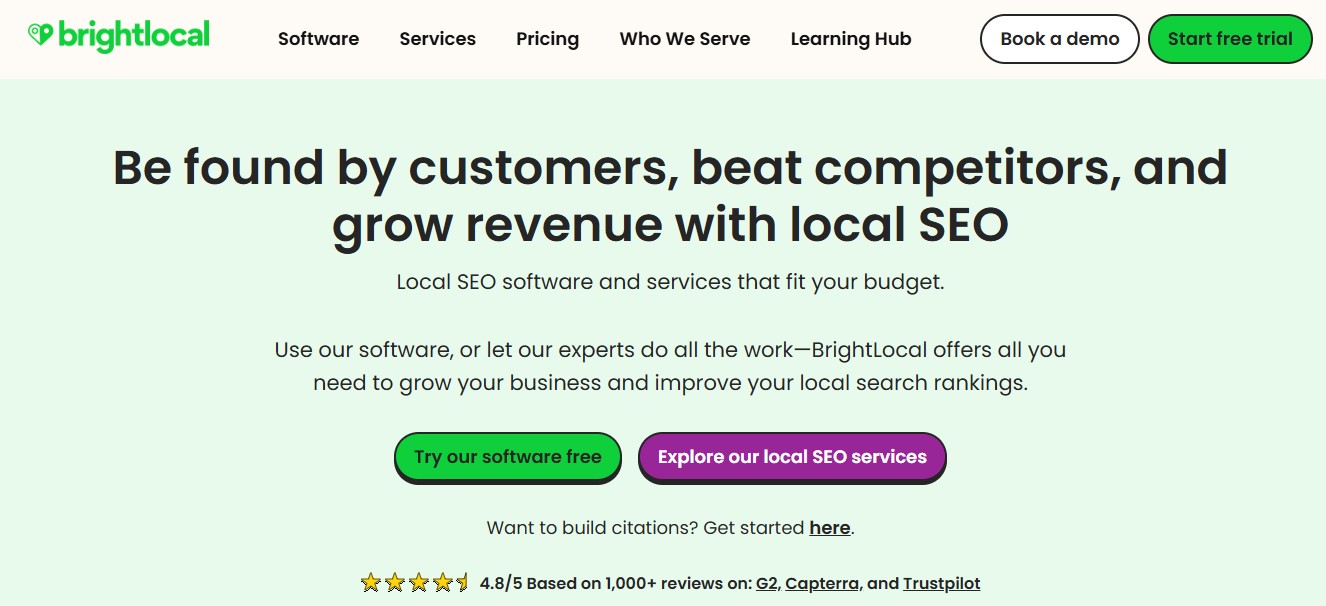
BrightLocal is the most popular Uberall alternative for agencies and small- to mid-size businesses that need local SEO tools alongside listing management.
If you want local rank tracking, citation building, and review management in one platform, BrightLocal covers it all at a fraction of Uberall’s cost.
What they do right: Local rank tracking shows exactly where your business appears in Google Maps and local search results for specific keywords, broken down by location.
Citation building identifies where your business is listed (and where it’s missing) across hundreds of directories.
The audit tool finds inconsistencies in NAP (Name, Address, Phone) data and helps you fix them.
Review monitoring pulls reviews from Google, Facebook, Yelp, TripAdvisor, and 80+ other sites into a single dashboard. You can respond to reviews directly and set up email alerts for new ones.
Steal this: Their “Local Search Grid” report. It shows a visual heat map of where your business ranks in Google Maps across a geographic area.
You can see ranking differences block by block, which is invaluable for understanding local competition.
What to know before choosing: BrightLocal doesn’t sync your listings automatically, unlike Uberall.
It audits and monitors, but you still need to update listings manually or use their citation-building service (at an additional cost). For automatic listing sync, Yext or Synup is a better fit.
Pricing: From $39/month. 14-day free trial.
2. WiserReview

WiserReview isn’t a listings management platform.
It’s a review collection and display tool that handles the specific piece Uberall does poorly: collecting first-party reviews and showing them on your website as social proof.
What they do right: WiserReview automates review collection via email, SMS, WhatsApp, and shareable links. Customers submit text, photo, and video reviews through branded forms.
You moderate from one dashboard and display the best reviews using customizable widgets (carousels, grids, badges).
Uberall pulls reviews from third-party platforms (Google, Yelp, Facebook) but doesn’t help you collect first-party reviews or display them on your own website.
WiserReview fills that gap at $15/month, rather than with enterprise pricing.
It integrates with Shopify, WooCommerce, WordPress, Wix, and Webflow. Google and Facebook review syncing pulls existing reviews into your dashboard alongside first-party ones.
Steal this: Their video review collection flow. Customers record video testimonials directly from their phone using a simple link.
No app download needed. Uberall doesn’t offer video review collection.
What to know before choosing: WiserReview doesn’t manage business listings, track local rankings, or sync NAP data across directories.
It’s specifically for review collection and website display. Pair it with BrightLocal or Synup to complete your local marketing stack.
Pricing: Free plan available. Paid from $15/month.
3. Yext

Yext is the most direct Uberall competitor and the default enterprise alternative for large-scale listings management.
If you need your business information synced across 200+ directories in real-time, Yext’s publisher network is the largest in the industry.
What they do right: Yext’s “Knowledge Graph” stores all your business data (addresses, hours, menus, staff bios, FAQs) in a single source of truth and pushes it to 200+ directories automatically.
Changes propagate within minutes, not days.
Review monitoring and response covers Google, Facebook, Yelp, and 100+ review sites.
AI-powered suggested responses help teams reply faster. Analytics show review sentiment trends and competitive benchmarks.
The Yext Pages feature generates SEO-optimized landing pages for each location.
Steal this: Their “Listings Score” metric. Yext gives each location a score based on listing accuracy, completeness, and consistency across directories. This makes it easy to identify which locations need attention first.
What to know before choosing: Yext is expensive. Published pricing starts at $4/week per location for basic listings, but most businesses need the higher tiers for review management and analytics.
Annual contracts are standard. For the “Uberall vs. Yext” comparison, Yext has a larger publisher network, but Uberall’s AI review responses and social posting features are more advanced.
Pricing: From $4/week per location (basic). Enterprise pricing for full features.
4. Birdeye

Birdeye is the all-in-one customer experience platform that combines review management with messaging, surveys, and payments.
If you want more than just listings and reviews, Birdeye bundles customer communication tools that Uberall doesn’t offer.
What they do right: Automated review requests via text message generate significantly more reviews than email-only approaches.
The unified messaging inbox handles texts, web chat, social media DMs, and Google Messages from one dashboard.
Listings management syncs your business data across 150+ directories. Review monitoring covers Google, Facebook, and industry-specific sites. AI-generated responses help teams reply at scale.
Steal this: Their text-based review request workflow. After a customer interaction, Birdeye automatically sends an SMS with a direct link to leave a Google review. One tap opens the review form.
What to know before choosing: Birdeye starts at $299/month, making it a premium option. The pricing is per location for multi-location businesses.
It’s worth the cost if you need messaging, reviews, and listings on a single platform, but it’s overkill if you only need listing management.
Pricing: From $299/month. No free plan.
5. Podium
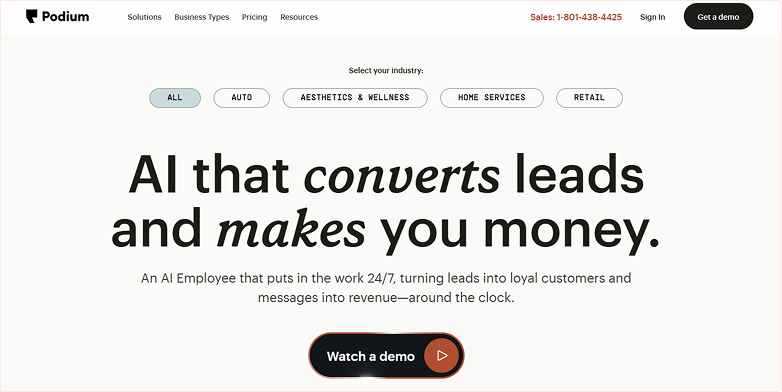
Podium combines review generation with customer messaging, payments, and a CRM.
If you’re looking for an Uberall alternative that also handles customer communication and payment collection, Podium goes further than any listings-only tool.
What they do right: Review generation via text message is Podium’s core strength. After an appointment or purchase, Podium sends an SMS with a link to leave a Google or Facebook review.
The unified inbox combines texts, web chat, social DMs, and Google Messages. Podium Payments lets you send payment requests via text, which is valuable for service businesses (dental offices, auto shops, contractors).
AI-powered chatbot handles common customer questions on your website, and routes leads to the right team member.
This replaces separate chatbot, messaging, and review tools with one platform.
Steal this: Their “Webchat to Text” feature. Visitors start a conversation on your website, and it continues via text message. Uberall doesn’t offer website chat or text messaging.
What to know before choosing: Podium starts at $399/month, making it one of the most expensive options here.
It’s designed for service businesses (healthcare, automotive, home services) rather than retail chains. Listings management is not Podium’s focus.
If you primarily need listings sync across directories, BrightLocal or Yext is a better fit.
Pricing: From $399/month. No free plan.
Build urgency
Add floating offers with countdown timer & coupon code.


6. Synup

Synup is the most affordable Uberall alternative that still offers automatic listings sync.
If Uberall’s pricing and minimums are your main pain points, Synup offers similar core features starting at $34/month per location, with no minimum.
What they do right: Listings sync updates your business information across 60+ directories automatically.
Changes to hours, address, or phone number push to Google, Facebook, Yelp, Apple Maps, and other platforms without manual updates.
Review monitoring pulls reviews from major platforms and sends alerts for new ones. Pre-written response templates speed up replies. Basic sentiment analysis helps identify trends across locations.
The agency white-label feature lets marketing agencies manage client locations under their own branding. This makes Synup a popular choice for agencies serving local businesses.
Steal this: Their per-location pricing with no minimum. Unlike Uberall’s 25-location minimum, Synup lets you manage a single location for $34/month.
What to know before choosing: Synup’s directory network (60+) is smaller than Yext’s (200+) or Uberall’s network.
For businesses that need coverage on niche or industry-specific directories, Yext may be necessary. Analytics and reporting are basic compared to enterprise platforms.
Pricing: From $34/month per location. 14-day free trial.
7. SOCi

SOCi is the enterprise alternative built specifically for franchise brands and multi-location businesses that need centralized control with local flexibility.
If you’re managing 50+ locations and need social posting alongside listings and reviews, SOCi is the closest Uberall competitor in feature scope.
What they do right: The “Genius” AI platform generates localized social content, review responses, and listing updates at scale.
Corporate teams set brand guidelines, and location managers get AI-suggested content that stays on-brand while feeling locally relevant.
Social publishing, review management, listings sync, local pages, and advertising are all in one dashboard.
This all-in-one approach mirrors Uberall’s scope but with stronger social media management features.
SOCi Listening monitors brand mentions, competitor activity, and local sentiment across social platforms and review sites.
Steal this: Their franchise-specific workflow. Corporate creates approved content templates, local managers customize and publish them, and corporate gains visibility into what each location posts.
What to know before choosing: SOCi uses custom enterprise pricing (contact sales). It’s designed for brands with 50+ locations and may not be cost-effective for smaller businesses.
The platform has a learning curve similar to Uberall.
Pricing: Custom (contact sales). No free plan.
8. Chatmeter

Chatmeter is the analytics-focused alternative for multi-location brands that prioritize competitive intelligence and sentiment analysis.
If you need deeper analytics than Uberall provides, Chatmeter’s data and reporting go significantly further.
What they do right: The “Pulse” AI platform analyzes customer sentiment across reviews, social media, and survey responses.
It identifies specific themes (wait times, staff friendliness, cleanliness) that drive positive or negative reviews at each location.
Competitive benchmarking shows how each of your locations performs relative to nearby competitors in Google Maps rankings, review volume, and average ratings.
Local SEO audits identify listing inaccuracies, missing citations, and optimization opportunities across directories.
The “Local Brand Visibility” score gives each location a single number representing its online presence strength.
Steal this: Their theme-based sentiment analysis. Instead of just “positive/negative,” Chatmeter breaks down reviews into specific topics (pricing, service speed, product quality) so you can identify exactly what’s driving customer satisfaction or complaints at each location.
What to know before choosing: Chatmeter uses custom pricing based on the number of locations.
It’s primarily used by healthcare chains, retail brands, and restaurant groups with 50+ locations. Smaller businesses will find BrightLocal or Synup more appropriate.
Pricing: Custom (contact sales). No free plan.
9. Moz Local

Moz Local is the SEO-first alternative for businesses that want listings management integrated with Moz’s broader SEO toolkit.
If you’re already using Moz Pro for SEO and need to add local listings management, Moz Local keeps everything in one ecosystem.
What they do right: Automated listings distribution pushes your business data to Google, Facebook, Apple Maps, and major data aggregators.
Duplicate listing detection finds and helps you remove duplicate Google Business Profiles and directory entries that hurt local SEO.
This is a common problem that Uberall addresses, but Moz Local handles more transparently.
Review monitoring and response covers major platforms. Integration with Moz Pro lets you see how local SEO efforts connect to organic search performance in a single dashboard.
Steal this: Their integration with Moz’s Domain Authority metrics. You can see how your local listing efforts impact your website’s overall search authority.
What to know before choosing: Moz Local’s directory network is smaller than Yext or Uberall.
It focuses on the most impactful directories rather than trying to cover every platform. For businesses that need wide directory coverage, Yext is a better choice.
Pricing: From $14/month per location. No free plan.
Boost Conversion Instantly
Add Social Proof & Urgency to your website
Common Mistakes When Switching from Uberall
I’ve watched multi-location brands make these errors when moving to a new listings-and-reputation platform.
#1: Not auditing your listings before switching. Export a complete inventory of every directory where Uberall manages your listings. If you cancel Uberall without migrating listings to a new platform, some directories may revert to outdated information.
#2: Assuming all platforms cover the same directories. Uberall, Yext, Synup, and Moz Local all cover different directory networks. Before switching, verify that your new platform covers the specific directories that matter for your industry and geography.
#3: Overlooking the review response history. Uberall stores your review response history. If you switch without documenting past responses, your new platform won’t show conversation context for existing reviews.
#4: Choosing based on price alone for multi-location. A $34/month tool managing 100 locations costs $3,400/month. At that scale, Uberall’s custom enterprise pricing may actually be competitive. Compare per-location costs at your specific scale before deciding.
#5: Forgetting about store locator and local pages. If you use Uberall’s store locator or local pages features, verify your new platform offers equivalents. BrightLocal and Synup don’t include store locators. Yext and SOCi do.
How to Pick the Right Uberall Alternative
Here’s my recommendation framework based on testing all of these tools.
Want affordable local SEO with rank tracking? BrightLocal. Transparent $39/month pricing with citation audits, rank tracking, and review monitoring.
Need to collect and display customer reviews on your website? WiserReview. First-party review collection with photo/video support and customizable display widgets.
Need enterprise-scale listings sync across 200+ directories? Yext. The largest publisher network with real-time data sync and SEO landing pages.
Want review generation + customer messaging in one tool? Birdeye. Text-based review requests, unified inbox, and customer surveys.
Service business that needs reviews + payments + chat? Podium. Built for healthcare, automotive, and home services with text-to-pay.
Small business or agency that needs listings sync affordably? Synup. $34/month per location, no minimum, white-label for agencies.
Franchise brand managing 50+ locations? SOCi. Centralized brand control with local flexibility for social, listings, and reviews.
Need deep competitive analytics for multi-location brands? Chatmeter. Theme-based sentiment analysis and location-level competitive benchmarking.
Already using Moz Pro for SEO? Moz Local. Keep listings management in the same ecosystem at $14/month per location.
Conclusion
Uberall is a powerful platform for enterprise brands managing hundreds of locations.
But the hidden pricing, 25-location minimum, and 60-day onboarding process push many growing businesses toward alternatives that let them start faster and scale more predictably.
If I had to pick one general-purpose replacement, I’d go with BrightLocal for agencies and SMBs (transparent pricing, local rank tracking, citation audits) or Yext for enterprise brands that need the widest directory coverage.
For businesses that need better review collection and display on their own website, WiserReview fills a gap that Uberall doesn’t cover, collecting first-party text, photo, and video reviews and displaying them as conversion-boosting social proof.
The right choice depends on your scale. Under 20 locations? Synup or BrightLocal.
Over 50 locations? SOCi, Chatmeter, or Yext. Need messaging and payments alongside reviews? Birdeye or Podium.
Request demos from your top 2-3 picks. Run them side by side for a week with one location. The tool that gets your team productive fastest is the right one.
Frequently Asked Questions
What is Uberall used for?
Uberall helps businesses manage online listings, customer reviews, and local SEO across multiple platforms.
Why do businesses look for Uberall alternatives?
Many switch due to high pricing, lack of a free trial, limited customization, or a long setup process.
Are there cheaper tools than Uberall for review management?
Yes. Tools like WiserReview offer review collection and display features at a lower cost.
Do Uberall alternatives support platforms like Shopify and WordPress?
Most alternatives support major platforms and also offer plugins or simple integration options.
Which Uberall alternative is easiest to set up?
WiserNotify and WiserReview are known for their fast setup and no-code options.

Krunal Vaghasiya is a marketing tech expert who boosts e-commerce conversion rates with automated social proof and FOMO strategies. He loves to keep posting insightful posts on online marketing software, marketing automations, and improving conversion rates.




 Capterra