
7 Restaurant Review Examples That Help Diners Decide (2026)
If you’ve ever searched “where to eat” and then spent 10 minutes scrolling through reviews before picking a place, you already understand how much power restaurant reviews hold.
Nearly 90% of customers read online reviews before visiting a new restaurant. One well-written review can fill tables. A handful of vague or negative ones can empty them.
So whether you’re a diner trying to leave helpful feedback, or a restaurant owner trying to understand what great reviews look like, this guide breaks it all down.
I’ll show you 7 real restaurant review examples, give you request templates if you’re trying to get more reviews for your own place, and cover how to respond to reviews once they come in.
What Makes a Great Restaurant Review
A great restaurant review isn’t just a star rating and a “food was good.” The reviews that help people, and help restaurants grow, do three things well.
They get specific
“Good food” is useless. “The grilled salmon with garlic butter was perfectly cooked, not a second overdone” is useful.
Specific details help readers picture the meal and help the restaurant understand what’s working. Mention the dish by name, describe the texture, the flavor, and the presentation.
That specificity is what separates a helpful review from filler.
They’re honest but fair
No restaurant gets everything right every time. A review that acknowledges a long wait but praises the attentive service reads as credible.
A review that’s either all praise or all complaint reads as suspicious. The most trusted reviews include at least one observation from both ends of the experience.
They cover the full experience
Food is the main event, but the dining experience includes how you were greeted, how long you waited, whether the space was clean, and whether the mood matched the occasion.
The best reviews capture all of it, which is why they’re so useful to other diners planning a similar visit.
Also check: How to Get More Reviews for Your Restaurant: From 0 to 200+

All your reviews in one place
Collect reviews, manage every response, and display them where they matter most.
Review Request Templates for Restaurant Owners
Getting more reviews usually isn’t about having more happy customers, it’s about asking the ones you already have at the right moment. Here are templates for the most common ways restaurants ask.
Post-visit email
Subject: How was your meal at [Restaurant Name]?
Hi [Customer Name], thanks for dining with us on [date]. We’d love to hear how it went. If you have a minute, a quick review on Google would mean a lot to us and helps other diners find us: [review link]
Text message request
“Hi [Name], thanks for stopping by [Restaurant Name] today! If you enjoyed your meal, leaving a review would really help us out: [link]. Thanks for your support!”
In-person ask (for staff)
“If everything looked good today, we’d really appreciate a review, it helps a place like ours get found by more people. There’s a QR code on your receipt if you have a second.”
QR code or receipt prompt
“Enjoyed your meal? Scan here to leave us a review. It takes less than a minute and means a lot to our team.”
Follow-up reminder
“Hi [Name], just following up in case our last message got buried. If you have 30 seconds, we’d love your feedback on your visit to [Restaurant Name]: [link]. No worries if you’re too busy!”
Where to Post Your Restaurant Review
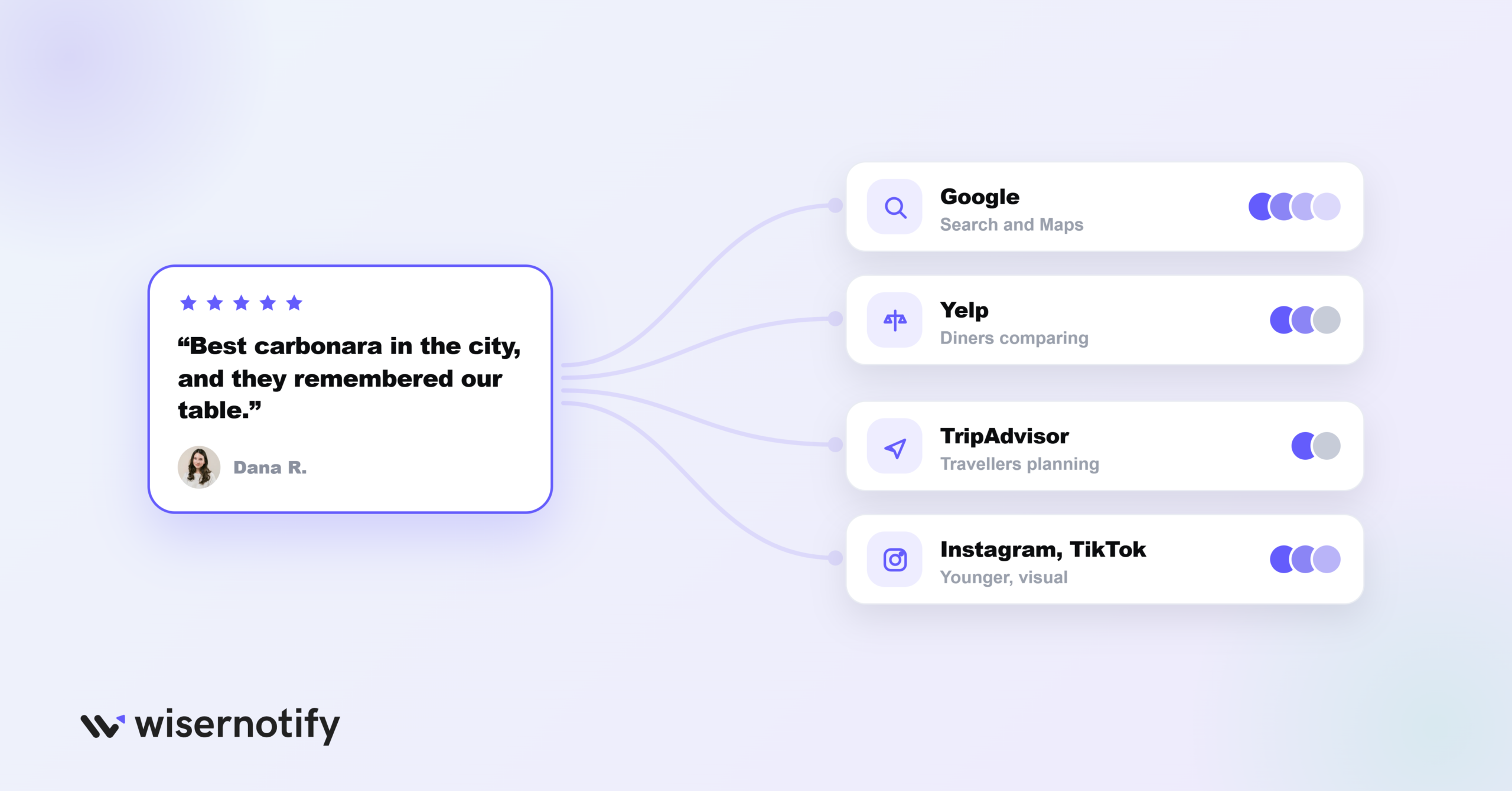
The platform you pick affects who sees your review. Here’s the quick breakdown.
- Google: Shows up directly in search and maps, so it’s the highest-visibility option and the one most restaurants watch closest.
- Yelp: Strong with diners specifically comparing restaurants before deciding where to go, especially in the US.
- TripAdvisor: Best for travelers researching a restaurant before a trip.
- Instagram or TikTok: Photo and video reviews reach a younger, visually-driven audience and often get noticed by the restaurant faster than a written review sitting in a queue.
Posting on more than one platform isn’t overkill. Different diners check different places, and a review that only exists in one spot only helps the people who happen to look there.
7 Restaurant Review Examples (And Why They Work)
1. The Family-Friendly Win
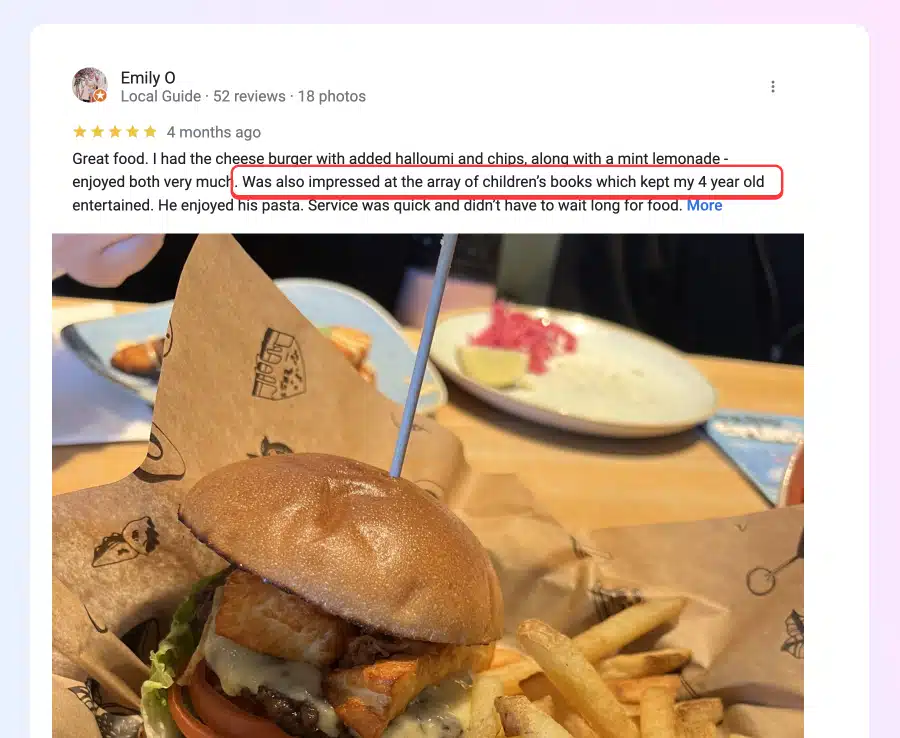
Emily’s review covers a cheeseburger with halloumi, chips, and mint lemonade, and specifically calls out the children’s books that kept her 4-year-old entertained during the meal.
That last detail is the whole review. Any parent reading it immediately understands this restaurant thought about families, not just tolerated them.
The food sounds good, the service was fast, but it’s the children’s books that turn a standard positive review into a recommendation parents will trust.
Why it works: Specific about food, mentions service speed, and adds a family-friendly detail that targets a precise audience. This review tells parents exactly what they need to know.
What to steal: Think about the unexpected detail that made your visit easier or more enjoyable. That’s the thing worth mentioning. It’s rarely the obvious stuff.
2. The Full-Experience Review
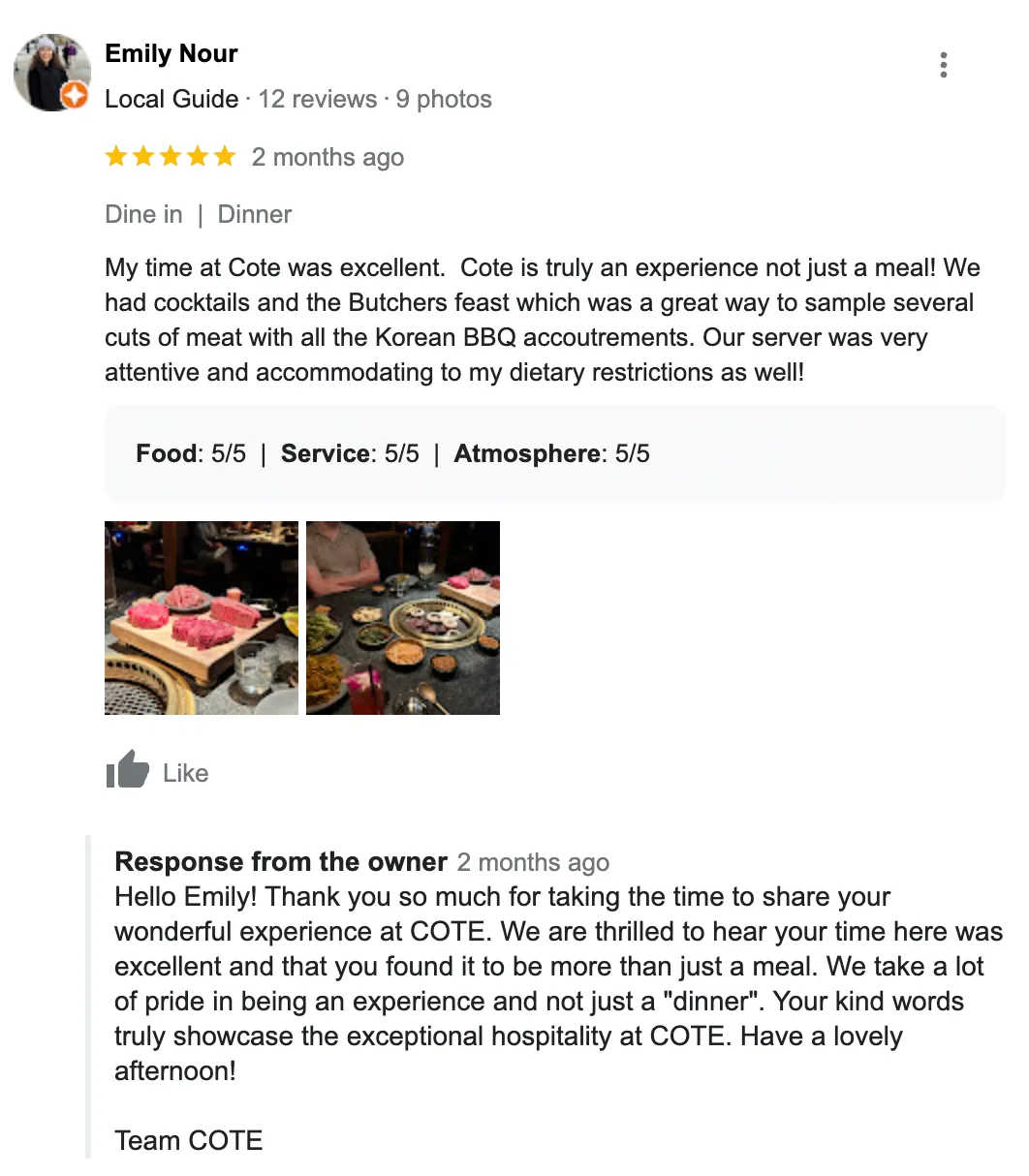
Emily’s review of COTE calls it “an experience, not just a meal.” She highlights the Butcher’s Feast, the cocktails, and specifically mentions how the staff handled her dietary requirements without making it awkward.
That dietary detail is trust-building gold. Anyone with food restrictions reading this can relax before they’ve even booked.
The 5/5 across food, service, and atmosphere backs everything up. And the owner’s thoughtful response shows a restaurant that’s paying attention.
Why it works: Covers food, service, and a personal detail that expands the review’s relevance beyond the reviewer’s own experience.
What to steal: Mention how the restaurant handled any specific need: dietary, accessibility, occasion-related. Those details resonate far beyond the average review.
3. The Theme-Plus-Taste Review
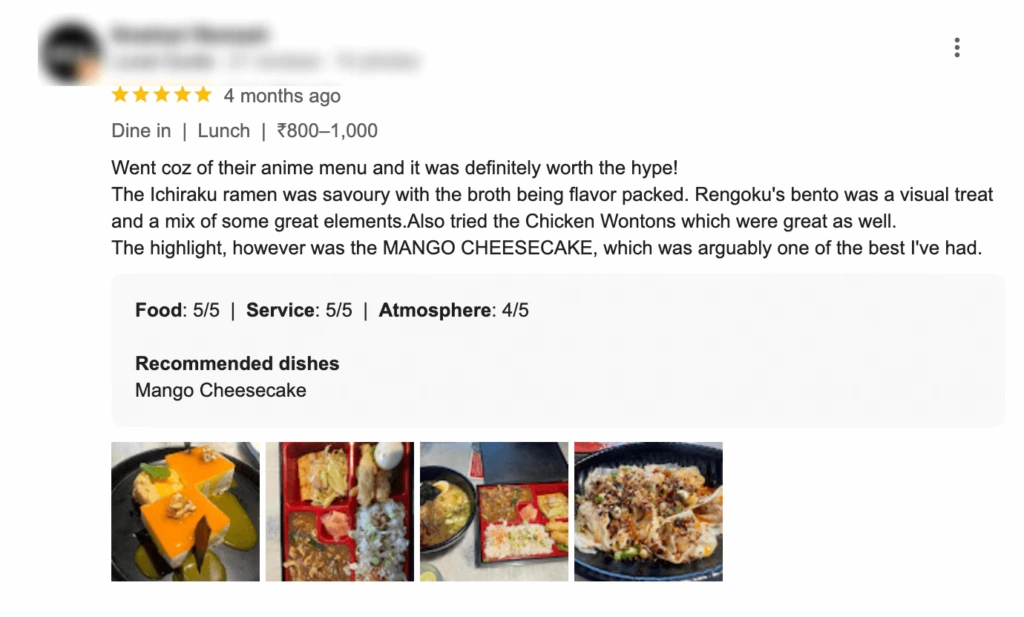
This reviewer came for the anime menu and left impressed by the food. They name specific dishes: Ichiraku ramen, Rengoku’s bento, Chicken Wontons, and single out the Mango Cheesecake as the standout.
The 5/5 for food and service alongside 4/5 for atmosphere signals a balanced, honest opinion. The reviewer didn’t just hype the theme. They evaluated what was on the plate.
Why it works: Clear dish names, honest scores across multiple categories, and genuine enthusiasm for the food itself makes it credible.
What to steal: Name at least two dishes specifically. Readers want to know what to order, not just whether the place is good.
4. The Clear and Fair Negative Review
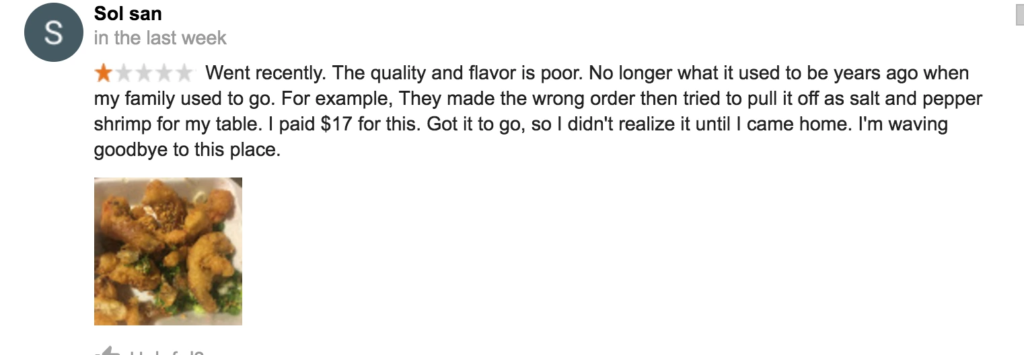
Sol’s review is short. The food quality dropped, the restaurant got the order wrong, and since it was takeaway the mistake wasn’t discovered until they got home.
What makes this a good negative review is that it’s factual, not emotional. There’s a specific dish, a specific problem, and a specific price. That’s exactly the kind of feedback a restaurant can use.
Why it works: Clear, calm, specific. The reviewer explains what went wrong without exaggerating.
What to steal (for restaurant owners): Acknowledge the wrong order, apologize, and invite them back. That response is often more visible than the review itself.
Also check: I Tested 21 Review Management Software Tools: Here Are the Top 5
5. The Special Occasion Rescue
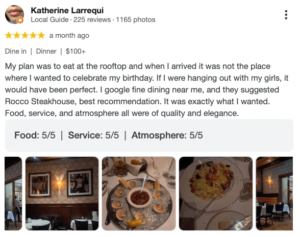
Katherine changed her plans last minute and picked Rocco Steakhouse based on Google reviews alone. She gave it 5/5 across food, service, and atmosphere, and described the experience as “quality and elegance.”
This review does something most don’t: it establishes stakes. She was looking for somewhere to rescue a birthday dinner. The restaurant delivered. That context turns a glowing review into a recommendation anyone in the same spot would trust.
Why it works: The occasion context makes the praise meaningful. Stakes make reviews credible.
What to steal: Mention why you were there. Date night, anniversary, family dinner. Context makes every other detail more relevant.
All your reviews in one place
Collect reviews, manage every response, and display them where they matter most.
6. The Atmosphere-First Review
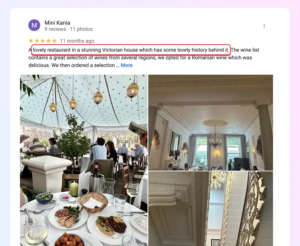
Mini’s review leads with setting: a “lovely restaurant in a stunning Victorian house.” She highlights the wine selection, calls out a Romanian wine specifically, and her images match exactly what she describes.
Not every diner chooses a restaurant primarily for food. Some care more about atmosphere. This review speaks directly to that audience in a way a food-first review never would.
Why it works: Matches what the reader is looking for. They want to know the space lives up to the setting.
What to steal: If the atmosphere was what stood out, lead with it. Match your review to the decision your reader is trying to make.
7. The Honest Mix of Hits and Misses
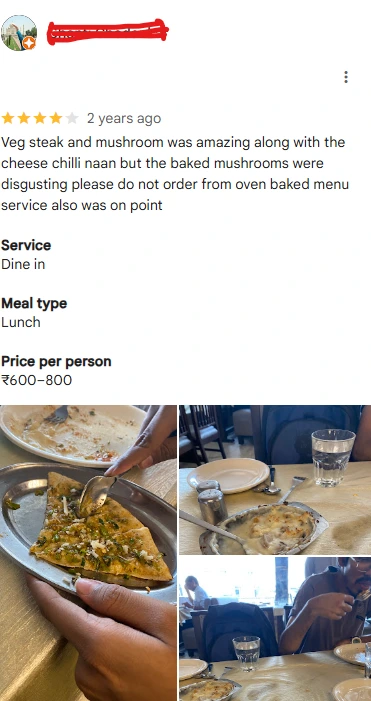
This reviewer loved the veg steak, mushrooms, and cheese chili naan. They called the baked mushrooms “disgusting.” They also praised the service and added a note for future diners about the oven-baked menu section.
That “disgusting” in an otherwise positive review is what makes it so trustworthy. Readers know they’re getting an honest take, not a promotional write-up.
Why it works: Balanced, specific, and practically useful. The reviewer gives you a roadmap: order this, avoid that.
What to steal: Don’t hide the one thing that didn’t work. Including it makes everything else you say more believable.
How to Respond to Restaurant Reviews (For Owners)
Responding to reviews is just as important as collecting them.
For positive reviews: Thank the customer by name if it appears. Reference something specific from what they said. Keep it short. Avoid the copy-paste “Thanks for your kind words!” on every single review.
Good example: “Thanks for the kind words, and especially for mentioning the truffle tagliatelle. We’ll pass that on to the kitchen team. Hope to see you again soon!”
For negative reviews: Stay calm. Don’t get defensive. Acknowledge what went wrong. Apologize if warranted. Offer to take it offline.
Good example: “We’re sorry your takeaway order wasn’t right. We’d love the chance to make it up to you. Please reach out to us directly.”
Never argue with a reviewer in public. You’re not writing for them. You’re writing for every potential customer who reads the exchange. A dedicated review management tool makes this easier to keep up with once you’re getting more than a handful a week.
WiserReview – Restaurant Review Management Tool

Most restaurants serve great food and then do nothing about their reviews. No collection system, no response process, no way to catch a bad review before it sits unanswered for three weeks.
That’s where WiserReview comes in.
WiserReview is a complete review management platform built for businesses that take their online reputation seriously.
For restaurants, it handles everything from collecting reviews right after a meal to displaying them on your website to using AI to reply, summarize, and translate feedback at scale.
Here’s what it does:
Collect Reviews
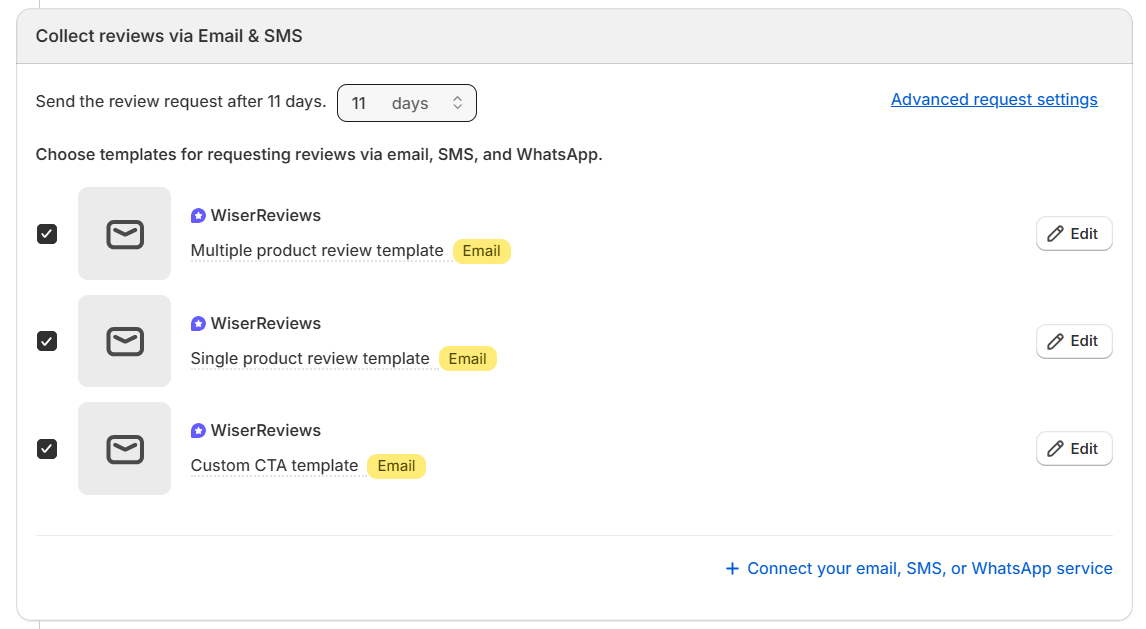
Getting reviews requires making it easy. WiserReview lets you send review requests through multiple channels so customers can respond however works best for them.
- SMS and email review requests are sent automatically after a visit
- QR code cards for tables, receipts, or takeaway packaging
- Web links you can share on social media or embed in email signatures
- Custom landing pages that match your brand
Automate Review Requests

Manual review follow-ups don’t scale. WiserReview automates the entire sequence so you never have to think about it.
- Set up automated review request flows triggered by a booking, order, or visit
- Schedule follow-up reminders if the first request goes unanswered
- Filter requests so only satisfied customers receive a review prompt
- Customize timing, delay windows, and message templates
Manage All Reviews in One Place
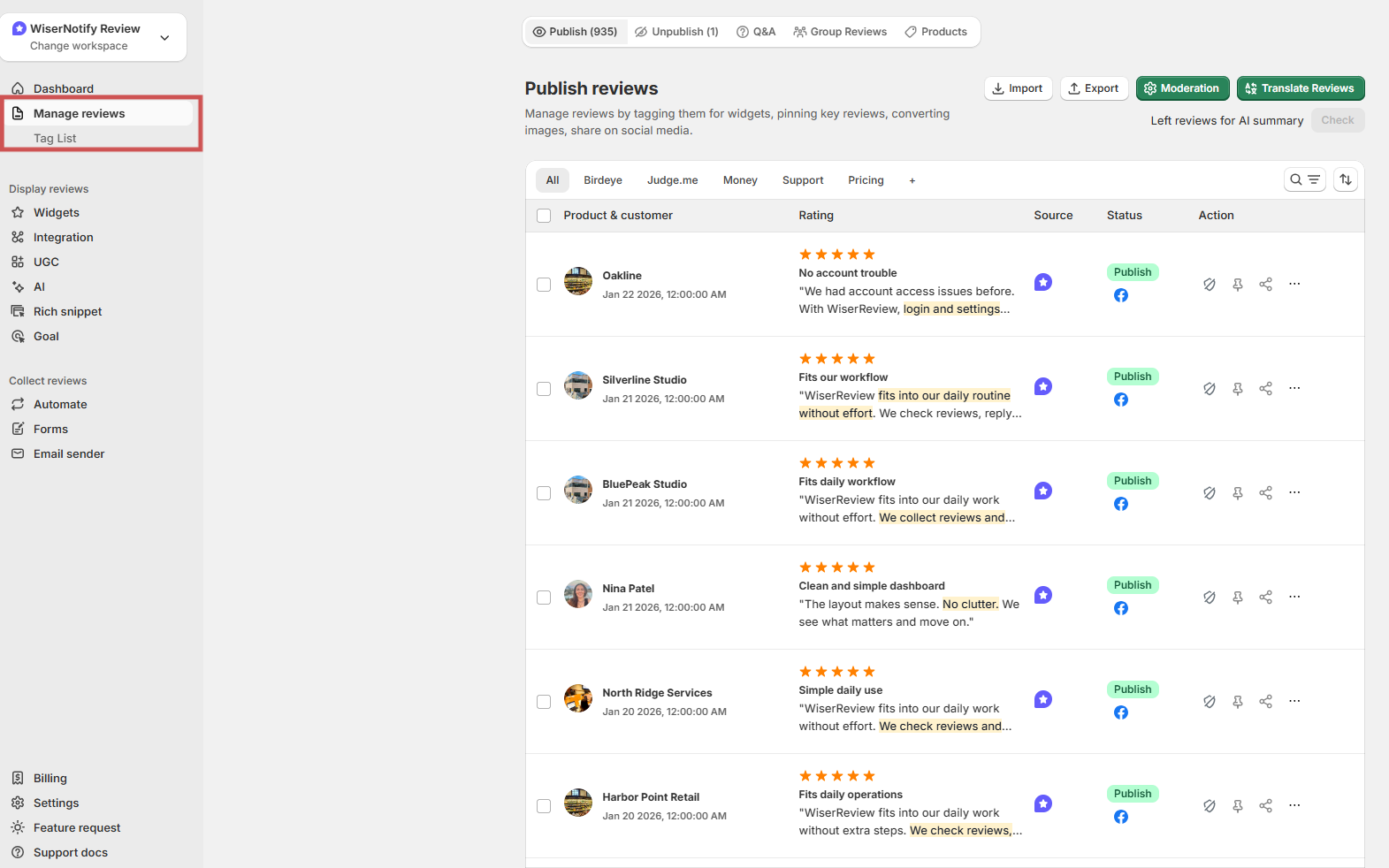
Keeping tabs on Google, Yelp, TripAdvisor, and Facebook separately is a full-time job. WiserReview pulls every review into a single dashboard so you can see and manage everything in one place, respond from one screen, and never miss a new piece of feedback.
- Centralized inbox for reviews from all major platforms
- Filter by rating, platform, date, or response status
- Flag urgent reviews (1 or 2 stars) for immediate attention
- Track response rate and average response time
Display Reviews on Your Website
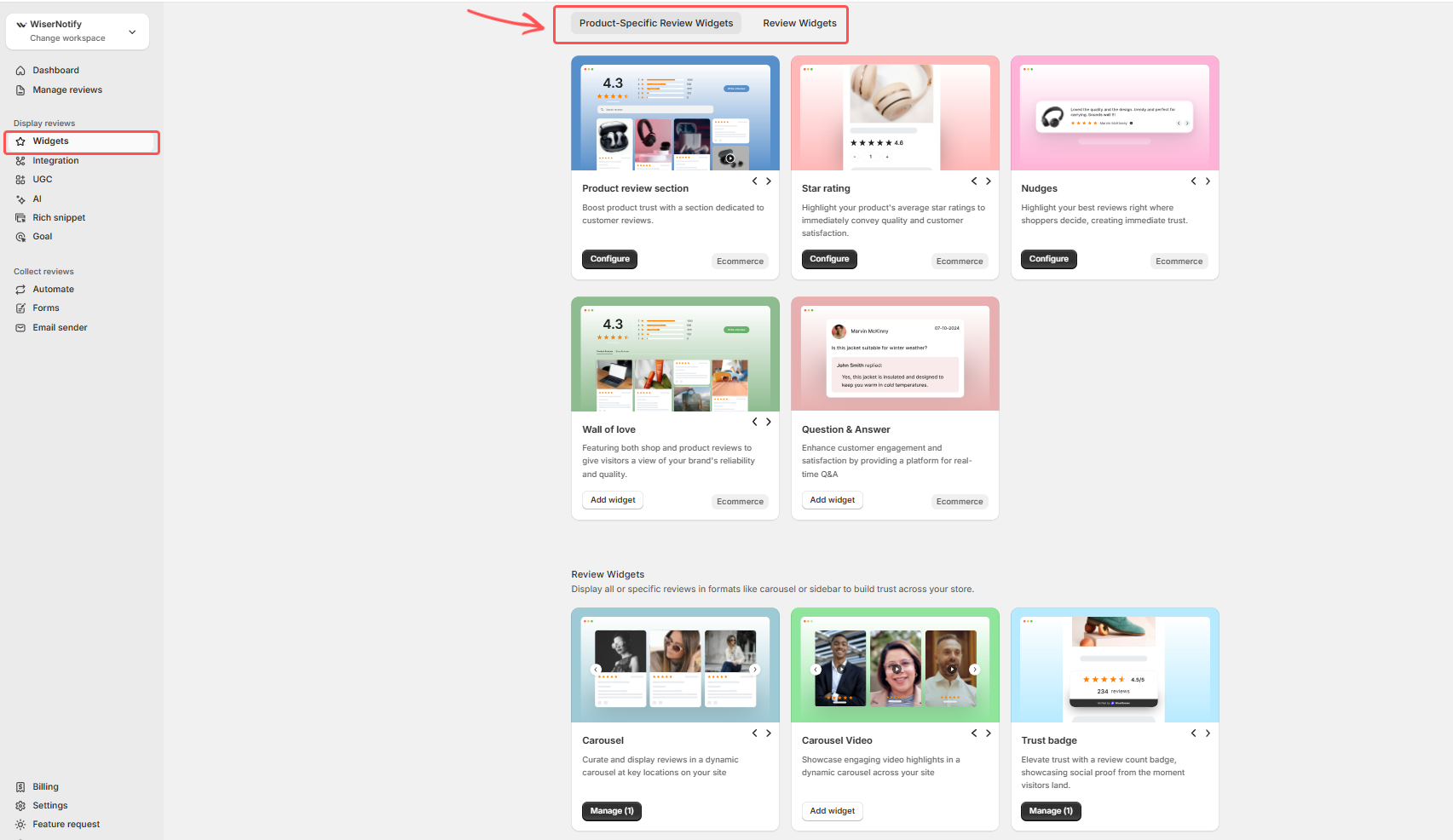
Collecting reviews is only half the job. Displaying them where new customers can see them is what drives bookings. WiserReview gives you fully customizable widgets to showcase your best feedback anywhere on your site.
- Embedded review widgets for homepage, menu pages, and booking pages
- Photo and video review galleries
- Google review pull (auto-syncs your latest Google ratings)
- Full design control: colors, layouts, fonts, and filters
AI Auto-Reply
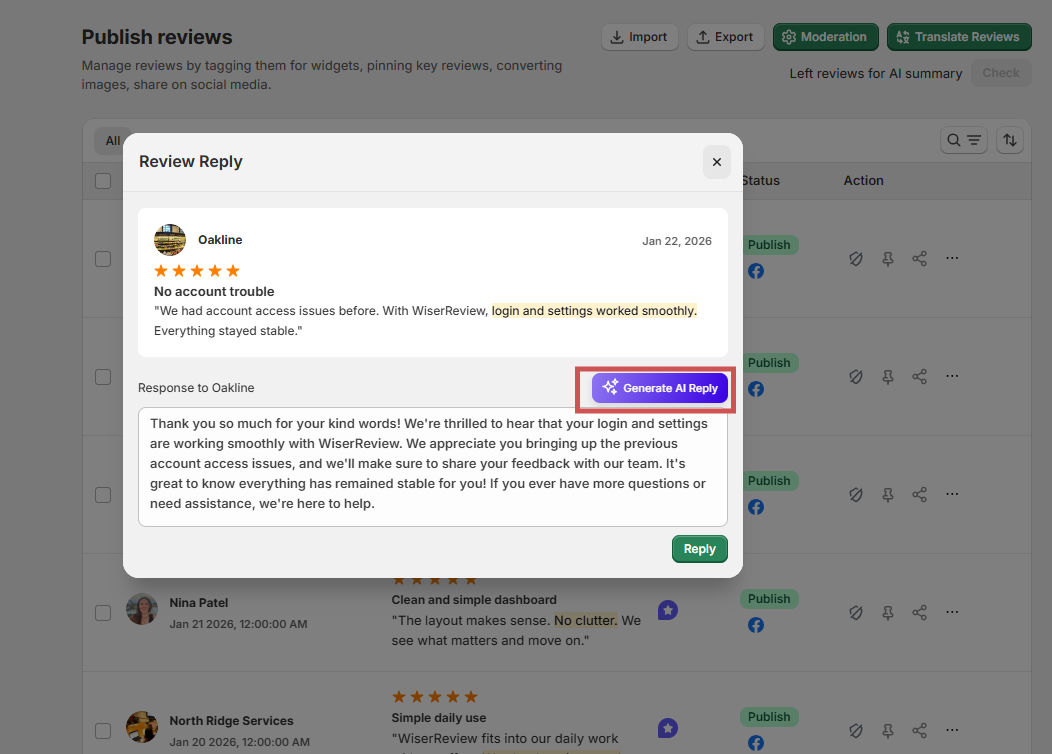
WiserReview generates personalized responses to new reviews automatically.
It reads the review content, matches the tone (warm for positive reviews, professional for negative ones), and drafts a reply you can approve or send directly.
Responding to reviews within 24 hours significantly improves local SEO, and an AI auto-reply makes that achievable without hiring someone to do it full-time.
AI Review Summary
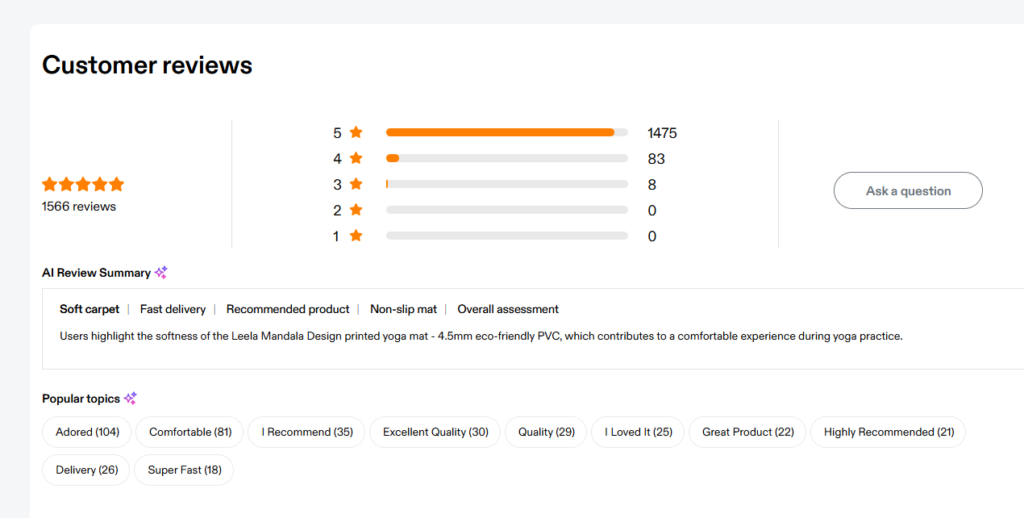
Instead of reading 200 individual reviews to understand what customers are saying, WiserReview’s AI summarizes the key themes.
It identifies what’s consistently praised (the risotto, the attentive service, the weekend brunch) and what’s repeatedly flagged (slow weekday service, parking).
That kind of pattern recognition used to take hours. Now it takes seconds.
AI Review Translation

If your restaurant attracts international guests or you operate in a multilingual city, reviews in other languages are both an opportunity and a challenge.
WiserReview translates foreign-language reviews into English automatically, and can generate responses in the reviewer’s language.
You don’t miss feedback because of a language barrier, and international guests get a response that feels personal.
AI Search
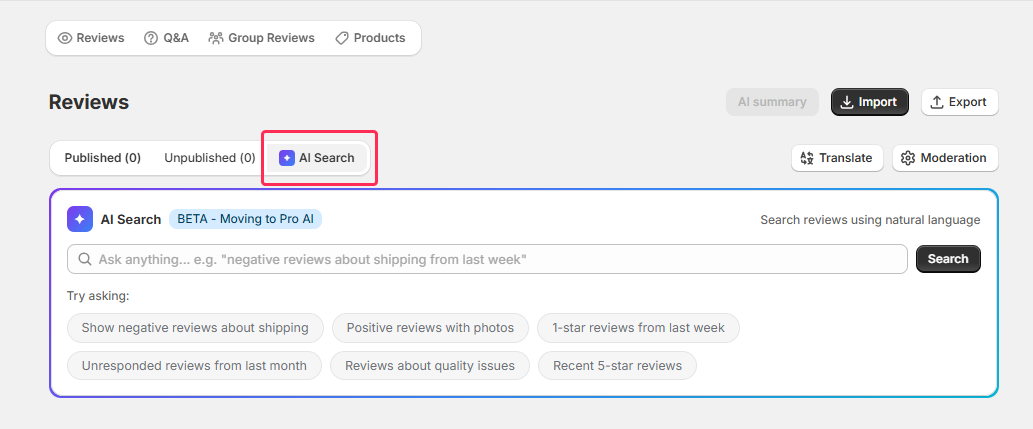
Instead of scrolling through hundreds of reviews to find what customers said about a specific dish or experience, WiserReview’s AI search lets you query your review library in plain language.
Ask “what do customers say about our pasta?” or “which reviews mention parking?” and get an instant, relevant answer. It turns your review archive into a searchable customer insights tool.
For a restaurant trying to grow on local search while keeping staff focused on the dining room, WiserReview handles the reputation side consistently and at scale.
Integrations

WiserReview connects with the tools restaurants already use, so adding it to your stack doesn’t mean rebuilding your workflow from scratch.
- Google Business Profile, Google Place, Google Customer Reviews, Google Shopping, Yelp, TripAdvisor, Facebook
- POS and booking systems for automated post-visit triggers
- Shopify, WooCommerce, and Magento for online ordering integrations
- Zapier and API access for custom workflows
This is where WiserReview pulls ahead of most review tools. The AI layer handles the repetitive, time-consuming parts of review management so your team can focus on the restaurant, not the inbox.
Pricing
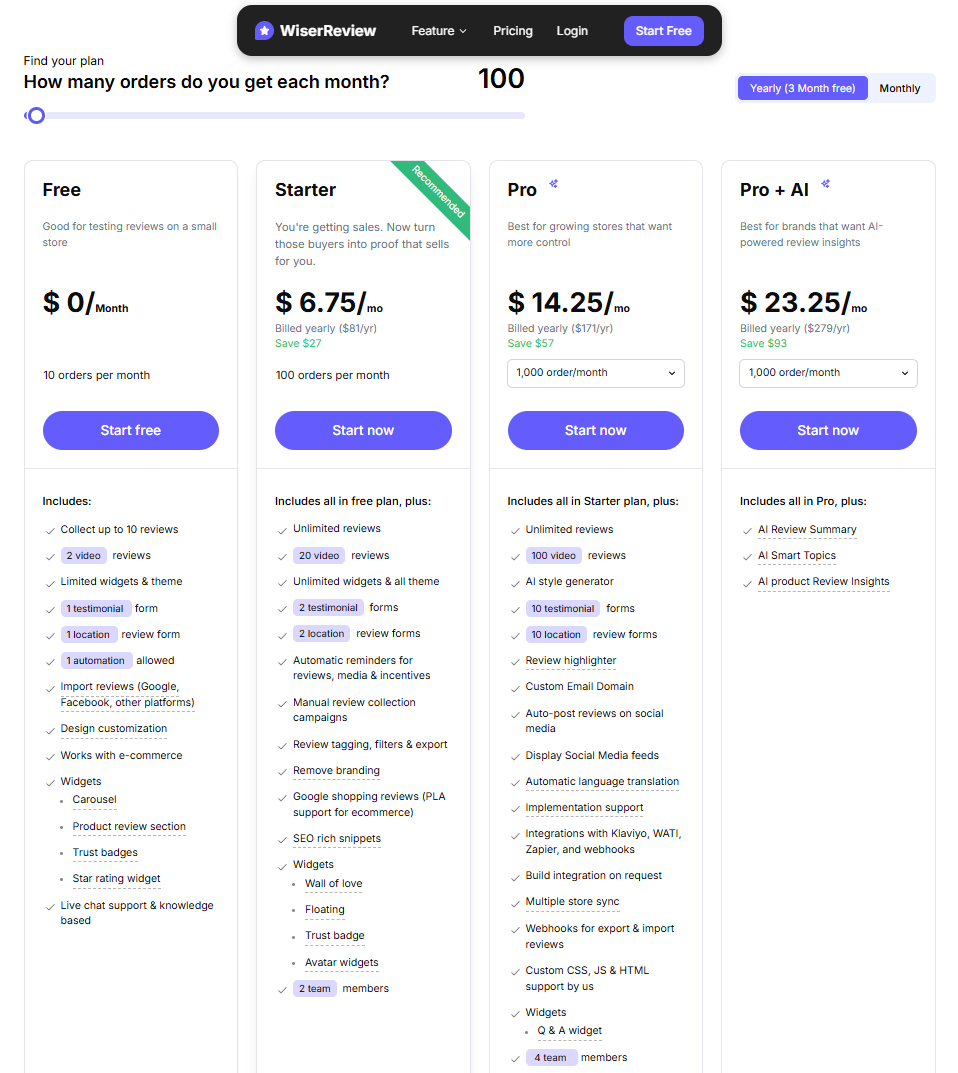
Show Real Reviews That Build Trust
Collect and display photo, video, and text reviews with full design control.
Common Mistakes in Restaurant Reviews
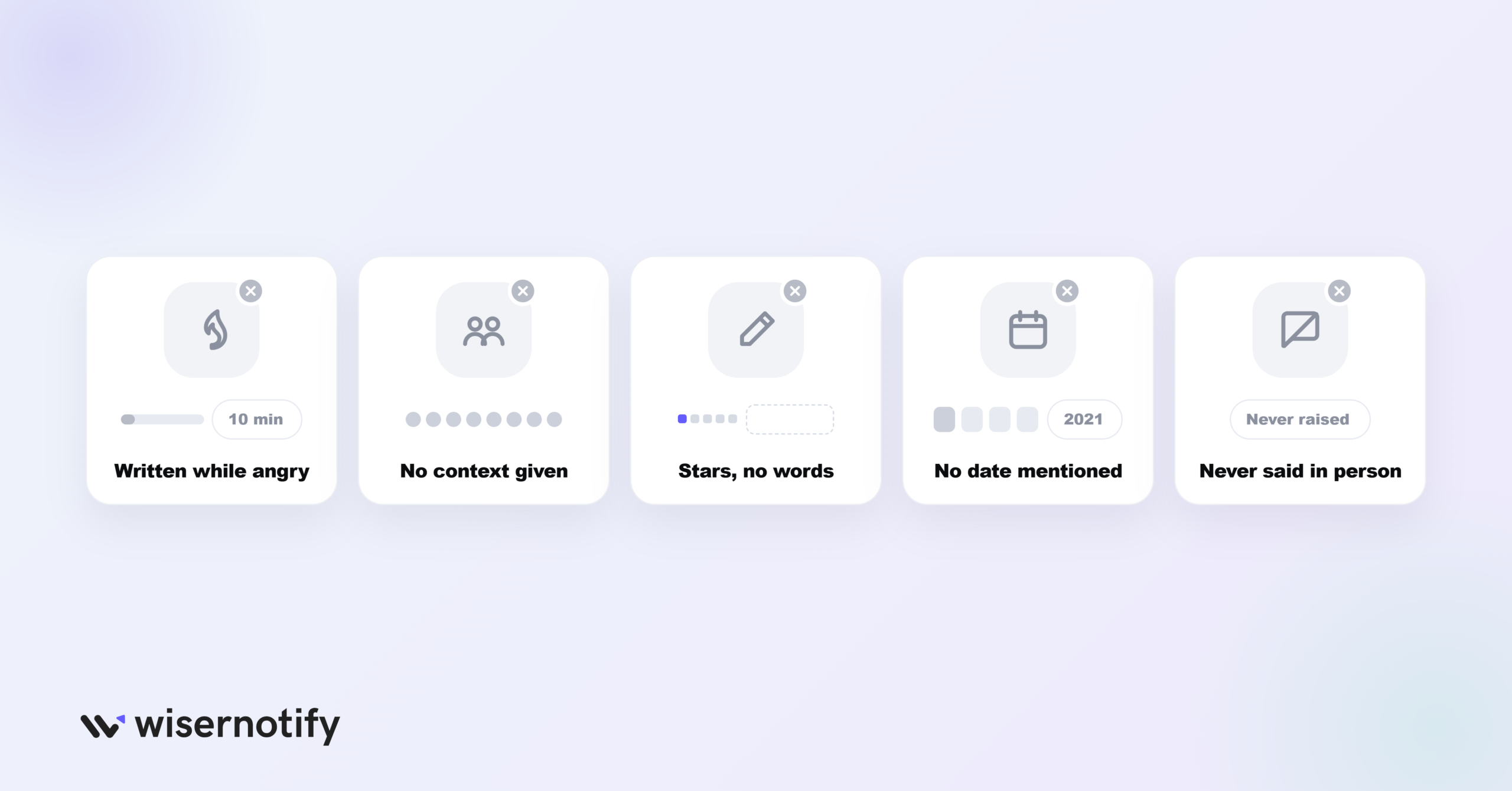
- Reviewing on emotion, not experience: Give it a day. Then write something that helps the next diner, not just vents your frustration.
- Ignoring the context: A restaurant that’s perfect for a quiet date might be terrible for a group of eight. Include the context.
- Leaving a rating with no words: A single star with no explanation doesn’t tell anyone what went wrong, not the next diner, not the restaurant trying to fix it.
- Never mentioning when you visited: A rave review from three years ago sitting at the top of a page doesn’t reflect a menu, chef, or team that’s already changed.
- Skipping the chance to raise it in person: Telling a manager on the spot usually gets a faster fix than a review, and you can still write about how it was handled afterward.
Wrapping Up
Great restaurant reviews come in a lot of shapes. What all 7 examples above have in common is specificity, honesty, and a sincere effort to help the next person make a better decision.
If you run a restaurant, those same qualities apply to every review response you write. Acknowledge the specific thing, be honest about what happened, and make it clear the customer’s experience mattered to you.
The reviews you collect and how you respond to them shape your restaurant’s reputation more than almost anything else you do. Treat them that way.
Frequently Asked Questions
What makes a good restaurant review?
A good review includes specific details about the food, service, and atmosphere. It should be honest, clear, and helpful for future diners.
Can I use these restaurant review examples for my own business?
Yes. You can use these examples as inspiration to guide your customers or team when writing or collecting reviews.
How do I get more reviews for my restaurant?
You can ask customers directly after their visit, use review request links via email or WhatsApp, or place QR codes on receipts or tables.
Should I respond to restaurant reviews?
Yes. Replying to both good and bad reviews shows that you care about feedback and helps build trust with new customers.
Can I include photos or videos in restaurant reviews?
Yes. Reviews with photos or videos are more trusted and get more attention from potential customers. Encourage guests to share visual feedback when possible.

Krunal Vaghasiya is a marketing tech expert who boosts e-commerce conversion rates with automated social proof and FOMO strategies. He loves to keep posting insightful posts on online marketing software, marketing automations, and improving conversion rates.




 Capterra