


I’ve worked with ecommerce brands that pay $30,000+ per year for Bazaarvoice. Some of them get great value from it. Most don’t.
The problem isn’t that Bazaarvoice is bad. It’s that it’s built for enterprise retailers with massive catalogs, retail syndication needs, and dedicated implementation teams.
If you’re a growing DTC brand or a mid-size store doing $1M-$20M in revenue, you’re paying enterprise prices for features you’ll never touch.
I’ve tested every major review platform on this list against Bazaarvoice.
Here are 6 alternatives that give you what actually matters (review collection, display, and syndication) without the $10,000+ implementation fees or annual contracts.
Why Brands Leave Bazaarvoice
I talk to store owners who’ve used Bazaarvoice almost every week. Here’s what pushes them to look elsewhere:
The pricing is opaque and expensive. Bazaarvoice doesn’t publish pricing. According to Vendr’s 2026 data, implementation and onboarding fees alone run $10,000 to $50,000+. Annual platform fees sit on top of that. For context, most alternatives on this list cost between $9 and $79 per month, with no setup fees.
Setup takes weeks, not minutes. Getting Bazaarvoice live on your store isn’t a plug-and-play situation. You’ll likely need developer support, and the onboarding process can stretch 4-8 weeks. I’ve seen stores where it took longer. On G2, over 30% of users rate setup and onboarding as difficult.
You’re locked into rigid structures. Bazaarvoice’s review forms, display widgets, and workflows are built for scale, not flexibility. If you want to customize how your review form looks, change the display layout, or set up specific automation rules, you’ll hit walls. Or you’ll need to file a support ticket and wait.
Support response times frustrate users. Even on premium plans, response times can lag. On TrustRadius, support responsiveness averages around 6.5 out of 10. For the price you’re paying, that’s not good enough.
You don’t need retail syndication. Bazaarvoice’s biggest strength is syndicating reviews across 1,750+ retail partner sites (Target, Walmart, Best Buy). If you’re selling primarily through your own website, you’re paying for a feature that doesn’t benefit you.
What to Look For in a Bazaarvoice Alternative
After helping hundreds of brands evaluate review platforms, here’s the checklist I use:
Transparent pricing. Monthly plans with clear feature tiers. No “contact sales” games. If a tool won’t tell you what it costs, that’s usually because it costs a lot.
Fast setup. You should be collecting reviews within a day, not a month. Any platform that requires a dedicated implementation team is overcomplicating things.
Automated review requests. Post-purchase emails, SMS, and (ideally) WhatsApp. The data on review collection is clear: automated requests generate 5-10x more reviews than passive collection.
Multi-platform support. If you’re on Shopify today but might expand to WooCommerce or BigCommerce, your review tool shouldn’t lock you into one platform.
Google Shopping feed. If you run Shopping ads, your reviews need to feed into Google Seller Ratings. This is a conversion multiplier that many cheap tools skip.
Review syndication (if you sell through retailers). This is where Bazaarvoice genuinely excels. If you need reviews on Target.com or Walmart.com, your options narrow. But if you sell DTC only, don’t pay for syndication you won’t use.
Quick Comparison: 6 Best Bazaarvoice Alternatives (2026)
| Platform | Best For | Platforms | Free Plan? | Pricing From |
|---|---|---|---|---|
| WiserReview | Multi-platform DTC brands | Shopify, WooCommerce, BigCommerce, WordPress | Yes | $9/mo |
| Yotpo | Enterprise DTC full-stack | Shopify, BigCommerce, WooCommerce | Limited | $79/mo |
| Reviews.io | Google-focused brands | Shopify, WooCommerce, BigCommerce | No | $29/mo |
| Stamped.io | Reviews + loyalty combo | Shopify, BigCommerce | No | $23/mo |
| Fera.ai | Reviews + social proof | Shopify, BigCommerce, Wix | No | $9/mo |
| Okendo | Shopify Plus premium UX | Shopify | No | $19/mo |
6 Best Bazaarvoice Alternatives I’ve Tested (2026)
1. WiserReview
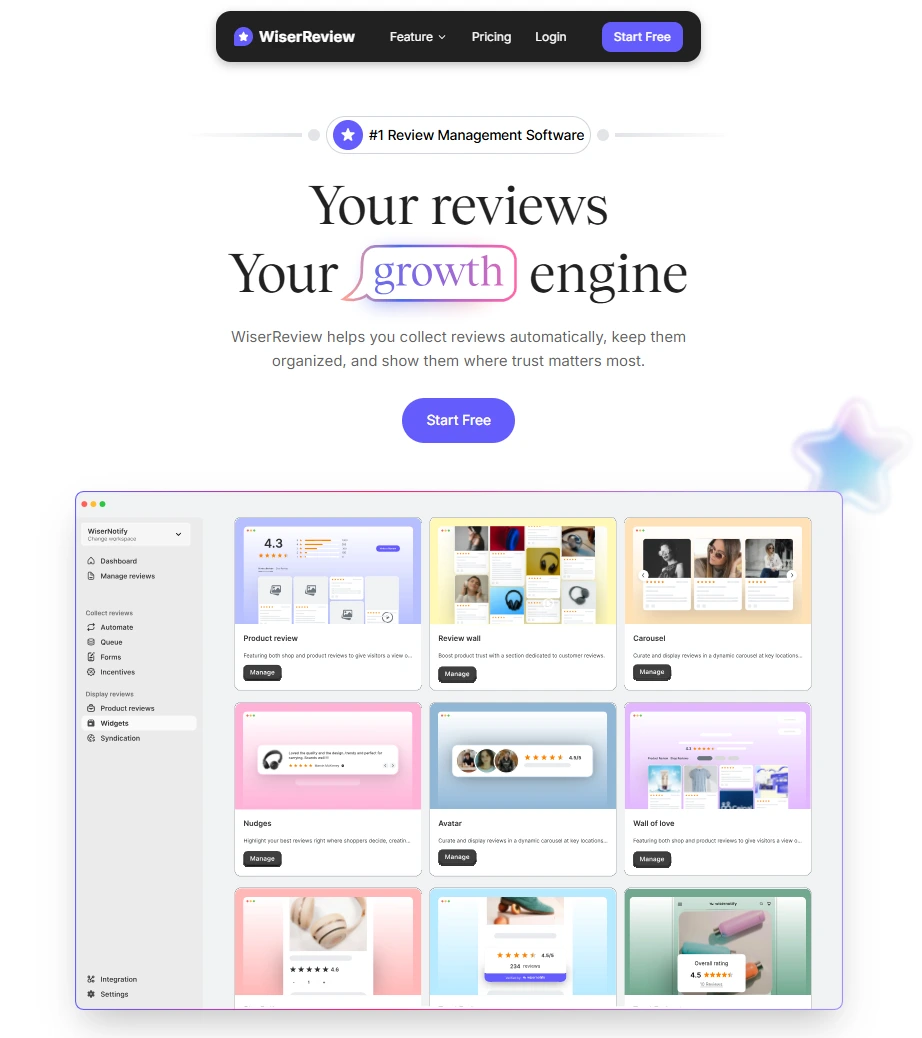
I built WiserReview, so full disclosure upfront. But I’m including it because it directly solves the #1 complaint I hear about Bazaarvoice: “I’m paying enterprise prices for features I don’t use.”
WiserReview gives you the core features that actually drive revenue (review collection, display widgets, automation, Google Shopping feeds) without the $30,000/year price tag or month-long implementation.
What it does well:
- Collects text, photo, and video reviews via automated email, SMS, and WhatsApp requests
- Works on Shopify, WooCommerce, BigCommerce, WordPress, and custom stores (no platform lock-in)
- One-click migration from Bazaarvoice with CSV import (reviews, ratings, and photos all transfer)
- CDN-delivered widgets that load fast even on media-heavy pages
- Google Shopping review feed included in paid plans
- Product-rich snippets for SEO without extra setup
Where it falls short: No retail syndication to partners like Target or Walmart. If you need reviews to appear on retail partner sites, then Yotpo is a better fit. The free plan also has sending limits for review requests.
Pricing: Free plan available. Paid plans start at $9/month.
Who should pick this: DTC brands on any platform that want Bazaarvoice-level review features at 90% less cost. Especially strong for stores on WooCommerce or BigCommerce, where options are limited.
2. Yotpo

Yotpo is the biggest name in DTC review platforms. They’ve expanded well beyond reviews into loyalty programs, SMS marketing, and social commerce.
If you want a single vendor to handle reviews, loyalty, and customer engagement, Yotpo aims to be that.
What they nail: The syndication network is impressive (Google, Meta, TikTok, plus retail partners like Target and Walmart). Their AI-powered review summaries save shoppers time when shopping for products with hundreds of reviews. And the loyalty program integration means customers can earn points for leaving reviews, which naturally boosts collection rates.
The catch: Pricing gets expensive fast. The free plan caps at 50 orders per month. The Reviews Pro plan starts at $79/month, and once you add the loyalty or SMS modules, you’re looking at $ 200–$500+/month. I’ve talked to brands paying more for Yotpo than they did for Bazaarvoice. The setup is also more complex than simpler tools.
Pricing: Free (50 orders). Paid plans start at $79/month.
Who should pick this: Mid-size to enterprise DTC brands that want reviews, loyalty, and SMS under one roof. If you only need reviews, Yotpo is overkill.
Also check: 10 Best Yotpo Alternatives I’ve Found in 2026 (Tested)
3. Reviews.io

Reviews.io is a licensed Google Review Partner, which gives them a leg up on search visibility.
If getting star ratings in Google search results and Shopping ads is your top priority, Reviews.io makes that straightforward.
What they nail: The Google integration is the smoothest I’ve tested. Company-level and product-level reviews both feed into Google Seller Ratings. Their video review collection is also strong, with a simple process that makes it easy for customers to record and submit videos. The influencer marketing tools are a nice bonus if you want to manage creator relationships alongside reviews.
The catch: Pricing starts at $29/month but jumps to $89/month for the features most brands actually need. The dashboard can feel overwhelming compared to simpler tools. And while they support multiple platforms, the Shopify integration is the most polished. WooCommerce and BigCommerce integrations need more work.
Pricing: Plans start at $29/month.
Who should pick this: Brands that prioritize Google Shopping and search visibility. Good for stores that want both company reviews (like Trustpilot) and product reviews in one platform.
4. Stamped.io

Stamped sits in the sweet spot between budget tools and enterprise platforms. You get product reviews, NPS surveys, loyalty programs, and referral features in one dashboard, at a price that won’t make you wince.
What they nail: The reviews-plus-loyalty combination is genuinely useful. I’ve seen DTC brands save $50-80/month by replacing separate review and loyalty apps with Stamped. Their community Q&A feature lets shoppers answer each other’s questions on product pages, which builds trust in a way user-generated content alone can’t match.
The catch: Video reviews are locked behind higher-tier plans. The loyalty features, while solid, aren’t as deep as dedicated platforms like Smile.io. And Stamped’s platform support is narrower than WiserReview or Yotpo (primarily Shopify and BigCommerce).
Pricing: Free plan available. Paid plans start at $23/month.
Who should pick this: DTC brands doing 200-2,000 monthly orders who want reviews and loyalty in one tool without Yotpo’s price tag.
5. Fera.ai

Fera combines product reviews with real-time social proof notifications. Those “Sarah from Austin just purchased…” popups alongside your product reviews? That’s Fera’s differentiator.
What they nail: The reviews-plus-social-proof combo creates a trust loop that separate tools can’t replicate as cleanly. They support Shopify, BigCommerce, AND Wix, which gives broader platform coverage than most competitors. Incentivized review requests (discounts for reviews) are easy to set up. And at $9/month, it’s one of the most affordable options.
The catch: social proof popups can annoy shoppers if you’re not careful with their configuration. I’ve seen stores where constant notifications actually hurt the experience. The review widget design is functional but not as polished as Okendo or Loox. And the free plan only covers 100 orders/month.
Pricing: Free plan available. Paid plans start at $9/month.
Who should pick this: Small to mid-size stores on Shopify, BigCommerce, or Wix that want review collection and social proof in one affordable tool.
6. Okendo

Okendo is the premium Shopify-focused alternative for brands that care deeply about the visual quality of their review experience. Their attribute-based reviews collect specific details (fit, quality, scent, texture) that generic review forms miss entirely.
What they nail: The review forms are the most detailed I’ve tested. Shoppers rate individual product attributes, upload photos, and provide structured feedback that’s useful for both marketing and product development. The widget loads quickly, and the Google Seller Ratings integration works well.
The catch: Shopify only. No WooCommerce, no BigCommerce. Pricing starts at $19/month, but the “Growth” plan at $119/month is where most of the useful features are. For a Shopify-only tool at that price, I’d expect multi-platform support.
Pricing: Starts at $19/month. Growth plan at $119/month.
Who should pick this: Shopify Plus brands in fashion, beauty, or wellness where detailed product attributes (fit, shade, texture) matter for purchasing decisions.
Also check: I Tested 10 Okendo Alternatives for Ecommerce (2026)
Bazaarvoice vs. Alternatives: The Pricing Reality
This is worth its own section because pricing is the #1 reason brands leave Bazaarvoice. Here’s what the numbers actually look like:
Bazaarvoice: No public pricing. Implementation fees of $10,000-$50,000+. Annual contracts reportedly $3,000-$30,000+/year. Total first-year cost can exceed $60,000.
Compare that to:
- WiserReview: $0-$108/year. No setup fees. Month-to-month.
- Stamped.io: $0-$276/year. No setup fees.
- Fera.ai: $0-$108/year. No setup fees.
- Yotpo: $0-$948/year (reviews only). No setup fees on lower tiers.
- Reviews.io: $348-$1,068/year. No setup fees.
The gap is massive. And from what I’ve seen, brands switching from Bazaarvoice to a self-serve platform typically see similar or better review collection rates, because the newer tools have better mobile optimization and smarter request timing.
Common Mistakes When Switching From Bazaarvoice
Forgetting to export your reviews first. Bazaarvoice lets you export reviews in CSV format. Do this before your contract ends. Your existing reviews are valuable assets that took months or years to build.
Paying for syndication you don’t need. If you sell DTC only through your own website, you don’t need retail syndication. That’s Bazaarvoice’s most expensive feature and the one most growing brands never use.
Choosing based on feature count instead of feature relevance. Yotpo has more features than WiserReview. That doesn’t make it a better choice for a brand doing 500 orders/month. Match the tool to your actual stage.
Ignoring widget speed. Bazaarvoice widgets can be heavy. When you switch, test the impact on page speed of your new tool. A review widget that adds 2+ seconds to load time costs you conversions.
Not testing the review request flow. The biggest driver of review volume isn’t which tool you use. It’s how your review request emails look on mobile. Test the actual customer experience before committing.
My Final Take
Bazaarvoice makes sense for a specific type of business: enterprise brands selling through major retail partners who need review syndication across 1,000+ retailer sites. If that’s you, Bazaarvoice (or PowerReviews) is probably worth the premium.
For everyone else? You’re overpaying.
If you’re a DTC brand on any platform, WiserReview gives you 90% of what Bazaarvoice offers at less than 5% of the cost.
If you want reviews, loyalty, and SMS, Yotpo or Stamped bundles those features (though Yotpo’s pricing can rival Bazaarvoice at scale).
If Google search visibility is your priority, Reviews.io is purpose-built for that.
And if you’re a small store just getting started? Fera.ai at $9/month or WiserReview’s free plan will get you collecting reviews today, not next quarter.
The impact of customer reviews on purchasing decisions continues to grow year over year.
Don’t let a bloated enterprise contract prevent you from building the social proof your store needs right now.


