
20 Testimonial Statistics for 2026 (The Psychology)
Most testimonial advice stops at “reviews build trust.” It rarely explains why one customer story converts and another gets scrolled past.
The difference usually comes down to psychology, not polish. People follow what others do, trust relatable stories over brand claims, and remember a specific number long after they forget a vague compliment.
This page covers the numbers behind testimonials, why they work, and where to place them for the best results.

Boost Conversion Instantly
Add Social Proof & Urgency to your website
Key Testimonial Statistics
Ten numbers that sum up testimonials right now. Figures are current as of August 2026, based on the latest published data from each source.
| Metric | Latest Figure |
|---|---|
| People who trust recommendations from others over branded content | 92% |
| Consumers who trust online reviews as much as personal recommendations | 88% |
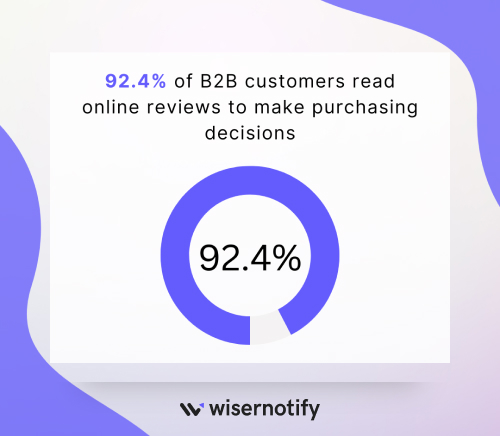
| B2B buyers who read reviews and testimonials before purchasing | 92.4% |
| Conversion lift from adding testimonials to a landing page | Up to 34% |
| Video testimonials trusted more than written reviews | 2 times more |
| Video testimonials trusted more than a star rating alone | 3 times more |
| Higher engagement for testimonials with 3+ specific numbers | 22% |
| Customers asked for a review who follow through and leave one | 83% |
| Shoppers who only buy from businesses rated 4 stars or higher | 68% |
| More likely to buy after seeing a testimonial from someone relatable | 66% more likely |
Why Do Testimonials Persuade? The Psychology
Testimonials work because they trigger specific, well-documented psychological patterns, not just because they contain positive words.
1. Social proof theory explains why people follow the actions of others when they are uncertain what to do, which is exactly the moment a testimonial appears in the buying journey.
2. Authority bias means people trust reviews from experts or credible figures in a field more than generic branded claims, even when the underlying product is identical.
3. 92% of people trust recommendations from other people over branded content, even when those people are complete strangers.
4. Testimonials that include at least 3 specific numbers, like revenue, time saved, or a percentage improvement, generate 22% higher engagement than vague praise alone.
5. Narrative persuasion research shows a well-told story shifts beliefs and behavior more reliably than the same information presented as plain facts.
6. 66% of shoppers say they are more likely to buy after watching a testimonial from someone whose situation resembles their own.
The most persuasive testimonial is rarely the most glowing one.
It is the most specific one, from someone the reader can picture themselves as, the same principle behind our full testimonial statistics guide.
Boost Conversion Instantly
Add Social Proof & Urgency to your website
How Much Do People Trust Testimonials?
Trust in testimonials has stayed remarkably strong even as more content online becomes AI-generated or paid.
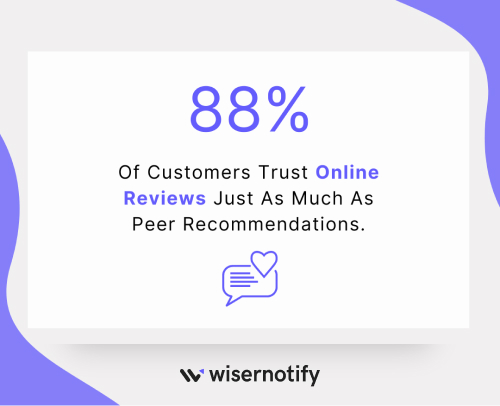
7. 88% of consumers trust online reviews and testimonials just as much as a recommendation from a friend.

Older research (Spiegel Research, 2017) once put the conversion lift from 5-star reviews as high as 270%, but that figure predates most of today’s review volume and is not a reliable planning number on its own.
Treat it as historical context, not a benchmark.
8. 69% trust a recommendation from a friend, family member, or relatable influencer, compared to just 38% who trust the same claim coming directly from a brand.
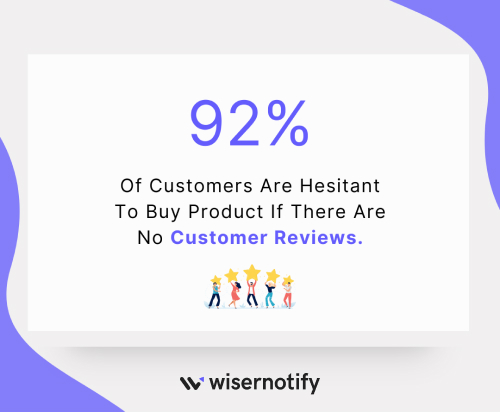
9. 92% of customers hesitate to buy a product that has no reviews or testimonials attached to it at all.
10. 83% of customers who are directly asked to leave a review follow through and write one, which means review volume is mostly a matter of asking, not luck.
11. 68% of consumers will only buy from a business rated 4 stars or higher, making that threshold matter more than total review count.
Trust in testimonials has not eroded, it has become more selective.
People increasingly look for specificity and relatability, not just a high star average, the same shift covered in our online review statistics.
Testimonial Statistics for B2B vs B2C
Testimonials carry different weight depending on who is buying and how much is at stake.
12. 92.4% of B2B buyers read online reviews and testimonials before making a purchasing decision.
13. Adding customer testimonials regularly to a product page can lift annual revenue by up to 62% for B2B sellers.

14. 72% of B2C customers say positive reviews and testimonials strengthen their trust in a business.
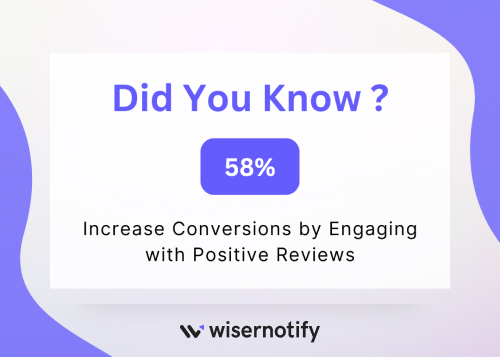
15. Customers who interact with a positive testimonial are 58% more likely to convert on that visit.
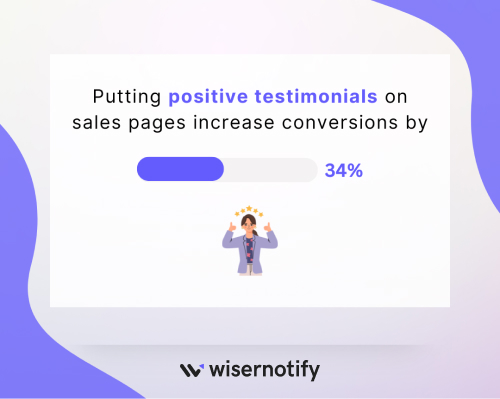
16. Testimonials on a landing page can increase conversions by up to 34%, one of the more consistently reproduced figures in conversion research.
B2B buyers lean on testimonials to justify a bigger, slower decision. B2C buyers lean on them to remove hesitation right before checkout.
Boost Conversion Instantly
Add Social Proof & Urgency to your website
Video Testimonial Statistics
Video adds nonverbal trust signals that text cannot carry, and the data backs that up consistently.
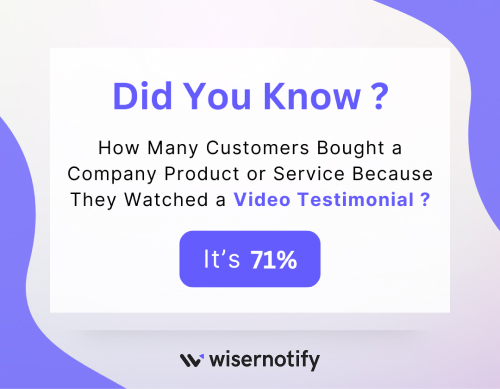
17. Video testimonials are trusted 2 times more than written reviews and 3 times more than a numerical star rating alone.
18. A customer is 2.1 times more likely to remember a video testimonial than a written one after the visit ends.
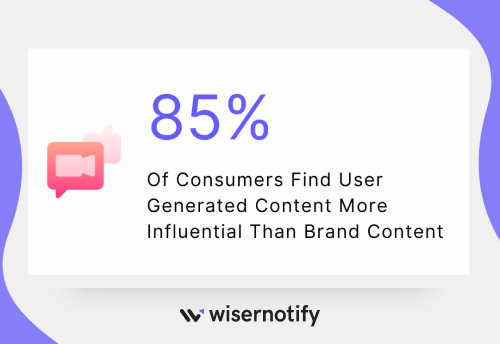
19. Testimonial videos created by an actual customer get 85% more views than polished, brand-produced content.
20. 79% of people say a brand’s video influenced them to buy the product.
For a deeper breakdown of length, format, and cost, see our full video testimonial statistics.
Where to Place Testimonials for the Best Results
Placement determines whether the psychology above gets a chance to work.
On the homepage, testimonials build initial trust with visitors who have no history with the brand yet.
On product pages, they reassure a shopper at the exact moment they are evaluating a specific item. Near the call to action, a short, specific testimonial reduces last-second doubt more effectively than any discount code.
Landing pages benefit most from a testimonial placed near the top, then a second one placed directly beside the primary call to action. See our guide on adding testimonials to your website for exact placement examples.
Boost Conversion Instantly
Add Social Proof & Urgency to your website
How to Use These Numbers
Ask directly for reviews rather than waiting for them, since 83% of people asked will follow through.
Favor specificity over polish, since testimonials with real numbers consistently outperform vague praise.
Place testimonials where the decision happens, not just on a dedicated reviews page. Pair them with visible social proof elsewhere on the site so trust compounds across the whole visit.
Boost Conversion Instantly
Add Social Proof & Urgency to your website
Wrap Up
Testimonials still work, and psychology is the reason why. People follow the crowd when they are unsure, and a relatable story sticks with them longer than any polished claim.
The businesses doing well here are not chasing the most reviews. They are collecting the most specific ones and putting them exactly where a visitor is deciding.
Ask directly, favor detail over polish, and put proof where the decision happens.
Sources
BrightLocal | Nielsen | VWO | Wistia | Wyzowl | Cialdini’s Influence
Frequently Asked Questions
Why do testimonials persuade people psychologically?
Social proof, authority bias, and narrative persuasion. People follow the actions of others when uncertain, and a well-told story shifts behavior more than plain facts.
How many people trust testimonials over brand claims?
92% trust recommendations from other people over branded content, even from complete strangers.
What makes a testimonial more persuasive?
Testimonials with at least 3 specific numbers, like revenue or time saved, get 22% higher engagement than vague praise.
Where should testimonials be placed for the best results?
On the homepage for initial trust, on product pages for reassurance, and right next to the call to action to reduce last-second doubt.
Are video testimonials more trusted than written ones?
Video testimonials are trusted 2 times more than written reviews and 3 times more than a star rating alone.

Krunal Vaghasiya is a marketing tech expert who boosts e-commerce conversion rates with automated social proof and FOMO strategies. He loves to keep posting insightful posts on online marketing software, marketing automations, and improving conversion rates.




 Capterra