
Synup vs BrightLocal: Best Pick for Review Management
Managing online reputation and local visibility is hard.
Businesses manage listings, reviews, and SEO. Many tools take time and money.
Switching platforms slows teams. Some tools have too many features. Others miss the basics. Businesses waste money or time.
This post compares Synup and BrightLocal. You will see their features, pricing, and use cases.
| Feature | Synup | BrightLocal | WiserReview |
|---|---|---|---|
| Best For | Multi-location businesses, agencies | SEO agencies, consultants | Small businesses, online stores |
| Listings Management | 70–80+ directories, real-time sync | Limited directories, high accuracy | Basic (Google, Yelp, others) |
| Review Management | 20+ platforms, AI replies, CRM sync | Manual replies are only available in the top plan | Text, photo, and video reviews |
| Rank Tracking | Basic tracking | Detailed local SEO reports | Not included |
| AI and Automation | AI replies, content, and posts | Minimal automation | Auto reminders, basic workflows |
| Pricing Start (per location) | $34.99/month | $39/month | Free (with paid upgrades) |
| Best Use Case | Broad marketing automation | Focused SEO and citations | Review collection and display |

Simple Review Tool That Just Works
Collect and show reviews without extra steps.
Synup and BrightLocal: What They Do Best

Synup supports businesses with many locations. It provides listing tools, review monitoring, social posting, and AI features. Teams work from one dashboard.
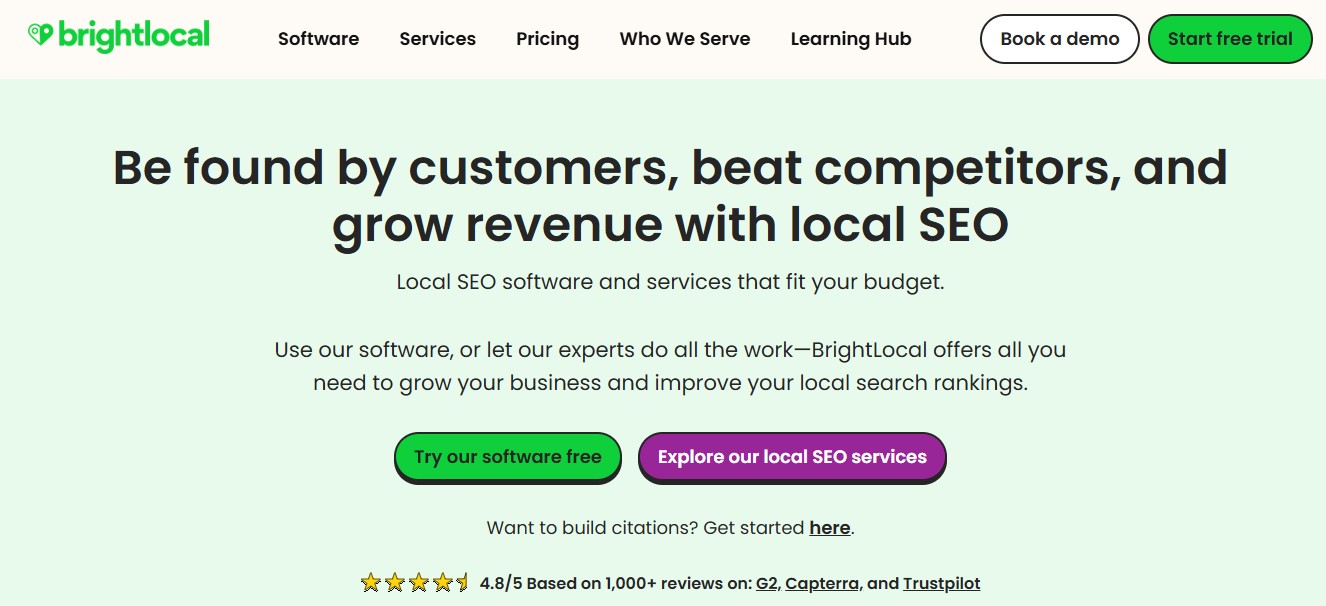
BrightLocal supports SEO-focused teams. It tracks rankings, runs audits, and fixes citations. It creates client-ready reports with white-label branding.
Synup gives more tools. BrightLocal gives more depth in SEO.
Feature Comparison
Here’s how Synup and BrightLocal compare on key features like listings, reviews, SEO, and automation.
Listings Management
Synup manages listings on 70–80+ directories. It includes Google, Facebook, and Yelp. Users update business details in bulk. The system syncs them in real time.
BrightLocal covers fewer directories. It syncs listings on major citation sites. The Citation Tracker finds and fixes errors.
Verdict: Synup suits businesses with many listings. BrightLocal suits users who want high accuracy.
Review Management
Synup monitors 20+ review platforms. It’s AI replies based on customer tone. It connects with CRM systems to send review requests.
BrightLocal includes review tools only in its Grow plan. Users track and reply to reviews. It does not support automation.
Verdict: Synup fits teams that want to automate review replies. BrightLocal fits those with basic review needs.
Rank Tracking and Analytics
BrightLocal tracks rankings on Google and Bing. Its tools show rankings by location. Maps display visibility clearly.
Synup offers basic rank tracking. Its reports show less depth.
Verdict: BrightLocal fits SEO teams that need accurate tracking.
AI and Automation
Synup provides AI in every plan. Users create content, reply to reviews, and automate posts.
BrightLocal tracks and reports data. It does not automate replies or content.
Verdict: Synup saves time with AI. BrightLocal supports manual processes.
Pricing Breakdown
Here’s a quick look at what each platform costs and what you get for the price.
Synup Pricing (per location)
Standard: $34.99/month or $29.99/year. Includes AI tools, 70 directories, 10 review platforms.
Professional: $89.99/month or $74.99/year. Includes CRM sync, 80 directories, 20 review platforms.
Enterprise: Custom quote.
BrightLocal Pricing (per location)
Track: $39/month or $29/year. Tracks rankings and citations.
Manage: $49/month or $36/year. Adds listing updates and Google Business posts.
Grow: $59/month or $44/year. Adds review tracking and campaigns.
Extras: $2 per listing for citations.
Verdict: Synup gives more value early. BrightLocal costs more if you need all the features.
Need Review Tools Without the Bloat?
WiserReview gives you what matters: easy review collection, display widgets, and automation.
What Users Say
Here’s a quick look at what real users like and dislike about each platform.
Synup Users Say
The dashboard is simple.
AI replies save time.
Multi-location tools are helpful.
Support is quick.
Features can feel overwhelming.
BrightLocal Users Say
SEO data is accurate.
Reports look professional.
Agencies like white-label tools.
The platform takes time to learn.
Extra costs can surprise users.
Who Should Use Each Tool?
Here’s who each platform is best suited for, based on goals and team needs.
Use Synup if you:
- Run many locations.
- Want to manage reviews, listings, and posts in one place?
- Prefer automation to save time.
- Like working from one dashboard.
Use BrightLocal if you:
- Work in SEO or manage SEO clients.
- Need accurate rankings and audits.
- Want to create branded client reports.
- Focus only on SEO.
Where WiserReview Comes In

Some businesses want quick review tools. They don’t need SEO reports or large dashboards. WiserReview supports that goal.
WiserReview works for:
- Small and mid-sized businesses.
- Shopify, WooCommerce, Webflow, and other integrations.
- Teams that want easy review forms and reminders.
You can collect text, photo, and video reviews. The setup is simple. Most tools work on the free plan. You get what others charge for.
Final Decision
Pick Synup if you want automation, AI, and multi-location support.
Pick BrightLocal if you need accurate SEO reports and local rank data.
Pick WiserReview if you want a fast, low-cost way to collect and show reviews.
Your choice depends on what you need. Choose the tool that matches your goals, budget, and time.
Frequently Asked Questions
What is the main difference between Synup and BrightLocal?
Synup offers an all-in-one platform with listings, reviews, social media, and AI features. BrightLocal focuses on accurate SEO data, rank tracking, and citation management for agencies.
Which tool is better for collecting customer reviews?
Synup works well for large teams with its AI-powered replies and CRM integration. WiserReview is better if you want a simple, low-cost way to collect and show text, photo, and video reviews.
I run an SEO agency. Should I choose Synup or BrightLocal?
BrightLocal is a better choice if your agency focuses on local SEO, ranking reports, and white-label client reporting. Synup is better if you want to manage more than just SEO.
Can I start collecting reviews without spending much?
Yes. WiserReview offers a free plan that includes review forms, reminders, and display tools. It’s ideal for small businesses that want to start fast without paying upfront.

Krunal Vaghasiya is a marketing tech expert who boosts e-commerce conversion rates with automated social proof and FOMO strategies. He loves to keep posting insightful posts on online marketing software, marketing automations, and improving conversion rates.




 Capterra