
How Do Product Reviews Impact Purchase Decisions? (2026 Data)
Your reviews get read before your product description does. For anything someone has not bought before, 96% check reviews first.
That part is not new. What changed this year is where they find them, how fast they stop believing them, and how little patience they have for anything stale.
Here is what drives the decision, and what to do about it on your own store. If you want the basics first, start with what product reviews are and how they work.
Short answer: reviews influence purchases by reducing uncertainty. They decide whether a product makes the shortlist, and the biggest conversion jump comes from a product’s first handful of reviews.
Key takeaways
- They decide the shortlist. Most buyers rule out anything under four stars.
- The first five matter most. Those do more than every review that follows.
- Recency beats volume. Anything older than three months barely counts.
- A perfect score backfires. Flawless ratings read as filtered.
- Discovery moved to AI. More people ask an assistant than scroll search results.
How do reviews influence purchasing decisions?
Buying online means buying blind. You cannot hold the thing, so you borrow the experience of someone who already did.
That plays out in three ways you can measure:
- They gate the shortlist. Below four stars, 72% will not look twice.
- They lift conversion. A product with five reviews is far likelier to sell than the same product with none.
- They move money, not just clicks. For independent restaurants, a one-star gain in rating has been shown to lift revenue outright.
The pattern holds everywhere. The more a buyer stands to lose, the more the reviews decide it.
What buyers expect now
The pattern across every recent survey is the same:
- 96% check reviews before a first-time purchase, and 47% always do before an unfamiliar brand.
- 72% will not consider a product rated under four stars.
- Only 15% trust a star rating on its own, without written detail behind it.
The bar also moved. The share holding out for 4.5 stars or higher went from 17% to 31% in a year, and 47% skip anything with fewer than twenty reviews.
Full figures, sources and dates are in our online review statistics roundup.

All your reviews in one place
Collect reviews, manage every response, and display them where they matter most.
Where do people read reviews now?
This is the change most stores have missed.
Use of AI tools to find local businesses jumped from 6% to 45% in a single year. Google’s slice shrank over the same stretch.
In practice:
- A recommendation now comes from ChatGPT or Google AI Mode as often as from a results page.
- Those tools summarize reviews rather than linking to every source.
- Your reviews now influence buyers through a layer you do not control.
Trust splits by platform too. Amazon and Google sit well above brand-owned review sections. Anything living only on your own site counts for the least.
So stop treating your own site as the only place reviews need to live:
- Build the profile on the platforms shoppers already trust, especially Google reviews, since those feed both search results and AI answers.
- Keep on-site reviews detailed and dated, because summarizing tools read text, not star widgets.
- Assume a buyer will cross-check you somewhere else before deciding.
How reviews affect each stage of the buying process
Reviews are not one checkpoint. They do a different job at each step.
1. When they first find you
Before anyone clicks, they see a star rating and a review count. Those two numbers decide whether you make the shortlist.
- Low volume removes you before quality is even judged.
- Star ratings appear in search results, AI answers, and map listings, often as the only signal shown.
2. When they compare you to someone else
Once you are on the list, reviews become the comparison tool.
- Confidence peaks when star ratings come with written detail or photos.
- A rating with no text gives nothing to compare against.
3. Right before they buy
At checkout, people go back one more time, either to confirm the choice or catch something they missed.
- Recency decides this moment. 74% look for reviews from the last three months, and 32% want the last two weeks.
- A page with 200 old reviews can lose to one with 25 recent ones.
4. After the order arrives
Today’s customer becomes tomorrow’s evidence. How fast you reply decides whether that happens.
- 19% of reviewers expect a reply the same day, and 32% by the next.
- Template replies get rejected as readily as no reply at all.
How many reviews do people read before deciding?
Fewer than most stores assume. Nobody reads the whole section; they sample it.
53% read between one and ten reviews before buying. Four to ten is the usual range.
What they do in those few minutes:
- Check the average star rating first, as a filter rather than a verdict.
- Scan the most recent reviews to see whether anything has slipped.
- Look for the complaint that matches their own worry, then see how you answered it.
So the reviews sitting at the top of your page do nearly all the work. Sort order is a real decision, not a setting to leave alone.
Bigger purchases stretch that out. The pricier or more complicated the thing, the longer the research.
Do reviews change what people will pay?
They change what a price feels like. A strong review record makes a higher price read as justified rather than optimistic.
The effect is strongest for brands nobody knows yet. When the name means nothing, the rating and the review count outweigh the price tag.
- Detailed reviews do more than short ones, because there is more to go on.
- A thin record leaves price as the only thing left to compare.
Which industries do reviews matter most in?
The bigger the risk, the harder anyone leans on someone else’s experience.
They matter most on big, considered purchases, where proof from someone who paid carries the weight.
| Category | Say reviews are essential | What buyers look for |
|---|---|---|
| Electronics | 54% | Durability, real-world performance |
| Small appliances | 51% | Reliability, size accuracy |
| Beauty | 41% | Photos, results on someone similar |
| Personal care | 36% | Sensitivity, repeat use |
| Packaged goods | 25% | Price and brand familiarity dominate |
No category escapes it. The question is never whether people look. It is how much a single bad review costs you.
For local and service businesses the stakes run higher again, because a poor experience cannot be returned.
Positive vs negative reviews: which matters more?
It is less one-sided than most people assume.
What good reviews do for you
Good ones lift sales, and that lift is steepest early on before it levels off. Our collection of positive review examples shows what the useful ones look like.
Conversion climbs sharply from zero to five reviews, then tapers. Getting a product off zero beats adding a hundredth review.
What bad reviews cost you
Bad ones do the reverse, and they pull far more attention than the good.
Eye-tracking work has shown far longer attention on the negative comments than the positive. The same work found nobody could reliably spot a fake.
Why a perfect 5.0 works against you
Purchase likelihood peaks a little above four stars, then drops as the rating creeps toward a perfect 5.0.
A flawless score reads as filtered. A few honest complaints, answered properly, make everything else believable.
| What to compare | Positive reviews | Negative reviews |
|---|---|---|
| Effect on the buyer | 85% more likely to buy | 77% put off |
| Attention it gets | Skimmed | Read closely |
| Where it helps | Biggest lift in the first five | Adds credibility to the rest |
| What to do | Collect steadily, keep recent | Reply fast, fix the cause |
How fake reviews are changing what shoppers trust
Everyone assumes some are fake now, and they are not wrong.
- Google pulled down 292 million policy-violating reviews last year, and that number climbs annually.
- 48% say they run into AI-written or doctored ones often.
- Suspected AI involvement costs a review its credibility for most readers.
That is why verified-buyer labels keep gaining weight. A review tied to a real order holds up where anonymous praise does not.
What protects you:
| Do this | Because |
|---|---|
| Label verified purchases clearly | The badge proves the review came from a real order |
| Leave the critical reviews up | A visible mix reads as unfiltered, and a perfect score costs conversions |
| Ask for specifics and photos | Generic praise now reads as machine-written |
| Never buy reviews | The FTC rule on fake reviews carries per-violation penalties |
Our guide to fake review statistics covers the scale of the problem across platforms.
Why reviews work: the psychology behind it
Three things are going on underneath.
People follow other people
We infer quality from the choices of others. A busy restaurant reads as good; an empty one reads as risky. Review counts are the online version of that signal, which is why social proof examples work on the same instinct.
Buyers trust buyers, not brands
A claim from the seller gets discounted; the same claim from a peer gets credited. The identical sentence carries more weight in a review than in your copy, because the writer has nothing to gain.
That transfer is the foundation of trust in an online store, and the reason word of mouth still outperforms paid channels.
Bad news sticks harder than good
A potential loss registers more strongly than an equivalent gain. That is the mechanism behind the eye-tracking result: “this broke in a week” lands harder than “works great”, so unanswered complaints do outsized damage.
How to use reviews to sell more
Six things, roughly in priority order.
- Start with the empty pages. An unreviewed product gets filtered out before anyone reads a word.
- Keep them recent. A steady trickle beats a large old archive. Automate the request instead of running occasional campaigns.
- Ask for detail, not stars. Almost nobody trusts a bare rating. Prompt for specifics and invite photos, since user-generated content answers questions your copy cannot.
- Mark verified buyers. Verified reviews carry proof that unlabeled ones cannot.
- Reply fast and individually. An answer is expected within a day, and a template is obvious.
- Put them in the buyer’s path. Ratings on listing pages, reviews beside the buy button, reassurance at checkout. The same logic applies to testimonials elsewhere on your site. A separate reviews tab influences nothing.
For the exact wording, our guides on how to ask for reviews and what a strong product review looks like go deeper.
How WiserReview handles this for you
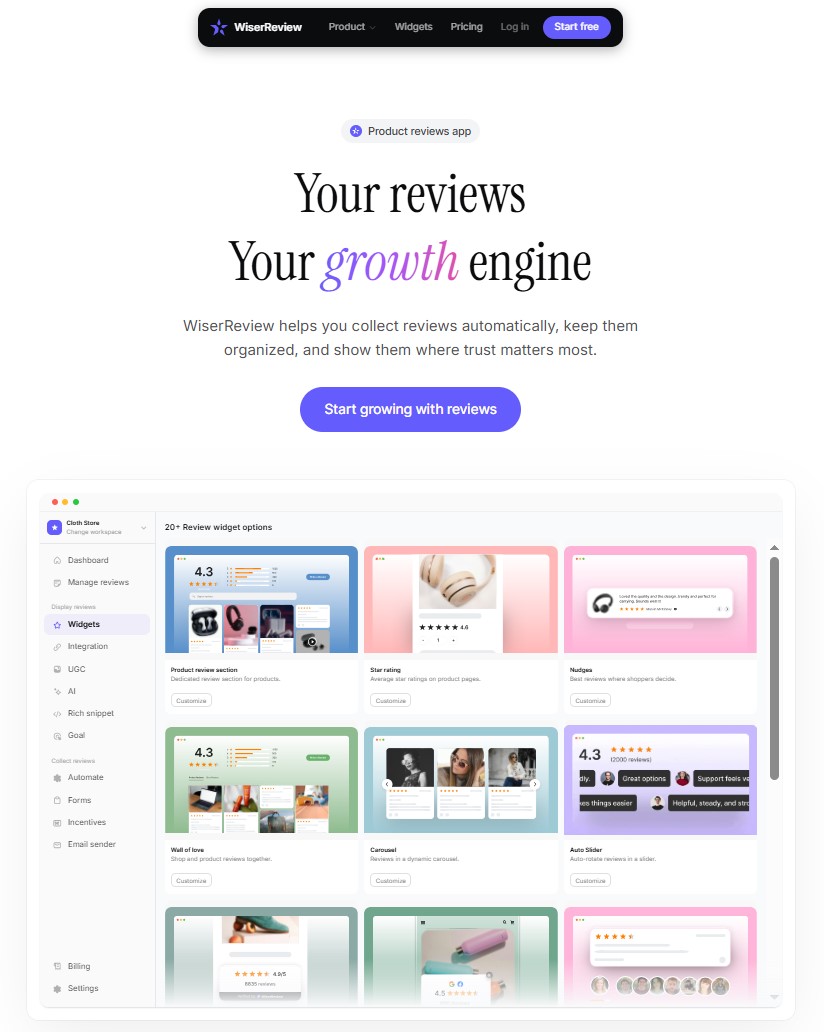
Everything above is repetitive work. Asking every buyer at the right moment, keeping the flow going, checking what came in, and getting it onto the page where it counts.
WiserReview is a product review app that runs that whole cycle for you. It collects reviews after each order, moderates what arrives, and displays the results on your storefront. More than 1,100 brands use it.
What it covers:
- Automated requests. Sent after delivery by email, SMS, WhatsApp or QR code, with smart sequences handling the follow-up.
- Flexible review form. Prompts for specifics and invites photos or video, which buyers trust over a bare rating.
- AI moderation. Filters spam, flags policy violations, reads sentiment and drafts replies for you to approve.
- Verified purchase labels. The badge that separates a real order from anonymous praise.
- 18+ display widgets. Product pages, sales pages, popups and review walls, styled to your brand.
- Google star sync. Ratings carry through to search results, and top reviews can post to social automatically.
It runs on Shopify, WooCommerce and custom builds, and works for service businesses as well as stores.
All your reviews in one place
Collect reviews, manage every response, and display them where they matter most.
What this means for your store
Three things shifted this year, and they stack on each other.
Standards went up. The share demanding 4.5 stars nearly doubled in a year, and fewer tolerate anything stale.
Trust went down. With machine-written reviews everywhere, proof and detail do the job that sheer volume used to.
Discovery moved. What you have written gets summarized by something else before anyone sees it, which makes the record underneath matter more.
The stores holding up under all three treat reviews as infrastructure: collected automatically, kept fresh, answered one by one, and shown where the decision happens.
The bottom line
Reviews are not a feature you switch on and forget. They are the first thing a stranger checks and the last thing confirmed before payment.
If you do nothing else this quarter, work through whatever is sitting at zero. That is where the curve is steepest and the fix is cheapest.
Then turn the request on automatically after delivery, so the flow never dries up and nothing goes stale.
The last piece is answering every review yourself within a day, especially the critical ones. That reply gets read by everyone who comes after.
None of it requires changing your product, your pricing, or your ads. It just requires treating what customers already say about you as something worth managing.
Frequently Asked Questions
How do online reviews influence consumer purchasing decisions?
Online reviews influence purchasing decisions by reducing uncertainty and building trust. 93% of consumers say reviews directly affect what they buy. Reviews serve as social proof, showing that real people have used the product and sharing their honest experience. Positive reviews increase confidence and conversion rates, while negative reviews can deter purchases or redirect shoppers to competitors.
What percentage of consumers read reviews before buying?
Between 93% and 96% of consumers read online reviews before making a purchase, according to multiple 2026 studies. For first-time purchases from unfamiliar brands, the number is even higher. Consumers spend an average of nearly 14 minutes reading reviews before trusting a business.
Do negative reviews hurt sales?
Negative reviews can hurt sales, with 86% of shoppers hesitating to buy from businesses that have them. However, a mix of positive and negative reviews (rather than only 5-star reviews) is actually more trusted by 76% of consumers. How you respond to negative reviews matters significantly. One unaddressed negative review can drive away 30 out of 50 potential customers.
How many reviews does a product need to increase conversions?
The first 5 reviews have the most dramatic impact, with products showing 5+ reviews converting 270% better than those with zero reviews. After that, more reviews continue to help but with diminishing returns. Review recency matters too. 73% of consumers only trust reviews from the last month.
Are online reviews more trusted than advertising?
Yes. Over 84% of millennials distrust traditional advertising, while 42% of all consumers trust online reviews as much as personal recommendations from friends and family. Among younger consumers (18-34), that trust level rises to 91%. Reviews are considered third-party validation rather than marketing, which gives them more credibility.
How can businesses get more customer reviews?
The most effective approach is to ask. 83% of consumers leave a review when asked by a business. Automated post-purchase emails and SMS review requests are the most efficient method. Offering incentives (like a small discount on their next order) can further increase response rates. The key is timing. Ask while the experience is fresh, ideally within 1-2 weeks of purchase.

Krunal Vaghasiya is a marketing tech expert who boosts e-commerce conversion rates with automated social proof and FOMO strategies. He loves to keep posting insightful posts on online marketing software, marketing automations, and improving conversion rates.




 Capterra