


I’ve worked with hundreds of store owners over the past five years. And Feefo comes up a lot, usually not as a tool people love, but as a tool they’re trying to get out of.
The complaints are pretty consistent. The pricing is steep and opaque. Essential features like SMS invites and advanced widgets are available only in higher tiers.
The widget customization is limited. And support is slow when you actually need it.
So I went through all the credible alternatives, tested the ones I hadn’t used, and put together this list based on what actually works for growing ecommerce businesses in 2026.
I’ll cover pricing, standout features, honest weaknesses, and which type of business each tool fits best.
Why Businesses Are Leaving Feefo
|
💰 Pricing Climbs Fast £99 → £249 → custom/mo as your review volume grows |
🚫 Invite-Only Reviews Can’t import from Google or Facebook. No open campaigns allowed |
⚙️ Built for Enterprise Feels clunky for lean teams needing speed and flexibility |
Before jumping into alternatives, it’s worth understanding what’s actually driving people away.
Feefo’s model is invitation-only, meaning only verified buyers can leave reviews.
That sounds like a plus for authenticity, but in practice, it limits your total review volume. You can’t import reviews from Google or Facebook.
You can’t run open review campaigns. You’re locked into one collection channel.
The pricing stings too. The Essentials plan starts at around £99/month (approximately $125 USD) for up to 200 review invites.
To get AI moderation, NPS surveys, and proper analytics, you’re looking at £249/month or more. SMS invites cost extra on top of that.
For a small store doing solid volume, that’s a meaningful chunk of your software budget, especially when comparable tools offer these features for a fraction of the cost.
The other thing I hear often is that Feefo is built for enterprise. If you’re a 6- or 7-figure DTC brand with a large team and a dedicated CX manager, it’s probably fine.
But if you’re running a lean operation and need something fast, flexible, and easy to customize, it starts to feel clunky.
That’s the gap these alternatives fill.
Quick Comparison: Top Feefo Alternatives
| Tool | Best For | Platforms | Free Plan? | Pricing From |
|---|---|---|---|---|
| WiserReview | Multi-platform stores | Shopify, WooCommerce, BigCommerce, Wix, Webflow | Yes | $9/mo |
| Judge.me | Budget Shopify stores | Shopify only | Yes | $15/mo |
| Stamped.io | Reviews + loyalty combo | Shopify, BigCommerce, WooCommerce | Yes | $23/mo |
| Yotpo | Enterprise brands | Shopify, BigCommerce, custom | Limited | $79/mo |
| Trustpilot | Brand reputation + SEO | Any website | Yes | $259/mo |
| PowerReviews | Mid-large retail brands | Any website | No | Custom |
| Fera.ai | Incentivized reviews + social proof | Shopify, BigCommerce, Wix | Yes | $9/mo |
7 Best Feefo Alternatives in 2026
1. WiserReview
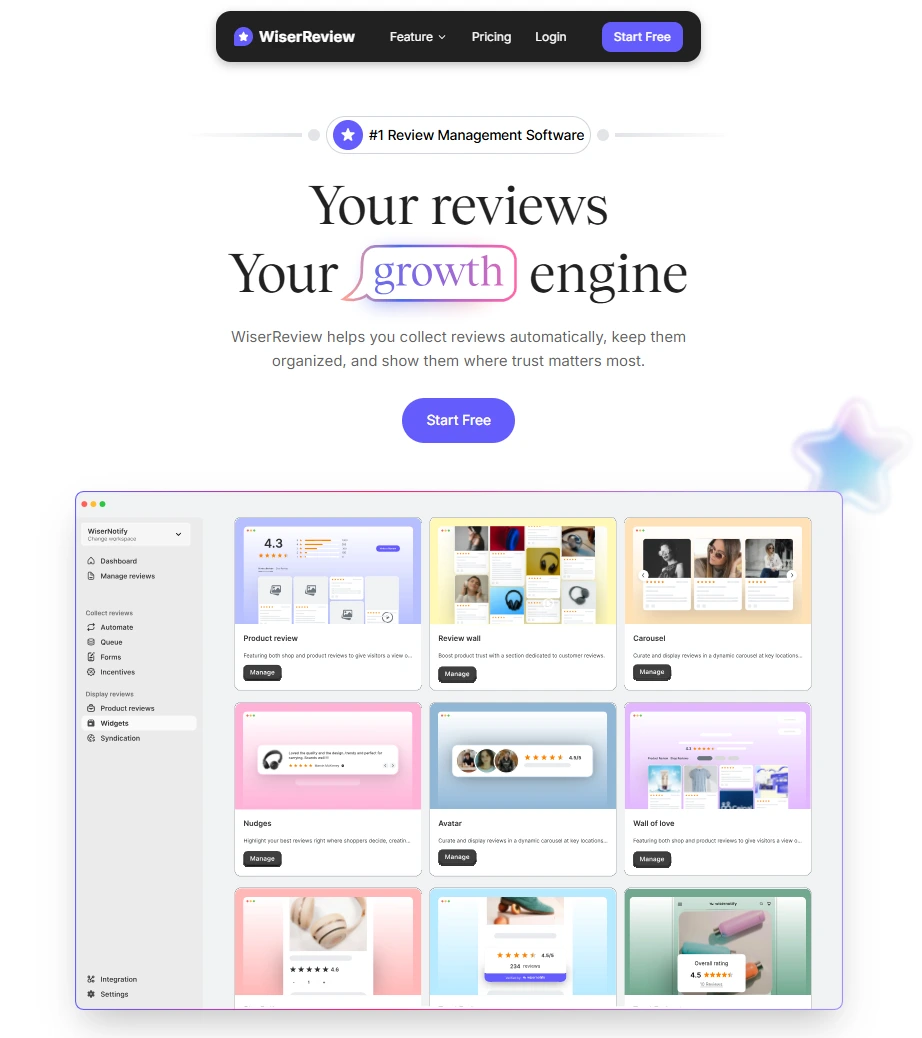
Best for: Businesses that want full control over how they collect, manage, and display reviews.
Full disclosure: WiserReview is our product. I’ll be upfront about that. But I’m also going to be honest about where it fits and where it doesn’t, because recommending the wrong tool doesn’t help anyone.
WiserReview was built specifically to fix the problems that keep coming up with tools like Feefo.
The invite-only model, the limited widget flexibility, and the multi-source lock-in. I’ve spent years watching these frustrations play out with real store owners, and that’s exactly what WiserReview addresses.
Here’s what you get that Feefo doesn’t offer:
- Photo, video, and text reviews collected in a single flow
- Custom review forms with your own logic, fields, and CTAs
- AI moderation built into every plan (not locked behind an enterprise tier)
- Review imports from Google, Facebook, Trustpilot, and others
- Multiple display widgets: sliders, walls, carousels, badges, grids
- SEO-friendly schema markup for rich snippets in search results
- Integrations with Shopify, WooCommerce, Wix, WordPress, and more
The setup takes under 30 minutes. No developer needed. And the free plan is actually useful, not a stripped-down demo.
Where WiserReview might not be your best fit: if you specifically need enterprise-grade compliance features or your brand requires the Feefo verification badge for industry trust, that’s a use case WiserReview doesn’t address.
For everyone else, especially stores paying Feefo’s £249/month tier for features that should’ve been standard, WiserReview is worth a hard look.
Rating: ⭐ 4.8/5
Pricing: Free plan available. Paid plans start at $9/month.
Also see: I Tested 21 Review Management Software (Here Are the Top 5 for 2026)
2. Judge.me

Best for: Shopify store owners who want maximum features at minimum cost.
Judge.me is the one that consistently surprises people. The free plan is genuinely functional.
Not “you can use it to test things” functional, but “you could realistically run a growing store on this” functional.
Unlimited review requests, photo reviews, verified buyer badges, and Google rich snippets are all available without paying a cent.
The $15/month paid plan adds video reviews, cross-shop review sharing (which helps newer stores build social proof faster), and some advanced display options.
That’s it. No aggressive upselling into higher tiers to unlock basics.
I’ve seen stores switch from Feefo to Judge.me and cut their software costs by 80% without losing meaningful functionality.
For most Shopify merchants, Judge.me does everything Feefo does at a fraction of the price.
The trade-off: the widget design options are less polished than some competitors, and if you’re on WooCommerce or another platform, the experience isn’t as seamless as it is on Shopify.
Rating: ⭐ 4.8/5
Pricing: Free plan available. Paid plans from $15/month.
3. Stamped.io

Best for: DTC brands that care about the visual presentation of their reviews.
Stamped sits in an interesting middle ground. It’s more capable than Judge.me in terms of display customization, but less enterprise-focused than Yotpo.
For DTC brands that want their review widgets to actually look good and match their brand, Stamped hits a sweet spot.
You get photo and video UGC collection, customizable display widgets, email and SMS review requests, NPS surveys, and loyalty integrations.
The integrations with Shopify and BigCommerce are solid. WooCommerce works well, too.
What I’d flag: the free plan is limited. If you’re planning to use Stamped properly, you’ll likely need a paid tier from day one.
And compared to some alternatives on this list, the interface takes a bit longer to get comfortable with.
But for brands where review aesthetics genuinely matter, where reviews on the product page need to look polished rather than just functional, Stamped is a strong choice.
Rating: ⭐ 4.7/5
Pricing: Free plan available. Paid plans from $23/month.
4. Yotpo

Best for: Scaling ecommerce brands that want reviews, loyalty, and SMS under one roof.
Yotpo is the all-in-one play. Reviews, loyalty programs, referrals, SMS marketing, and visual UGC.
It’s all there, and it’s all connected. For brands that want to run their customer retention strategy from a single platform, Yotpo makes that possible in a way most tools don’t.
The review collection side is strong: automated request emails and SMS, photo and video reviews, customizable widgets, and Google Shopping integration.
It’s genuinely enterprise-capable without requiring a developer to set it up.
The catch is price. Yotpo offers a free plan, but it’s quite limited.
To access the features that make Yotpo interesting, you’re typically looking at $79/month or more, and costs scale up quickly as your store grows.
For smaller brands, the ROI math doesn’t always work out.
If you’re doing decent revenue and want a platform that grows with you without stitching together five different tools, Yotpo is worth evaluating.
If you’re at an earlier stage, the alternatives on this list will offer better value for the dollar.
Rating: ⭐ 4.6/5
Pricing: Free plan available. Paid plans from $79/month.
Also see: 10 Best Yotpo Alternatives I’ve Found in 2026 (Tested)
5. Trustpilot

Best for: Brands that need widely recognized third-party trust signals.
Trustpilot is a different kind of tool from Feefo.
It’s less about collecting and managing reviews on your site, and more about building a public reputation on a platform that shoppers actually recognize and trust independently.
That distinction matters. When someone searches for your brand name and sees a Trustpilot rating in the results, that’s a trust signal from outside your brand.
It’s harder to game and more credible to skeptical shoppers than reviews you’re hosting on your own website.
The trade-offs are real, though. Trustpilot is expensive (paid plans start around $259/month), and because it’s an open review platform, negative reviews can come in from anyone, not just your verified customers.
You can’t delete them. You can only respond and build volume to balance them out.
I’d consider Trustpilot as a supplement to another tool, not a replacement. Use it for brand reputation.
Use something like WiserReview or Judge.me for on-site product reviews. They serve different purposes.
Rating: ⭐ 4.4/5
Pricing: Free plan available. Paid plans from $259/month.
6. PowerReviews

Best for: Mid-to-large retailers that need review syndication across retail networks.
PowerReviews is one of the few platforms with serious review syndication capabilities.
That means your product reviews can appear not just on your own site, but across major retail partners and networks.
For brands selling through third-party retailers or large department stores, this is a feature that actually moves conversion metrics.
Beyond syndication, PowerReviews handles product and site reviews, Q&A content, photo and video UGC, deep analytics, and sentiment analysis.
The platform is built for teams that use review data as a business intelligence input, not just a display tool.
The downside is that PowerReviews operates on a custom pricing model. There’s no public pricing page, which usually means “this is built for larger contracts.”
If you’re a smaller brand, you’ll likely find both better pricing and easier onboarding with the other tools on this list.
Rating: ⭐ 4.6/5
Pricing: Custom pricing. Contact for a quote.
7. Fera.ai

Best for: Stores that want to incentivize review collection while showing social proof.
Fera.ai combines review collection with a social proof display layer in a single tool.
You can collect photo and video reviews, offer rewards to customers who leave them, and display real-time notifications on your site, all without needing separate platforms for each piece.
The review request emails are clean and customizable. The widget options are solid.
And the incentive system (rewarding customers with points or discounts for leaving reviews) genuinely works for stores that are struggling to get review volume off the ground.
Fera integrates with Shopify, BigCommerce, and Wix. The starting price is competitive at $9/month.
And unlike many tools in this space, the interface is genuinely easy to navigate from day one.
It’s not as feature-deep as Yotpo or Stamped, but for stores that want a clean, affordable starting point that covers both review collection and basic social proof, Fera is an underrated option.
Rating: ⭐ 4.6/5
Pricing: Free trial available. Paid plans from $9/month.
How to Choose the Right Feefo Alternative for Your Business
The right choice depends entirely on what problem you’re actually trying to solve. Here’s how I’d break it down:
You want to collect more reviews and control how they appear on your site, WiserReview or Judge.me is your best starting point. Both give you a multi-format collection (photos, videos, text), flexible display widgets, and proper platform integrations at a price that doesn’t sting.
Budget is the primary constraint, Judge.me’s free plan is hard to beat. It’s the rare case where “free” actually means free without major feature gates.
You need reputation management as much as on-site reviews, Trustpilot makes sense as a complement to whatever else you’re using. Just go in with realistic expectations about cost and the open review model.
You’re a larger brand with syndication needs or enterprise complexity, PowerReviews or Yotpo are worth exploring on a demo call.
Common Mistakes When Switching Review Platforms
I’ve seen these play out enough times that they’re worth calling out before you make a move.
Starting from zero when you don’t have to. Before you switch, check what review import options your new tool supports. Most platforms on this list let you bring over existing reviews from Google, your old tool, or CSV exports. Don’t throw away months of social proof because you skipped the import step.
Choosing based on features you won’t actually use. Yotpo has an impressive feature list. So does Stamped. But if you’re a two-person team managing a mid-sized store, you probably don’t need half of what those platforms offer. Match the tool to your actual workflow, not your aspirational workflow.
Not testing the widget before committing. Review widgets live on your product pages where customers see them. Make sure the one you choose actually looks good with your specific theme. Most tools offer free trials or demo installs. Use them.
Ignoring the support quality. One of the main complaints I hear about Feefo is slow support. Before switching, check recent reviews on G2 or Capterra, specifically for mentions of support. A tool that’s fast to set up but slow to help when something breaks isn’t actually saving you time.
Final Thoughts
Feefo works for certain businesses, particularly larger brands with dedicated CX teams and a need for verified-only review systems.
But for most growing ecommerce operations, there are better options that cost less and give you more flexibility.
My honest recommendation for most stores: start with WiserReview if you want full control over collection and display. Use Judge.me if you’re on Shopify, and your budget is tight.
Look at Yotpo once you’re scaling and want everything in one place.
The review platform you use matters less than actually using it.
The stores I’ve seen grow fastest are the ones that pick something, commit to a consistent review collection strategy, and keep iterating on how they display and deploy that social proof.
Pick the tool that you’ll actually use consistently. That’s the real answer.


