A landing page has one job: convert the visitor in front of it. The copy explains the offer, the design directs attention, and the CTA asks for action.
But the piece that actually moves the undecided visitor over the line is proof that other people have already made that decision and found it worth it.
That’s what customer reviews do on a landing page. Not decoration: evidence.
And the difference between reviews that convert and reviews that get ignored almost entirely comes down to where you put them and how they’re displayed.
This guide covers both, using WiserReview’s review widget library to show exactly how it works in practice.
Why Reviews on Landing Pages Convert Better Than Reviews Anywhere Else
Product pages and homepage testimonials have their place, but landing pages are where the pressure is highest. Someone has clicked an ad, followed a link, or responded to an email and landed on a page with a single ask.
They’re evaluating right now whether to give you their email, their money, or their time.
At that moment, a well-placed review does something your copy can’t do alone: it removes the “but what do actual customers think?” objection before the visitor has to go find the answer somewhere else.
Research consistently shows that 88% of consumers trust online reviews as much as personal recommendations. On a landing page, that trust translates directly to form submissions, signups, and purchases.
The specific advantage of landing pages over other page types is context. You control exactly who sees this page, what offer they’re responding to, and what objection they’re most likely to have. That means you can:
•Place a review that addresses the exact objection your audience has
•Filter to show reviews from customers who match the visitor’s situation
•Position proof precisely where hesitation is highest on your specific layout
•Match the review format to the visual design so it reads as native content, not an add-on
Also check: How to add reviews to your website in minutes
All your reviews in one place
Collect reviews, manage every response, and display them where they matter most.
How to Add Reviews to a Landing Page with WiserReview
WiserReview embeds on any landing page builder: WordPress, Webflow, Wix, Squarespace, ClickFunnels, Unbounce, Leadpages, and custom-coded pages. The process is the same regardless of platform. Three steps, no developer required.
Step 1: Choose and Customize Your Widget
Sign in to the WiserReview account and go to the Widgets tab. You’ll see the full library of widget types: carousel, popup, review wall, floating badge, star rating, and more.
Click Manage on the widget that fits the placement you have in mind.

Inside the widget editor, configure the widget for your specific landing page position:
•Choose the layout: carousel or slider near the headline keeps it compact; review wall or grid mid-page gives it visual weight
•Filter which reviews display: by tag, rating, product, or keyword so only the most relevant reviews for this offer appear
•Customize the styling: match colors, fonts, and card design to your landing page so the widget looks native, not embedded

A widget that matches your page design performs better than one that looks like a third-party embed. Once it looks right, move to step two.
Step 2: Copy the Embed Code
Click Install or Embed inside the widget editor. WiserReview generates a short HTML snippet or JavaScript code block. Copy the entire code: it’s typically two to three lines.

This code is lightweight and loads asynchronously, meaning it doesn’t block your landing page from rendering. For pages where load speed directly affects ad quality scores and conversion rates, that matters.
Step 3: Paste Into Your Landing Page Builder
In your page editor, add an HTML block, a custom code section, or an embed element wherever you want the reviews to appear. Paste the code from WiserReview. Save and publish.
The widget goes live immediately and updates automatically as new reviews come in.
You don’t need to touch the landing page again when a new review arrives: WiserReview handles the sync. Before you publish, preview across both desktop and mobile to confirm the widget renders cleanly at both screen sizes.
All your reviews in one place
Collect reviews, manage every response, and display them where they matter most.
After the Widget: Collecting and Managing Reviews
A widget is only as good as the reviews feeding it. Here’s how to keep your landing page proof fresh and high-quality.
Collect More Reviews Automatically

WiserReview automates review requests so your widget library grows without manual effort. After each order or service interaction, review requests go out automatically on a schedule you control.
Review collection options include:
•Email and WhatsApp review requests sent post-purchase or post-service
•Shopify trigger: request fires automatically when an order is fulfilled
•Webhook and manual upload for non-ecommerce businesses
•Customizable timing and messaging to match your brand tone
Manage and Organize Before They Go Live

Every review comes into your WiserReview dashboard for approval before it appears anywhere on your site. From the dashboard, you can:
•Approve, reject, or edit reviews before publishing
•Tag reviews by product, feature, use case, or campaign
•Filter by rating, keyword, or date to find the strongest proof for each offer
•Pull tagged reviews into specific widgets using the filter controls in the widget editor
Also check: Manage Reviews | Moderate, Tag, and Organize |
Which Widget Type Works Where on a Landing Page
WiserReview gives you ten widget formats. Each is designed for a specific placement and conversion job. Here’s how to match the right format to the right position on your page.
Avatar Strip and Floating Popup
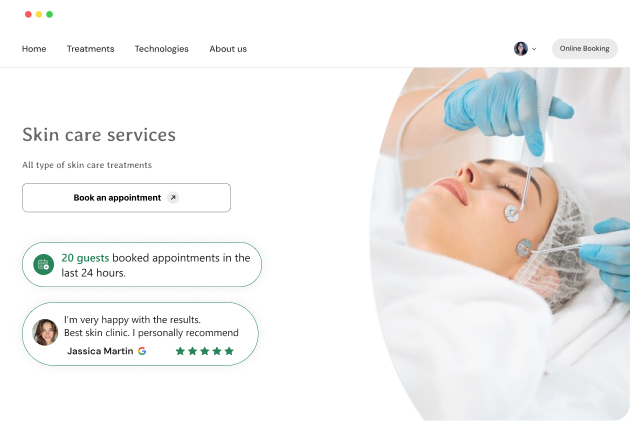
The avatar strip shows a row of customer profile photos with a star rating aggregate, compact enough to sit directly below your headline without breaking the visual flow.
It answers the “have real people used this?” question instantly without requiring scrolling.
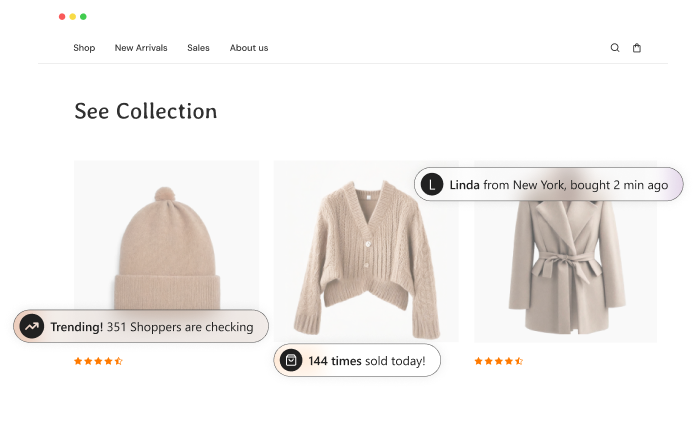
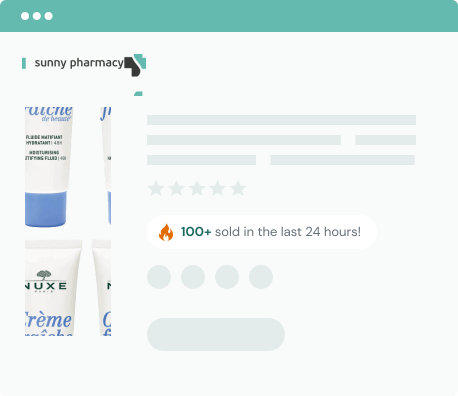
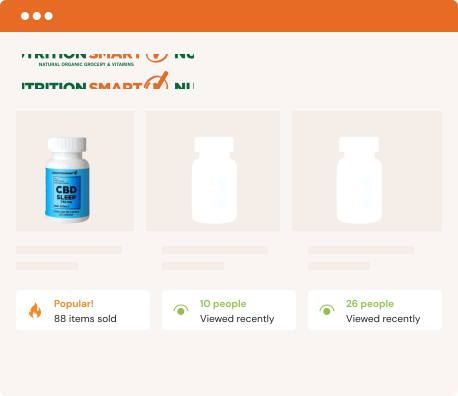
The floating popup appears automatically while someone browses, surfacing a single strong review at the moment they’re considering the offer.
•Avatar strip: best near your hero headline or directly above the fold
•Floating popup: best on longer landing pages where the CTA sits below the initial viewport, keeps proof visible without requiring scroll
Carousel and Auto Slider

The carousel rotates through multiple reviews in a contained horizontal space, showing two or three at a time.
The auto slider runs on its own, cycling through reviews without visitor interaction.
Both are ideal when you have reviews covering different aspects of your offer: one about quality, one about service speed, one about outcome, and you want visitors to see all three without dedicating too much vertical space.
•Place in a dedicated testimonials section mid-page
•Position between your main benefit explanation and your CTA, where visitors are actively evaluating
Nudge and Trust Badge

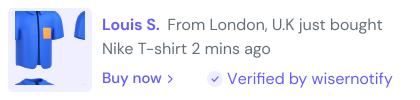
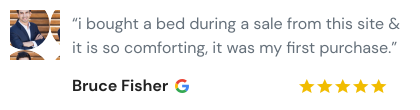
Nudges are small inline quote widgets designed to appear right next to decision points.
They pull a single strong review sentence and display it as a quiet but persuasive reinforcement at the exact spot where the visitor is committing or hesitating.
The trust badge shows your aggregate star rating and total review count in a compact format.
•Nudge: beside a pricing table, next to a form field, or near a buy button
•Trust badge: in a page header, near a price, or in a footer
•Both work best within eye travel distance of your CTA, not below it
All your reviews in one place
Collect reviews, manage every response, and display them where they matter most.
Product Review Section and Star Rating

For ecommerce landing pages promoting a specific product, the product review section shows full customer reviews tied to that item: text, photos, verified buyer status, and star ratings.
The standalone star rating is a stripped-down version, showing just the aggregate score and count, small enough to sit inline with the product name or price without disrupting the layout.
•Product review section: below the product description, where detail-seeking visitors look
•Star rating: inline with the product name or price to add instant credibility without breaking layout
Sidebar Snippet and Floating Badge

On longer landing pages, the sidebar snippet attaches as a tab to the edge of the browser window.
Visitors can expand it to read reviews without leaving the page. The floating badge persists as visitors scroll, showing your overall star rating and review count as a constant trust signal across the full page experience.
•Both work best on long-form pages where the offer requires significant explanation before the ask
•Effective on mobile, where a persistent badge stays in view without taking up content space
Wall of Love and Review Wall

The review wall and wall of love display a masonry grid of multiple reviews in a full-section layout.
These work best when your offer requires significant trust building before conversion: high-ticket products, B2B services, courses, or anything where the visitor needs to feel confident before committing.
•Use as a full section where trust is the primary conversion barrier
•Position clearly before the pricing or signup section, not after it
•Filter by tag to show only reviews relevant to this specific landing page’s offer
Where to Place Reviews on a Landing Page
The widget type matters less than the placement. The same carousel in the wrong position underperforms compared to a simple nudge in exactly the right spot. Three placement rules that consistently move conversion rates:
Directly below your headline: The headline makes a claim. A review immediately beneath it proves that claim with someone else’s words. This catches the visitor at the moment of maximum attention before they’ve decided whether to engage.
Next to your primary CTA: The moment before a visitor fills a form or clicks a button is the highest-hesitation moment on the page. A review here, specifically one that addresses what happens after someone acts, answers the “but will it actually work for me?” question at exactly the right time.
Near your pricing or offer section: Price is the most common conversion barrier. A review from someone who specifically mentions value, ROI, or outcome next to your price makes the cost feel justified before the visitor has to justify it themselves.
Common Mistakes That Kill Review Performance on Landing Pages
The setup is only half the work. These are the mistakes that negate even well-placed reviews:
•Using reviews that don’t match the page’s specific offer: A generic brand testimonial on a page promoting a specific product or service creates a mismatch. The visitor is evaluating this offer, not your company in general. Use WiserReview’s tagging to filter for reviews that specifically mention the outcome this landing page promises.
•Burying reviews below the fold: If your first review is only visible after significant scrolling, the visitors who most need it have already bounced. Put at least one strong review above the fold or immediately below the headline. Everything else can live lower.
•Letting widget design clash with page design: A review widget that visually breaks from your page’s color scheme and typography signals “third-party add-on” rather than native content. Match fonts, colors, and card styling in WiserReview’s widget editor before publishing.
•Showing too many reviews: Three to five strong, specific reviews outperform twenty generic ones every time. More reviews don’t mean more trust: they mean more scroll time before the visitor reaches your CTA. Pick the best using WiserReview’s filter tools and show only those.
•Never updating the widget after launch: Review widgets showing the same content for months feel stale. New reviews referencing recent experiences are more credible than older ones. Make sure collection automation is running, so fresh proof keeps flowing into the widget automatically.
Also check: Social proof on landing pages: what works and what doesn’t
All your reviews in one place
Collect reviews, manage every response, and display them where they matter most.
Final Word
Reviews on landing pages aren’t a nice-to-have. For any page where the conversion barrier is trust rather than awareness, they’re the difference between a page that converts and one that doesn’t.
The process is straightforward: choose the right widget for each placement, filter for reviews that match your specific offer, embed in three steps, and put them where hesitation is highest.
WiserReview handles the rest: auto-updating as new reviews come in, loading without slowing your page, and staying responsive across every device your visitors use.
The visitors who land on your page are already interested. The reviews you show them are what convert that interest into action.