I’ve tested every major review platform on this list. Some I’ve used for years. Others I signed up for just to see what the hype was about.
Here’s what I know after building WiserNotify and working with thousands of online businesses: Trustpilot isn’t bad. It’s just not the right fit for most growing brands.
The pricing climbs fast. You don’t own your reviews. And the display options feel rigid when you want reviews to actually drive sales on your site.
So I put together this list of 11 Trustpilot alternatives that solve specific problems. Not a generic roundup.
Each tool here earned its spot because it does something Trustpilot doesn’t, or does it better.
Quick Comparison: Trustpilot Alternatives at a Glance
Before we get into the details, here’s how these platforms stack up in terms of what matters most.
| Platform | Best For | Starting Price | Google Seller Ratings | Review Ownership |
|---|---|---|---|---|
| WiserReview | Full review control + display | Free (paid from $9/mo) | No | You own everything |
| WiserNotify | Real-time social proof + FOMO | $16/mo | No | You own everything |
| Reviews.io | Mid-market review collection | $99/mo | Yes | You own reviews |
| Yotpo | Shopify Plus + enterprise | Free (paid from $79/mo) | Yes | Platform-hosted |
| Stamped.io | Shopify review automation | Free (paid from $23/mo) | Yes | Platform-hosted |
| Bazaarvoice | Enterprise retail syndication | Custom | Yes | Syndicated network |
| Birdeye | Multi-location reputation | Custom | Yes | Platform-hosted |
| Feefo | Verified-only reviews | Custom | Yes | Feefo-hosted |
| Loox | Visual reviews for Shopify | $12.99/mo | Yes | Shopify-hosted |
| Boast | Video testimonials (B2B) | $59/mo | No | You own content |
| Trustmary | Review import + display | $19/mo | No | You own content |
Why Brands Actually Leave Trustpilot

I talk to store owners every week. The complaints about Trustpilot are almost always the same.
You don’t own your reviews. Trustpilot hosts everything on its domain. Your review page lives at trustpilot.com/company/yourbrand. That means Trustpilot gets the SEO juice, not you. And if you ever cancel? Those reviews stay on Trustpilot.
Pricing scales poorly. The free plan is basically a listing page. Paid plans start at $259/month and can hit $1,229/month. For that price, you get automated review invites, but they’re capped (50 to 500 per month depending on your plan). That’s a hard ceiling on growth.
Anyone can leave a review. Trustpilot is an open platform. That means people who never bought from you can post reviews. For some brands, this is a nightmare. Competitors, disgruntled non-customers, and even bots can leave feedback.
Limited display control. Trustpilot widgets look like Trustpilot, not like your brand. You get their green stars and their layout. If you want reviews that blend into your product pages and checkout flow, you’ll hit walls fast.
None of this means Trustpilot is useless. Their brand recognition is strong, and some enterprise brands benefit from the third-party credibility. But for most growing businesses, there are better options.
11 Best Trustpilot Alternatives (Ranked by Use Case)
1. WiserReview

Best for: Brands that want full control over collecting, managing, and displaying reviews on their own website.
I built WiserNotify first (the social proof notification tool). But I kept hearing the same thing from customers: “We need a way to collect and manage reviews too, not just display social proof popups.”
That’s why WiserReview exists. It’s a review management platform where you own 100% of your reviews. They live on your site, in your database, under your brand.

What makes it different from Trustpilot:
You collect text, photo, and video reviews through clean, brand-matching forms. No Trustpilot logo. No redirecting customers to a third-party site.

The dashboard keeps everything in one place. Approve, reject, reply, or filter by rating or date. Automated review requests go out after purchases without you lifting a finger.

And the display options are where WiserReview really pulls ahead. You can place review widgets on product pages, landing pages, checkout pages, or anywhere else trust matters. Match your brand colors. Choose your layout.

I’ll be honest about what it doesn’t do: WiserReview isn’t a Google Seller Ratings partner (yet). If you need star ratings in Google Ads, you’ll need a platform like Reviews.io or Yotpo to support them. For everything else (collection, display, management, on-site trust), it’s the most flexible option on this list.
Rating: 4.8/5
Pricing: Free plan available. Paid plans from $9/month.
2. WiserNotify

Best for: Turning existing reviews and customer activity into real-time trust signals that boost conversions.
This is our social proof notification platform. While WiserReview focuses on collecting and managing reviews, WiserNotify focuses on displaying social proof at the exact moment visitors are making decisions.
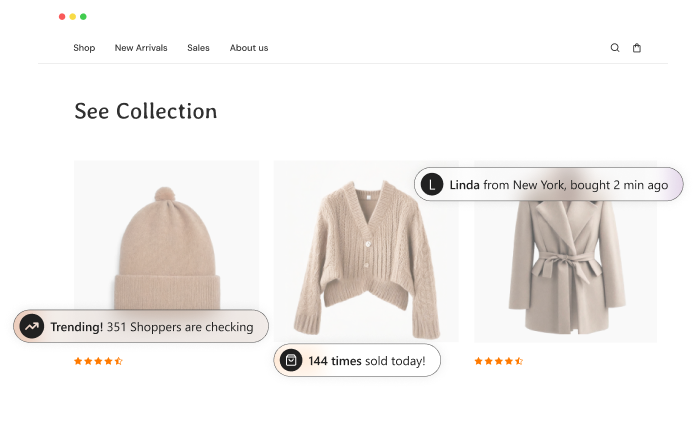
Here’s how it works: when someone buys from your store, signs up for your service, or leaves a review, WiserNotify displays a small pop-up notification on your site. “Sarah from London just purchased…” or “David left a 5-star review 2 minutes ago.”
Sounds simple. But the impact is real. According to social proof research, products with visible social proof convert up to 270% better than products without it.
Key features that set it apart:
Real-time purchase, signup, and review notifications.
Urgency widgets (countdown timers, low-stock alerts).
Smart page targeting so you show the right proof on the right page.
Full design control (colors, fonts, position, animation).
250+ integrations, including Shopify, WooCommerce, Wix, and WordPress.
Built-in A/B testing and performance analytics.
Why it works alongside Trustpilot alternatives: Many brands use WiserNotify paired with a review collection tool. You collect reviews with WiserReview (or another platform), then WiserNotify displays them as live notifications across your site. That combo covers both collection and conversion.
Rating: 4.7/5
Pricing: Starts at $16/month.
3. Reviews.io

Best for: Mid-market businesses that need Google Seller Ratings and flexible review collection.
Reviews.io is probably the strongest direct Trustpilot competitor on this list. They position themselves as the anti-Trustpilot, and honestly, they back it up.
The biggest win? You own your reviews. Unlike Trustpilot, Reviews.io lets you take your review data if you leave. That alone makes it worth considering.
They support email, SMS, and in-app review collection. Product reviews with photos and videos are included.
And they’re a Google Seller Ratings partner, so your stars can show up in Google Ads and Shopping results.
Where it falls short: Startup pricing starts at $99/month, which is cheaper than Trustpilot but still not cheap. Monthly review invite caps mean your growth ceiling depends on your plan tier. And while their widgets are better than Trustpilot’s, they still don’t offer the level of display customization you’d get with a dedicated tool.
Rating: 4.7/5
Pricing: Starts at $99/month with a free trial.
4. Yotpo

Best for: Shopify Plus stores and enterprise ecommerce brands that want reviews, loyalty, and SMS in one platform.
Yotpo is a powerhouse. Reviews, loyalty programs, SMS marketing, subscriptions, and user-generated content all under one roof.
If you’re running a Shopify Plus store doing $5M+ in revenue, Yotpo makes a lot of sense. The integration is tight, the review collection is automated, and the data flows between their products nicely.
But here’s the catch: Yotpo gets expensive fast. The free plan is extremely limited. Paid plans start around $79/month, and most serious features require the $169+/month tiers. Enterprise pricing goes much higher.
I’ve also heard from multiple store owners that Yotpo’s dashboard has a learning curve. One told me, “It took our team two weeks just to figure out where everything was.”
If budget isn’t your primary concern and you want an all-in-one ecommerce marketing stack, Yotpo is a strong option. If you just want a review platform, it’s overkill.
Also check: 12 Cheaper Yotpo Alternatives and Competitors
Rating: 4.5/5
Pricing: Free plan available. Paid plans from $79/month.
5. Stamped.io

Best for: Shopify stores that want affordable review automation with loyalty program features.
Stamped is the budget-friendly Yotpo alternative. It does reviews, NPS surveys, and loyalty programs, but without the enterprise price tag.
I’ve set it up for a few stores, and the Shopify integration works well. Review request emails go out automatically. Customers can leave photo and video reviews. And the on-site widgets look clean.
What I appreciate about Stamped is the free plan. It’s actually usable. You get up to 50 orders per month, which is enough to test if the platform fits your workflow before committing money.
Where it gets tricky: The NPS and loyalty features feel bolted on rather than deeply integrated. If you’re primarily looking for a review tool, Stamped delivers. If you want a true loyalty platform, you might need something more dedicated.
Rating: 4.7/5
Pricing: Free plan available. Paid plans from $23/month.
6. Bazaarvoice

Best for: Large brands that sell through retail channels and need review syndication across multiple retailers.
Bazaarvoice operates in a completely different space than most tools on this list. It’s not just a review platform. It’s a UGC syndication network.
If your products are sold on Walmart.com, Target.com, Best Buy, or other major retailers, Bazaarvoice syndicates your reviews across those channels.
One review collected on your site can appear on 10+ retail partner sites.
That’s incredibly powerful for enterprise brands. But for a growing DTC brand doing $500K/year? Complete overkill.
Pricing is custom and not cheap. Implementation requires dedicated resources. And the platform is complex enough that most companies need onboarding support.
Also check: I Tested 6 Bazaarvoice Alternatives for Ecommerce (2026)
Rating: 4.5/5
Pricing: Custom (typically enterprise-level).
Build urgency
Add floating offers with countdown timer & coupon code.
7. Birdeye

Best for: Multi-location service businesses that need reputation management across Google, Facebook, and dozens of other sites.
If you run a dental practice with 8 locations, a restaurant chain, or a home services company, Birdeye is built for you.
It pulls reviews from Google, Facebook, Yelp, Healthgrades, and 200+ other sites into one dashboard.
You can respond to reviews across all platforms without switching tabs. And it automates review requests through SMS and email.
The AI-powered features are strong, too. Birdeye can generate response suggestions, analyze sentiment trends, and flag negative reviews for quick attention.
Why most online businesses don’t need it: Birdeye is designed for local and multi-location businesses. If you’re running an ecommerce store or SaaS product, you don’t need to monitor Yelp and Healthgrades. The pricing reflects the enterprise positioning (custom quotes, annual contracts) and includes more tools than most online-only brands require.
Rating: 4.7/5
Pricing: Custom pricing.
8. Feefo

Best for: Brands that want only verified buyer reviews (no open platform reviews).
Feefo takes the opposite approach to Trustpilot. While Trustpilot lets anyone leave a review, Feefo only collects reviews from verified purchasers. Period.
This means every review on Feefo has a real transaction behind it. For brands worried about fake reviews or competitor sabotage, that’s a massive plus.
Feefo is also a Google Seller Ratings partner. Reviews sync to Google Ads and Shopping. The analytics dashboard gives you customer experience insights beyond basic star ratings.
The downside: Feefo’s pricing is custom and tends to be on the higher side. The platform is more popular in the UK and Europe than in North America. And the verified-only model means you’ll collect fewer total reviews than an open platform.
Rating: 4.6/5
Pricing: Custom pricing based on business size.
9. Loox

Best for: Shopify stores that want beautiful photo and video review galleries.
Loox is all about visual reviews. If your product looks good in customer photos (fashion, beauty, home decor, food), Loox turns those photos into conversion machines.
The gallery layouts actually look great on mobile. I’ve seen Loox galleries that look like Instagram feeds embedded on product pages. Customers can submit photos and videos with their reviews, and you can offer discount codes as incentives.
Loox also has a built-in referral feature. After a customer leaves a review, they can share a referral link for a discount. It’s a nice post-purchase loop.
What to know before choosing Loox: It’s Shopify-only. No WooCommerce, no Wix, no custom sites. And it’s focused purely on visual reviews. If you need text-heavy reviews, Q&A features, or non-Shopify support, Loox isn’t the right fit.
Rating: 4.7/5
Pricing: Starts at $12.99/month.
10. Boast

Best for: Service businesses and B2B companies seeking client video testimonials.
Boast specializes in something most review platforms ignore: video testimonials.
If you’re an agency, consultant, or service company, written reviews only tell part of the story. A 60-second video of a client talking about their experience? That’s social proof gold.
Boast makes it easy to request and collect video testimonials. Customers get a link, record on their phone or webcam, and you get a polished video you can embed on your site.
The tradeoff: Boast isn’t built for product reviews or high-volume ecommerce. It’s a testimonial platform, not a review management platform. Pricing starts at $59/month, which is reasonable for B2B but might not fit small DTC brands.
Rating: 4.6/5
Pricing: 14-day free trial. Starts at $59/month.
11. Trustmary

Best for: Businesses that want to import existing reviews from Google, Yelp, and Facebook and display them on their site.
Trustmary solves a specific problem: you already have reviews scattered across Google, Facebook, Yelp, and TripAdvisor, and you want to pull them all onto your website.
The import feature grabs your existing reviews and lets you display them through customizable widgets. You can also collect new reviews and video testimonials directly through Trustmary.
What caught my attention is the conversion tracking. Trustmary shows you exactly how your review widgets impact conversions, clicks, and time on page. Most review platforms don’t offer that level of insight.
One thing to know: You can’t import reviews from Trustpilot into Trustmary. Trustpilot doesn’t allow third-party tools to pull reviews from their platform. So if your reviews are mostly on Trustpilot, switching means starting fresh.
Also check: Top Trustmary Alternatives Worth Considering
Rating: 4.6/5
Pricing: Starts at $19/month.
Build trust & FOMO
Highlight real-time activities like reviews, sales & sign-ups.
How to Choose the Right Trustpilot Alternative

Picking the right tool depends entirely on what you’re trying to solve. Not what sounds impressive, but what actually moves the needle for your business.
If you want to collect and manage reviews with full control, look for platforms that let you own the data, customize forms, and display widgets on your own site. WiserReview fits this well. Reviews.io and Trustmary are solid options, too.
If you want reviews to directly boost conversions, you need more than a static widget. Real-time notifications that show recent reviews, purchases, and signups create both urgency and trust. That’s what social proof nudges are built for, and WiserNotify handles this better than any tool on the list.
If you need Google Seller Ratings for Google Ads, your options narrow to Google-approved partners. Reviews.io, Yotpo, Feefo, and Stamped.io all qualify. Neither WiserReview nor WiserNotify supports this (yet), so keep that in mind if paid ads are your primary channel.
If you’re on Shopify specifically, Loox (for visual reviews), Stamped.io (for affordable automation), or Yotpo (for an all-in-one stack) integrate natively. WiserReview also works with Shopify stores.
If you run a multi-location service business, Birdeye is your best bet. It’s built for managing reputation across dozens of review sites and locations.
Here’s what I’ve seen work best for most growing brands: pair a review-collection tool with a social-proof display tool.
Collect reviews with one platform. Display them in real-time with another. That combination covers both trust building and conversion optimization.
Trustpilot Pricing: What You’re Actually Paying For
I think pricing deserves its own section because Trustpilot’s costs surprise a lot of people.
| Trustpilot Plan | Monthly Cost | Review Invites/Month | Key Limitation |
|---|---|---|---|
| Free | $0 | Manual only | No automation, basic profile page |
| Standard | $259 | 100 | Low invite cap for the price |
| Growth | $549 | 300 | Better widgets, still capped |
| Enterprise | $1,229+ | 500+ | Annual contract required |
Compare that to WiserReview at $9/month with no invite caps. Or Stamped.io at $23/month. Or even Reviews.io at $99/month with more invites per dollar.
The math often doesn’t work for growing brands. You’re paying $259/month and can only send 100 review invites. At a typical 5-10% response rate, that’s 5-10 new reviews per month. For $259.
That’s why most businesses I work with switch to tools that let them scale without hitting a pricing wall every time they grow.
Getting Started
Trustpilot built a great brand. But brand recognition doesn’t pay your bills.
Reviews on your own website, displayed at the right moment, in the right way, are what actually drive sales.
Pick the tool that matches your stage and your goal. If you’re starting from scratch with reviews, WiserReview gives you the most control at the lowest cost.
If you already have reviews and want to turn them into real-time conversion signals, WiserNotify’s social proof features are built exactly for that.
And if you’re not sure? Start with a free plan. Test it on one page. Measure the results. That’s how you find the right fit without overthinking it.