I’ve been working with user-generated content across 10,000+ ecommerce stores for the past 5 years.
And if there’s one trend I’m certain about in 2026, it’s this: brands that collect and use UGC consistently outsell brands that don’t.
It’s not even close. Research shows that displaying UGC on product pages can increase conversions by up to 166%.
Consumers are 2.4x more likely to view user-generated content as authentic than brand-created content. And products with 5+ reviews are 270% more likely to sell.
But collecting, managing, and displaying UGC manually? That’s a nightmare. You need tools.
The problem is that there are dozens of UGC tools, and each does something different. Some help you collect reviews.
Some connect you with creators. Some aggregate social media posts. Some generate AI video content. Picking the wrong one wastes your budget and your time.
So I tested and compared 11 UGC tools that cover the full spectrum: collection, management, display, creator marketplaces, and AI-powered content generation.
I’ve ranked them from must-have to specialized, so you can pick exactly what your brand needs.
Quick Comparison: 11 Best UGC Tools (2026)
| # | Tool | Best For | Starting Price |
|---|---|---|---|
| 1 | WiserReview | Collecting & displaying product reviews | Free plan |
| 2 | Tint | Aggregating UGC from multiple platforms | Custom pricing |
| 3 | Yotpo | Enterprise reviews + loyalty + SMS | $24/mo |
| 4 | JoinBrands | Connecting brands with UGC creators | $99/mo |
| 5 | Billo | Quick UGC video production | $99/video |
| 6 | Social Native | Enterprise UGC creation & distribution | Custom pricing |
| 7 | Insense | Creator marketplace for paid social | $400/mo |
| 8 | Taggstar | Hashtag tracking & social UGC | Custom pricing |
| 9 | Arcads | AI-generated UGC video ads | $99/mo |
| 10 | Collabstr | Self-serve creator marketplace | Pay per creator |
| 11 | Curator | Social media aggregation walls | Free plan |
Also check: 10 Best UGC Platforms for Brands and Creators
What Do UGC Tools Actually Do?
Before jumping into the list, it helps to understand the four categories of UGC tools.
Most brands need at least two.
Collection tools pull UGC from social media, review platforms, and direct submissions. They aggregate customer photos, videos, reviews, and mentions into one dashboard.
Management tools handle moderation, rights management, organization, and approval workflows. They make sure you’re only publishing quality content with proper permissions.
Display tools showcase UGC on your website, product pages, digital signage, and marketing channels. They turn raw customer content into conversion-driving elements like review widgets, social walls, and shoppable galleries.
Creator tools connect you with UGC creators or use AI to generate UGC-style content. They solve the “I need more content than my customers organically create” problem.
Most platforms overlap across categories. The tools below are organized by their primary strength.
UGC Review Collection & Display Tools
1. WiserReview: Product Review Collection & Display

Full disclosure: WiserReview is our product. But here’s why it leads this list.
Reviews are the most valuable form of UGC, and most stores don’t collect enough of them. I’ve watched hundreds of store owners struggle with the same pattern: decent traffic, good products, barely any conversions. The missing piece is almost always reviews.
WiserReview automates the entire review collection process. After a purchase, it sends automated requests via email, SMS, or WhatsApp.
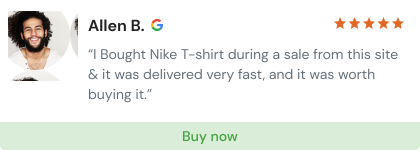
Customers can submit text, photo, and video reviews. You moderate them, then display them on product pages with widgets that include Google-ready schema markup.
The AI features help too. Sentiment detection, review translation (shows reviews in the visitor’s browser language), spam filtering, reply suggestions, review summaries, and topic tagging.
These aren’t gimmicks. They save hours of manual moderation work.
The free plan covers the basics: 10 text reviews, 2 video reviews, 10 automated invitations per month, and a carousel widget.
For stores starting out, that’s enough to build the review foundation that makes everything else work.
Pricing: Free plan available. Paid plans from $9/month.
Best for: Every ecommerce store. Reviews are the #1 form of UGC that directly impacts purchasing decisions.
Also check: 20 User-Generated Content Examples I’d Copy
UGC Aggregation & Management Tools
2. Tint: Multi-Platform UGC Aggregation

Tint pulls UGC from multiple social media platforms into one dashboard. You can build social media walls, shoppable galleries, and embed user content across your website and digital signage.
The interface is genuinely user-friendly. Content moderation tools let you filter and approve posts before they go live.
The customizable display options give you control over how UGC looks on your site without needing a developer.
Where Tint shines is in event marketing and in-store displays. If you’re running a conference, trade show, or retail location, their social media walls create engagement that static content can’t match.
Pricing: Custom pricing (contact for a quote).
Best for: Mid-size to enterprise brands running multi-channel UGC campaigns or event marketing.
3. Yotpo: Enterprise Reviews + Loyalty + SMS

Yotpo combines reviews, visual UGC, loyalty programs, referrals, and SMS marketing into one connected platform. It’s built for ecommerce brands that want everything in a single ecosystem.
The strength is the unified approach. The same customer review that builds trust on your product page can feed into your loyalty program, trigger a referral, and power an SMS campaign.
That integration saves time and reduces tool sprawl.
The downside? It’s expensive at scale, and the all-in-one approach means you’re locked into their ecosystem. If you only need reviews, it’s overkill.
But if you need reviews, loyalty, and SMS, it can replace 3-4 separate tools.
Pricing: Starter from $24/month (based on order volume). Enterprise requires a custom quote.
Best for: Established ecommerce brands that want reviews, loyalty, and marketing in one platform.
Build urgency
Add floating offers with countdown timer & coupon code.
UGC Creator Marketplace Tools
4. JoinBrands: Brand-Creator Matching

JoinBrands connects brands with UGC creators who produce authentic content on demand. You post a brief; creators apply; you pick the ones that fit your brand; and they deliver content.
The platform handles campaign management, content collaboration, and usage rights.
What I appreciate is the vetting process: creators go through quality checks, so you’re not gambling on someone who’ll deliver unusable footage.
Pricing: From $99/month.
Best for: DTC brands that need consistent UGC video content but don’t have enough organic customer submissions.
5. Billo: Fast UGC Video Production

Billo is built for speed. Post a brief, get matched with a creator, and receive a finished UGC video within 5-7 days. The flat-rate pricing ($99/video) makes budgeting simple.
Their Billo IQ feature generates automated briefs from your product URL, which saves time if you’re running high-volume campaigns.
The platform also tracks performance through Meta ad account integrations, so you can see which videos actually drive results.
The limitation is creative control. The creator pool skews toward general lifestyle content, so if you’re in a niche industry, the styles can feel formulaic across multiple orders. Vary your briefs to avoid this.
Pricing: From $99/video. Annual plans from $500/year.
Best for: Ecommerce brands that need UGC videos for TikTok, Instagram, and Facebook ads at predictable costs.
6. Social Native: Enterprise UGC Creation

Social Native gives brands access to a network of professional UGC creators, with built-in content creation services, social media distribution, and performance analytics.
This is an enterprise-grade platform. If you’re managing UGC across multiple brands, regions, or product lines, the workflow tools and creator network justify the price.
For smaller brands, it’s likely more than you need.
Pricing: Custom pricing (contact for a quote).
Best for: Enterprise brands and agencies managing large-scale UGC campaigns across multiple markets.
7. Insense: Creator Marketplace for Paid Social

Insense positions itself specifically for paid social campaigns.
The platform connects brands with creators who produce UGC optimized for TikTok Spark Ads, Meta whitelisting, and Instagram Reels.
The add-on services are useful for teams that lack in-house creative capabilities, including dedicated platform managers, end-to-end production packages, post-production editing, and creative concept development.
Pricing: From $400/month. Add-on services from $1,600/month.
Best for: DTC brands and agencies scaling paid social campaigns with creator-driven content.
Social Media UGC & Hashtag Tools
8. Taggstar: Hashtag Tracking & Social UGC

Taggstar collects UGC from social media by tracking specific hashtags. It’s a straightforward approach: pick your branded hashtags, and the platform aggregates all matching content into a moderation dashboard.
The social media analytics help you understand which UGC performs best and which creators drive the most engagement. Content moderation keeps off-brand posts from slipping through.
Pricing: Custom pricing (contact for a quote).
Best for: Brands running hashtag campaigns that want to collect and repurpose social UGC.
9. Curator: Social Media Aggregation Walls

Curator is a social media aggregator that pulls content from Instagram, TikTok, Facebook, Twitter, YouTube, and other platforms into embeddable feeds on your website.
The free plan is genuinely useful for small brands. You can create a basic social wall using content from a single source.
Paid plans unlock multiple sources, advanced moderation, and analytics. The Chrome extension for rights management makes it easy to request permission from creators with a few clicks.
Pricing: Free plan available. Paid from $25/month.
Best for: Brands that want to display social media content on their website without heavy investment.
Also check: How to Build a Social Media Wall for Your Website
AI-Powered UGC Tools
10. Arcads: AI-Generated UGC Video Ads

This is the newest category, and it’s growing fast. Arcads creates UGC-style video ads using AI avatars that look remarkably realistic. You input a script (or let the AI generate one from your product URL), pick an avatar, and export a finished video in minutes.
The economics are compelling: $2-20 per AI video versus $150-500 per human creator video. For performance marketing, where you need to test 50 ad variations to find winners, the cost difference is massive.
AI UGC doesn’t replace real customer content for trust-building on product pages. But for paid social ads where you need volume, speed, and testability, it’s a legitimate option in 2026.
Pricing: From $99/month.
Best for: Performance marketers who need high-volume UGC-style video ads for testing.
11. Collabstr: Self-Serve Creator Marketplace

Collabstr is a self-serve marketplace where you browse 250,000+ vetted creators by niche, platform, and budget. You can search directly for creators or post campaign briefs and let them apply.
The platform manages payments, chat, and delivery, so you don’t handle contracts off-platform. Services start at under $100, making them accessible to smaller brands.
The analytics tools track engagement, impressions, and campaign performance from a centralized dashboard.
Pricing: Pay per creator (services start under $100).
Best for: Brands that want to handpick individual creators for specific campaigns.
How to Choose the Right UGC Tool
The right tool depends on what type of UGC you need and where you are in your growth.
Just starting out? Begin with WiserReview (free plan) to collect and display product reviews. That single tool covers the fundamentals of UGC without any upfront investment.
Growing and need more content? Add a creator marketplace, such as JoinBrands or Billo, to supplement organic UGC with creator-produced content. Layer in Curator or Tint if you’re running hashtag campaigns and want to aggregate social content.
Scaling paid social? Look at Insense for managed creator campaigns or Arcads for AI-generated video ads. These tools are built for volume and performance testing.
Enterprise with multiple brands? Yotpo or Social Native gives you the all-in-one infrastructure and workflow tools that multi-brand operations need.
Before you commit, consider these factors:
- Budget: Free tools exist (WiserReview, Curator).
- Don’t overspend on features you won’t use for months.
- Rights management: Ensure the tool supports usage permissions.
- Using UGC without consent creates legal risk.
- Integration: Does it connect with your ecommerce platform, email tool, and ad accounts? Siloed tools create extra work.
- Moderation: Automated collection without review is dangerous.
- Make sure you can filter content before it goes live on your website.
3 UGC Tool Mistakes That Kill Results
1. Collecting UGC Without Reviewing It
Automated hashtag aggregation sounds great until someone posts off-brand, hostile, or irrelevant content using your hashtag.
I’ve seen brands accidentally display competitors’ promotions on their own website because they set up a collection and forgot to moderate it.
The fix: always use content moderation features. Assign someone to review aggregated content before publication. “Set it and forget it” doesn’t work with UGC.
2. Ignoring Platform-Specific Formatting
Embedding a generic social media wall on your website without adjusting the format makes it look amateurish.
Vertical TikTok videos displayed horizontally? Instagram carousels squished into tiny thumbnails? These formatting mismatches hurt your brand more than displaying no UGC at all.
The fix: Customize your UGC display for each channel. Use shoppable galleries optimized for desktop and mobile on your website. Use short video loops for digital signage. Test on actual devices before publishing.
3. Skipping Usage Rights
Just because someone posted something publicly doesn’t mean you can use it in your marketing.
Using UGC without permission creates legal liability and damages trust with the very customers you’re trying to feature.
The fix: use tools with built-in rights management (Tint, Curator, and most enterprise platforms have this). If your tool doesn’t, create a manual process: message the creator, get explicit permission, and keep records.
Conclusion
UGC isn’t optional in 2026. Consumers trust real customer content more than anything a brand creates, and the data backs it up across every industry.
The right UGC tool stack depends on your stage. Start with review collection (WiserReview) as your foundation.
Add creator tools and aggregation platforms as your content needs grow. Save enterprise and AI tools for when volume and scale demand them.
Pick one or two tools that match your immediate needs, implement them properly, and measure the impact before adding more.
A simple stack done well beats a complex stack done poorly every time.