I’ve spent a lot of time studying what actually separates product bundles that drive real revenue from the ones that just sit on a page collecting dust.
The difference isn’t the discount. It’s the logic behind the bundle – whether the combination makes sense to the shopper and whether the value is obvious at a glance.
Product bundling is one of the highest-ROI tactics available to ecommerce brands right now.
Research shows that brands implementing bundles see an average 20-30% increase in average order value, and McKinsey data confirms bundling strategies increase revenue by 5-15% while improving customer retention by up to 30%. The numbers are real, but only when the bundle is built right.
I’ve pulled together 15 real product bundling examples from brands across fashion, beauty, tech, food, and more.
For each one, I’ve broken down the specific strategy worth copying. Whether you’re building your first bundle or looking to improve what you have, these examples give you a concrete starting point.
What is Product Bundling and Why Does it Work

Product bundling is selling two or more products together as a combined package, typically at a lower price than buying each item separately.
It works because it solves a real problem for shoppers: instead of making multiple decisions about multiple products, they make one decision about one purchase.
From a psychology standpoint, bundles reduce decision fatigue while increasing perceived value.
The shopper feels they’re getting more for less, even when the total spend is higher than they originally planned. That’s why bundling is one of the few strategies that simultaneously increases AOV for the store and satisfaction for the customer.
Also check: How to Improve Average Order Value for Your Store
Build trust & FOMO
Highlight real-time activities like reviews, sales & sign-ups.
4 Types of Product Bundles Explained

Most of the examples above use one of four fundamental bundle structures. Understanding which type fits your store is the first decision you need to make before building anything.
Pure bundling
Items are only available as part of the bundle, not individually. This works well for moving slower inventory alongside bestsellers, for creating starter kits that require multiple components to be useful, and for products where selling items individually would create compatibility confusion.
The risk is that some shoppers who only want one item in the bundle will leave rather than buy the full package.
Use pure bundling when the bundle itself is clearly better than any of its components.
Mixed bundling
Products are available individually and as a bundle at a discount. This is the most flexible structure and works for most ecommerce categories.
The key is making the savings comparison explicit and keeping the bundle price meaningful enough to justify the combined purchase. If the discount is too small, shoppers buy individually. If it’s too large, your margins suffer.
Cross-sell bundling
Complementary products from different categories are bundled together. The shopper came for one thing; the bundle surfaces something they need but weren’t planning to buy.
This is the most effective structure for increasing AOV without requiring the shopper to start a new purchase decision. The bundle completes a natural need rather than creating an artificial one.
Subscription bundling
A curated collection delivered on a recurring schedule. Subscription bundles trade the immediate AOV boost of one-time bundles for long-term retention and predictable revenue.
They work best for consumables, products with ongoing routines, or categories where curation has genuine value (wine, beauty, food).
15 Product Bundling Examples Worth Stealing
Fashion
1. Mango


Mango builds bundles around complete, styled outfits rather than individual garments.
A single product page shows a detachable gilet trench coat paired with a striped sweater, denim skirt, patent leather moccasins, and earrings.
Every item is shoppable, and the full look is presented as the obvious purchase rather than a bonus.
The genius of this approach is that Mango isn’t asking shoppers to imagine how pieces go together – they’ve already done it.
The styling work is done before the shopper arrives. That removes the friction that kills cross-category fashion sales: “But would this actually work together?”
What to steal: Do the styling work for your customer before they arrive on the page. A pre-built outfit or look eliminates hesitation and makes the multi-item purchase feel like a smart decision rather than an impulse.
2. 3Wisemen

3Wisemen uses a visually distinct, color-coded bundle layout that segments different product categories into separate visual zones.
Each bundle deal category has its own color block, making the page scannable without requiring the shopper to read much copy.
The visual segmentation does something important: it helps shoppers self-select into the right bundle without feeling overwhelmed. They see their category, their price range, and their product type – all at a glance.
What to steal: Use color and visual segmentation to organize multiple bundle options. When shoppers can scan rather than read, they find what they need faster and add to cart sooner.
Beauty and Skincare
3. Sephora

Sephora’s seasonal bundle strategy is one of the most studied in beauty retail.
They create holiday-themed sets across every category – skincare, makeup, fragrance – at multiple price points, and they layer two conversion mechanisms on top: limited edition packaging and explicit “Limited Edition” tags that create purchase urgency.
What Sephora understands is that bundles are primarily a gifting vehicle for many shoppers. Someone buying a skincare set for their sister doesn’t want to make five product decisions – they want to make one.
Sephora makes that decision feel curated, seasonal, and exclusive.
What to steal: Create seasonal bundles with dedicated packaging and limited edition tags. The “limited” signal activates urgency even without a discount. Shoppers who would have browsed individual products often convert faster when a pre-curated bundle makes the gifting decision simple.
Build urgency
Add floating offers with countdown timer & coupon code.
4. Clean Beautique

Clean Beautique’s “Clean Beauty Roulette Box” is a subscription mystery bundle priced at $37/month.
Shoppers don’t know exactly which clean beauty products they’ll receive – the surprise is the product.
This inverts the standard bundle logic: instead of showing the shopper what they’re getting, you sell them the experience of discovery.
Mystery bundles work because they address a specific shopper psychology: the desire to try new things without the commitment of buying full-size products of something unfamiliar.
The $37 price feels like low-risk exploration rather than a $37 purchase of specific items.
What to steal: If you have a large product catalog with items customers haven’t tried, a mystery or surprise bundle removes the friction of choosing. The discovery experience itself is the value proposition, and subscription layering ensures recurring revenue without requiring recurring decisions from the customer.
5. Vanity Planet

Vanity Planet bundles skincare tools that enhance each other’s effectiveness: the Aira Facial Steamer opens pores, the Tona Lift and Tone Sculpting Bar treats the opened pores, and the Pose 2.0 LED Travel Mirror provides the lighting needed for precision application. Each product makes the others more effective.
This is cross-sell bundling done at its best. The bundle isn’t just about convenience or savings – it’s about a better outcome.
A shopper using only one of these tools gets partial results. Using all three together gets the full skincare treatment the brand is known for.
What to steal: Build bundles where each item makes the others work better. When you can explain “Product A is more effective when used with Product B,” the bundle becomes a recommendation, not a sales tactic. Outcome-based bundling converts at higher rates because the logic is self-evident.
Also check: How to Optimize Your Product Page for Higher Conversions
Tech and Electronics
6. GetFPV

GetFPV bundles the Lumenier QAV-S JohnnyFPV Special Edition Drone with DJI FPV Remote Controller and DJI FPV Goggles V2. The bundle price is lower than buying the three components individually, but the more important feature is that the bundle solves a completeness problem: a drone without a compatible controller and goggles is useless. The bundle is the minimum viable product.
This is pure bundling applied intelligently. GetFPV’s core buyer is a drone enthusiast who needs all three items to fly. Selling them separately means the shopper either has to navigate complex compatibility questions or leave to figure it out elsewhere. The bundle removes both friction points.
What to steal: When your product requires companion items to work properly, bundle them as the default. Don’t make technically complex buyers do compatibility research. Make the complete solution obvious, add savings, and convert the shopper who would have left to verify compatibility.
7. PlayStation

PlayStation’s console bundles have been one of the most consistently successful product bundling strategies in consumer electronics.
Their VR bundle – headset, camera, PlayStation VR Worlds, and additional controllers – combines hardware and software into a package that delivers the full VR experience from day one.
The single most important thing PlayStation understands about bundles: the standalone product creates uncertainty about total cost and setup complexity.
The bundle eliminates that uncertainty. “Buy this and you’re ready to play” is a more compelling value proposition than “buy this and then figure out what else you need.”
What to steal: Frame your bundle around readiness rather than savings. “Everything you need to get started” is often more persuasive than “save 15%.” Shoppers who are uncertain about what they need respond better to a complete solution than to a discount on one piece of it.
Build trust & FOMO
Highlight real-time activities like reviews, sales & sign-ups.
Food and Beverage
8. Cuisinery

Cuisinery’s “At Home French Bakery Bundle” sells authentic French pastries – croissants, canelés, and other items – that are genuinely difficult to find outside specialty bakeries.
The bundle price is justified not just by quantity but by access. These aren’t products you can get at the local supermarket.
The bundle’s value proposition is layered: you’re not just buying pastries, you’re buying a gourmet experience you couldn’t create on your own.
That positioning allows Cuisinery to charge a premium without the shopper comparing it to grocery store alternatives, because the comparison doesn’t apply.
What to steal: Position your bundle around access and experience, not just savings. If your products are difficult to source or require expertise to curate, that curation is a value worth calling out. “This bundle gives you access to something you can’t easily build yourself” is a different and often more powerful pitch than a percentage discount.
9. Zing

Zing’s “Mala’s Besties Combo” bundles four distinct condiments – Boom Seasoning Salt, Hakka-ish Chili Crisp, Buzz Hot Honey, and Mala Seasoning Salt – at $40.01.
None of these items obviously pair with each other in the way shampoo pairs with conditioner. The bundle logic here is curation: these are the four items the brand believes represent their best flavors for adventurous cooks.
The naming deserves attention. “Mala’s Besties” creates a personality and implies insider knowledge.
You’re not just buying condiments – you’re getting the recommendation of someone who knows which ones belong together. That social framing converts shoppers who would have been overwhelmed by the full catalog.
What to steal: Name your bundles with personality, not just product names. A bundle called “The Weekend Cook’s Starter Pack” or “The Flavor Seeker Bundle” tells a story about who it’s for. When the bundle name creates an identity the shopper wants to have, the conversion logic shifts from price to aspiration.
Apparel and Lifestyle
10. Nordstrom

Nordstrom’s “Complete the Look” bundle strategy surfaces matching outfit suggestions at the product level.
When a shopper views a blazer, the page shows complementary trousers, shoes, and accessories that complete the look.
The bundles are segmented by occasion, season, and style preference, and the price differential between individual items and the suggested bundle is always shown.
What Nordstrom gets right is the placement. The bundle recommendation appears at exactly the moment when the shopper’s style intent is clearest – they’re looking at a specific item because they have a specific look in mind.
The “complete the look” suggestion meets them there rather than interrupting them elsewhere.
What to steal: Place bundle suggestions at the point of highest intent, not as a generic homepage promotion. A shopper viewing a specific product already has context. Meeting them with a bundle that extends their purchase in the same direction they’re already moving converts far better than a general bundle page.
Build trust & FOMO
Highlight real-time activities like reviews, sales & sign-ups.
11. Harry’s

Harry’s razor starter kit is a textbook pure bundle. It includes the razor handle, blade cartridges, shaving cream, and travel case – items that are only available together in the starter configuration.
The bundle removes the decision of which components to pick and gives first-time buyers a complete shaving system rather than just a razor.
The strategic insight: for a first-time buyer, knowing which blade cartridge to pair with which handle is a barrier to purchase.
Harry’s collapses that decision into zero by bundling the complete system. The bundle is simultaneously a product and an onboarding experience.
What to steal: Design a bundle specifically for first-time buyers that removes every configuration decision. When you sell a system rather than components, first-time conversion rates improve because you’ve eliminated the research burden. And a customer who starts with the complete system is more likely to reorder the consumable components long-term.
Also check: How to Create Urgency That Actually Converts
Food Kits and Subscriptions
12. Blue Apron

Blue Apron’s meal kit bundles are a subscription model built entirely around the bundle concept.
A weekly plan bundles all the pre-measured ingredients and recipe cards for three to five meals.
Shoppers don’t buy chicken, vegetables, and spices separately – they buy a complete cooking experience. The bundle price covers curation, sourcing, and portion control alongside the ingredients themselves.
The retention mechanism is important: once a subscriber is cooking Blue Apron meals, the switching cost of going back to individual grocery shopping increases.
They’d have to re-learn how to plan and shop for meals rather than just following the recipe card. The bundle creates a behavioral dependency that supports long-term retention.
What to steal: When your product category involves ongoing decisions (what to make for dinner, what products to use in a routine), a subscription bundle that removes those recurring decisions creates retention through convenience rather than loyalty programs. Removing friction is a stronger retention mechanism than points.
13. Glossier

Glossier’s skincare sets are mixed bundles – the products are available individually, but the bundle version (like “The Skincare Edit”) is presented as the starting point rather than an add-on.
The site leads with the set and shows the individual product savings clearly.
Shoppers who try to build their own routine by selecting individual products are subtly nudged back to the curated set through the pricing transparency.
Glossier also uses bundle names that describe the customer rather than the products. “The Skincare Edit” implies editorial judgment.
“The Makeup Bag Essentials” implies insider knowledge of what belongs in a makeup bag. Both frames make the bundle feel expert-curated rather than inventory-clearing.
What to steal: Name bundles after the customer’s identity or outcome, not the product contents. And when you offer both individual and bundled purchasing, make the savings comparison visible and specific. “Save $18 vs. buying individually” converts better than “save 20%” because the dollar amount is concrete.
Outdoor and Gear
14. The North Face

The North Face’s “Advanced Mountain Kit” bundles performance layers that work together as a system: a base moisture management layer, a mid-layer for insulation, and an outer waterproof shell.
Each layer is designed to work with the others, and the bundle page explains the functional relationship between them rather than just listing the products.
This is educational bundling at its best. The North Face doesn’t assume the shopper knows that layering systems require three specific types of garments.
They explain the system, then present the bundle as the solution.
A shopper who understands why they need all three layers is far more likely to buy all three than a shopper who sees three separate product pages.
What to steal: Educate before you sell. If your bundle involves products that work together in ways the shopper might not understand, explain the logic first. A shopper who understands the system buys the complete system. A shopper who doesn’t understand it buys one item and figures out the rest later – often from a competitor.
15. M.M. LaFleur

M.M. LaFleur’s “The Always Capsule” takes mix-and-match bundling further than most brands dare.
Shoppers choose their own combination of pieces from a curated collection and receive 15% off when they buy two or more items.
The brand updates the capsule regularly, and the discount is applied automatically to qualifying combinations.
The behavioral insight here: when customers build their own bundle, the commitment to the purchase increases significantly.
They’ve invested time in the curation, they feel ownership of the selection, and the discount rewards their engagement. The 15% feels earned rather than given.
What to steal: Let customers build their own bundles from a defined product set. The curation effort increases commitment, the savings reward engagement, and you get real-time data on which product combinations customers actually want together. That data makes your next pre-built bundle far more accurate.
Build trust & FOMO
Highlight real-time activities like reviews, sales & sign-ups.
How WiserNotify Helps You Sell More Bundles

A bundle that isn’t converting has one of two problems: the shopper doesn’t believe it’s worth the combined price, or they don’t feel any pressure to buy it today.
WiserNotify solves both. It’s a social proof and urgency platform trusted by 11,000+ ecommerce stores – and every feature below is built specifically around how bundle shoppers think and hesitate.
Show bundle purchases as they happen

The biggest conversion killer on a bundle page isn’t the price – it’s doubt.
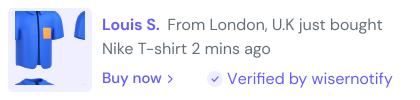
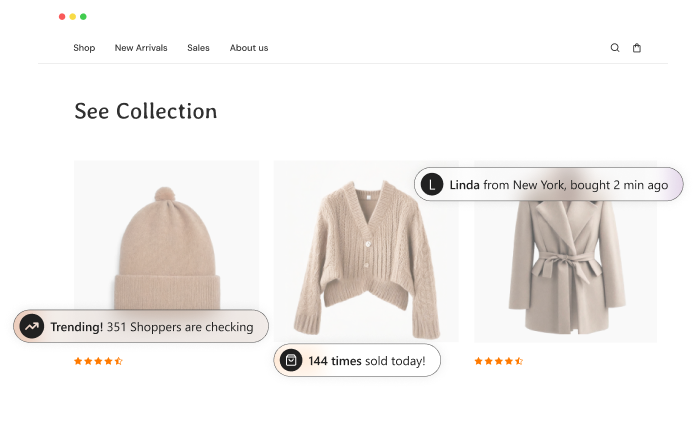
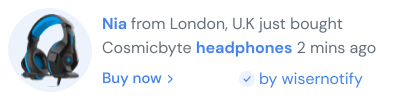
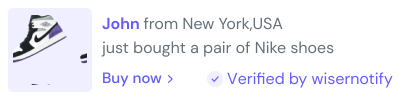
“Is this bundle actually worth it? Do people actually buy these together?” A pop-up showing “Emma from Toronto just bought the Complete Skincare Kit – 6 minutes ago” answers both questions simultaneously.
Someone else made this exact decision, and they made it recently.
What separates this from a generic trust badge is the specificity. WiserNotify pulls real order data from your store – the actual bundle name, real customer first name, real city, real timestamp.
Shoppers have learned to ignore vague social proof. Real transaction data from real people is a completely different signal.
You can configure which bundles trigger notifications, how frequently they fire, and whether they appear only after the shopper has spent 20+ seconds on the bundle page.
Announce your bundle deal across every page

Most stores hide their bundle offers on a dedicated bundles page that only shoppers who actively look for it will find.
A smarter approach is making the bundle deal visible everywhere – on product pages, category pages, and the cart – so shoppers discover the offer at whatever point they enter the site.
WiserNotify’s announcement bar puts your bundle promotion at the top of every page.
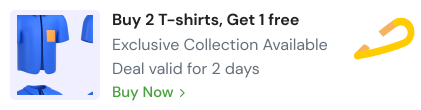
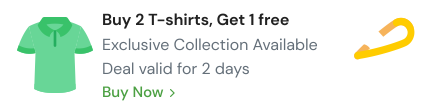
“Buy any 2 products, save 20%” shown persistently means a shopper who lands on a single product page immediately knows a bundle deal exists.
The bar can rotate through multiple messages, embed a live countdown for time-limited offers, and show different copy on the cart page versus the product page – so “Add one more to save 20%” appears when the shopper is closest to completing the bundle.
Create urgency around time-limited bundle pricing

Bundles are a natural fit for limited-time pricing because the savings logic makes the deadline feel legitimate.
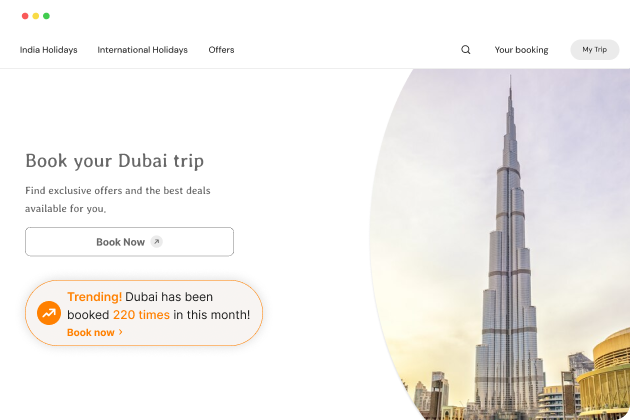
“This bundle price saves you $24 – offer ends in 3 hours” gives the shopper both a reason to act and a deadline to act by.
Without the deadline, the bundle is just a discount they can come back to later (and often don’t).
WiserNotify’s countdown timers can be set to trigger conditionally – only for shoppers who’ve been on the bundle page for 45+ seconds (the ones who are genuinely hesitating), only for first-time visitors, or only when a bundle is low in stock.
That targeting prevents urgency fatigue: returning customers who’ve already seen the timer don’t see it again, which keeps the signal credible.
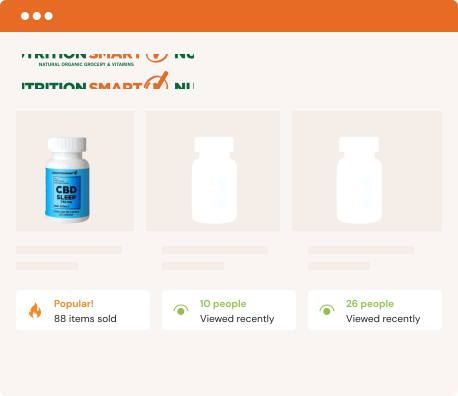
Show how many people are viewing the same bundle

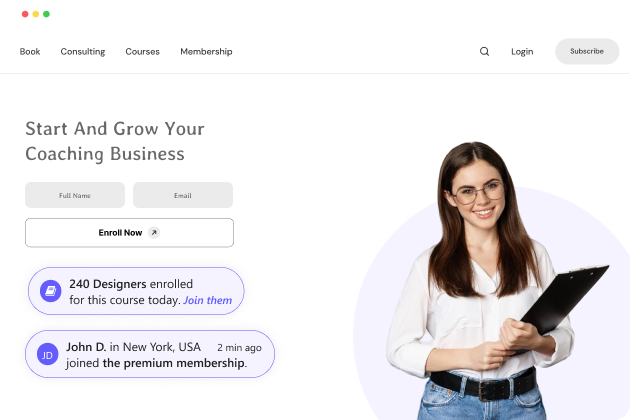
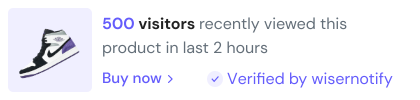
“28 people viewing this bundle right now” does something a discount can’t: it tells the shopper the bundle is worth viewing.
When other people are actively looking at the same product, it validates the shopper’s interest and adds competitive pressure without reducing the price.
WiserNotify’s live visitor counter updates in real time and can be scoped specifically to bundle product pages rather than the whole site – so the count is always relevant to what the shopper is looking at.
Inline social proof on the bundle page itself

Beyond floating popups, WiserNotify can embed social proof directly into the bundle page layout.
A counter showing “1,240 bundles sold this month” placed near the bundle price answers the implicit question every bundle shopper has: “Do people actually buy this?”
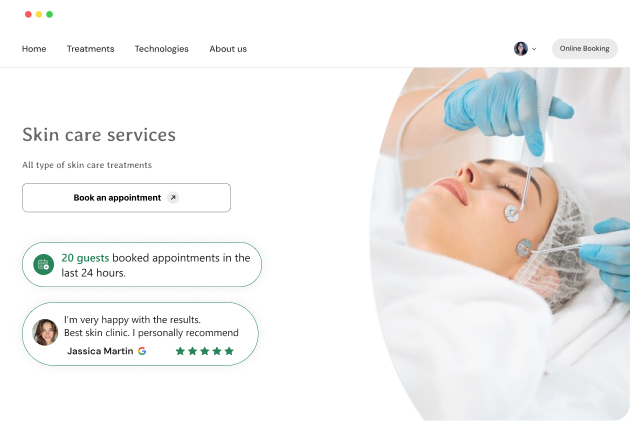
Inline purchase counters, star ratings pulled from your review platform, and stock level alerts all embed natively inside the page without interrupting the shopper’s scroll.
For bundle pages where the goal is to communicate value, native integration converts better than a pop-up they can dismiss.
A/B test which bundle offer converts best

Bundle strategy involves real decisions: does “Save $18” outperform “Save 20%”? Does urgency messaging increase bundle conversion or annoy loyal customers who’ve seen it before? Does social proof work better on the bundle product page or only at the cart stage?
WiserNotify’s A/B testing lets you run these experiments directly inside the dashboard without touching your store code.
You can compare two different notification messages on the same bundle page, measure conversion rates per variant, and see which specific combination – message, timing, trigger condition – produces the highest bundle completion rate.
The analytics track performance at the notification level, not just the page level, so you know exactly which signal drove the sale.
Design customization

A notification that looks like it was bolted on from a different tool destroys the trust it’s trying to build.
WiserNotify’s design customization lets every notification match your store’s visual identity exactly – fonts, colors, corner radius, position, and animation style all adapt to your brand without touching code.
For bundle pages specifically, this matters more than it does elsewhere. Bundle shoppers are already evaluating whether the combined purchase is worth it.
A notification that looks native to the page reinforces that your brand is polished and trustworthy. One that looks out of place raises the opposite question. Key settings you can configure per notification type:
- Position on screen: bottom-left, bottom-right, top-left, or top-right – place it where it doesn’t compete with your bundle CTA
- Color scheme: match your brand’s primary and accent colors so the notification reads as part of the page, not an overlay from another tool
- Display format: compact pill or expanded card with more room for product name and customer detail
- Animation style: slide in, fade, or pop – choose what fits your store’s motion language
- Mobile layout: notifications automatically reformat for smaller screens with adjustable sizing and positioning
- Custom CSS: override any element for precise brand matching without rebuilding from scratch
Timing rules

The wrong notification at the wrong moment is noise. The right notification at the right moment is a conversion.
Timing rules are what separate WiserNotify from a simple pop-up tool – you control exactly when each notification fires, for which visitors, and under what conditions.
For bundle pages, timing is especially critical because bundle shoppers go through a specific hesitation pattern: they arrive, see the combined price, pause, and calculate whether the savings justify buying two or three items at once.
That pause – typically 30 to 60 seconds into the page visit – is the highest-leverage moment for social proof.
Fire too early, and the shopper hasn’t formed a question yet. Fire too late and they’ve left. Timing rules you can set per notification:
- Page delay: trigger only after the shopper has spent a set number of seconds on the bundle page (30 seconds recommended for bundle-specific social proof)
- Session frequency cap: limit how many notifications a single visitor sees per session to prevent fatigue
- Visitor type targeting: show urgency timers only to first-time visitors, purchase counts to all visitors
- Scroll trigger: fire after the shopper has scrolled past the bundle price – they’ve engaged, now reinforce
- Exit intent: show a final notification when the cursor moves toward the browser tab – last chance before they leave
- Device targeting: configure separate timing for mobile versus desktop since mobile sessions tend to be shorter
Pricing

You can set up notifications on your bundle pages and measure the impact before spending anything.
All plans include the 7-day free trial. Start your free trial here – no credit card needed.
5 Product Bundle Best Practices That Actually Move the Needle

1. Make the savings specific and visible
Show the total price of individual items next to the bundle price on the same page. “Individual items: $87 | Bundle price: $69 | You save: $18” converts better than “20% off bundle.”
Dollar amounts are concrete; percentages require mental calculation. Every step of mental effort between the shopper and the decision costs conversions. Remove the math entirely by doing it for them.
2. Build bundles around problems, not products
The strongest bundles solve a specific problem rather than grouping similar items together. “Everything you need to start running” solves a problem.
“Running shoes and socks bundle” just groups items. The problem-framing identifies who the bundle is for and why they need it, which is more persuasive than a product list at a discount.
When you frame around the outcome, you filter in high-intent buyers and filter out browsers.
3. Place bundle offers at high-intent moments
Bundle promotions placed on product pages convert better than homepage banners.
Bundle suggestions at the cart stage convert better than both. The reason: purchase intent increases at each stage of the journey.
A shopper viewing a product page is more likely to add a bundle than a shopper browsing the homepage. A shopper reviewing their cart is even more likely. Put your bundle offers where intent is highest, not just where they’re most visible.
4. Use data to identify what actually gets bought together
The bundles that perform best are usually the ones where customers were already buying both products separately.
Your order history data will show you which products appear together in carts most frequently. Start there before getting creative.
A bundle of two products that 30% of customers already buy together will outperform an aspirational bundle of products that have never co-occurred in an order.
5. Name bundles for the customer, not the contents
The naming of a bundle does more conversion work than most brands realize.
“Starter Kit,” “Complete Set,” “The Weekend Kit,” “Date Night Bundle” – these names tell a story about who the bundle is for and when they’d use it.
That story makes the bundle relevant to the right shopper and irrelevant to everyone else, which is exactly what you want.
A bundle with a clear intended audience converts better than a generic grouping, even if the products are identical.
Also check: How to Improve the Online Shopping Experience
Conclusion
The 15 examples above cover a wide range of approaches – outfit bundles, mystery subscriptions, outcome-based tech kits, educational layering systems, and customer-built capsule wardrobes.
What they share is that every bundle has a clear logic that the shopper can understand immediately. The combination makes sense, the savings are visible, and the bundle is positioned around a need or outcome rather than just discounted inventory.
Start with your order data. Find the two or three product combinations that already appear together in real customer orders.
Build a bundle around those first. Then layer in social proof and urgency to show new shoppers what existing customers already know.
The bundle that sells itself is the one built from real purchase behavior, not from what you think should go together.