
How to Increase Beauty Product Sales Online (11 Ways)
Beauty is the hardest thing to sell online, because the one thing a buyer wants to do is the one thing they cannot. They cannot swatch it, smell it, or hold it against their skin.
So everything below is trying to do the same job. Close the gap between a photo on a screen and knowing it will suit them.
Here are eleven ways to do that, plus what to do with customer photos and how to promote skincare on social without sounding like an advert.
How to Increase Beauty Product Sales Online
Eleven ways, roughly in order of what they return.
1. Shade and skin type decide the sale
A foundation shot on one model does not help anybody else. What the shopper wants to know is whether it works on skin like theirs.
- Swatches on a range of skin tones, not one arm in studio lighting.
- Say who it suits, and who it does not. Oily, dry, sensitive, reactive.
- Show the finish. Matte, dewy and satin look identical in a product shot and nothing alike on a face.
- Give the shade a reference. “Similar to NC25” saves more returns than any description.
Our product description examples show how the good ones handle this.
2. The ingredient list is the spec sheet
Plenty of beauty shoppers go straight to the ingredients. Some are hunting for one thing. Others are checking it is not in there.
Put the full list where they can find it, name the actives and their percentages, and say plainly what it is free from. Fragrance-free, alcohol-free and non-comedogenic all get typed into search boxes by name.
3. Nobody wants to be the first buyer
Somebody about to put an unfamiliar cream on their face wants proof other people did it and were fine.
- Recent purchases, pulled from your own orders.
- Ratings beside the price, not at the bottom of the page.
- Reviews that say whose skin it was on. “Combination, no breakouts” does more than ten five-star ratings.
- Counts that mean something. “1,240 sold this month” beats a badge.
Our roundup of social proof examples has the formats, and the social proof statistics cover how far they move a decision.
Build trust & FOMO
Highlight real-time activities like reviews, sales & sign-ups.


4. Samples sell the full size
Few people will spend forty pounds to find out whether a serum breaks them out. Hand over a sample and that worry goes away.
Send one free with every order and let people buy trial sizes on their own. The follow-up email a fortnight later, asking how they got on, is where the full-size order comes from.
5. Returns are a selling point
Beauty gets returned more than almost anything else, and buyers know it. What they do not know is whether you will make it difficult.
Put the promise next to the buy button rather than in the footer. A policy nobody sees reassures nobody. It works for the same reason product reviews matter so much here.
6. Routines sell better than products
Somebody buying a cleanser is already wondering what goes with it. Answer that and they buy two more things.
Build the morning routine and the evening routine as sets with their own price. Say what order to use them in, because that is the part people get wrong and then blame the product for.
7. Repeat orders come built in
A moisturiser runs out. Nothing else in retail hands you a reason to get back in touch like that, and most shops let it go by.
Work out roughly how long each product lasts and email at that point. Offer a subscription with a proper saving and the ability to skip a month, because the thing that kills beauty subscriptions is a box arriving when the last one is still full.
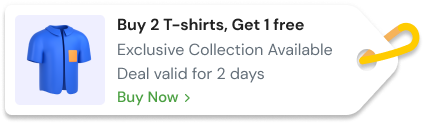
8. A deadline works when it is true
This industry runs on offers, which is exactly why buyers have learned to wait for the next one.
- A sale that ends on Friday, and does end on Friday.
- A gift with purchase while stocks last, when they do run out.
- An early window for the list, which gives people a reason to be on it.
Run offers constantly and you train everybody to hold out for twenty percent off. We have covered where the line sits in creating urgency in sales and in our discount strategies.
Build trust & FOMO
Highlight real-time activities like reviews, sales & sign-ups.
9. Checkout is where you lose them
Anyone who reaches your checkout wanted to buy. If they leave at that point, the checkout did it.
- Let people buy without an account. Making somebody set a password to buy a lip balm costs you orders.
- Take the wallet payments they already use.
- Show the delivery cost early. A number turning up at the last step feels like a trick.
The cart abandonment statistics put a figure on what each of those costs you.
10. Answer the awkward questions
Most beauty shoppers are quietly unsure about something. Whether it will react, whether they are too old for it, whether they are using it wrong.
A quiz that recommends by skin type, a live session with somebody who knows, or a short written answer. Handle a question in the open and you stop getting it in your inbox.
11. Search is where the buying starts
People search for the problem long before they search for a brand. Dark circles, dry patches, a foundation that lasts through a shift.
Write for those, then link to the product that answers it. A guide that ranks keeps bringing buyers for years. An advert stops the day you stop paying.
How to Boost Beauty Product Sales With UGC
A professionally lit model tells a shopper nothing about what the product does in a bathroom mirror on a Tuesday. Customer photos do a job in beauty that studio photography cannot, because the shopper is looking for somebody who looks like them.
- Ask at the right moment. A fortnight after delivery, once they have used it enough to have a view.
- Ask what their skin is like too. A photo on its own is just a nice picture. With “dry, forty-two” underneath, it proves something.
- Take them in ordinary light. A before-and-after shot under studio lighting persuades nobody.
- Put them on the product page, not a separate gallery nobody visits.
- Give people a reason. Loyalty points or entry to something, rather than a discount that makes the next order worth less.
- Get permission in writing, especially for faces. A screenshot of a comment is not permission.
- Reuse the good ones everywhere. Ads, email, the homepage. A customer photo in a paid ad usually beats the studio version.
The user generated content statistics show how far it carries, and there is more on the display side in visual reviews and collecting photo reviews.
How Brands Benefit From Honest Reviews
Letting unfiltered reviews through feels like a risk in a category built on promises. It pays back four ways.
Mixed reviews make the rest believable
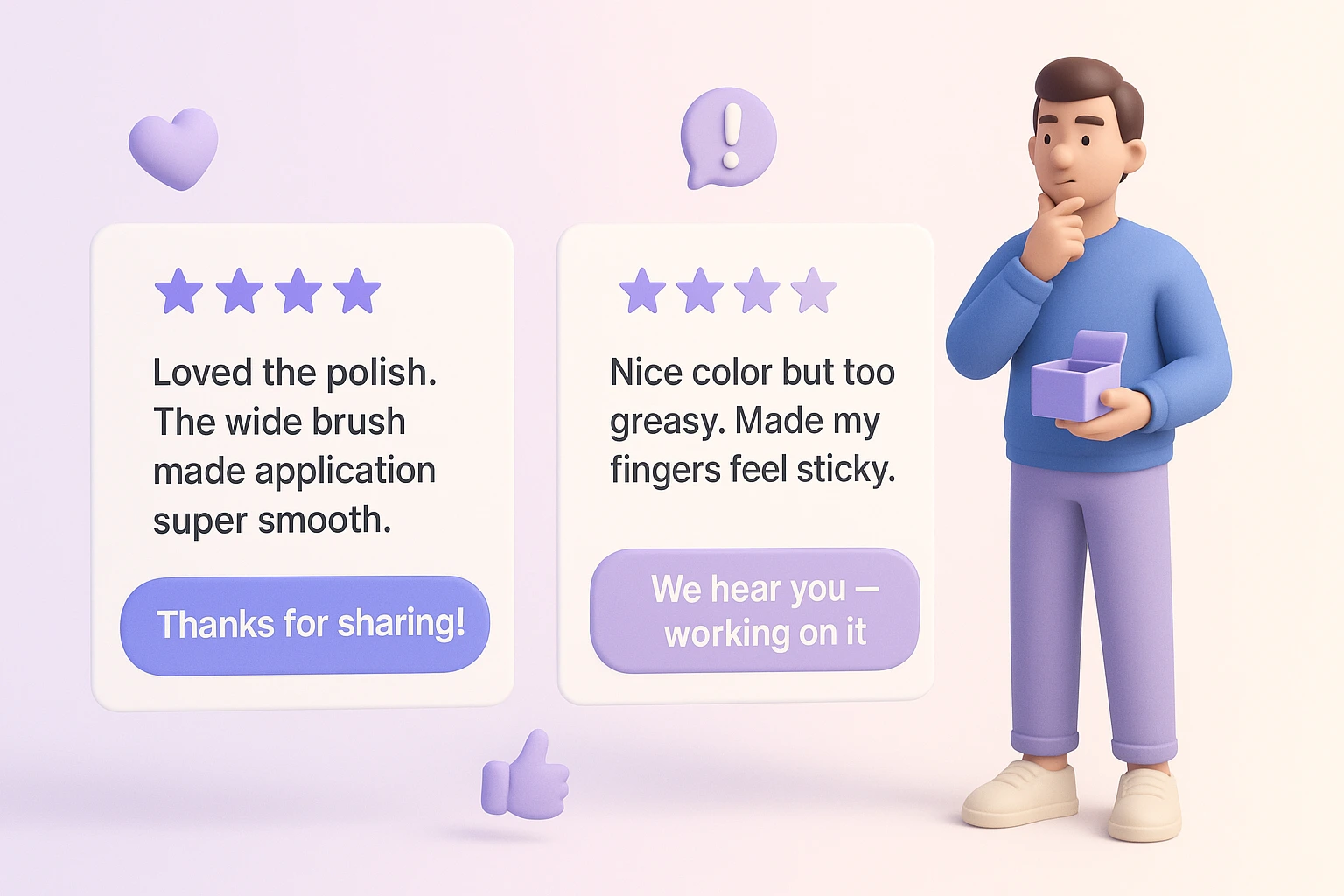
A page of five-star praise reads as filtered. A four-star review that says “nice colour but greasy” next to a five-star one makes both credible, and a reply to the critical one (“we hear you, working on it”) shows a brand that stands behind the product.
Feedback catches what the lab missed
Reviews surface what testing and marketing cannot: packaging that leaks, a reaction on sensitive skin, a texture that changed between batches, instructions nobody read. Brands that act on that in public, and say so, turn complainers into repeat buyers.
Real results are the strongest proof
A before-and-after on a customer’s own face, a video of the product going on, a review that names the skin type and the week the change showed. Put those on the product page, in ads and in email; they outperform studio shots because the shopper is looking for someone like them.
Featured customers keep posting
When a brand reposts a customer’s photo or quotes their review, that customer sends the next one, and their followers see it. Reviews bring trust, trust brings sales, sales bring more reviews. The section above on collecting UGC is how you start the loop.
Promoting Skincare Products on Social Media
Sell on social and skincare falls flat. Teach on it and the same product moves. The brands that grow are the ones answering questions, not posting product shots.
- Teach, then mention the product. How to layer actives, what not to use together, why something stings. The product belongs at the end.
- Show the same face over weeks. Skincare results are slow, and a series is more believable than a single transformation.
- Answer comments properly. The questions people ask under a post are the ones your product page should cover too.
- Use smaller creators. A word from somebody with ten thousand followers in your niche costs less and gets believed more.
- Put a link where the interest is. A story sticker to the product, not to your homepage.
- Keep the claims honest. Beauty advertising rules are strict, and a claim you cannot back is a bigger problem than a slow month.
Our guide to social proof marketing covers turning that attention into orders.
How WiserNotify Helps You Sell More Beauty Products
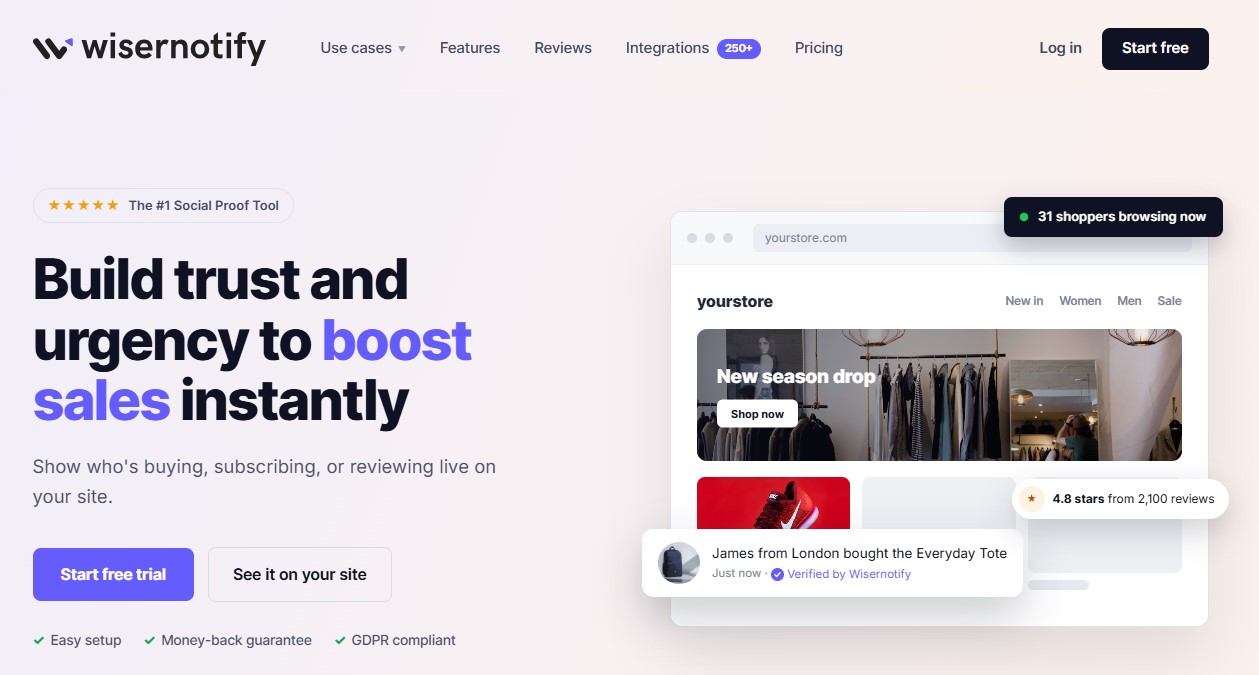
Everything above needs proof where the buyer is looking. Getting your real orders and ratings onto every product page, and keeping them right, is the part most shops never get to. So the page stays bare.
WiserNotify is a social proof tool that does that side for you.
- Purchase notifications. “Someone bought this 12 minutes ago”, straight from Shopify, WooCommerce or Wix.
- Live visitor notifications. How many people are looking now, with a floor so quiet days stay quiet.
- Recent activity counters. Units sold over a window you set, per product or per collection.
- Review notifications and the review feed widget. Your ratings next to the price, where the decision happens.
- Countdown timer widget and announcement bar. For a sale that does end, and for saying so across the site.
- Display and trigger rules. By page, device and whether they have visited before, so a returning shopper sees something different.
- A/B testing and reports. Impressions, clicks and hovers per notification, so you can tell which ones sell.
It all comes out of your own store through 250-plus integrations, so a quiet week looks like a quiet week.
Wrap Up
Swatch on real skin tones, put the ingredients where people can read them, and let somebody try before they commit. Those three deal with what stops most beauty orders.
After that it is customer photos and the repeat order, because a moisturiser running out is the cheapest sale you will ever make.
Also check: How to get more salon bookings online
Related Guides
- How to get more beauty reviews
- How to increase subscription sales
- Reducing shopping cart abandonment
- Online review statistics

Boost Conversion Instantly
Add Social Proof & Urgency to your website
Frequently Asked Questions
How can I attract more customers to my beauty ecommerce store?
Focus on content marketing, social media platforms, and influencer partnerships to drive traffic. Offering free samples and setting clear delivery expectations also helps.
What is the best way to build customer loyalty?
Use loyalty programs, personalized email campaigns, and social proof like positive reviews and UGC to keep customers engaged.
How do I use social proof effectively?
Incorporate customer testimonials, UGC, and expert endorsements across your website and social media.
Should I offer discounts to increase sales?
Yes, but pair discounts with cross-sell opportunities or limited-time offers to create urgency and maximize conversions.
What are some effective strategies for promoting beauty products?
Satisfaction guarantees, subscription boxes, influencer marketing, and workshops are powerful strategies to increase sales and build your beauty brand.

Krunal Vaghasiya is a marketing tech expert who boosts e-commerce conversion rates with automated social proof and FOMO strategies. He loves to keep posting insightful posts on online marketing software, marketing automations, and improving conversion rates.




 Capterra