
I pulled 45 fake review stats you can trust (2026)
 Krunal Vaghasiya|Mar 3, 2026
Here’s a number that changed how I think about social proof: fake reviews cost online consumers an estimated $770.7 billion worldwide in 2025. That’s not businesses. That’s shoppers, buying things they wouldn’t have bought if the star ratings had been honest.
I’ve been running WiserNotify for over five years, and fake reviews come up in almost every conversation I have with store owners. They want to show social proof on their site. But the moment buyers started catching on to AI-generated reviews, “5 stars” stopped carrying the weight it used to.
So I’ve pulled together 45 fake review statistics from platform enforcement reports. The goal’s simple: give you an honest picture of where things stand in 2026, and more usefully, what to do about it if you’re selling online.
Also check: 45 Online Review Statistics 2026: Consumer Trends & Data
Key Fake Review Statistics at a Glance
- Around 30% of all online reviews are estimated to be fake or inauthentic.
- 82% of consumers encountered at least one fake review in the past 12 months
- Fake reviews cost online consumers $770.7 billion worldwide in 2025
- Fake reviews cost U.S. businesses nearly $152 billion annually in lost revenue
- The FTC found that buying fake reviews generates a 1,900% ROI for businesses that do it
- Google blocked or removed 240 million policy-violating reviews in 2024
- Amazon spent over $500 million and hired 8,000 employees in one year to fight fakes
- 46% of identified fake reviews are 5-star ratings
- 85% of consumers suspect reviews are fake “sometimes or often.”
- The number of fake reviews is growing 12.1% faster than total online reviews
Let’s go through these sections.
All your reviews in one place
How Common Are Fake Reviews? (Latest 2026 Data)
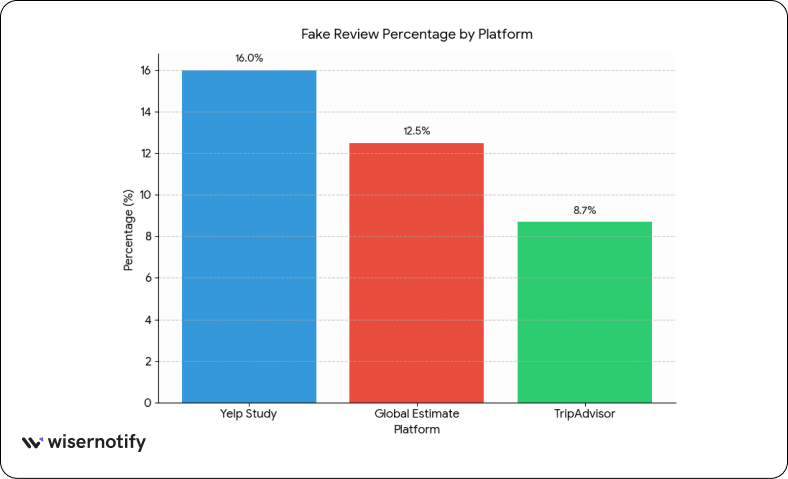
The scale of the problem is hard to grasp until you see the numbers side by side.
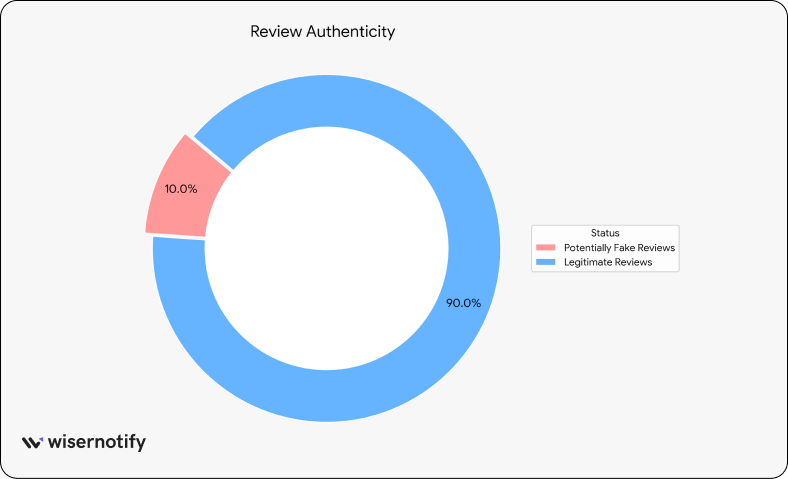
1. An average of 30% of online reviews are considered fake or inauthentic.
That’s nearly one in three reviews. It varies by platform, but 30%’s the working estimate across the industry.
2. On major websites, up to 43% of reviews are identified as suspicious.
These sites end up removing roughly 6.9% of reviews outright. The rest sit in flagged or hidden states, visible to moderators but not to shoppers.
3. The number of fake reviews is growing 12.1% faster than the total number of all online reviews.
This is the stat I’d pin to the wall if I ran review moderation. The problem isn’t stable. It’s accelerating faster than the authentic review supply can keep up with.
4. 82% of consumers say they encountered at least one fake review in the past 12 months.
Four in five shoppers. Fake reviews aren’t a fringe experience anymore; they’re the mainstream one.
5. 85% of consumers suspect reviews are fake “sometimes or often.”
Even people who can’t point to a specific fake are already skeptical. That skepticism’s the default mindset now, not the exception.
6. 67% of consumers are concerned about review fraud.
Two-thirds of potential buyers are actively worried about being deceived before they’ve even landed on your product page.
7. 92% of millennials (18 to 34) say they’ve encountered fake reviews, compared to 59% of consumers aged 55 and older.
Younger buyers are more exposed and more skeptical. They’re also the fastest-growing buyer demographic for most ecommerce stores.
8. 46% of identified fake reviews are 5-star ratings.
Nearly half of all detected fakes are perfect scores. When you see a product with an unusually heavy 5-star lean and no middle ratings, that’s the pattern worth a second look.
Also check: 27 Google Business Profile Statistics You Need to Know in 2026
The Financial Impact of Fake Reviews
The money moving through the fake review economy is staggering on both sides. Consumers lose. Honest businesses lose. Dishonest businesses cash in until they get caught.
9. Fake reviews cost online consumers worldwide an estimated $770.7 billion in 2025 in purchases they wouldn’t have made with accurate information.
By 2030, Capital One Shopping projects that the number will climb to $1.07 trillion.
10. The average consumer wastes $125 per year on products bought because of fake reviews.
On its own, $125 doesn’t feel dramatic. Multiply it across hundreds of millions of shoppers, and you’ve got the world’s most expensive marketing fraud.
11. Fake reviews cost U.S. businesses nearly $152 billion annually.
That’s lost revenue for honest stores undercut by competitors using fake ratings to inflate their rankings.
12. Negative fake reviews can cut a business’s revenue by up to 25%.
Competitor sabotage through fake 1-star reviews is real, documented, and increasingly common in local service categories. I’ve seen store owners lose a quarter of their monthly sales to coordinated attacks like this.
13. The FTC found a business purchasing fake reviews can generate a 1,900% return on investment.
This is why the problem persists even with tighter enforcement. The short-term math is obscene. Bad actors keep running the same play because it works until the fine lands.
14. Fake reviews boost product sales by 12.5% in the first two weeks after they go live.
The short-term spike is real. What most buyers of fake reviews never factor in: the long-term reputation damage and the legal risk that now comes with it.
15. One additional star on Yelp or Google can boost local business revenue by 5 to 9%.
This one, single-star lift, is the financial reason fake reviews won’t go away on their own. A restaurant gaming its way to one extra star can see 9% more revenue.
16. In a 5-star review system, one extra star can lift product demand by 38%.
The ROI math on fake reviews is exactly why they persist despite enforcement, fines, and reputational risk.
How Fake Reviews Affect Consumer Behavior
Even when shoppers can’t prove a review’s fake, the suspicion alone changes how they act.
This is the piece most business owners underestimate, and it’s the reason I care about this topic so much at WiserNotify.
When trust breaks, conversion breaks with it.
17. 54% of buyers say they won’t purchase a product if they believe the reviews are fake.
Suspicion alone kills the sale. You don’t need proof. The feeling of inauthenticity is enough to send a shopper to your competitor.
18. 94% of consumers have avoided a business after reading negative reviews.
Whether those negative reviews are real or planted by a competitor, the behavioral outcome is the same. The buyer leaves.
19. 83% of review readers say they’re very likely to avoid a business that has fake or compensated reviews.
The moment shoppers believe your reviews aren’t authentic, the damage to trust is nearly impossible to reverse.
20. 74% of consumers say they can’t always tell whether a review is genuine or fake.
Three-quarters of buyers are trying to make decisions with information they can’t verify. That’s the trust gap authentic social proof is supposed to close.
21. 62% of buyers have received a product that was significantly different from what the reviews described.
This is the real-world outcome of fake review pollution. People buy things that don’t match reality, then they stop trusting reviews in general.
22. 46% of customers are suspicious of reviews that read like AI-generated content.
This is a new 2026 signal. Buyers have developed an intuition for AI-written text, even when they can’t technically prove it. It’s making generic AI-generated fakes less effective.
23. 65% of consumers worldwide suspect companies aren’t actively addressing fake information.
Most of your buyers believe that businesses are either ignoring the fake-review problem or quietly benefiting from it. That’s the trust deficit you’re walking into every time a new visitor hits your product page.
Also check: 50+ Testimonial Statistics Every Marketer Must Know in 2026
Platform-by-Platform Fake Review Analysis
Every major platform handles fake reviews differently. Here’s where each one stands in 2026, pulled from their own enforcement reports and third-party research.
24. Google blocked or removed over 240 million policy-violating reviews in 2024.
That’s up from 170 million the year before. Google is scaling its enforcement fast.
25. Google also blocked or removed over 12 million fake business profiles in 2024.
It isn’t just individual fake reviews anymore. Entire fake business listings are now a documented tactic, and Google has placed posting restrictions on more than 900,000 accounts due to repeated violations.
26. Around 10.7% of Google reviews are estimated to be fake.
Google has the highest rate of fake reviews of any major platform, partly because it’s the largest and most commercially valuable. Fraud follows volume.
Amazon
27. Amazon blocked or removed over 275 million fake reviews in 2024.
That’s more than any other platform reports, though it reflects Amazon’s scale as much as its fraud rate.
28. Amazon spent over $500 million and hired 8,000 employees in a single year to combat fake reviews.
Half a billion dollars. That’s what it costs to keep review integrity functional at Amazon scale.
29. A Fakespot analysis found approximately 43% of reviews on Amazon’s bestselling products were unreliable or fabricated.
The top-selling categories attract the most fraud because the revenue stakes are highest. That 43% is far above Amazon’s publicly reported removal rate, suggesting plenty of fakes are getting past automated filters.
Yelp
30. Yelp removes an average of 9% of reviews from its pages and marks an additional 15% as suspicious.
Nearly a quarter of all Yelp reviews end up flagged or removed. That’s aggressive filtering by the platform’s own measure.
31. Yelp’s baseline fake review rate is approximately 7.1%.
Lower than Google and Amazon. Yelp’s audience skews toward high-intent local searchers, where fake reviews are harder to produce at scale.
TripAdvisor
32. TripAdvisor removed approximately 2.7 million reviews in 2024, or 8.71% of everything submitted that year.
The travel category is especially vulnerable because a single fake review can move a hotel’s ranking enough to swing bookings.
33. 93% of travelers make booking decisions based on reviews.
High stakes plus easy manipulation equals one of the most review-manipulated verticals on the internet.
Trustpilot
34. Trustpilot removed an estimated 4.5 million reviews in 2024, about 7.0% of all reviews on the platform.
For a platform built on review integrity, a 7% removal rate is a serious operational challenge.
35. 93% of Facebook users suspect fake reviews on the platform.
Facebook’s review trust problem is worse than any other major platform. Only 7% of users believe Facebook reviews are reliable, which is why Facebook’s been quietly de-emphasizing reviews across its product.
Also check: 48+ Facebook Reviews Statistics & Engagement Metrics (2026)
How Platforms Are Fighting Fake Reviews
Online platforms now treat review fraud as a serious threat to the product as a whole, not just a policy issue. The tools have evolved from keyword filters to behavioral graphs.
36. Machine learning systems analyzing 2.1 million product reviews in one UK study found that network patterns between reviewers were a stronger fraud signal than review text itself.
Text-based detection is mostly solved at this point. The frontier’s behavior, who’s connected to whom, how accounts coordinate, and where the posting spikes cluster. Platforms look at:
- Review timing patterns and posting velocity
- Reviewer account age and history
- Repeated generic phrases across unrelated reviews
- Reviewer-to-business relationships and IP patterns
- Device fingerprints tied to multiple “unique” accounts
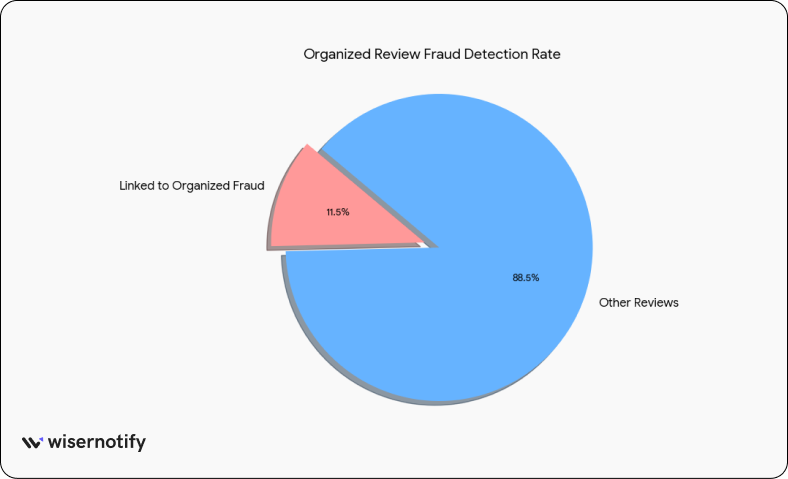
37. In a large app marketplace dataset, 11.5% of reviews were linked to organized crowdturfing activity.
That’s not scattered bad actors. It’s coordinated, paid review rings operating at scale.
38. One global travel platform reports that 8.87% of submitted reviews are removed for policy violations each year.
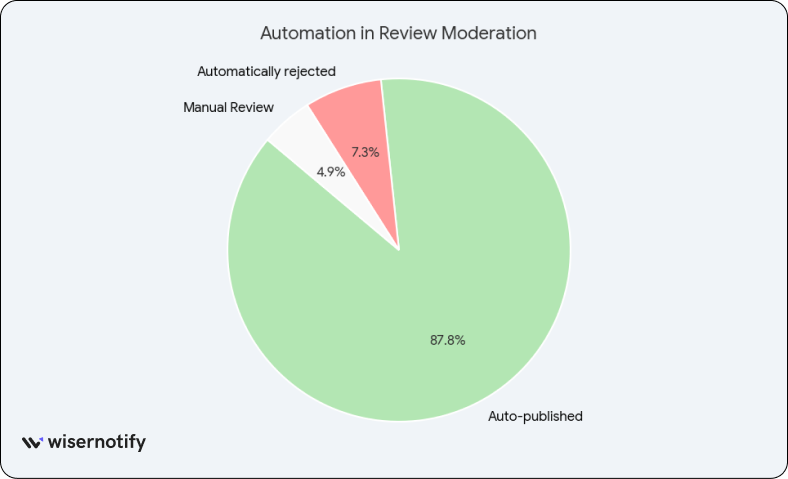
And another 7.3% get rejected automatically before they ever publish.
39. Around 22% of reviews on Yelp are marked as “not recommended” by automated filters.
Nearly a quarter of all incoming reviews get filtered before they appear. Whether that’s overkill or undershooting depends on who you ask.
40. The FTC cited approximately 700 businesses for fabricating endorsements and issued substantial fines.
U.S. enforcement against fake reviews escalated significantly in 2024 and 2025. Buying reviews isn’t a low-risk move anymore. The UK’s Competition and Markets Authority rolled out similar rules, making fake reviews a legal risk across multiple markets.
How to Spot Fake Reviews (Backed by Data)
Fake reviews follow patterns. When shoppers know what to look for, they can spot the obvious ones and raise their skepticism on the subtle ones.
The telltale signs
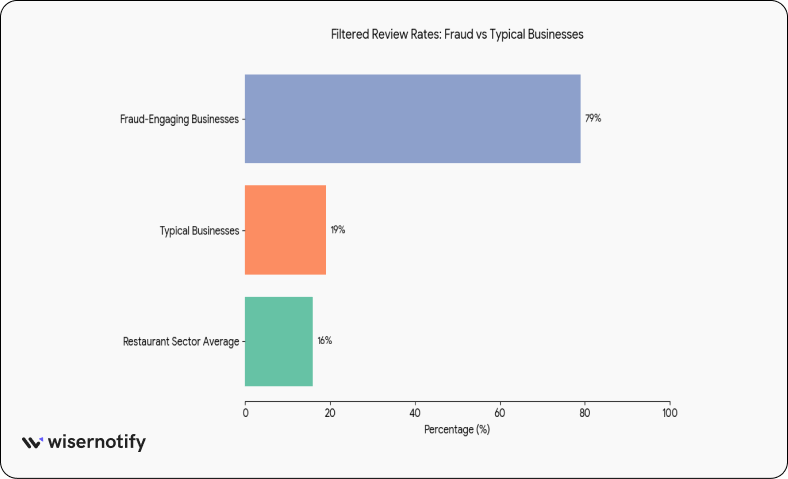
41. Businesses caught engaging in review fraud had 79% filtered reviews, compared to 19% for normal businesses.
That gap’s enormous. A legitimate business filters out roughly 1 in 5 reviews through normal platform moderation. A fraud-heavy business filters out 4 in 5.
42. In high-risk sectors like locksmith services, suspicious review rates reach 14.5%.
Fake review concentration isn’t random. It clusters in categories where one-time purchases, emergency decisions, and limited price comparison make ratings disproportionately influential.
43. Across large academic studies, fake review rates consistently fall between 8% and 16% by category.
This is the “floor” estimate. Even conservative methodologies find at least 1 in 12 reviews are fake in common product categories.
Healthy rating distributions include mixed feedback. When a product has mostly 5-star and 1-star ratings with almost nothing in between, that bimodal shape’s a warning sign. Real customers generate 2-star and 3-star reviews too, and a suspicious lack of them tells you something.
Quick red flags for shoppers
- Vague language with no purchase-specific detail
- Reviewer accounts with only one review
- Sudden bursts of similar reviews posted within days of each other
- Generic phrases that could fit any product (“great quality, fast shipping”)
- Unusual writing patterns, either too polished or oddly off
Tools like Fakespot analyze these patterns at scale. For individual products, a 30-second scan of the review distribution and the most recent 10 reviews will usually tell you if something feels off.
All your reviews in one place
The Future of Fake Reviews
Fake reviews are changing fast. Generative AI makes new fakes cheaper to produce, while AI-based detection and regulatory pressure make them more dangerous to run at scale.
AI-generated reviews and detection
44. A major travel platform reports 87.8% of reviews are now auto-published, with 7.3% rejected automatically before they go live.
Automated moderation’s doing most of the work now, because the submission volume is simply too high for human review alone.
As generative AI makes fake reviews sound more natural, platforms are leaning more heavily on behavioral signals, reviewer networks, and metadata rather than just on text analysis.
Shoppers are doing the same. The 46% who already suspect AI-written reviews are a meaningful early warning signal for every business relying on ratings.
Consumer education and skepticism
45. BrightLocal’s 2026 survey found consumers increasingly want harsher consequences for businesses caught manipulating reviews.
Public sentiment is shifting from passive frustration to active demand for accountability. That’s a meaningful change because “getting caught” now carries social consequences, not just legal ones.
What This Means for Your Business
Here’s the part most statistics posts skip. What do you actually do about this if you’re running an online store?
Fake reviews are a threat on two fronts. Competitors can plant fake positives to outrank you. Competitors can plant fake negatives to sink your conversions. The defense against both is almost identical.
I’d prioritize these five moves, in roughly this order.
➔ Build review volume that makes individual fakes irrelevant.
A store with 500 authentic reviews is much harder to damage with a handful of fake negatives than one with 20. Volume’s your best insulation against sabotage, and it’s the thing most store owners under-invest in.
➔ Respond to every review, including the obvious fakes.
A calm, professional response to a clearly fake 1-star tells real customers you take your reputation seriously. It also creates a paper trail if you escalate to the platform for removal later.
➔ Report suspicious reviews through the official process.
Every major platform has a reporting workflow. Use it consistently. Document patterns. If the same reviewer gives 1-star ratings to three unrelated businesses in your category, that’s worth flagging.
➔ Never buy reviews, no matter how good the math looks.
I know, the FTC’s 1,900% ROI stat is hard to unsee. But the downside, fines, platform bans, public exposure, and reputational collapse, is catastrophic. The enforcement environment in 2026 is much stricter than it was two years ago.
➔ Show visible authenticity markers everywhere you can.
Verified purchase badges, timestamps, reviewer location, and response history. 84% of Americans said they trust online reviews in a January 2026 Omnisend study, but that trust is conditional on authenticity signals they can actually see.
On your own site, this is where social proof notifications come in. Real-time signals such as recent purchase notifications, live visitor counts, and review displays provide shoppers with verification in the moment of doubt.
WiserNotify’s built for exactly this, turning authentic activity into visible proof, pulled from real orders, real reviews, and real signups. The free plan’s enough to try the approach without committing.
Key Takeaways
Fake reviews aren’t isolated incidents. Across studies, across platforms, and across categories, the data tells a consistent story. Review fraud is a systemic problem, and it’s growing faster than the supply of authentic reviews.
A few things I’d keep in mind:
1. For shoppers: Star ratings alone don’t work anymore. Read a handful of reviews. Check the distribution shape. Scan reviewer histories. Look for verified purchase markers. A 4.8-star product with 3,000 reviews and a realistic distribution is far more trustworthy than a 5.0-star product with 40 reviews, all glowing.
2. For businesses: You can’t control fake reviews. You can control whether you have enough real ones to outweigh them. Prioritize volume, respond publicly, and layer verified social proof everywhere it helps the buyer decide.
In a marketplace where roughly 1 in 3 reviews may be fake, the stores that win are the ones whose authenticity is visible, verifiable, and hard to fake. That’s the direction every serious review strategy has to head in 2026.
Also check: 45 Online Review Statistics 2026: Consumer Trends & Data
Conclusion
The 45 statistics in this post tell a consistent story. Fake reviews cost consumers hundreds of billions of dollars a year, damage honest businesses, and force platforms to spend hundreds of millions on detection.
But consumer trust in reviews hasn’t collapsed. BrightLocal’s 2026 data still shows that most consumers rely on reviews to guide their purchasing decisions. What’s changed is the bar for what “authentic” looks like. More volume. Verified markers. Recent timestamps. Honest responses to negatives. Visible review structure that both humans and AI-powered search tools can parse quickly.
The stores that win in 2026 aren’t the ones that game the review system. They’re the ones who build review profiles so genuine that fakes can’t touch them, and they back that authenticity with real-time social proof across their site.
If that’s the kind of trust signal you want to build on your store, WiserNotify‘s a good place to start. It surfaces real customer activity, real purchases, and real reviews in the exact places where shopper doubt shows up.
Source
Krunal Vaghasiya is a marketing tech expert who boosts e-commerce conversion rates with automated social proof and FOMO strategies. He loves to keep posting insightful posts on online marketing software, marketing automations, and improving conversion rates.




 Capterra