
How to Create Review Notifications (Step by Step)

Reviews only work if people see them, and most visitors never scroll far enough to find yours. A review notification is the small pop-up that puts one in front of them while they are still deciding.
This is the whole setup in WiserNotify, from signing up to seeing it live on your site. About fifteen minutes, no code needed.
What You Need Before You Start
You need reviews somewhere already. Google, Facebook, Capterra, Trustpilot, Yelp, Amazon, or a spreadsheet of what you have collected so far will all work.
WiserNotify connects to those platforms and displays the reviews on your site as notifications. It runs on any website through a single pixel, and there is no developer involved.
How to Create Review Notifications using WiserNotify
WiserNotify is a social proof marketing tool that pulls reviews from the platforms you already collect them on, then displays them on your site as notifications.
Seven steps, in order.
1. Create your account
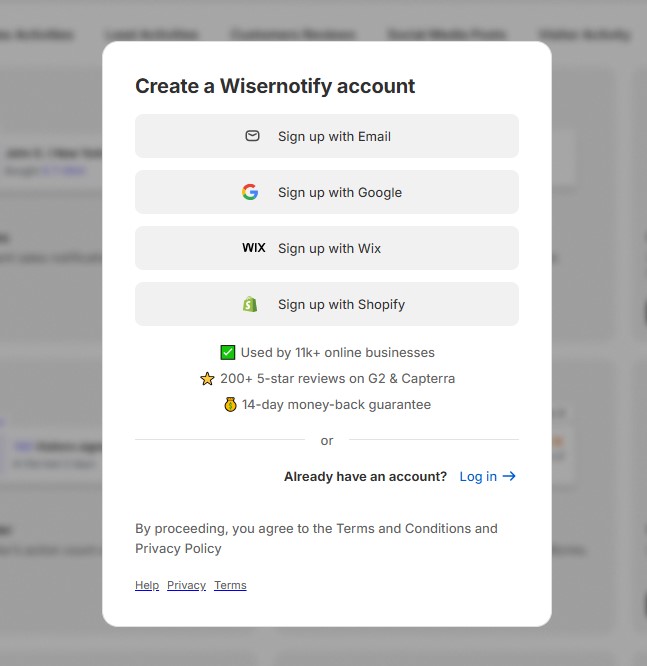
Go to the signup page and create an account. Name, email and password, or sign up with Google or Facebook.
2. Install the pixel
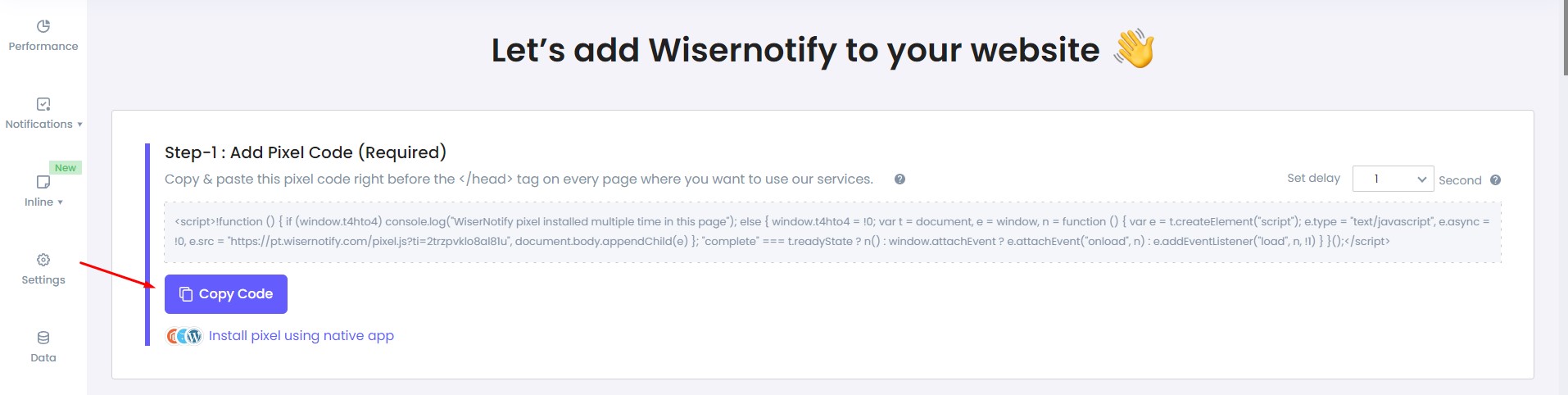
Do this before creating the notification. Your code is on the pixel page inside your account.
Click Copy Code and paste it into your website, or install the app if you are on Shopify or WooCommerce. On WordPress, the plugin does it for you.
3. Add the notification
From your social proof notification list, click + Add notification. You will see every notification type laid out as cards.

There are two review cards:
- Review. Real reviews with the reviewer’s photo, the rating and the review text.
- Review count. The total number of reviews with an average rating, from multiple platforms.
Click Add on the one you want. A box appears headed “Let’s create Review notification”. Enter a name, type your website URL and press enter to add it, then click Create & customize.
4. Design tab
The editor has three tabs across the top: Design, Display and Data source. A live preview sits on the right with mobile and desktop toggles.
The design tab has eight options down the left:
- Text editor. The wording, with fallback text and trimming.
- Click actions. Whether the notification is clickable and where it sends people.
- Position & animation. Separate settings for mobile and desktop, including animation style, display position and a compact mobile view.
- Style. Colours, fonts and size.
- Embed code. Place the notification inline in your own HTML instead of floating. Our guide to showing reviews on your website covers when that suits better.
- Data control. Which review data feeds the notification, including the rating and character filters.
- Timing control. Delay, display time and the gap between notifications.
- Verify label. The “Verified by wisernotify” label, its font and its link.
If your reviews have photographs attached, our guide to visual reviews and how to collect them is worth reading before you settle the design.
Click Next.
5. Display tab
Set where and to whom it shows.
- Select pages. All pages, or specific ones.
- Multiple websites. Add more than one domain.
- Advanced targeting. Country based targeting to show or hide by location, UTM based targeting, cookies and referrer.
Click Next.
6. Data source tab
Open the integrations panel and go to the Reviews category in the left menu.
Connect the platform you collect reviews on, or import from a CSV file if yours live somewhere without an integration. For Google specifically, our guide to automating Google reviews covers keeping the feed current, and this comparison of customer review platforms weighs up the sources themselves.
Once it is connected, tick its checkbox to activate it.
7. Publish and switch it on
Click Publish.
Then go back to your notification list and switch the toggle from Off to On. It is now live, so open one of the pages you targeted and check it.
Where to Show Review Notifications
The page you choose matters more than the design you picked. Some places earn their keep and some cost you the visit.
- Product pages. The obvious one and still the best. Pull reviews of that specific item where the integration allows it.
- The pricing page. Where hesitation lives, and usually the page with no review content of its own.
- Checkout. One quiet reminder that other people completed this. Leave click actions off, because anything leading away from that page costs you the order. There is more in our guide to increasing checkout conversion.
- Ad landing pages. Cold traffic has no reason to trust you yet, so this is where proof does the most work.
- Not the blog. An article reader is not a buyer, and interrupting them only costs you the read.
- Not login or account pages. Existing customers do not need convincing.
Our roundup of social proof statistics covers how much a rating moves a decision once it is in front of somebody, and why product reviews matter makes the wider case.
Build trust & FOMO
Highlight real-time activities like reviews, sales & sign-ups.


Mistakes to Avoid
A notification that feels invented does more damage than none at all, because somebody who suspects one thing starts suspecting everything.
- Made-up activity. Invented names and counts get spotted, and there is no coming back from it. Everything shown should come out of your own data.
- Running it site-wide. The same one following somebody from page to page stops registering after the second time.
- No character filter. Without it you will show ratings with no words attached, which say nothing to a visitor.
- Two on one page. They compete for attention and both get ignored.
- Ignoring the mobile preview. Position and animation are set separately for mobile, and covering the checkout button costs more than the notification wins.
- Set and forgotten. A feed that stopped updating months ago is worse than nothing at all.
The fake review stats show how many shoppers reckon they can spot an invented one, and these Google review response examples cover answering the bad ones.
If It Is Not Showing
Four things to check before assuming something is broken.
- Use a private window. Cache is the reason nine times out of ten, and your own browser is the worst place to test.
- Check the toggle is on. Publishing and switching on are two separate actions.
- Confirm the pixel is firing on that particular page, not just the homepage.
- Check the integration checkbox is ticked and the rating filter is not so high that nothing qualifies.
If it still will not appear, live chat inside your account will get to it faster than guessing.
After It Is Live
Most people set one up and never look at it again, which is where the value leaks away.
- Read the report after a fortnight. Impressions, clicks and hovers per notification. Turn off anything nobody touches.
- Test one thing at a time. Review against review count is the comparison worth running first.
- Add a second page once the first works. Pricing is usually the next one worth doing.
There are more formats worth borrowing in these social proof examples that seal the deal, and the online review stats put numbers on what a rating is worth.
Wrap Up
The seven steps above take about fifteen minutes end to end, and the two that decide whether it works are the display rules and the data control filters.
Get those wrong and you either annoy people or show them nothing. Get them right and the rest is design.
Also check: How to Add Google Reviews to Your Website
Related Guides
Frequently Asked Questions
Do I need a developer to set this up?
No. The pixel is one script you paste before the closing head tag, and the Shopify, WooCommerce and WordPress apps handle even that for you. Everything after installation is done in the dashboard.
Which review platforms can I connect?
Google, Facebook, Trustpilot and Capterra connect directly, along with a dozen more review platforms. If yours are somewhere without an integration, you can import them from a CSV file instead.
Why is my notification not showing?
Almost always cache, so check in a private window first. After that, confirm you toggled the notification on rather than only publishing it, check the pixel is firing on that specific page, and compare the page URL against the display rule you set, since a trailing slash or query string can put it outside the match.
How many notifications should I run on a page?
One. Two competing for attention on the same page gets both ignored. Get one working on your highest-intent page, read the report after a fortnight, then add a second page rather than a second notification.
How do I stop weak reviews being shown?
Set a minimum rating in the data source filters and hide any review with no written text, since a bare rating with no words says nothing to a visitor. Check what it looks like on a quiet week too, because an empty feed should show nothing rather than something from months ago.

Krunal Vaghasiya is a marketing tech expert who boosts e-commerce conversion rates with automated social proof and FOMO strategies. He loves to keep posting insightful posts on online marketing software, marketing automations, and improving conversion rates.




 Capterra