
I Tested 9 Poptin Alternatives for Popups (2026)
 Krunal Vaghasiya|Jul 23, 2025
I’ve tested most popup builders on the market. Poptin is one I keep coming back to because of its simplicity, but it’s also one I keep running into limits with.
The free plan caps at 1,000 visitors per month. That’s barely enough to test whether popups work for your site.
The paid plans jump to $25/month (10K visitors), $59/month (50K visitors), and $119/month (150K visitors). For a tool that only does popups and forms, that pricing adds up fast.
And here’s what really frustrates me: Poptin still doesn’t offer A/B testing on its lower plans. In 2026, that’s a dealbreaker. You can’t optimize what you can’t test.
I compared 9 popup builders that solve Poptin’s biggest limitations: better free plans, built-in A/B testing, more templates, and pricing that doesn’t punish you for getting more traffic.
Build urgency
Add floating offers with countdown timer & coupon code.


Quick Comparison: Poptin vs 9 Alternatives
Why Brands Switch from Poptin
Poptin is fine for getting started. But here’s where users consistently hit walls.
Visitor-Based Pricing Gets Expensive
Poptin charges based on monthly visitors, not popups or campaigns. A viral blog post or seasonal traffic spike can push you into a higher tier overnight.
The free plan (1,000 visitors) is barely functional. The Basic plan ($25/month) covers 10,000 visitors. Pro is $59/month for 50,000 visitors. Agency jumps to $119/month for 150,000 visitors.
Compare that to tools like OptiMonk, which offers a free plan for up to 15,000 pageviews, or Hello Bar, which includes unlimited popups on its free tier.
Only 12 Templates
Poptin ships with about 12 popup templates. That’s not a lot for 2026 standards.
OptiMonk offers 300+ templates. OptinMonster has 400+. Wisepops has 100+ purpose-built templates for different campaign types (lead capture, cart recovery, announcements, gamification).
If you want variety without designing from scratch, Poptin’s template library feels thin.
No A/B Testing on Lower Plans
A/B testing is how you figure out which headline, offer, or design converts best. Poptin restricts this to higher-tier plans.
Most competitors (OptiMonk, OptinMonster, Wisepops, Justuno) include A/B testing on all paid plans. Some even include it on free plans. Without it, you’re guessing.
Limited Popup Types
Poptin supports lightbox popups, slide-ins, full-screen overlays, and top/bottom bars. That’s solid, but competitors go further.
OptiMonk adds gamified spin-to-win wheels (which average 10.15% conversion rates), embedded content blocks, and surveys.
Wisepops offers advent calendars and Easter egg hunts for seasonal campaigns. Justuno has AI-powered product recommendation popups.
Support Response Times
Users on G2 and Trustpilot report 24-48 hour response times from Poptin support, even on paid plans.
There’s no 24/7 live chat. For teams running time-sensitive campaigns, waiting two days for a bug fix is costly.
Poptin Pricing (2026)
The visitor-based model is the core issue. If your site gets 60,000 visitors a month, you’re paying $59/month for a popup tool.
Alternatives like OptiMonk charge by pageviews (not visitors), and tools like Hello Bar offer unlimited popups on free plans.

Boost Conversion Instantly
Add Social Proof & Urgency to your website
9 Best Poptin Alternatives for Popups (2026)
1. OptinMonster

OptinMonster is the most popular Poptin alternative, and for good reason. It’s the popup tool I’d recommend for WordPress users and businesses that want the deepest targeting and testing capabilities.
What they do right: 400+ pre-designed templates across every popup type: lightbox, floating bar, slide-in, fullscreen, inline forms, and gamified spin wheels. The drag-and-drop builder is intuitive, and you can customize every pixel without touching code.
The targeting engine is where OptinMonster really sets itself apart from Poptin. Page-level targeting, exit-intent detection, scroll triggers, referral source targeting, device-based rules, and even OnSite Retargeting (showing different popups to returning visitors). A/B testing is included on all paid plans.
Their WordPress plugin is the best in the category. Native integration means faster load times and easier setup than any third-party popup tool.
Steal this: Their “MonsterLinks” feature. Turn any text link or button into a popup trigger. Instead of showing popups to everyone, you only show them to visitors who click a specific link. This feels less intrusive and converts better because the visitor opted in to seeing the popup.
What to know before choosing: OptinMonster is impression-based, not visitor-based. Plans start at $7/month (Basic, billed annually), but the features most people need (A/B testing, exit-intent) require the Pro plan at $29/month. It’s not the cheapest option, but the improvements in conversion rate usually justify the cost.
Pricing: From $7/month (Basic). Pro from $29/month.
Rating: 4.3/5
2. OptiMonk

OptiMonk is the Poptin alternative I’d pick for ecommerce stores that want AI-powered personalization, not just basic popups.
What they do right: OptiMonk’s free plan covers 15,000 pageviews per month. That’s 15x more than Poptin’s free plan. And it includes A/B testing, which Poptin locks behind its $59/month Pro plan.
The AI capabilities are genuinely useful. The Smart Personalizer automatically generates personalized headlines and copy based on visitor behavior. The AI-powered product recommendations show different products to different visitors based on their browsing history.
Gamified popups (spin-to-win wheels) convert at 10.15% on average, according to OptiMonk’s own data. That’s significantly higher than standard email capture forms.
300+ templates cover every use case: lead capture, cart abandonment, product recommendations, upsells, social proof, announcements, and more.
Steal this: Their “Smart Tags” feature. Personalize popup content dynamically based on the visitor’s location, referral source, or the product they were viewing. A popup that says “Hey, we noticed you were looking at running shoes” converts way better than a generic “Sign up for 10% off.”
What to know before choosing: OptiMonk’s AI features take time to set up properly. If you just want a simple popup with an email form, this platform has more complexity than you need. But if you want to squeeze maximum conversion from every visitor, OptiMonk gives you the tools to do it.
Pricing: Free plan (15K pageviews). Paid from $29/month.
Rating: 4.7/5
Build trust & FOMO
Highlight real-time activities like reviews, sales & sign-ups.

3. Privy

Privy is built specifically for ecommerce. If you’re on Shopify and want popups that tie directly into your email and SMS marketing, Privy is the simplest option.
What they do right: One-click Shopify integration. Privy syncs with your store’s product catalog, so you can show targeted popups based on what’s in the cart, what products someone browsed, or how much they’ve spent.
The popup builder includes spin-to-win wheels, cart savers, cross-sell popups, and free shipping bars. Everything is designed around ecommerce conversion. It doesn’t try to be a general-purpose lead generation tool. It focuses on getting more revenue from your existing store traffic.
Privy also includes built-in email and SMS marketing. You can capture an email with a popup and immediately put that subscriber into an automated welcome sequence. No Zapier connection or third-party email tool needed.
Steal this: Their “Cart Saver” popup. When a visitor tries to leave with items in their cart, Privy shows a personalized exit-intent popup with the actual products in their cart and a discount code. It’s more effective than a generic “Wait, don’t leave!” popup.
What to know before choosing: Privy is Shopify-first. If you’re on WordPress, WooCommerce, or a custom platform, other tools integrate better. Also, Privy’s pricing scales with the size of your email contact list, not your visitor count. At higher contact volumes, it can get expensive.
Pricing: Free plan available. Paid from $30/month.
Rating: 4.6/5
4. Justuno

Justuno is an AI-powered popup platform trusted by Shopify retailers that goes way beyond basic lead capture. If you need product recommendations, cross-sells, and personalized offers inside your popups, Justuno is the most advanced option.
What they do right: Justuno uses billions of data points to power intelligent pop-ups that adapt to each visitor. Exit offers show dynamically based on what the visitor was browsing. Upsell and cross-sell popups recommend products based on the contents of the cart. Abandoned cart recovery popups include the actual products left behind.
The targeting rules are the deepest I’ve seen. You can trigger popups based on UTM parameters, cart value thresholds, viewed product categories, number of visits, geographic location, and dozens of other signals.
A/B testing is built in across all plans. You can test headlines, images, offers, and entire popup designs against each other.
Steal this: Their AI product recommendation engine inside popups. Instead of showing a generic “Here are our bestsellers,” Justuno shows products personalized to each visitor based on their browsing behavior. This turns a popup from a lead capture tool into a revenue driver.
What to know before choosing: Justuno is more complex than Poptin. The setup takes longer, and the interface has a steeper learning curve. If you just need a simple email capture popup, Justuno is overkill. But for ecommerce stores spending $5K+/month on ads, the personalization pays for itself.
Pricing: Free plan available (limited). Paid from $29/month.
Rating: 4.5/5
Build trust & FOMO
Highlight real-time activities like reviews, sales & sign-ups.

5. Wisepops

Wisepops is the premium Poptin alternative for brands that want beautiful, conversion-optimized popups with the deepest gamification and AI features in the category.
What they do right: Wisepops has the most developed AI in the popup space. Predictive cart recovery triggers before a visitor even reaches the exit button. The product recommendation engine personalizes popup content per visitor automatically.
The gamification library is unmatched. Spin-to-win wheels, advent calendars, Easter egg hunts, scratch cards. These interactive formats consistently outperform standard exit popups on conversion rates.
190+ templates cover every campaign type. The drag-and-drop editor produces popups that genuinely look premium, not the “generic popup tool” aesthetic of cheaper tools.
Steal this: Their notification feed feature. Instead of showing intrusive popups, you can display a notification bell icon that, when clicked, reveals a feed of messages, offers, and updates. It feels native to the site experience rather than disruptive.
What to know before choosing: Wisepops starts at $55/month, making it one of the most expensive options on this list. For small blogs or early-stage sites, that’s hard to justify. But for established ecommerce brands that take conversion optimization seriously, the ROI is clear.
Pricing: From $55/month. 14-day free trial.
Rating: 4.7/5
6. Hello Bar
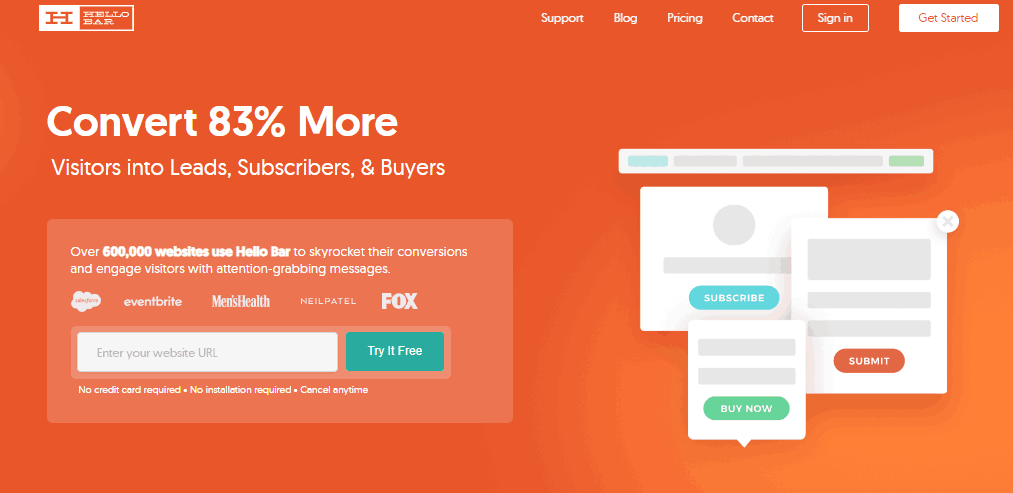
Hello Bar is the simplest Poptin alternative on this list. If you want a popup tool that takes 5 minutes to set up and just works, start here.
What they do right: Hello Bar’s free plan includes unlimited popups with no visitor cap. That alone makes it more generous than Poptin’s free tier. You get page takeovers, modals, sliders, alert bells, and the signature top-of-page notification bar.
Setup is genuinely fast. Enter your URL, Hello Bar scans your site, and suggests popup designs that match your branding. Pick a goal (collect emails, announce something, drive traffic), customize the design, and publish. The whole process takes under 5 minutes.
A/B testing is available on paid plans. The analytics dashboard shows views, clicks, and conversions for each popup without any extra setup.
Steal this: Their “Exit Intent” on the free plan. Most tools lock exit-intent behind paid tiers. Hello Bar gives it away, which makes it the best free option for reducing bounce rates.
What to know before choosing: Hello Bar is intentionally simple. It doesn’t have AI personalization, product recommendations, or advanced behavioral targeting. For complex ecommerce campaigns, you’ll need something more powerful. But for bloggers, small businesses, and anyone who just needs a working popup quickly, Hello Bar is perfect.
Pricing: Free plan (unlimited popups). Paid from $29/month.
Rating: 4.4/5
Build trust & FOMO
Highlight real-time activities like reviews, sales & sign-ups.

7. Sleeknote
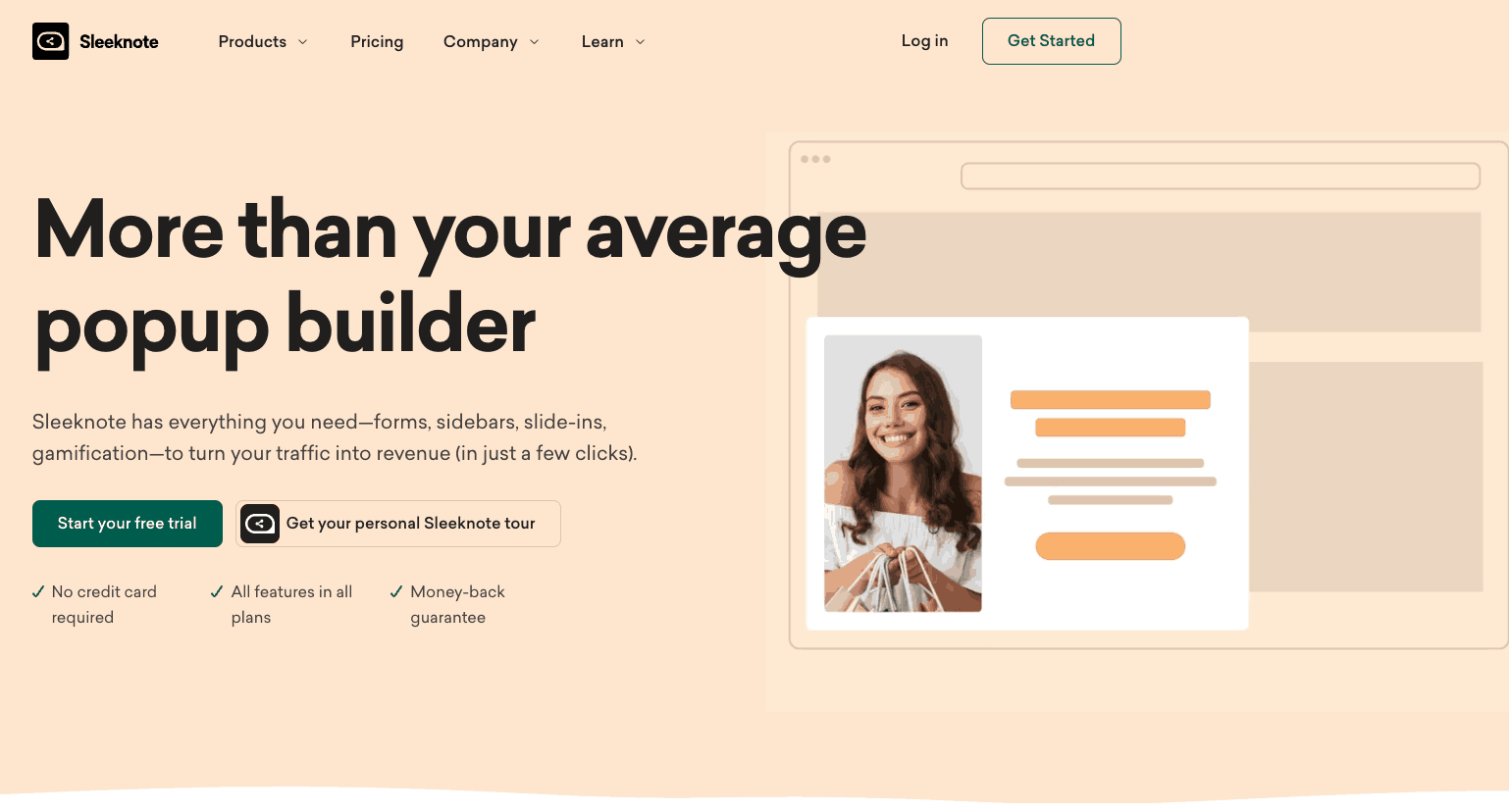
Sleeknote is the Poptin alternative for brands that want effective popups without annoying their visitors. Their whole philosophy is “non-intrusive” lead capture.
What they do right: Sleeknote’s popups are designed to feel like part of the page rather than interruptions. Slide-ins from the corner, embedded forms within content, and subtle bottom bars that don’t block the page. Google’s guidelines on intrusive interstitials? Sleeknote was built with those in mind.
The targeting is smart. You can show different popups based on traffic source, device, page URL, scroll depth, and even UTM parameters. The “Teaser” feature shows a small tab on the edge of the screen. Visitors click it if they’re interested. No forced interruption.
Their template library is well-organized by industry and goal. Ecommerce, SaaS, media, B2B. Each template is purpose-built, not a generic popup with different colors.
Steal this: Their position-based targeting. Show a sidebar popup on blog posts, a bottom bar on product pages, and a full-screen welcome mat on landing pages. Different formats for different contexts, all managed from one dashboard.
What to know before choosing: Sleeknote is on the expensive side. Plans start around $55/month. If you’re just getting started with popups and need something cheap, Hello Bar or OptiMonk’s free plan make more sense. Sleeknote is best for established brands that want premium popup experiences.
Pricing: From ~$55/month.
Rating: 4.6/5
8. Omnisend

Omnisend isn’t primarily a popup tool. It’s an email and SMS marketing platform that happens to include excellent popup builders. If you want popups AND email automation in one subscription, Omnisend eliminates the need for two separate tools.
What they do right: Popups, signup boxes, landing pages, and Wheel of Fortune gamification are all included. But the real value is what happens after someone signs up. Their email/SMS automation flows trigger immediately. Cart abandonment, welcome series, browse abandonment, and post-purchase follow-ups. All from the same platform that captured the lead.
For ecommerce brands on Shopify, this is a compelling all-in-one. Instead of paying for Poptin ($25-$119/month) plus an email tool ($30-$100+/month), Omnisend handles both.
The free plan includes popups, signup forms, and up to 500 emails/month to 250 contacts. Paid plans start at $16/month.
Steal this: Their pop-up-to-automation workflow. Capture an email with an exit-intent popup, automatically tag the subscriber based on which page they were on, and send a personalized welcome email within 60 seconds. The tight integration between popup and email makes this seamless.
What to know before choosing: If you already have an email marketing platform you love (Klaviyo, Mailchimp, ActiveCampaign), adding Omnisend just for popups doesn’t make sense. This is best for brands that want to consolidate their popup + email + SMS stack into one tool.
Pricing: Free plan available. Paid from $16/month.
Rating: 4.6/5
Build trust & FOMO
Highlight real-time activities like reviews, sales & sign-ups.

9. WiserNotify

I’ll be direct: WiserNotify isn’t a popup builder like Poptin. It’s a social proof notification platform. But it solves the same core problem (converting more visitors) through a completely different approach.
What they do right: Instead of interrupting visitors with popup forms, WiserNotify shows real-time activity on your site. “Mike from Denver just purchased this product.” “43 people are viewing this page right now.” “Sarah left a 5-star review 2 hours ago.”
These notifications build trust and create urgency without asking for anything. No form to fill out. No popup to close. Just subtle proof that other people trust your business.
Countdown timers, visitor counters, and low-stock alerts add FOMO without being aggressive. It integrates with 250+ platforms, including Shopify, WooCommerce, and WordPress.
Steal this: The combination strategy. Use a popup tool (OptiMonk, Hello Bar) for lead capture, and WiserNotify for background social proof on every page. The popup captures the email. WiserNotify builds trust, making visitors more likely to convert in the first place.
What to know before choosing: This doesn’t replace Poptin. You can’t create email capture forms or exit-intent popups with WiserNotify. It’s a complementary tool that works alongside your popup builder to boost overall conversion rates.
Pricing: Starts at $16/month.
Rating: 4.7/5
Build urgency
Add floating offers with countdown timer & coupon code.
Common Mistakes When Switching from Poptin
I see these happen repeatedly when brands move to a new popup tool.
#1: Not exporting your subscriber list first. Before canceling Poptin, export all your captured leads. Most popup tools don’t transfer data between platforms. Download your CSV and import it into your new tool or email platform.
#2: Picking a tool based on template count alone. 400 templates mean nothing if they’re all variations of the same basic popup. Look at template quality, not quantity. Test how customizable they actually are before committing.
#3: Ignoring page speed impact. Popup scripts add weight to your pages. Some tools (OptinMonster, Wisepops) load asynchronously and barely impact speed. Others can add 200-500ms to your load time. Test your Core Web Vitals before and after installing any popup tool.
#4: Not setting up A/B tests from day one. The first popup you create is almost never the best one. Set up an A/B test immediately: try two different headlines, two different offers, or two different designs. Let data decide what works.
#5: Showing the same popup to every visitor. New visitors need a different message than returning visitors. Mobile users need a different popup format than desktop users. Set up at least 2-3 targeting rules before going live.
How to Pick the Right Poptin Alternative
Here’s my framework after testing all of these tools.
WordPress site on a budget? OptinMonster. Best WordPress integration in the category, and the Basic plan at $7/month is cheaper than Poptin’s Basic.
Ecommerce store wanting AI personalization? OptiMonk. Free plan with 15K pageviews, AI product recommendations, and gamified popups that convert at 10%+.
Shopify store wanting popups + email in one tool? Privy or Omnisend. Both integrate deeply with Shopify and include email/SMS automation alongside popups.
Need the most advanced targeting and product recommendations? Justuno. Built for data-driven ecommerce teams that want to personalize every touchpoint.
Want premium popups with gamification? Wisepops. Spin wheels, advent calendars, scratch cards. The highest-quality gamified popup experiences available.
Just need something simple and free? Hello Bar. Unlimited popups, exit-intent on the free plan, 5-minute setup. Can’t beat it for getting started.
Want non-intrusive, Google-friendly popups? Sleeknote. Built specifically to convert without annoying visitors or hurting your SEO.
Want to boost conversions without any popups at all? WiserNotify. Social proof notifications build trust and urgency without interrupting the browsing experience.
Boost Conversion Instantly
Add Social Proof & Urgency to your website
Conclusion
Poptin is a decent starter popup tool. But its 1,000-visitor free plan, lack of A/B testing on lower tiers, limited templates, and visitor-based pricing make it hard to grow with.
If I had to pick just one alternative, I’d go with OptiMonk for ecommerce (free plan with 15K pageviews and AI personalization) or OptinMonster for WordPress (best native integration and targeting depth).
But the smart move is to test 2-3 options using their free plans. Every popup tool on this list offers a free tier or trial. Set up the same popup on your site using two different tools, run them for a week each, and compare conversion rates.
The best popup tool isn’t the one with the most features. It’s the one that gets the most signups on YOUR site, with YOUR audience. Test and let the data decide.
Krunal Vaghasiya is a marketing tech expert who boosts e-commerce conversion rates with automated social proof and FOMO strategies. He loves to keep posting insightful posts on online marketing software, marketing automations, and improving conversion rates.




 Capterra