



Online reviews play a big role in how consumers choose businesses, products, and services.
Whether someone is looking for a local restaurant, a healthcare provider, or shopping at an online store, they usually read online reviews before making a purchase.
Today, online customer reviews influence buying decisions almost as much as personal recommendations. Platforms like Google reviews, Amazon reviews, and Yelp reviews shape a business’s online reputation, search visibility, and sales.
In this guide, we’ll look at the latest online review statistics, growth trends, fake review data, and what they mean for businesses.
Key Online Review Statistics
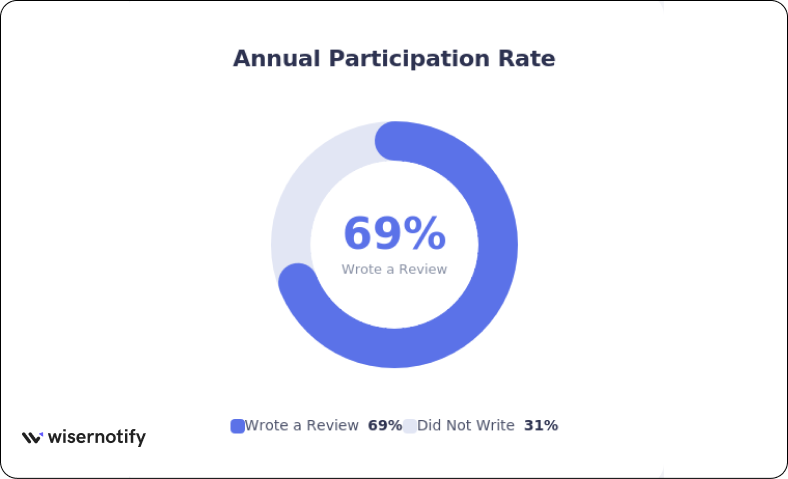
69% of consumers wrote at least one business review in the past 12 months
The average consumer writes 4–6 reviews
20% of consumers wrote more than 10 reviews
45% of consumers leave local business reviews on Google
Yelp grew from 121M reviews to 330M reviews
Trustpilot surpassed 320M cumulative reviews
TripAdvisor reported 31.1M annual review submissions
65.8% of Tripadvisor reviews are 5-star ratings
Google removed or blocked 240M policy-violating reviews
89% of consumers expect businesses to respond to reviews
How Many People Write Online Reviews?
Online reviews are now part of everyday consumer behavior. Most internet users have either written or read reviews before making purchasing decisions.
Let’s look at how often consumers contribute reviews and what that means for businesses.
Annual Review Writing Behavior
Most consumers actively participate in online review platforms, but the level of activity varies.
1. 69% of consumers wrote an online review in the past 12 months.
This shows that the majority of consumers regularly engage with review sites.
2. The average consumer writes 4–6 reviews per year.
However, review writing is not evenly distributed.
3. 47% of consumers write six or fewer reviews annually.
4. 20% write more than 10 reviews per year.
5. 7% write more than 50 reviews annually.
This means a small group of highly active reviewers can strongly influence a business’s average star rating and online reputation.
The Power of Asking for Reviews
Many consumers are willing to leave feedback, especially when businesses ask.
6. 78% of consumers were asked to write a review in the past year.
7. 65% of those asked actually wrote one.
This proves that review generation is often about process, not persuasion.
Businesses that actively manage review requests through email, SMS, or point-of-sale prompts gain more reviews than those that wait for customers to act on their own.
Also Read: 37 Ultimate List of Video Testimonial Statistics for 2026
Online Review Growth by Major Platforms
Online review platforms continue to grow as more consumers read online reviews before making purchasing decisions.
From local business reviews to online product reviews, review platforms now play a key role in brand research, online reputation, and buying decisions.
Below is a closer look at how major review sites are expanding.
Yelp Statistics
Yelp remains one of the most popular online review platforms for local businesses, restaurants, service providers, and healthcare providers.
Many prospective customers check Yelp reviews before choosing a business.
8. Yelp grew from 121 million cumulative reviews to 330 million.
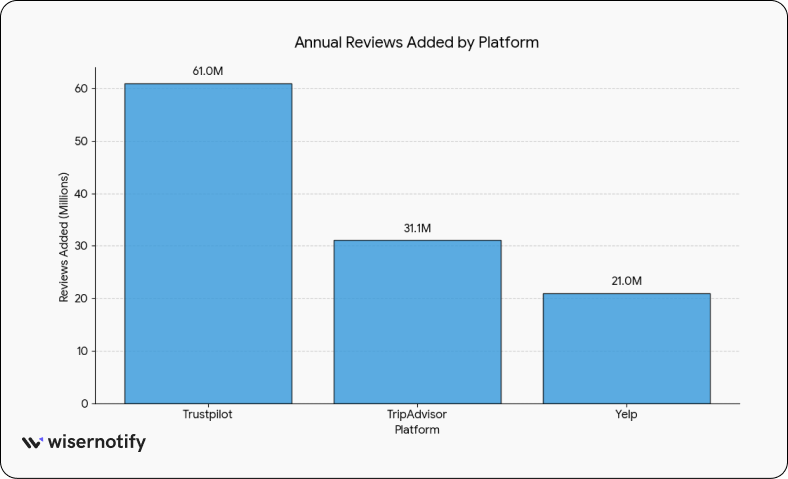
9. Yelp added 21 million new reviews in one year.
More reviews increase visibility and strengthen a business’s online reputation.
For local businesses, maintaining positive reviews on Yelp can directly impact purchase likelihood and new clients.
Trustpilot Statistics
Trustpilot is widely used for online business reviews, especially among online retailers and service brands.
It plays a major role in online shopping and trust reviews.
10. Trustpilot grew from 167 million cumulative reviews to over 320 million reviews.
11. More than 61 million reviews were written on Trustpilot in one year.
As more consumers turn to online customer reviews, maintaining a positive online reputation on platforms like Trustpilot can boost sales and influence purchasing decisions.
Tripadvisor Statistics
TripAdvisor is a leading review site in travel and hospitality.
Consumers read reviews before booking hotels, restaurants, and experiences.
12. TripAdvisor recorded 31.1 million review submissions in one year.
In high-commitment purchases like travel, online ratings and the number of reviews strongly influence buying decisions.

All your reviews in one place
Collect reviews, manage every response, and display them where they matter most.
Where Consumers Leave Reviews (Platform Share)
Consumers rarely rely on just one review platform.
Before making a purchase, many consumers read online reviews across multiple review sites to compare ratings, number of reviews, and overall customer feedback.
From local business reviews to online product reviews, review platforms influence purchasing decisions at every stage of the buyer journey.
Local Business Platforms
When it comes to local businesses, Google reviews dominate.
Because Google is deeply connected to search engines and maps, it plays a major role in how prospective customers discover and evaluate businesses.
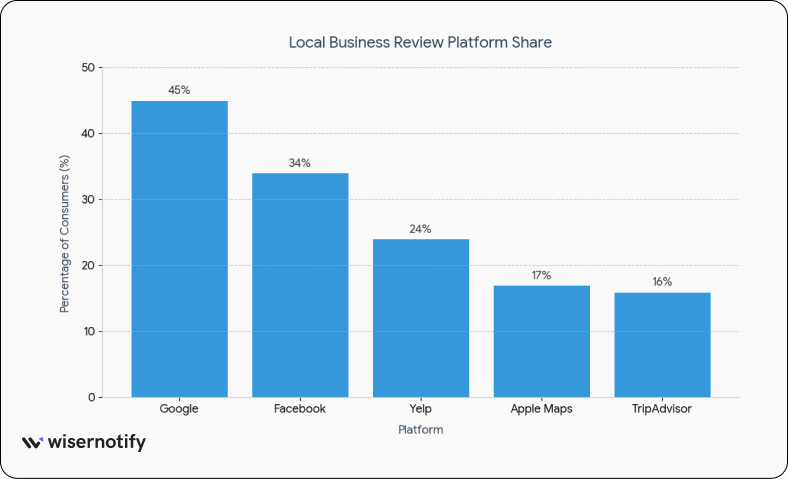
13. 45% of consumers leave local business reviews on Google.
14. 34% leave reviews on Facebook.
15. 24% leave Yelp reviews.
16. 17% leave reviews on Apple Maps.
17. 16% leave reviews on TripAdvisor.
18. 83% of consumers use Google to find local business reviews.
Because consumers check online reviews directly in search engines, Google-based reviews strongly impact online reputation and local rankings.
Many consumers also compare reviews across social media platforms and the Better Business Bureau when researching a business.
Ecommerce & Product Reviews
In online shopping, online product reviews are often the final deciding factor before making a purchase.
Consumers read reviews to evaluate product quality, customer experience, and average star rating.
19. 94% of shoppers read Amazon reviews.
20. 91% read reviews on retailer websites.
21. 70% use search engines during brand research.
This shows that online retailers depend heavily on customer reviews to boost sales and increase purchase likelihood.
The number of reviews and overall online ratings often influence consumers purchasing decisions more than product descriptions alone.
B2B Software Review Platforms
In B2B markets, reviews also influence buying decisions, especially for high-value software and service purchases.
Decision-makers use review platforms to compare vendors, assess product performance, and reduce risk.
22. G2 hosts over 3 million software reviews.
23. Capterra has over 2.5 million verified reviews.
24. Gartner Peer Insights reports 820,000+ verified ratings and reviews.
25. TrustRadius reports 500,000+ reviews and ratings.
For B2B businesses, online business reviews influence pipeline growth, vendor trust, and long-term contracts.
In many cases, consumers read reviews as much as they rely on personal recommendations when making purchasing decisions.
Online Review Ratings & Sentiment Trends
Online ratings strongly influence purchasing decisions.
When consumers read online reviews, they usually check the average star rating, number of reviews, and overall tone of customer feedback.
Are Reviews Mostly Positive?
26. 65.8% of Tripadvisor reviews are 5-star ratings.
27. 7.2% are 1-star ratings.
28. The average star rating is 4.30 out of 5.
Consumers are also more likely to post positive reviews than negative reviews:
29. 60% are more likely to share positive experiences.
30. 29% are more likely to share negative feedback.
While positive online reviews dominate, negative reviews still affect online reputation.
Many consumers read both before making a purchase to better understand the full customer experience.
Fake Review Statistics & Moderation Data
Fake reviews remain a major concern across online review platforms.
As more consumers trust online reviews when making purchasing decisions, platforms are increasing enforcement to protect online reputation and review credibility.
Google Enforcement Data
Google actively monitors and removes fake or policy-violating content from Google reviews.
31. 240 million policy-violating reviews were blocked or removed in one year.
32. 170 million were blocked or removed the year prior.
These include spam, fake or compensated reviews, and other violations.
Strong moderation helps maintain trust in Google-based reviews and search engine results.
Platform-Reported Fake Review Rates
Other review sites also publish fraud data to improve transparency.
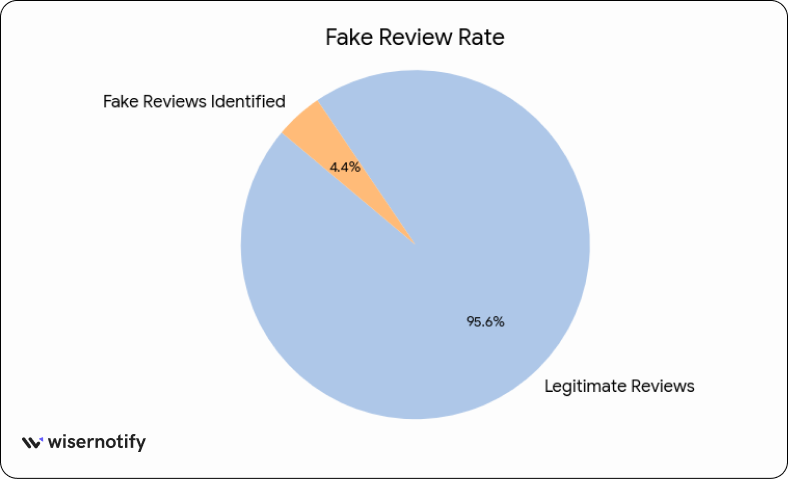
33. 4.4% of Tripadvisor submissions were identified as fake.
34. 72% of fake Tripadvisor reviews were caught before posting.
35. 7.4% of Trustpilot submitted reviews were removed as fake.
Because consumers read reviews before making a purchase, strong moderation is essential.
Trust reviews and customer reviews only influence buying decisions when people believe they are genuine.
Review Response Statistics & Benchmarks
Today, online reputation is not just about collecting reviews — it’s about responding to them.
Consumers expect businesses to actively manage online business reviews and engage with customer feedback.
Consumer Expectations
Consumers expect brands to respond, especially when they leave reviews about their customer experience.
36. 89% of consumers expect a response to their review.
37. 51% expect a response within one day.
Fast responses are becoming part of the standard customer experience.
When businesses reply quickly to both positive reviews and negative feedback, it increases trust and improves purchase likelihood among prospective customers.
Business Performance Benchmarks
Despite rising expectations, many businesses fall behind.
38. The average response rate benchmark is around 56%.
39. The average response time is about 4 days.
This gap between consumer expectations and actual performance can hurt online reputation.
All your reviews in one place
Collect reviews, manage every response, and display them where they matter most.
Demographics & Device Trends
Review behavior is not the same across all internet users. Age group and device type both influence how consumers read online reviews and write customer reviews.
Age-Based Review Behavior
Younger consumers are more active on review platforms and social media platforms, while older age groups participate less frequently.
40. 80% of consumers aged 18–34 have written online reviews.
41. 41% of consumers over 55 have written reviews.
Younger American consumers are more likely to read reviews, leave feedback, and use review sites during brand research and purchasing decisions.
Mobile vs Desktop Review Submissions
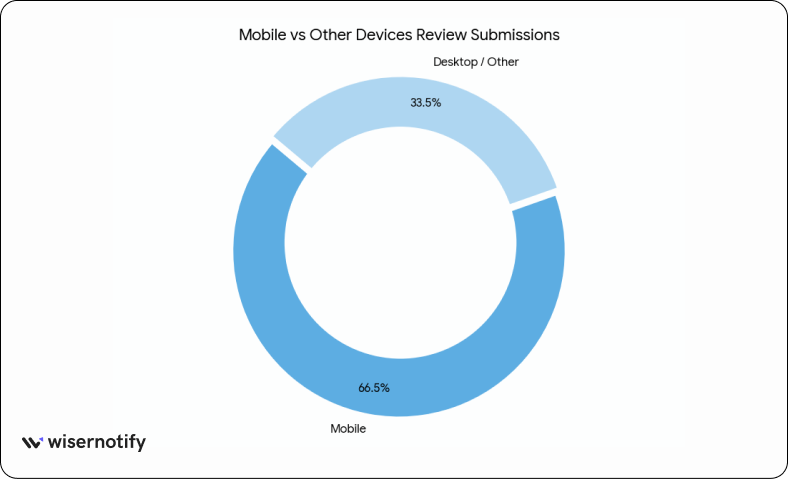
Device usage also shapes how reviews are submitted. Many consumers now rely on mobile devices during online shopping and while visiting local businesses.
42. 66.5% of reviews on Booking.com were submitted via mobile.
43. 31.8% of reviews on Tripadvisor were submitted via mobile.
Mobile behavior varies by platform, but the trend shows that online customer reviews are increasingly tied to on-the-go consumer behavior and digital customer experience.
Also Read: 50+ Testimonial Statistics Every Marketer Must Know in 2026
Do Online Reviews Impact SEO & Sales?
Online reviews do more than build online reputation; they directly affect search visibility and purchasing decisions.
For many consumers, reading online reviews is part of the final step before making a purchase.
Reviews & Local Rankings
Reviews influence how local businesses appear in search engines.
Google states that more reviews and positive ratings can help local ranking
This means Google reviews and overall online ratings contribute to visibility. Businesses with more reviews and a strong average star rating are more likely to appear higher in local search results.
For local businesses, this creates a simple growth cycle:
More reviews → better visibility → more prospective customers → more new clients.
Reviews & Conversion Rates
Online customer reviews also impact sales and purchase likelihood, especially in online shopping.
44. Displaying reviews increased conversion rates by 190% for lower-priced products.
45. Displaying reviews increased conversion rates by 380% for higher-priced products.
This shows that consumers’ purchasing decisions are strongly influenced by customer reviews.
Key Takeaways for Businesses
Online reviews directly impact online reputation, search visibility, and purchasing decisions.
Whether consumers are checking Google reviews, Yelp reviews, or Amazon reviews, reviews influence trust and buying behavior.
Key points to remember:
- Consumers read online reviews before making a purchase. Customer reviews influence buying decisions as much as personal recommendations.
- More reviews improve visibility. A higher number of reviews and a strong average star rating help local businesses rank better in search engines.
- Positive reviews boost sales. Positive online reviews increase purchase likelihood, especially in online shopping.
- Negative feedback should be managed. Responding quickly improves customer experience and builds trust with prospective customers.
- Authenticity matters. Avoid fake or compensated reviews and focus on genuine customer feedback.
Businesses that actively manage reviews attract more new clients and build a stronger online reputation.
All your reviews in one place
Collect reviews, manage every response, and display them where they matter most.
Conclusion
Online reviews strongly influence purchasing decisions. Most consumers read online reviews before choosing a product, service, or local business.
Positive reviews boost sales and improve visibility in search engines, while negative feedback and fake reviews can hurt online reputation if ignored.
Consumers also expect businesses to respond quickly.
Businesses that actively manage customer reviews, protect trust, and build a positive online reputation are more likely to attract new clients and grow consistently.


