
I Tested 9 Bonjoro Alternatives (2026)

I’ve tested and compared more Bonjoro alternatives than I’d like to admit.
Here’s what I kept finding: most “alternatives” lists just dump tool names with a screenshot and a price.
That’s not helpful when you’re trying to figure out which platform actually fits your workflow, your budget, and the way your team records video.
Bonjoro does two things: personalized video messaging and video testimonial collection. It’s solid at both. But it’s not the only option, and depending on what you actually need, it might not even be the best one.
I looked at nine tools that genuinely replace Bonjoro for different use cases. Below, I break down each one honestly, including where they fall short.
Quick Comparison: Bonjoro Alternatives at a Glance
| Tool | Best For | Starting Price | Free Plan | Rating |
|---|---|---|---|---|
| WiserReview | Video testimonials, review management | $9/mo | Yes | 4.8/5 |
| Loom | Async team comms, demos | $12.50/user/mo | Yes | 4.7/5 |
| Vidyard | Sales teams, AI video at scale | $59/user/mo | Yes | 4.6/5 |
| BombBomb | Real estate, email-first teams | $33/mo | No | 4.5/5 |
| Dubb | Sales teams with CRM workflows | $59/mo | Yes (limited) | 4.6/5 |
| Hippo Video | Personalized video at scale | $20/user/mo | Yes | 4.6/5 |
| SendSpark | Cold outreach, personalization | $45/mo | Yes | 4.7/5 |
| Tella | Creators, polished async video | $19/mo | Yes | 4.5/5 |
| Covideo | Enterprise sales, SMS delivery | Custom | No | 4.6/5 |
Why People Switch From Bonjoro
Before getting into alternatives, it helps to know where Bonjoro actually struggles. I’ve seen these complaints come up repeatedly.
- Pricing gets steep fast: The free plan gives you only 10 video testimonials. The Pro plan for testimonials is $20/month, and for video messaging the Growth plan hits $79/month. Teams with more than 3 users often end up on the Company plan at $399/month.
- Testimonial import is very restricted: You can only import manually or from Twitter. No Google, no G2, no Capterra, no Facebook. If you already have reviews across platforms, Bonjoro won’t consolidate them.
- Widget customization is minimal: The display options for testimonials are basic. For businesses that care about how social proof looks on their site, this is a real limitation.
- Limited video editing: No trimming, no filters. You record it and send it. Works for casual outreach but feels limiting for polished testimonial content.
- CRM integrations rely on Zapier: A lot of workflows still need Zapier as a middleman. On Zapier’s free tier, that means polling delays of up to 15 minutes, which defeats the purpose of time-sensitive triggered video outreach.
Also check: Customer retention analytics: what to track and why it matters

All your reviews in one place
Collect reviews, manage every response, and display them where they matter most.
9 Best Bonjoro Alternatives in 2026
1. WiserReview

WiserReview is a purpose-built testimonial and review management platform. Where Bonjoro treats testimonials as a secondary feature layered on top of video messaging, WiserReview was designed entirely around collecting, managing, and displaying testimonials.
That focus makes a difference at every step of the workflow.
It pulls reviews from Google, G2, Capterra, Facebook, and Trustpilot automatically. Customers submit video or text testimonials through a branded collection page, with no app download or account creation required on their end.
The widget library lets you display testimonials in formats that actually fit your site, not just a basic embed.
Pricing is sharper, too. The Pro plan starts at $9/month, which is less than half of what Bonjoro charges for their testimonial plan, and it comes with more import sources and customization options.
Key Features:
•Review imports from Google, G2, Capterra, Facebook, and Trustpilot
•One-click video and text testimonial collection via shareable link
•Fully customizable display widgets (grid, carousel, wall of love)
•No app download required for customers submitting testimonials
•Centralized dashboard to manage reviews from all platforms in one place
•AI-powered reply suggestions and sentiment analysis to respond to reviews faster
•Auto-tagging, smart filtering, and review translation across multiple languages
| Pros | Cons |
|---|---|
| •Multi-platform review import (Google, G2, Capterra, Facebook)
•Fully customizable testimonial widgets •Frictionless collection, no app needed for customers •Free plan available; Pro starts at $9/month •Every feature is built around testimonials; nothing is wasted |
•Not a video outreach or sales messaging tool
•No CRM-triggered video workflows •Not suited for async internal team communication |
Rating: 4.7/5
Pricing: Free plan available; Pro starts at $9/month
All your reviews in one place
2. Loom
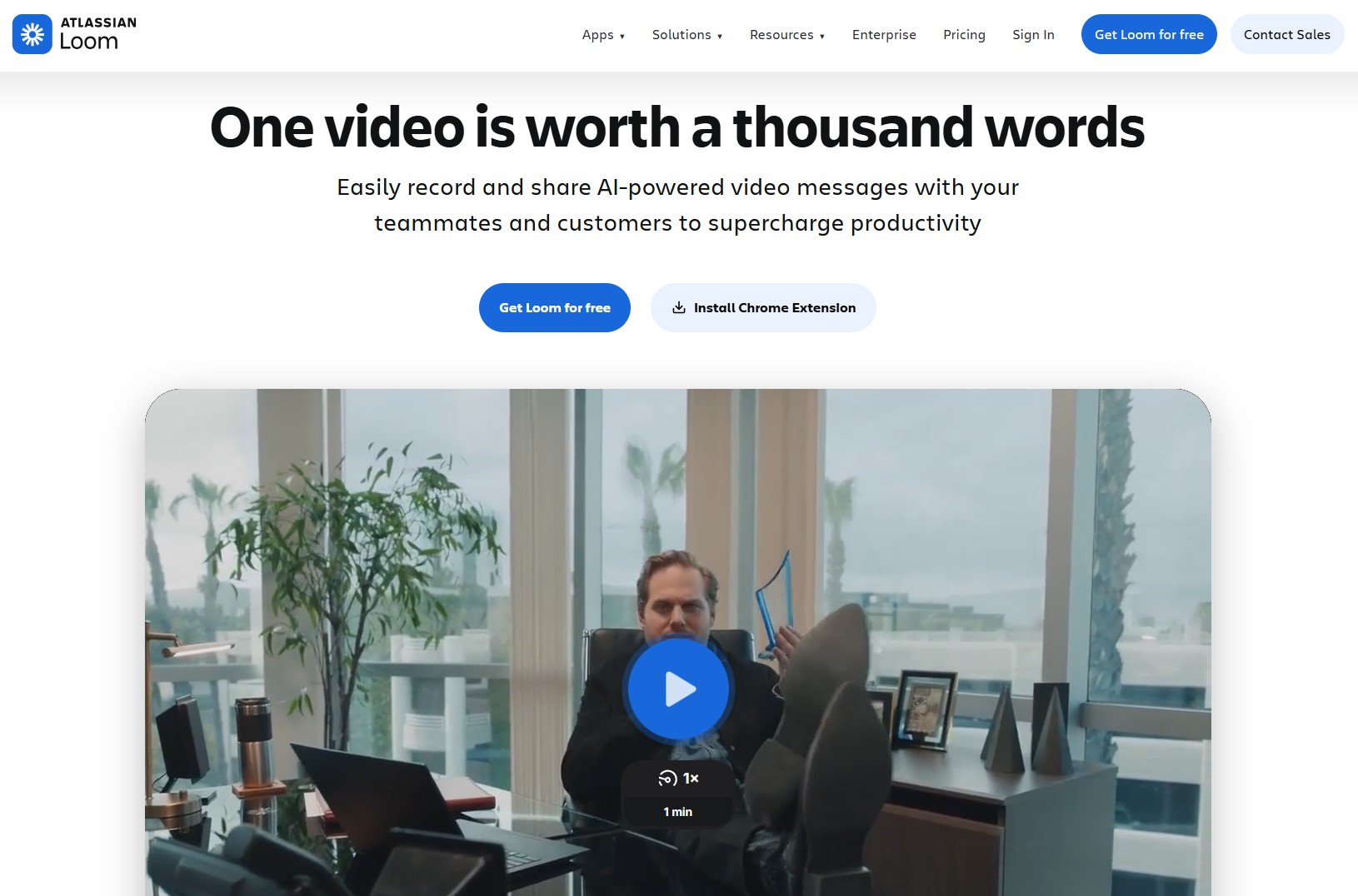
Loom is the go-to tool for teams who need to capture and share information quickly without scheduling a call. It’s not a triggered outreach platform like Bonjoro.
It’s a communication tool: you see something that needs explaining, you record it, and you share the link. The recipient watches when they’re ready, leaves a comment if needed, and you both move on faster than a meeting would have allowed.
The Chrome extension makes the recording workflow genuinely fast. Click, choose screen or camera or both, record, and your shareable link copies to clipboard the moment you stop. Viewers can comment at specific timestamps, react with emoji, and read an auto-generated transcript.
The free plan handles unlimited recordings with a 5-minute cap, which covers most everyday use cases without paying anything.
Where Bonjoro is built around the “new customer comes in, record a personal video now” moment, Loom is built around replacing the emails and meetings you’d have had anyway. Different tool, different job.
Key Features:
•Screen, camera, or combined recording via Chrome extension
•Auto-generated transcripts on all plans
•Timestamp comments and emoji reactions from viewers
•View notifications when someone watches your video
•Integrations with Notion, Slack, HubSpot, and Linear
| Pros | Cons |
|---|---|
| •Fastest recording-to-share workflow on this list
•Auto-transcripts and timestamp comments out of the box •Free plan is genuinely usable for most individuals •Viewer notifications so you know when someone watches •Clean integrations with Slack, Notion, and HubSpot |
•Not built for triggered sales outreach workflows
•No 1-to-many video sending •5-minute cap on free plan recordings •Analytics are basic vs dedicated sales video tools |
Rating: 4.7/5
Pricing: Free plan available; Business starts at $12.50/user/month (annual)
Also check: CTA design types that actually convert visitors into customers
3. Vidyard
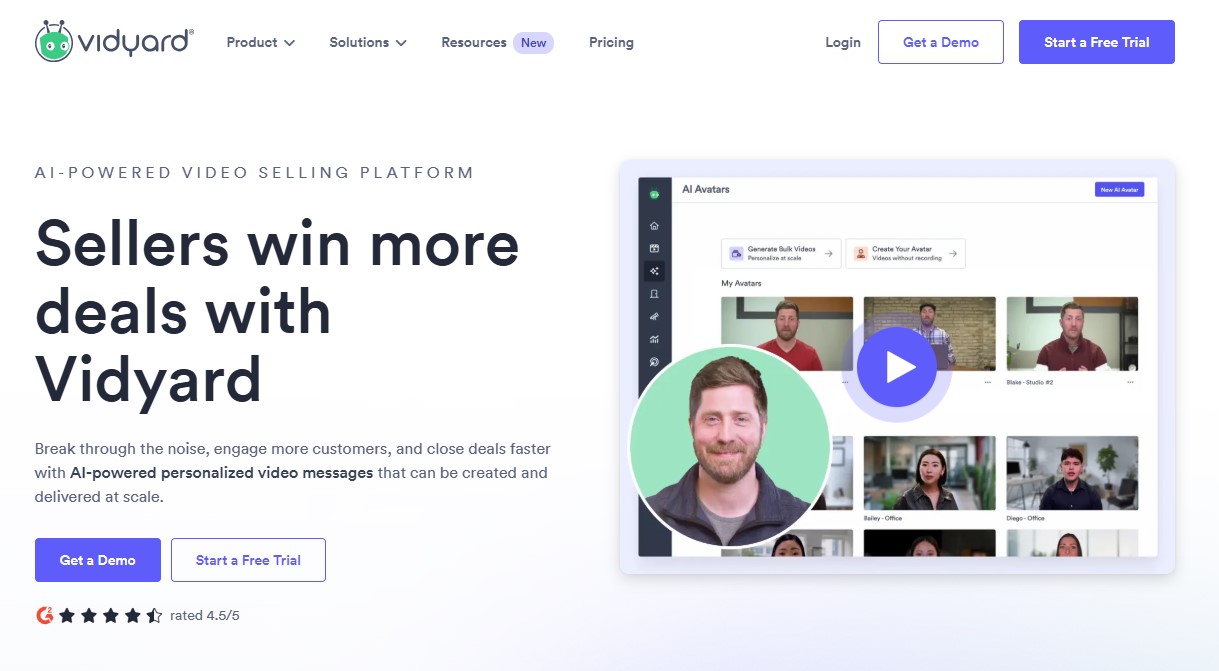
Vidyard is the most enterprise-complete video platform on this list. It’s built for sales teams sending high volumes of personalized video and needing every open, watch, and click automatically logged in their CRM.
If Bonjoro is the personal touch for a small team, Vidyard is the infrastructure for a full SDR floor.
The analytics alone separate it from everything else here. You see exactly who watched, how far they got, which parts they replayed, and what they clicked after.
That data syncs into HubSpot or Salesforce in real time, so reps know which prospects are actually warm before picking up the phone. Their AI Video Agent adds another layer: it auto-generates personalized videos from CRM data at scale, so you’re not recording every message individually.
The trade-off is cost. A 5-person sales team on paid plans is looking at roughly $295/month minimum. That’s a real investment and only makes sense if video is a core part of your outreach strategy, not an occasional experiment.
Key Features:
•Per-viewer analytics: who watched, how much, what they clicked
•AI Video Agent that generates personalized videos from CRM data
•Native sync with HubSpot and Salesforce
•Video hosting with branded player on all plans
•Chrome extension for quick screen and camera recording
| Pros | Cons |
|---|---|
| •Best-in-class per-viewer analytics on the market
•AI Video Agent for personalized video at scale •Real-time CRM sync with HubSpot and Salesforce •Video hosting included with all plans •Strong fit for high-volume SDR teams |
•$59/user/month is expensive, adds up quickly for teams
•Overkill for solo users or occasional video use •AI features cost extra on top of the base plan •Steeper learning curve than simpler tools |
Rating: 4.6/5
Pricing: Free plan available; paid plans from $59/user/month
All your reviews in one place
Collect reviews, manage every response, and display them where they matter most.
4. BombBomb
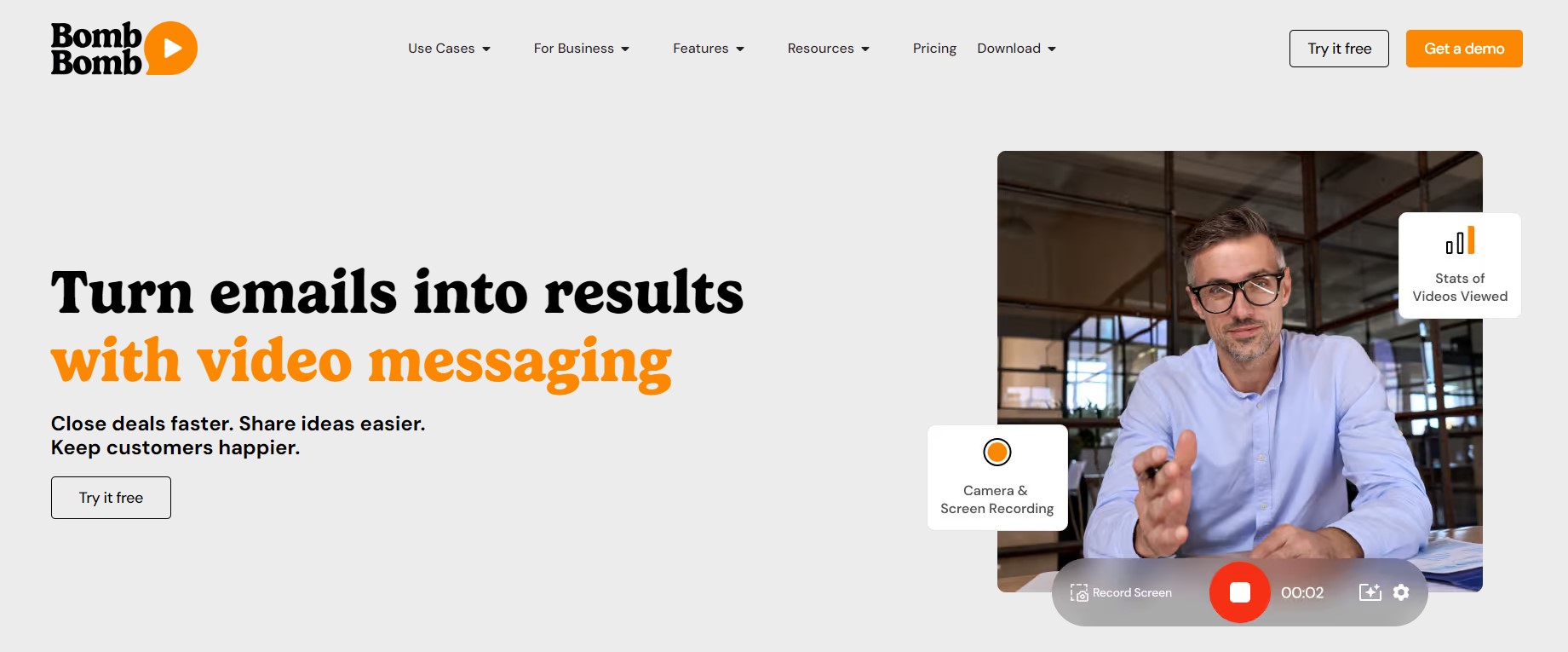
BombBomb sits inside your inbox rather than beside it. You record directly from Gmail or Outlook, and the video lands in your email as an embedded thumbnail with a play button.
Recipients watch without leaving their inbox, which removes a real friction point that most video tools ignore. That single difference in delivery drives meaningfully higher watch rates than sending a standalone video link.
It’s been around since 2006 and has built its deepest following in real estate, financial services, insurance, and automotive.
These are industries where building a personal connection is the whole job, and where email is still the primary communication channel. BombBomb fits naturally into that workflow without asking people to change how they work.
The AI Copilot additions are worth noting: script suggestions before you record, noise reduction during, and automated follow-up sequences after. They’re making the $33/month starting price easier to justify than it was a year ago.
Key Features:
•Record and send video directly from Gmail and Outlook
•Video thumbnail embedded in email, no external link needed
•AI Copilot with script suggestions and noise reduction
•Reusable video library for frequently sent messages
•Automated follow-up sequences triggered after video sends
| Pros | Cons |
|---|---|
| •Native Gmail and Outlook integration, no tab switching
•Embedded thumbnail drives higher watch rates than link sharing •AI script suggestions and noise reduction on paid plans •Strong track record in real estate and financial services •Reusable video library saves time on repeat outreach |
•No free plan, $33/month minimum before you can evaluate
•Interface feels dated vs newer tools like Loom or Tella •Per-user pricing gets expensive for larger teams •Analytics less granular than Vidyard |
Rating: 4.5/5
Pricing: Starts at $33/month
Also check: UGC statistics: the data behind user-generated content in 2026
5. Dubb
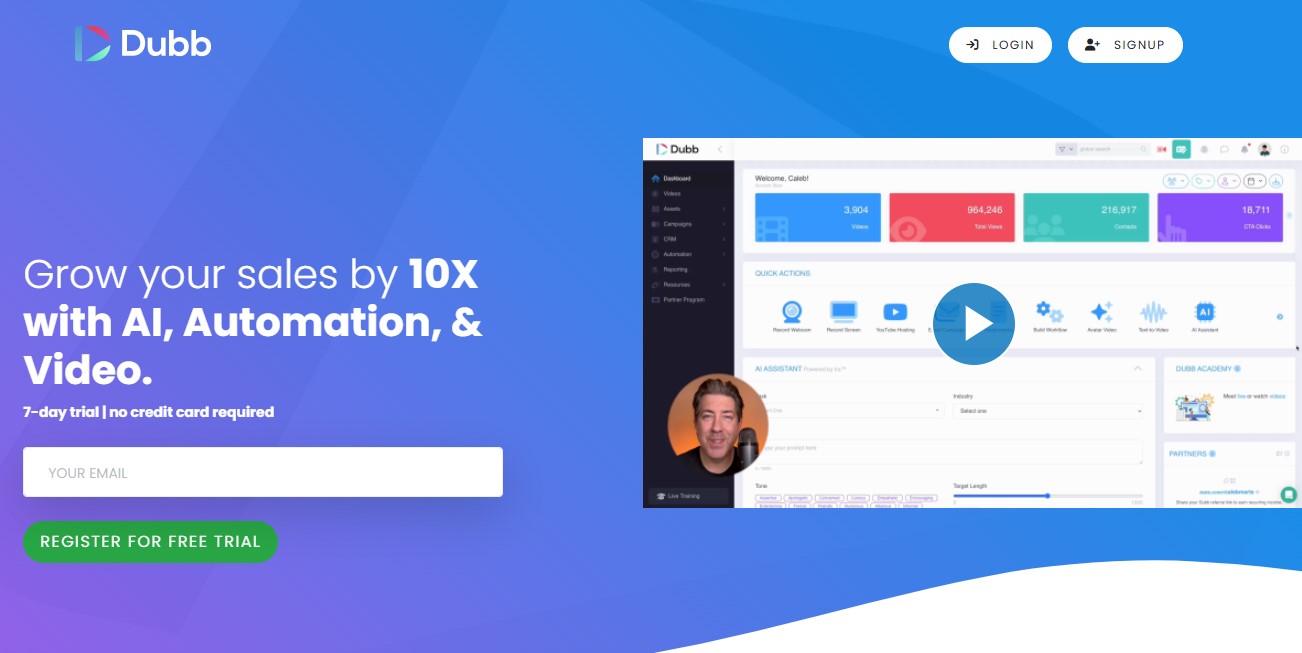
Dubb’s core value proposition is channel flexibility. You record one video and deliver it across Gmail, Outlook, LinkedIn, Instagram DM, SMS, and CRM simultaneously.
Most video tools lock you into one or two delivery channels. Dubb treats multi-channel as the default, which makes a real difference for sales reps working across multiple platforms every day.
Beyond delivery, Dubb builds automation around viewer behavior. Someone watches 75% of your video and gets automatically moved to a warm sequence. Someone clicks the CTA and a task appears in your CRM.
Every video you send goes out on its own branded landing page with a customizable CTA, reply option, and booking link, so you’re not just sharing a video, you’re sending a mini conversion page.
The interface takes time to learn. There’s a lot packed in, and new users often spend the first session just finding where things are. The value makes sense for reps doing consistent multi-channel outbound. For lighter use, Loom or BombBomb will serve you better at lower cost.
Key Features:
•Send one video across Gmail, LinkedIn, SMS, Instagram, and CRM
•Viewer behavior triggers automated CRM tasks and sequences
•Branded video landing pages with CTAs and booking links
•Built-in CRM for managing video sales pipeline
•Real-time tracking of opens, watch duration, and clicks
| Pros | Cons |
|---|---|
| •Multi-channel delivery across 6+ platforms from one recording
•Viewer behavior triggers automated follow-up workflows •Branded landing pages turn video links into conversion pages •Built-in CRM for full video pipeline management •Real-time engagement tracking on every video sent |
•Interface has a steep learning curve for new users
•$59/month is expensive for solo or low-volume users •Mobile app less polished than the desktop experience •Some integrations still require Zapier as a middleman |
Rating: 4.6/5
Pricing: Starts at $59/month
All your reviews in one place
6. Hippo Video
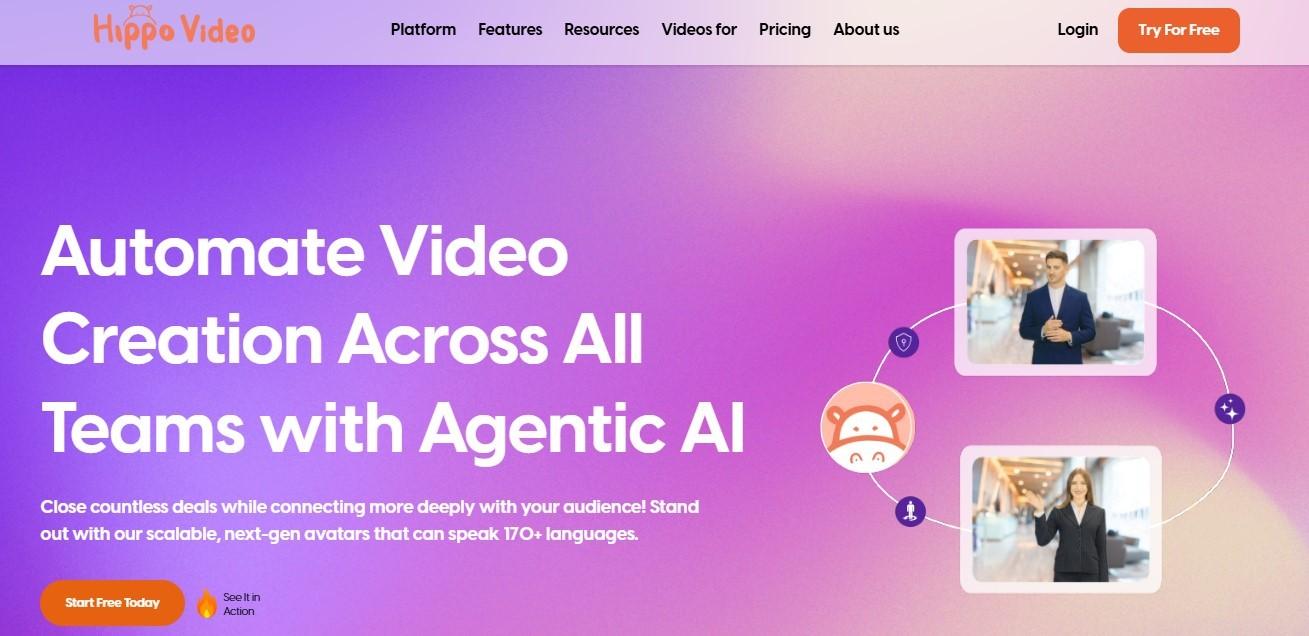
Hippo Video’s standout capability is the in-video CTA. You embed a form, a calendar booking link, or a button directly inside the video player itself.
A prospect watches your demo and books a call without leaving the video. That collapsed conversion step removes friction at the exact moment someone is most engaged, which is something no other tool on this list handles quite this way.
It also does AI-powered personalization for sequences. You connect your CRM, set up an email sequence, and Hippo Video automatically inserts the recipient’s name and company into each video. The result looks personalized without requiring you to record individually for each contact.
At $20/user/month, it sits between Loom and Vidyard on price, making it a reasonable choice for small sales teams that need more than basic recording but can’t justify Vidyard’s per-seat cost.
The interface is cluttered. Finding a specific setting can take longer than it should, and customer support response times have been slow for some users. Not deal-breakers, but worth knowing before you commit.
Key Features:
•In-video CTAs, forms, polls, and calendar booking links
•AI-powered video personalization using CRM data
•Sales sequence integration with personalized video inserts
•Analytics for tracking viewer engagement and drop-off
•Works across sales, marketing, and customer support teams
| Pros | Cons |
|---|---|
| •In-video CTAs and booking links no other tool matches
•CRM-powered AI personalization for email sequences •Solid engagement analytics with drop-off tracking •More affordable than Vidyard for small sales teams •Flexible across sales, marketing, and support use cases |
•Interface is cluttered and takes time to navigate
•Customer support response times can be slow •Recording experience less polished than Loom •Advanced features gated behind higher-tier plans |
Rating: 4.6/5
Pricing: Starts at $20/user/month
Also check: Video testimonial statistics: 37 numbers that show why video converts
7. SendSpark
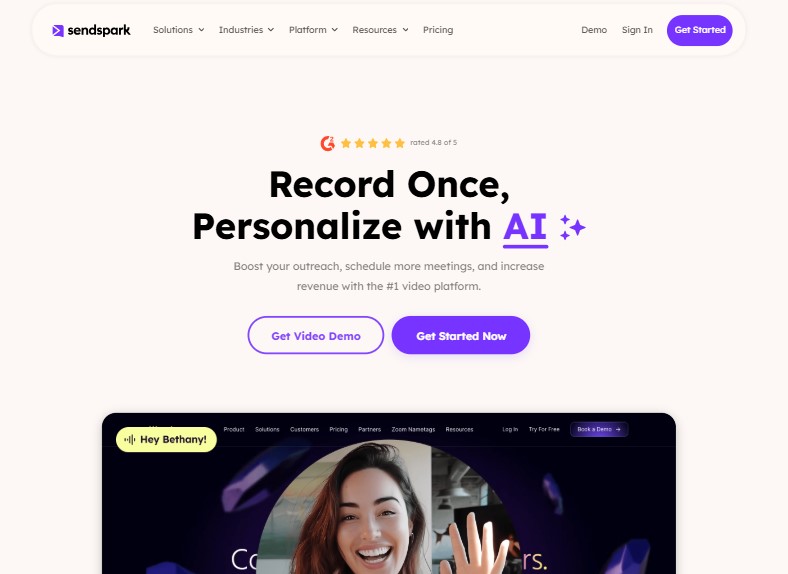
SendSpark solves a specific problem: how do you make high-volume outreach feel personal without recording a separate video for every contact.
The answer is dynamic personalization. You record one video, and SendSpark overlays each recipient’s name, company, or even a live screenshot of their website as a visual element while you talk. The final result looks individually recorded. Prospects respond to it that way too.
The “video request” feature works in reverse: instead of sending a video, you send a short request link that makes it easy for a prospect or customer to record a video back. That’s useful for qualifying leads asynchronously, collecting informal testimonials, or getting video replies from prospects you’re trying to engage.
SendSpark is purpose-built for outbound. If your use case is internal communication, async team updates, or polished demo recordings, there are better fits on this list.
But for founders and sales reps doing cold email or LinkedIn outreach at volume, it’s the sharpest tool for making one recording reach hundreds of people personally.
Key Features:
•Dynamic personalization overlays name, company, and website on video
•Video request links for collecting responses from prospects
•Chrome extension for fast recording without leaving your workflow
•Analytics on open rates, watch rates, and CTA clicks
•Free plan available with core features to evaluate before paying
| Pros | Cons |
|---|---|
| •Dynamic personalization makes one video feel 1-to-1 at scale
•Video request feature flips outreach into a two-way exchange •Chrome extension keeps recording inside existing workflow •Free plan is genuinely usable for evaluation •Clear analytics on watch rates and CTA performance |
•Built for cold outreach, limited value for other use cases
•$45/month Pro plan steep for low-volume senders •Fewer CRM integration options than Dubb or Vidyard •Design customization limited on lower plans |
Rating: 4.7/5
Pricing: Free plan available; Pro starts at $45/month
All your reviews in one place
Collect reviews, manage every response, and display them where they matter most.
8. Tella
Tella is the tool you reach for when output quality matters more than workflow automation. Record the same 60-second clip in Loom and in Tella, and the Tella version looks noticeably better without any extra effort on your part.
Custom backgrounds, flexible webcam layouts, and a drag-and-drop editing timeline that lets you trim dead air in seconds. The result looks like something you spent time on even when you didn’t.
That quality improvement matters because for a lot of people the real barrier to sending video is embarrassment about how the recording looks.
Tella removes that friction by making the default output something you’re actually proud to share. It’s particularly well suited for creators recording course content, consultants sending client updates, and solo teams who want async video to feel polished without a production setup.
There’s no CRM integration, no triggered workflows, no sales automation of any kind. Tella is a communication tool, not a sales tool. If you need video to connect to your pipeline, look at Dubb or Hippo Video. But if polished output at low cost is the priority, nothing on this list touches it at $19/month.
Key Features:
•Custom backgrounds and flexible webcam display layouts
•Drag-and-drop editing timeline for trimming and rearranging
•Smooth scene transitions with minimal editing effort
•Custom branding on paid plans (logo, colors, domain)
•Team sharing and collaboration on paid plans
| Pros | Cons |
|---|---|
| •Best default recording output quality on this list
•Dead-air trimming takes seconds, not minutes •Custom backgrounds and webcam layouts built in •Affordable at $19/month for paid plan •Excellent for creators, consultants, and course content |
•No CRM integrations or sales pipeline automation
•Not built for triggered outreach or 1-to-many sends •Analytics minimal compared to sales-focused tools •Not suited for high-volume sales team workflows |
Rating: 4.5/5
Pricing: Free plan available; paid plans from $19/month
Also check: Testimonial statistics: 50+ numbers marketers need to know in 2026
9. Covideo
Every other tool on this list treats email as the primary delivery channel. Covideo treats SMS as equal, which matters in industries where email open rates are low and text messages actually get read.
You record your video, the link goes out as a text, the recipient taps it, and the video plays in their browser with no app install required. That workflow fits naturally into automotive, healthcare, real estate, and mortgage, where texting a customer is already how business gets done.
Covideo has been around since 2004, and that longevity shows in their feature set for regulated industries. Custom domain support, branded landing pages, and compliance-friendly workflows make it a fit for dealerships, mortgage companies, and healthcare providers who need their communication tools to meet specific standards.
The branding control is thorough: your logo, your colors, your domain on every video landing page your team sends.
The pricing isn’t published. You fill out a form, talk to sales, and get a quote. That’s workable for an enterprise running a proper evaluation. It’s a blocker for smaller teams trying to test quickly before committing.
Key Features:
•SMS video delivery as a first-class channel alongside email
•Custom domain and full branding on video landing pages
•Compliance-friendly workflows for regulated industries
•CRM integrations for automotive, real estate, and healthcare tools
•Mobile-friendly recording and no app install required for viewers
| Pros | Cons |
|---|---|
| •SMS video delivery, not just email, as a core feature
•Full custom branding, including the domain on landing pages •Compliance workflows for healthcare, automotive, and finance •Long track record with enterprise and regulated industries •No app install needed for video recipients |
•No public pricing, requires a sales conversation
•Interface feels dated compared to newer tools •Less suitable for small teams wanting to test quickly •Not ideal for async internal communication |
Rating: 4.6/5
Pricing: Custom pricing (contact sales)
How to Choose the Right Bonjoro Alternative
Start with your primary use case. Everything else follows from that.
Need to collect and display video testimonials? WiserReview is the strongest pick. It’s purpose-built for that job, imports from every major review platform, and costs less than Bonjoro’s own testimonial plan.
Want quick, frictionless recording for demos and walkthroughs? Loom. The free plan handles most use cases and the recording experience is the fastest on this list.
Running a sales team doing daily video outreach? Vidyard for large teams with budget. Hippo Video for teams of 2-5 watching costs. Dubb if multi-channel delivery across LinkedIn, SMS, and email in the same workflow matters.
Live in Gmail or Outlook and want video to feel native to email? BombBomb. The embedded thumbnail is a real conversion driver and the workflow stays inside your inbox.
Doing cold outreach at volume and want each video to feel personal? SendSpark’s dynamic personalization makes one recording look like a hundred individual videos.
Care most about how polished your recordings look? Tella. No editing skills needed, the output looks good by default.
Reaching prospects via SMS in automotive, real estate, or healthcare? Covideo is the only tool that takes SMS delivery seriously as a primary feature.
Common Mistakes to Avoid When Switching From Bonjoro
Switching tools without defining your use case first: Bonjoro does two different things: video messaging and testimonial collection. Know which one you’re actually replacing before you evaluate alternatives. A testimonial tool won’t fix a sales workflow problem, and a sales video tool won’t build your review library.
Ignoring the viewer experience: You’ll spend five minutes recording. Your prospect spends that time watching. Whether they need an account, how many clicks to play, how easy the CTA is to find. These things matter more than how easy the recording side was for you.
Not testing the integration before committing: If video needs to trigger from CRM events or push data back to HubSpot, test that specific workflow in the free trial first. Zapier-based integrations can introduce 15-minute delays that break time-sensitive outreach.
Over-producing the video: The personal feel is usually the point. If you spend 20 minutes on lighting and background for a 30-second follow-up, you’ve missed why video messaging works. Record it, send it, move on.
Skipping the analytics after launch: Most of these tools tell you who watched, how much, and what they clicked. If you’re not reviewing that data in the first two weeks, you’re flying blind on what’s actually working.
Also check: 7 best ecommerce tools for scaling brands in 2026
All your reviews in one place
Collect reviews, manage every response, and display them where they matter most.
Final Thoughts
Bonjoro earned its reputation. The notification-triggered workflow is fast, the testimonial collection is simple, and for solopreneurs the Pro plan is reasonably priced.
But it’s not the best at everything it does.
If testimonials are your primary use case, WiserReview does that job better at a lower price. If you need sales automation and CRM-connected analytics, Vidyard and Dubb go significantly deeper.
If you want clean, fast screen recording without fuss, Loom wins on the free plan. And if your prospects are more likely to watch a text link than an email, Covideo is the only tool built around that reality.
Pick the tool that matches how you actually work. The best video platform is the one you use consistently, not the one with the most features on the pricing page.
Frequently Asked Questions
What is Bonjoro, and why do people look for alternatives?
Bonjoro is a personalized video messaging tool used to send custom videos to clients and prospects to build relationships and drive engagement. People often look for alternatives due to pricing, features, or seeking a platform better suited to their business needs.
What are the key features to look for in a Bonjoro alternative?
When searching for a Bonjoro alternative, key features to look for include video personalization, ease of integration with CRMs and email tools, automation capabilities, video editing tools, and a user-friendly interface. Pricing and scalability also play a major role.
Can I use Bonjoro alternatives for both sales and customer support?
Yes, many Bonjoro alternatives offer features that can be used for both sales and customer support. These tools enable you to create personalized video responses, automate customer communication, and improve engagement across both marketing and customer service teams.
Are Bonjoro alternatives more affordable than Bonjoro?
The cost of Bonjoro alternatives varies based on the features and plans offered. Some alternatives provide more affordable pricing options with comparable functionality, while others offer advanced features that may justify higher costs.
How do I choose the best Bonjoro alternative for my business?
To choose the best Bonjoro alternative, consider your business needs, such as the number of users, the type of customer interaction you need (sales, support, or both), integrations with other tools, and your budget. Testing a few alternatives through free trials can help you make a well-informed decision.

Krunal Vaghasiya is a marketing tech expert who boosts e-commerce conversion rates with automated social proof and FOMO strategies. He loves to keep posting insightful posts on online marketing software, marketing automations, and improving conversion rates.




 Capterra